
加载中...
共找到 26,217 条相关资讯
Operator: Good day, and welcome to the Precision Optics Reports Fourth Quarter and Fiscal Year 2025 Financial Results Conference Call. [Operator Instructions] Please note that this event is being recorded. I would now like to turn the conference over to Mr. Robert Blum with Lytham Partners. Please go ahead. Robert Blum: All right. Thank you very much, operator, and thank you to everyone joining the call today. As the operator mentioned, on today's call, we will discuss Precision Optics' fourth quarter and fiscal year 2025 financial results for the period ended June 30, 2025. With us on the call representing the company today is Dr. Joe Forkey, Precision Optics' Chief Executive Officer; and Mr. Wayne Coll, the company's Chief Financial Officer. At the conclusion of today's prepared remarks, we will open the call for a question-and-answer session. [Operator Instructions] Before we begin with prepared remarks, we submit for the record the following statement. Statements made by the management team of Precision Optics during the course of this conference call may contain forward-looking statements within the meaning of Section 27A of the Securities Act of 1933 as amended and Section 21E of the Securities Exchange Act of 1934 as amended, and such forward-looking statements are made pursuant to the safe harbor provisions of the Private Securities Litigation Reform Act of 1995. Forward-looking statements describe future expectations, plans, results or strategies and are generally preceded by words such as may, future, plan or planned, will or should, expected, anticipates, draft, eventually or projected. Listeners are cautioned that such statements are subject to a multitude of risks and uncertainties that could cause future circumstances, events or results to differ materially from those projected in the forward-looking statements, including the risks that actual results may differ materially from those projected in the forward-looking statements as a result of various factors and other risks identified in the company's filings with the Securities and Exchange Commission. All forward-looking statements contained during this conference call speak only as of the date in which they were made and are based on management's assumptions and estimates as of such date. The company does not undertake any obligation to publicly update any forward-looking statements whether as a result of the receipt of new information, the occurrence of future events or otherwise. All right. With that said, let me turn the call over to Dr. Joe Forkey, Chief Executive Officer of Precision Optics. Joe, please proceed. Joseph Forkey: Thank you, Robert, and thank you all for joining our call today. Let me start by saying we certainly have a lot to be excited about at Precision Optics. We just finished the fiscal year with the highest quarterly revenue in our company's history. The $6.2 million fourth quarter puts us at an annualized run rate of approximately $25 million and the underlying drivers of this increase are sustainable into the foreseeable future. Our production business has grown substantially, and we expect that trend to continue. While we've experienced gross margin challenges in Q3 and Q4 of fiscal 2025, we understand these challenges and are aggressively taking steps to resolve them. With ongoing higher top line revenue, the growing engineering pipeline and improving gross margins, we believe we are now operating at a new level for Precision Optics and expect the gains we have made in revenue increases in fiscal '25 will increasingly flow through to the bottom line throughout fiscal '26 and beyond. The key driver to the achievement of these record revenues is the advancement of two major programs, which transitioned over the past year or so from our development pipeline into production. And while the benefits of the recent transition of these two major programs haven't flowed through to the bottom line yet, the increase in top line revenue provides the foundation upon which Precision Optics will grow to become a much larger and more profitable company. These two programs, one with a top-tier aerospace company and the other with a surgical robotics company focused on transformative solutions in urology carry long-term contracts with minimum annual commitments. These production contracts, along with additional programs in our development pipeline that are expected to move to production over the next 12 to 36 months, provide increased visibility and confidence into the future outlook for POC. With the growth that we anticipate, we have recently invested in our facilities to support the company's growth, not only for fiscal 2025 and 2026, but for years to come. In September, we moved our headquarters and corporate offices from Gardner, Massachusetts to Littleton, Massachusetts. This move opens up space at our existing facilities in Gardner for the consolidation and expansion of dedicated production resources. The new facility in Littleton, which is less than an hour from Boston, along with the new facility in South Portland, Maine, which we moved into in August, also allows us access to a broader engineering talent pool to support the company's growing product development pipeline. I believe we will look back at fiscal 2025 a few years from now as a critical inflection point in the company's history. When we advanced multiple products from our pipeline into production, began to refine operating processes to efficiently manufacture at higher scales, made the necessary investments in our facilities to sustainably support growth and build a strong backlog of programs through the launch of the Unity platform, all of which has provided us the foundation for substantial growth and greater visibility into the future. Today, I'll focus my remarks on the following items. First, updates on our two major production programs. Second, gross margin challenges in fiscal 2025. Third, steps we've taken to improve gross margin in fiscal 2026 and beyond. And finally, guidance for fiscal 2026. With that high-level overview, let me provide some more details, starting with our large production contract with a top tier aerospace company. This is a highly complex and specific assembly we are producing, and it is essential for our customers' product and revenue forecast. We continue to increase production to meet the ever-growing demand from this customer with revenues increasing sequentially every quarter throughout the year and increase is expected to continue throughout fiscal 2026. For perspective, Q1 revenue for this program was $300,000, Q2 revenue was $600,000, Q3 was $900,000 and in Q4 of fiscal 2025, revenue for this program was just under $2 million. We are now operating at record daily production revenues with the month of June contributing more than $900,000 alone. That's 3x what we shipped in the entire first quarter. We continue to take steps to further increase production capacity and we have commitments from our customers to accept deliveries at rates approximately double the average rate of Q4. We also have received significant additional production orders so that our current backlog for this program alone now stands at a record of nearly $9 million. We estimate our gross margin, specifically on this program is in the mid-30% range, so the ongoing increase in shipments will help to improve overall gross margin. Also, our customer for this product has agreed to reimburse BOC for tariff costs, and we are finalizing arrangements to these reimbursements now. Production revenue for our single-use cystoscope also hit a record level in Q4 of nearly $800,000, continuing the trend of increasing revenue each of the four quarters since production began. With the introduction of a partial second production line in August of this year and ongoing increases in demand from our customer and the end user market, we expect revenue levels from this program to continue to increase throughout fiscal 2026. While we are certainly pleased with this continuing revenue growth for this program, it has not been without its challenges as we've communicated in recent quarters. Compared to our aerospace customer, this is a lower-priced, higher-volume single-use production program. For this program, in particular, we have run into challenges with production yield, more than anticipated labor touch time and substantial tariff increases. Considering the impact of all these issues together, we believe this product was operating at zero gross margin or a slight loss during the fourth quarter of fiscal 2025 and significantly pulled down our overall corporate gross margin. In the first quarter of fiscal 2026, we have already taken several steps to increase the profitability of this product. We have identified opportunities for yield improvement through design updates and touch time reduction through fixture and process improvements. We are working with our customer who is an agreement with these steps we've taken and is generally extremely supportive. There is a mutual understanding of the complexity of the assembly and attitude that we must get this working right. These are robust long-term solutions and are not out of the ordinary for a production line recently started and used for a highly complex product like this one. While we are confident these modifications will bring the profitability of this product in line with our original expectations, they will take some months to implement. In the meantime, we have renegotiated pricing with our customer to account for lower yields and higher touch time costs in the near term. The renegotiated near-term price is approximately 24% higher than the price at the end of the fourth quarter of fiscal 2025. In addition, our customer has agreed to cover tariffs associated with this product, which represents approximately 20% of the price at the end of the fourth quarter. We believe these design and production changes, along with pricing updates for the near term will result in steadily increasing profitability for this product beginning in the first quarter of fiscal 2026 and continuing throughout the year. In addition to the two large programs, there are a number of other continuing programs that round out our production forecast for fiscal 2026. Summarizing our systems manufacturing business, while we are experienced in growing teams of a very small business, taking on large and complex initial program challenges -- excited that production is growing to a size that will begin to reflect scaling and efficiencies as we move through the new fiscal year. We expect our systems manufacturing business to grow at least 75% in fiscal 2026. Beyond our production programs, our product development pipeline is recovering from the dip caused by the transfer of the single-use cystoscope to production. We continue to expect two to three programs to transfer to production in each of the next two years, and we are quickly gaining momentum with a number of new customers based on the Unity platform that we discussed in recent calls. Our business development team is working aggressively to reach new customers through increased outreach, including our first-ever panel webinar, which I will host this coming Wednesday to discuss current trends in medical device imaging. For anyone interested in this event, registration is on our website. So while revenue for fiscal 2026 will largely be driven by our two largest programs, there is a host of other programs right behind those that will continue growth into the future. With strong confidence in our ability to maintain revenue at the higher level seen in the fourth quarter of fiscal 2025, let me turn now to a few comments on gross margin. A number of issues pulled down gross margins in Q3 and Q4 of fiscal 2025. And while Q4 gross margin was slightly higher than that of Q3, we expect margins to recover substantially more in fiscal 2026. Because our single-use cystoscope program occupied so much of our engineering team's efforts prior to fiscal 2025, its transition this past year to production led to a reduction in product development revenue for the first time in over 6 years. Because product development revenue tends to have higher margins than production, overall gross margin suffered from this shift in product mix. In fiscal 2025, this issue was exacerbated by the need to pull design engineers into troubleshooting on the single-use cystoscope line, reducing the amount of engineering resources available for billable product development work. As I already mentioned, we have a clear path now to improve the single-use cystoscope production line, which will reduce the requirement for engineering support. Also, we are already beginning to see a recovery of the product development pipeline and expect steady increases throughout fiscal 2026. In the fourth quarter of fiscal 2025, about $0.5 million of product development revenue was for tooling and fixtures for additional production lines, which carries a margin just under 10%. Because these revenues are mainly for low-risk pass-through materials purchases that still contribute to the bottom line, we welcome orders like these, but they do pull down overall gross margin percentage. While we expect materials revenues such as this to continue, we expect it will be a smaller percentage of total revenue, and therefore, should be much less impactful as production programs grow. Finally, the impact of the tariff increases in Q3 and particularly in Q4, was substantial. Total tariff costs in Q4 alone were approximately $180,000, representing about 3% gross margin. We have worked aggressively on this issue. As I already mentioned, we are close to having agreements on tariff reimbursement with our two major production customers, at least one of which we expect will be retroactive to July 1, and we now have a policy requiring tariff reimbursement on virtually all new orders. We are investing in the business through the operational steps I described already, but also by strengthening our overall operations team. In the first quarter of fiscal 2026, we recruited and hired our first manufacturing and quality engineers. We just recently hired a new Director of Quality and Regulatory Affairs, and I'm really pleased to announce today that we have just come to agreement with Joe Traut who will start as our new Chief Operating Officer on October 1. Joe is an industry veteran with over 30 years of experience in medical device production, much of it focused on bringing up new production lines, transferring production lines from one location to another and overall improving manufacturing efficiency and performance. Joe has consulted to us for the last two months. He's already familiar with the issues we need to tackle, and I'm really thrilled that he has agreed to come on full time to help us drive the performance of our operations to higher levels. Joe will be replacing Mahesh Lawande, who has been in the COO position for about two years. These were two critical years for our operations as we launched our aerospace and single-use cystoscope production programs. I want to thank Mahesh for his tireless efforts and dedication during this time. For fiscal 2026, we expect revenue of approximately $25 million which compares to $19 million in 2025, an increase of over 30%. This will be driven largely by our systems manufacturing business, which is forecasted to increase by more than 75% as our two large production programs continue to expand. We expect fiscal 2026 gross margins of approximately 30%, which favorably compares to 18% in 2025. Improved manufacturing yields, better pass-through of tariffs and elimination of some low-margin revenue are all key factors to the improvement. Our long-term margin goal remains 40% with significant increases in revenue and gross margins, we expect to recover positive adjusted EBITDA in the range of $0.5 million for fiscal 2026. We believe there is substantial operating leverage to drive significant bottom line profit as revenues continue to increase. With that, let me turn it over to Wayne to review the financials in more detail. I will then provide some closing comments and then open the call to questions. Wayne? Wayne Coll: Thank you, Joe. Let me expand on some of Joe's comments on the financial results, starting with revenue. For the fourth quarter, revenue was $6.2 million compared to $4.2 million in the prior sequential quarter and $4.7 million in the year ago or fourth quarter of fiscal 2024. Breaking it down, production revenue was $5.1 million compared to $3.3 million in the prior sequential quarter and $2.8 million in the year ago quarter, while engineering revenue was $1.1 million compared to $1.9 million in the year ago quarter. For the year, revenue was flat compared to the prior year at $19.1 million. This, on the surface, masks the trend in the transformation of our more engineering-focused business to a more rapidly scaling manufacturing enterprise. On the product development side, our engineering pipeline continues to strengthen in response to marketing around the Unity platform, coupled with an expanding outreach that is focused on broadening our customer base. We now project fiscal 2026 revenues to reach $25 billion. This growth is being driven by continued expansion of our systems manufacturing business as our backlog and production demand continues to increase, driven by recent purchase commitments for the aerospace and single-use programs. Growth of 75% is expected in this area from approximately $8.3 million in fiscal 2025 to $14.5 million in fiscal 2026. This continues the trend from fiscal 2025, where revenue from this business segment nearly tripled from $1.2 million in Q1 to $3.4 million in Q4. Conservatively, we are currently forecasting a modest recovery in product development going from $4.9 million in fiscal 2025 to $5.6 million in 2026. Revenue from our micro-optics labs is expected to drop from $2.1 million in fiscal 2025 to $1.3 million in fiscal 2026 due entirely to timing of that division's large defense customer reorder. And our Ross Optical operations are expected to be essentially flat at $3.7 million to $3.8 million. For the quarter ending June 30, 2025, gross margins were 13% compared to 10% in the prior sequential quarter and 22% in the fourth quarter of a year ago. Although we continue to scale production of our single-use cystoscope following the production costs incurred during the previous sequential quarter, we continue to recognize suboptimal yields. We expect those yields to improve and normalize toward target levels in the third quarter of fiscal 2026 for all the reasons Joe covered. The under-absorption of engineering resources was a contributing factor here as well. For the year, gross margins were 18% compared to 30% in the prior year. We expect gross margin to continue to recover as production revenues increase. We are expecting a blended gross margin of approximately 30% for fiscal 2026 with much of the improvement occurring in the second half of the fiscal year. We decreased R&D spending in the quarter from $355,000 to $228,000 compared to the quarter ending June 30, 2024. R&D spending in the current fiscal year increased approximately $180,000 to $1.2 million compared to $982,000 during the year ending June 30, 2024, primarily due to our investment in Unity. Selling, general and administrative expenses increased $2 million during the three months ended June 30, 2025 compared to $1.9 million during the three months ending June 30, 2024. For the year, SG&A increased from $7.5 million to $7.8 million primarily due to increased personnel costs, primarily stock-based compensation and recruiting expenses. As a result of the factors I've discussed, our net loss was $1.4 million for the quarter as it was for the same quarter last year. Our net loss for the year was $5.8 million compared to $3 million in the prior year. Adjusted EBITDA, which excludes stock-based compensation, interest expense, depreciation and amortization was negative $856,000 in the fourth quarter of 2025 compared to negative $1.3 million in the previous sequential quarter and negative $1.1 million in the year ago quarter. For fiscal 2025, adjusted EBITDA was negative $3.7 million compared to negative $1.6 million in fiscal 2024. Cash at the end of June was approximately $1.8 million and debt was below $1.9 million. Accordingly, we are working to increase the availability of debt capital to fund our continued business expansion. I will now turn the call back over to Joe for some final comments. Joseph Forkey: Thank you, Wayne. Let me finish by summarizing a few key points. First, we are very optimistic about the future, given the high growth expectations of our production business and the high degree of confidence and visibility into these programs. Second, we believe that these new higher revenue levels of roughly $6 million per quarter or $25 million per year are sustainable given our significant production backlog. And finally, we are investing in the team to quickly address all operations, challenges, including those associated with a small and rapidly growing production business. We are maturing as a company. We may not get everything perfect the first time, but we're building our internal capacity to take on challenges and deliver strong long-term business results. To all of you on the call, I thank you for your continued support of Precision Optics. We will be participating in the Lytham Partners Fall Investor Conference with one-on-one meetings tomorrow. Please contact Robert for more information. With that, we'd be happy to take any questions. Operator: [Operator Instructions] And your first question today will come from [ Chris Bechowski ], Private Investor. Unknown Attendee: I have a couple of questions. First, just like off the top of my head, it seems like you're guiding at about the same revenue for '26 to be at the same revenue rate -- quarterly revenue rate as Q4 that you just reported. But you are also saying that your two largest customers will progressively increase the revenue contributions throughout the next year. And you're saying that you will also get bigger engineering revenues throughout the next year. So how do we -- is that -- are you just being conservative in your guidance? How do we square these things? Joseph Forkey: Yes, sure. It's a great question. So we are being a little conservative, that's true. If you were listening carefully when Wayne went through the different business units, there is one business unit, our micro optics lab that will come down about $800,000 in the year. That's exclusively due to timing of one big order that we typically get from them. The other thing, though, is embedded in some of the gross margin commentary, we talked about the fact that there is $0.5 million in Q4 that was from tooling and fixturing that we put together for expansion of production lines. So that tooling and fixturing, that's $0.5 million in a quarter right? That will be replaced by much higher margin production revenue as we go through quarter-to-quarter throughout fiscal '26. So basically, the mix of revenue is going to change a little bit and there will be more of it coming through, especially with that higher margin aerospace program. Unknown Attendee: Okay. I understand. So you're a little bit different than the usual manufacturing company that you actually get to charge some of your capital costs to your customers and you get revenue from that. Joseph Forkey: That's exactly right. It's -- the markup is small but it's low risk and it's sort of pass-through. So it benefits the bottom line, but it sort of artificially reduces what the gross margin percentage is. Unknown Attendee: Okay. All right. So now for your medical program, what you're saying is that your client agreed to pay higher cost to kind of reimburse you for some of the initial production difficulties. And then presumably, they will kind of ramp down to the original cost. How is that going to work? Is it going -- is it like previously agreed schedule of the ramp-down or is it going to be -- are they just going to kind of wait for you to tell them that, yes now we've overcome the difficulties so we can sell it to you for a lower price. Joseph Forkey: Yes. So it's a little bit of a combination. So for this customer, we have open book pricing, and we've negotiated margins, but they recognize that the start-up costs have been more substantial than we anticipated. So basically, referencing back to that open book pricing, we came back to them and they agreed that the costs were higher, so they would cover some costs in the short term. The reason I say it's sort of a combination is that they have given us targets by which they would like us to see solutions to some of these near-term problems. So we've negotiated sort of a step down from the price that we're at now with an understanding that ultimately, we need to get back to the margins that we originally negotiated at the beginning of the program. Unknown Attendee: Okay. And about the tariff reimbursement, you're still in negotiations about those? Joseph Forkey: Sorry, you were asking about the tariff reimbursement? Unknown Attendee: Well, I guess they're not really reimbursements, but just price hikes for tariffs. Joseph Forkey: Yes. So we basically have verbal agreements. We just have to document it all. They were in the process... Unknown Attendee: Yes. Okay. All right. And regarding the medical program as well, I think you said that you're kind of done with the engineering part of the solution. You've already engineered a solution, so now it's just implementation. So your engineering resources are ready to be used for actual engineering revenue. Is that correct? Joseph Forkey: Generally, that's correct. Let me explain in a little more detail. So some of the issues that we're seeing with regard to yield can be improved, can be solved by doing some slight redesigns to the product itself. That work will still require our engineering design team and that will continue. What was happening in the fourth quarter is that there are enough issues on the line that we were pulling the engineering design team onto the line to do what some people would call sustaining engineering. And the amount of that work that we have to do has substantially been reduced because the team got in there and they got some solutions. Also, we've hired a manufacturing engineer and a quality engineer whose job specialty is really digging into things like that on the line. So for all those reasons, while we still need the design engineers to help with the redesign aspects that we're using to get better yields, that will still be less of their time than we were pulling them in for earlier when we were working on all the yield issues. Unknown Attendee: Okay. So I guess you're saying that engineering resource would be still feed up kind of progressively throughout '26? Joseph Forkey: That's right. With the pretty big jump in Q1 and Q2 from where we were in Q4. Unknown Attendee: Okay. And do you have projects lined up for those people? Joseph Forkey: We do. Yes. And we're bringing in more and more continuously. The market is responding well to the Unity platform. Our -- as I alluded to, our business development team is doing a good job with outreach and sort of expanded their marketing efforts. We have this new first-ever webinar that we're doing this week, and there are a number of programs like that, that our team is using to continue to fill the pipeline. So we have -- I think we have 7 or 8 programs that are already in the pipeline that we have plenty of work for our engineers to work on. But we also have -- are working aggressively to get even more. So yes, we're in good shape there. Unknown Attendee: Okay. That's great to hear. And just to be clear, as opposed to most other companies, you get revenue in the beginning of the pipeline, right, as soon as your engineers start working on it, you start billing, right? That's good. And the other thing I was going to ask is this couple of quarters where you had your engineers busy. Do you think it will affect the number of incoming production orders just because your engineers weren't working on new production orders? Or do you already have new production orders coming in? Joseph Forkey: Yes, that's a great question. To some extent, the engineering revenue that we saw before '25 and '23 and '24 was a little bit artificially high, if you like, because the amount of engineering work then and then following on where we were using the engineers on the production line for the cystoscope was much greater than we would typically expect for a typical product development program. So all of that is to say, even though we had our engineers working on that one big project, which made a lot of sense because the future potential for that program is tremendous. We still had a number of other programs that we're continuing to move along. We had specific engineers who were focused on the other programs other than the cystoscope program. So if you look in our slide deck that we always post on our website and that we talk about on one-on-ones, there's an engineering pipeline side. And if you were to look at that today -- we just updated it today, you'll see that there are some 6 or 7 or 8 programs, three of those, in particular, are in the verification validation phase. And that phase is the one that's immediately prior to production. So we expect those three programs will go into production in the next 12 months. There's also one other program that was in production that we pulled back on. This was a laparoscope for robotic surgery. We pulled back because there are some yield issues on that project, which we think we have a handle on, but also because we were moving that product production line from our main facility to our Gardner, Massachusetts facility as part of this realignment and consolidation of production in one location in Gardner. That one will come back online later this year as well. So between that program and the three programs that are in verification validation, we expect we'll have plenty of programs coming in the next 12 months. If you look at the pipeline, you'll see there are a number of other programs that are behind those first three. Those other programs we expect will come in the 12- to 24-month time frame. So really, what we're doing now is we're pulling in new programs, we're pulling those in with the target of having these newer programs coming in today ready for production in two to three years and given the benefits of the Unity platform, where we're starting with the baseline design, we expect that we'll be able to get new programs that come in today queued up and ready to go for 24 to 36 months, which is really the place where we need to be looking at new programs for production given the pipeline -- given how the pipeline looks today. Unknown Attendee: This is great to hear, and I'll have a lot of fun looking through your deck. Okay. This is it for me. Good luck. Operator: [Operator Instructions] Robert Blum: All right. Operator, this is Robert here. While we wait to see if anyone else dials into the traditional teleconference line. We have a couple of webcast questions. [Operator Instructions] Chris actually addressed some of the questions that were already asked here, but a couple that weren't, Joe and Wayne, if you could touch on these. How are -- there's a second single-use program here. How are things going with that? And are any of the same maybe challenges that related to the first single-use program occurring there as well? Joseph Forkey: Yes. Thanks. So that program is moving along nicely. We announced, I think, in the last earnings call that, that program went into production in the March, April time frame. It's been ramping much more slowly than the cystoscope program. So it's given us more time to sort of develop things as we go. Nonetheless, there are still some start-up challenges. But we expect, and what we've seen is that all the things that we've learned on the cystoscope program are allowing us to respond the similar kinds of issues. They are different designs, so they're specifically different but there are similar kinds of issues. And so we're using what we learned from the cystoscope program to be able to move through those start-up pickups and challenges that always come when you start a new production line. That, combined with the fact that it's starting off more slowly means that it's coming online, I would say, a little bit more smoothly. Now similar to the cystoscopy program, our customer just told us a couple of weeks ago that they want to double their forecast. So again, we're going to -- even after we're getting started, we're going to have to ramp pretty quickly. And so we're poised to do that. Again, we've got a great team. They've learned a lot from the cystoscope program. We have Joe Traut coming on who I think is really ideal for these kinds of challenges. So I expect that the ramp on that program will be much smoother than the one -- than it has been on the cystoscope program. Robert Blum: All right. Very good. [Operator Instructions] Barring any additional questions, Joe and Wayne maybe final question here. You mentioned that gross margin improvement will be back half weighted. Does that mean Q4 gross margins next year will be well north of 30%? Wayne Coll: That would be correct, Robert. We'll see strengthening margins as we get further into the year following the work we're doing on the cystoscope line and with the ramping of the aerospace program as well. Robert Blum: Okay. Great. I am showing no further questions. So with that, Joe, I will turn it back over to you for any closing remarks. Joseph Forkey: Great. Thanks very much, Robert, and thank you very much, everyone, for joining us on the call today. We look forward to talking with everyone again soon. Thank you. Operator: The conference has now concluded. Thank you for attending today's presentation. You may now disconnect.

Operator: Greetings, and welcome. [Operator Instructions] As a reminder, this conference is being recorded. It is now my pleasure to introduce you to our host, Jeff Stanlis with FNK IR. Mr. [ Fink ], you may begin. Jeff Stanlis: Thank you, operator, and good afternoon, everyone. Thank you for joining us today for ReposiTrak's Fiscal Fourth Quarter and Full Year Earnings Call. Hosting the call today are Randy Fields, ReposiTrak's, Chairman and CEO; and John Merrill, ReposiTrak's CFO. Before we begin, I would like to remind everyone that this call could contain forward-looking statements about ReposiTrak within the meaning of the Private Securities Litigation Reform Act of 1995. Forward-looking statements are statements that are not subject to historical facts. Such forward-looking statements are based on current beliefs and expectations. ReposiTrak's remarks are subject to risks and uncertainties, and actual results may differ materially. Such risks are fully discussed in the company's filings with the Securities and Exchange Commission. Information set forth herein should be considered in light of such risks. ReposiTrak does not assume any obligation to update information contained in this conference call. Shortly after the market closed today, the company issued a press release overviewing the financial results that we will discuss on today's call. Investors can visit the Investor Relations section of the company's website at repositrak.com to access this press release. With all that said, I would now like to turn the call over to John Merrill. John, the call is yours. John Merrill: Thanks, Jeff, and good afternoon, everyone. You've heard me say time and time again, the proof is in the numbers, no excuses, no puffery, just actual GAAP results. The performance for fiscal 2025 once again validates that our strategy delivers results, not only for shareholders, but our customers as well. We have and will continue to execute our strategy, fine-tuning as we go. Our strategy is unwavering and remains the same: grow annual recurring revenue somewhere between 10% to 20% and grow profitability even faster; generating more and more cash and return more capital to shareholders. Simultaneously, without exception, we take superb care of the customer because when they are successful, they buy more. Yes, conceptually, it really is that simple. But execution is far more complicated, but that's where we excel. Let's get to the numbers. For the full fiscal year ending June 30, 2025, total revenue increased 11% from $20.5 million to $22.6 million. Recurring revenue increased 10% to $22.3 million. Setup fees increased from $95,000 in fiscal 2024 to over $300,000 in fiscal 2025. This is the result of the increased number of suppliers we onboarded for all lines of business during the year. Obviously, those suppliers will generate recurring revenue over the next 12 to 18 months. This is reflected in our deferred revenue, which increased 30% from $2.4 million to $3.2 million. I will add more color on that in a minute. Total operating expenses for the fiscal year were up 6%. This is largely due to investment in RTN, which includes ongoing investment in development of the Wizard onboarding tools, more cybersecurity costs, Oracle license fees and other direct costs associated with development. Fiscal year-to-date SG&A costs were up 5% due to investments in RTN, higher payroll costs due to higher revenues and increases in employee benefit costs. We continue to grow total revenue at approximately twice the rate of SG&A expenses. Simultaneously, we delivered $343,000 of revenue per employee, almost twice the rate of the 2024 Statista software industry average of $175,000 per employee. This is due to our lean nature, laser focus on automation and efficiency and spending decisions based on return on investment and not hope. At the same time, we will never trade growth at the expense of delivering subpar customer care that will never happen. Fiscal year income from operations was up 24% to $6.2 million versus $5 million. GAAP net income was $7 million, up 17% versus $6 million last year. GAAP net income to common shareholders increased 22% from $5.4 million to $6.6 million. Earnings per share for the fiscal year 2025 was $0.36 basic and $0.35 diluted. This is based on 18.3 million basic shares outstanding and 19.1 million shares diluted, resulting in a year-over-year EPS growth of 21%. Cash from operations increased 21% from $7 million to $8.4 million. Total cash increased 14% from $25.2 million to $28.6 million, and the company has 0 bank debt. Turning to the fourth quarter numbers. Total revenue for the fourth quarter fiscal 2025 was up 11% to $5.8 million versus $5.2 million. Recurring revenue increased 11% to $5.8 million. Annual recurring revenue continues to represent between 98% and 99% of total revenue. Operating expenses increased 8%, again, as a result of our ongoing investment in RTN, cybersecurity costs, higher payroll costs due to higher revenue and increases in employee benefit costs. Quarterly sales and marketing increased 6% due to continued spending on awareness and higher sales commissions and payroll taxes due to higher revenues. G&A increased 9%. The increase is the result of higher employee benefit costs and increase in compliance costs and other insurance cost increases during the quarter. Depreciation and amortization increased 16% due to capital leased equipment for a newest data center located in Switch Reno, Nevada, Switch Reno complements our main data center located at Switch Las Vegas and eliminates our corporate headquarters data center in Murray, Utah. Income from operations increased 20% from $1.3 million to $1.6 million. GAAP net income increased from $1.6 million to $1.8 million, up 14%. GAAP income to shareholders increased from $1.5 million to $1.7 million, up 19%. Earnings per share basic and diluted was $0.09 per share. This compares to $0.08 per basic and diluted share in the fourth fiscal quarter last year, an increase of 18%. Cash was $28.6 million at the end of June 2025. Keep in mind, this balance is net of the more than $25 million in capital returned to shareholders, which includes a redemption of more than half of the preferred shares thus far, buy back 2.1 million common shares and paying off over $6 million in bank debt since we instituted our capital allocation strategy only a few short years ago. I remain confident that our continued growth and profitability will double the size of our company over the next several years. Historically, our business model results reflect double-digit revenue growth, 80-plus percentage gross margins and 30-plus net margins and a strong growing cash generation. Obviously, I don't have a crystal ball. However, in my view, we will stay the course and deliver the results, as my father used to say, if an [indiscernible] broke, don't fix it. I don't want to steal Randy's thunder, but I will leave it to him to speak to the continued initiative to position ReposiTrak as the go-to source to address the track and trace opportunity. Our market share, the growth in recurring revenue, the growth in our deferred revenue all validate the success we have had in this initiative. As you know, while traceability is grabbing headlines, we are experiencing growth in all lines of business, not just traceability, but equally in compliance and Supply Chain. While traditional sales of one service to solve one problem continues to grow, our cross-selling initiatives are delivering accelerated momentum. This is due to our intentional and conscious design of an end-to-end solution on a common platform. Once we have integrated the customers' data and they are successful in one solution, expanding to an additional solution is relatively easy, delivers incremental efficiencies for the customer. We've been pointing out the growth in deferred revenue. As most of you know, deferred revenue is an indicator of future revenue yet to be recognized. Be clear, this is contracted revenue and represents all of our solutions, not just traceability. As our services are delivered in accordance with the contract, that earned revenue will be layered in over the subsequent 12 to 18 months. As I previously stated, deferred revenue was $3.2 million at June 30, up from $2.4 million a year ago. This represents an increase of more than 30% and represents approximately $800,000 in new signed contracts in hand at the end of the June 2025 quarter. This does not include any pending or sequent sales efforts after the June 2025 quarter. Again, the proof is in the numbers. Our primary business focus is on generating earnings and cash. In the last fiscal year, 11% revenue growth was converted into 17% net income growth. More importantly, we converted $2.2 million in incremental revenue into $3.1 million in incremental cash from operations. Why? Because many of our contracts require the annual subscription paid in advance. So the result is cash will always run ahead of revenue. So for the fiscal year, $0.47 for every incremental revenue dollar fell to the bottom line on a GAAP basis. Those results reflect the increased investments in marketing, technology and onboarding of new customers, resulting in modestly higher costs that will flatten over time. While our incremental conversion is meaningful, I'm not satisfied. Our longer-term goal is to move our contribution margin from approximately 50% where it is today, closer towards 80%. The investments in automation and efficiency is how we will ultimately get there. Again, our strategy is simple: first, take exceptional care of the customer and execute perfectly; second, grow recurring revenue, increase profitability, used cash to buy back common stock, redeem the preferred and do it with no bank debt. At the same time, return capital to shareholders through an increase in cash dividend; third, we continue to build cash in the balance sheet, over $28 million as of June 30, 2025. Yes, it really is a simple. Turning to our capital allocation plan. Since inception of the capital allocation plan, the company has paid off over $6 million of bank debt. As of June 30, 2025, the company has 0 bank debt. Given our sell balance sheet, we chose to terminate our $12 million credit facility with a bank. Since inception, the company has redeemed 501,679 shares of preferred stock for a total of $5.4 million. The amount remaining to redeem the remaining preferred shares of $3.6 million. At the current rate of redemption, I anticipate we will redeem all of the remaining preferred shares issued and outstanding on or before December 2026, given our cash generation. Since inception, the company has bought back 2.13 million shares of common stock for approximately $13 million. Roughly $8 million remains available for future buybacks under the current share repurchase program as approved by the Board of Directors and shareholders as of June 30, 2025. The company holds no treasury stock, common shares or repurchase and simultaneously cancel. Since inception, we have paid over $5 million in cash dividends to shareholders and raised the common stock dividend now 3x by 10% each time since December of 2023. From time to time, the Board will evaluate our capital allocation strategy, making appropriate adjustments based on the approach most beneficial to all shareholders at that time. Our goal is to continue to return 50% of annual cash from operations to shareholders and putting the other half from the bank. That's all I have today, thanks everyone, for your time at this point. I'll pass the call over to Randy. Randy? Randall Fields: Thanks, John. As John outlined, our results over the past year reflects solid revenue growth and a rapidly growing profitability. Our business model is becoming increasingly efficient and our learnings from our onboarding Wizard and automation activities are helping to shape our future. This process, thinking step-by-step about the onboarding process from a customer perspective is really changing how we go about our business. Historically, the amount of human intervention onboard a customer was significantly higher than it is today. Today, with our Wizard approach, as we call it, we have a solid, very much automated onboarding process. This new approach opens new opportunities across the entire business, certainly not just in traceability. Based on our experience in creating the on-boarding Wizard, we've meaningfully shifted our marketing approach to all of our solutions. In simplest terms, it enables us to deal with smaller accounts, with the same level of service and frankly, success as we've had historically with larger accounts. Obviously, this means our total addressable market is growing. The approach started with traceability, but due to the unique challenges of the new requirements placed on suppliers, it's enabled us to expand our target market for the suite of applications that we have well beyond just traceability. Let me elaborate. Historically, we exclusively used a retailer-centric hub model. This means that we built a relationship with a large retailer or wholesaler. And this customer then rolls out the use of our service to their supply chain to their suppliers. It's been a successful model for our compliance solution, for example, enabling us to build a network with thousands of customers across the industry. As the traceability initiative unfolded, however, it became clear that the traceability, the rules created the challenge for suppliers because they need accurate data from their suppliers all the way down to, frankly, to [ dirt ]. In short, it's both a multilevel opportunity and a challenge. These ingredient suppliers are typically rather small and rarely had IT support. When the FDA extended the deadline for compliance, One of the primary reasons that they cited was that suppliers were unable to meet the more aggressive time line. They were right. Using our traditional hub-centric model, we might never have reached this far down the value chain. But under the new traceability system, these suppliers play a very important role, in fact, a central role. We were hearing from larger suppliers, companies with dozens, perhaps hundreds of ingredient suppliers but it was a challenge. They need to attract the individual ingredients and their suppliers, frankly, were not equipped to do so. We are the solution. So in our current view, the mandate is not only coming from a retailer at the top, but a supplier in the middle and is pushing both upstream and downstream. If a manufacturer cannot track the ingredients to the system, they can't meet the traceability requirements of the retailer. So since we had a large network who already knew us and since these manufacturers and suppliers knew they needed to meet traceability requirements for their customers, we realize the appropriate approach was not only a top-down strategy, but a bottom-up approach or something in the middle. As a result, an increasingly larger number of our referrals are coming from suppliers and manufacturers who are pushing their suppliers to join the network. These customers require a transparency of traceability. They demand better information from their downstream suppliers. And the retailers at the top of the value chain are still driving the timing and scope of traceability. So in a sense, we're providing the solution for all of them so that suppliers can make it all work. Importantly, keep in mind, this isn't just for traceability. We're now employing a similar approach in generating similar results for our other business lines as well. For each of our services, remember, we charge a very modest price. We solve a real business problem, and we do so at such a compelling price point, we are perceived as providing significant value. Over the past year, we've invested significantly in our infrastructure, especially our AI onboarding Wizard. We'll continue to tweak this solution with the goal to continue to eliminate as much human intervention from the onboarding process as possible. With tens of thousands of potential small customers out there, automation is key and we're getting quite good at this. We'll never onboard 100% of the customers in a 100% automated fashion. Today, though, nearly all of our customers are using the automated Wizard for at least some portion of their onboarding. Keep in mind, this is not a new venture for us. Over the past several years, we've added thousands of accounts and our head count is essentially flat. We understand automation and what it can do. And yes, AI is showing up in more and more aspects of our technology. Keep in mind, we were using AI long before it became a buzzword. Another benefit at this middle up approach is that these middle tier suppliers not only have a number of suppliers downstream, but they also typically have several, sometimes dozens or even hundreds of upstream customers. Each of these relationships is a viable target for us for all of our solutions. These customers need to comply with traceability requirements as well. And if their suppliers are using our solution, we're a natural fit. With the top-down hub-centric approach, referrals really only work downstream. The middle out approach provides us much more referral opportunities, both upstream and downstream. We have and will continue to establish and cultivate relationships with larger hubs, but the scale of our network, our reputation and the value we provide is enabling us to expand our addressable market by targeting a larger pool of smaller customers, think pull, not push. ReposiTrak has emerged as the go-to solution to meet traceability requirements. More importantly, the traceability network aligns well with the individual preferences of retailers as well as their suppliers. Our solution, I think, in a sense, is sort of a Rosetta Stone, a universal translator. It will work with not just our solutions but other solutions and those developed by retailers internally. Today, we're arguably the largest traceability network in the world. The network effect is beginning to take place. New customers bring additional target customers and grow our opportunities. The FDA's change in time line has given us and our customers breathing room to roll this out effectively. A significant result of the growth in the number of customers is a growing pipeline of cross-selling opportunities. As a reminder, all of our major solutions, traceability, supply chain, Compliance are built on a single technology platform, and that's a key and importantly, intentional differentiator. This common platform creates incredible financial and operational efficiencies and facilitates our cross-selling. A customer using the RTN network has already done the hard work. Data has been collected, synchronized scrubbed and mapped, wow, and the data is now likely to be ensured to be very accurate. As a result, expanding into other ReposiTrak service offerings such as compliance or supply chain is actually pretty easy. In summary, our accomplishments to date are precisely what we've communicated to shareholders over some time. Our profitability is increasing at approximately twice the pace of our revenue, demonstrating the inherent leverage of our business model. We continue to grow our cash reserves, maintain a fortress balance sheet with no debt and once again increased our quarterly dividend now for the third time in this many years. Still we really have just scratched the surface. We believe the growth will continue to be converted into cash and approximately half of our cash generation will continue to be returned to shareholders. It's an elegant model. So with that, I'd like to open it up for questions. Operator? Operator: [Operator Instructions] And our first question comes from the line of Thomas Forte with Maxim Group. Thomas Forte: Randy and John, congrats on the quarter and year. I have 4 questions, but I might have another 1 depending on your answers. And then my last 1 is a bit of an indulgence question. So I hope you can indulge me in the last one. The -- all right. So first, I'll go 1 at a time. First off, this is my clarification question. So Randy, did you say you changed your pricing strategy or your billing strategy? Can you explain that one more time? Randall Fields: Well, it's not really either of those or it's both, and I don't mean to be vague. But what we've done is to find because of the automation we did that we can be as effective with smaller accounts as we can with larger accounts. In other words, we can provide the same level of technical success and relationship success. That was a breakthrough for us. It was something we hoped for but didn't want to count on it. So the implication is that instead of dealing it only the first level of suppliers to a retailer, we're able now to start with those suppliers and move down the -- no pun intended food chain until we're all the way down to dirt. So in other words, this massively changes the scope of what we do, changes how we market, changes a little bit in terms of how we bill, but ultimately, it means that we can deal and will be dealing with smaller accounts, not just the very largest. So it's a pretty significant change. For those of you who've been around for a while, you know that we're an operationally inclined business. So before we set out to go do this, we wanted to be just absolutely sure that we could offer the same level of service as we historically have and found that once again through our automation technology, that -- that's going to be possible. And it changes everything. It really does changes everything for us. So the answer is either neither or both, but part of going after smaller accounts than we historically have. Did that clarify it, I hope. Thomas Forte: All right. And then for my second question. If I'm not clear, and this is too open-ended, let me know. So how, if at all, have tariffs impacted your business? And if that's too vague, I can be a little more specific. Randall Fields: Well, the answer at this point is that it really hasn't significantly. It could in the future for the following reasons. It hasn't so far because the impact on food retailers, food manufacturers hasn't been excessive. However, some portions of the food supply chain are literally outside the U.S. So a significant amount of fish, a significant amount of vegetables and fruit, et cetera, come from outside the U.S. That part of the food chain is going to be impacted. And what we don't know is whether that can be passed on, whether it's going to be absorbed, we just don't know yet, it's too soon. So theoretically, it could hurt our customers, which can't be in the long run, a good thing. But at this point, it really has had little, if any, effect. Thomas Forte: All right. So then this is a follow-on to that one. Okay. So you have not been indirectly impacted to the extent that your core food retail customers have perhaps been distracted by tariffs. So you just answered that there's been no direct impact to you because of tariffs in that regard. But is there any indirect impact, meaning anything that takes the time of your food retailers works against you? Randall Fields: And the answer to that is, at this point, no. But in the long run, as we adjust to tariffs, retailers are very clever at how to avoid cost increases and whatnot. Could it become distracting? It could. But at this point, again, just no impact, nothing that we see. It's just ordinary course of business. Thomas Forte: Okay. And then the remaining are all kind of different flavors of capital allocation questions. So what are your current thoughts on strategic M&A. You have, obviously, huge advantages that would make you an excellent acquirer, including, among others, a strong balance sheet, but what's your current thoughts? Randall Fields: Well, John and Randy do keep their eyes open for opportunities. It's fair to say that the -- that activity has picked up recently. We're seeing more things and more things that are of interest, frankly. But we certainly have nothing to announce. It's way early. But M&A, at this point, if you said are you -- if we were watching this on a some kind of a meter. Is the meter moving in the direction of more likely. The answer to that is yes, but it hasn't reached the point that it's going to happen. How is that for a mealy-mouthed answer to your question? Thomas Forte: Okay. So I'll give you a chance to add. So historically, do you have any parameters? It has to be accretive? Has to give you new customers? Any other like high-level ways you would describe it? Randall Fields: Definitely yes. It would definitely have to be accretive. It would definitely have to be something that we either wouldn't or couldn't over the near term, develop ourselves. Most likely, we would want it to take us into either an adjacent industry where we don't have as much domain expertise. So those would really typically be the characteristics. But anything we do would have to be accretive for sure. John, any commentary on that? John Merrill: No. I think we look at opportunities all the time. I think we have plenty of opportunity in what we do in all lines of business. But if something came along that didn't dilute our margins and was accretive, it was a bolt-on service or got us into another industry, I completely agree, but definitely that opportunity. And I think Randy put it eloquently that we look at those things all the time. But as far as that moving the needle and where we are in that path, way too early. Thomas Forte: Okay. We're down to my final 2. On capital allocation, would you consider paying a onetime dividend? I've seen other companies with similar financial profiles as yours pay onetime dividends. John Merrill: My opinion is, no. I don't think it makes sense for investors to -- I would much rather have an investor look at what we have done, which is, hey, it's possible that they might increase their dividend going forward based on their 50% givebacks to shareholders versus a one and done of -- I don't think that gives you any line of sight. And I think that's the same way we've been in our financials. We've always been transparent and said, from a SaaS model, you can see this growth, you can see these margins. And I think we've done what we've said, said what we've done, and I'm just not a fan of the one time. Maybe, Randy has a different position, but I would much rather continue to pay down the pay off the preferred. Get back into buying back the common, continue to increase the dividend, but long-winded answer, I'm not a fan of onetime dividends. Randall Fields: The only thing I would say that's -- yes, let me say one thing that's slightly different than that. We're speaking about where we are now. it is possible if we do exceptionally well over the next few years that the cash on our balance sheet will become what I would call unwieldy. In other words, it's the tail wagging the dog. So it's conceptually possible at some future point, we might reconsider that. But right now, absolutely not. Thomas Forte: Okay. So now we're down to the indulgence question. But I do, Randy and John, want a full thoughtful answer, not just a dismissive no without [ hitting ] your minds. Okay. Do you have any crypto treasury plans? Why or why not? Randall Fields: John? John Merrill: We have no crypto. No, we do not. As a fiduciary, I think most investors would look at us and say, are you guys out of your mind, why don't you just go to Vegas and put it on black? I don't know enough about it, and it's just not worth the risk. And I think our cash generation gives us peace of mind that we can deliver our capital allocation strategy without crypto. Thomas Forte: Okay. So thank you for laughing but giving a thoughtful answers, John. John Merrill: I was actually going to say maybe. i was going to say may be just so I didn't say no. Thomas Forte: Okay. No, I appreciate the reasoning. Operator: [Operator Instructions] And it looks like there are no further questions at this time. I would like to turn the call back to Randy Fields for closing remarks. Randall Fields: Operator, thank you. Thanks all of you for joining us. Obviously, you can tell from our tone, we feel really good about where we are. And we're hoping that from what John has said and what Randy has said that you understand how our business model is working and why the next few years feel very, very good to us. So thank you. Thanks for your time, everybody. Have a good. Bye-bye. John Merrill: Thank you. Bye-bye. Operator: Thank you. And with that, this does conclude today's teleconference. We thank you for your participation, and you may now disconnect your lines, and have a wonderful day.
Operator: Ladies and gentlemen, thank you for standing by, and welcome to Uxin's Earnings Conference Call for the quarter ended June 30, 2025. [Operator Instructions] Today's conference is being recorded. [Operator Instructions] I would now like to turn the call over to your host for today's conference call, Ms. Ellie Wang. Please go ahead, Ellie. Unknown Executive: Thank you, operator. Hello, everyone. Welcome to Uxin's earnings conference call for the second quarter ended June 30, 2025. On the call with me today, we have D.K., our Founder and CEO; and John Lin, our CFO. D.K. will review business, operations and company highlights followed by John, who will discuss financials and guidance. They will both be available to answer your questions during the Q&A session that follows. Before we proceed, I would like to remind you that this call may contain forward-looking statements, which are inherently subject to risks and uncertainties that may cause actual results to differ from our current expectations. For detailed discussions of the risks and uncertainties, please refer to our filings with the SEC. Now with that, I will turn the call over to our CEO, D.K. Please go ahead, sir. Dai Kun: [interpreted] Hello, everyone, and thank you for joining our earnings conference call. To ensure smooth communication with both our domestic and international investors, I will share our latest updates in both Chinese and English. In the second quarter of 2025, we delivered another strong set of results. Retail transaction volume reached 10,385 units, up 154% year-over-year. This marks the fifth consecutive quarter with year-over-year growth above 140%, underscoring the strong and sustainable growth potential of our model. Inventory turnover also remained healthy at roughly 30 days, reflecting our efficient operations and a balanced inventory structure. On customer satisfaction, our Net Promoter Score was 65 this quarter, maintaining the highest level in the industry for 5 consecutive quarters. Over the past few years, we have built a standardized management and operating system in our flagship superstores in Xi'an and Hefei. This framework enables new locations to ramp quickly and efficiently. Our Wuhan superstore, which opened at the end of February, has performed well above expectations in both business ramp-up and operational maturity. The one-stop used car experience offered by our large-scale superstore model has been warmly received by local consumers, starting with an initial retail inventory of 250 units in March. So Wuhan store has consistently sustained approximately 30-day inventory turnovers. By September, the store's retail transaction volume is expected to reach around 1,400 as this momentum continues to build. On the sourcing side, our capabilities have been thoroughly tested and proven. We have integrated diverse vehicle acquisition channels, improved pricing precision and ensured smooth operations at our reconditioning facilities. Together, these strengths provide a stable, sufficient vehicle supply. As such, profitability at the Wuhan store is improving quickly alongside its rapid sales growth. Compared with our superstores in Xi'an and Hefei, start-up losses in Wuhan have been meaningfully smaller. At the same time, the ramp-up of our Wuhan superstore has also enabled us to further improve our operational precision and enhance our superstore model. First, we have continued to improve the capabilities of our digital management system, drawing on real transaction data from daily operations to fine-tune our in-house engines for pricing, reconditioning and customer acquisition, allowing us to adapt more swiftly to evolving market conditions. Second, we're continuously optimizing service workflows to ensure that even as our customer base expands rapidly, we remain firmly rooted in our core operating philosophy of delivering customer value. Third, we have also been refining our talent development framework to help new store employees build professional competence and service capabilities more quickly, supporting rapid business growth while preparing a solid talent pipeline for future expansion. Additionally, we are actively exploring the integration of AI technologies into our business operations to unlock greater efficiency and scalability over time. Our new store expansion is progressing steadily as planned. On September 27, we officially opened our Zhengzhou superstore. With a planned floor area of approximately 150,000 square meters, the facility can accommodate up to 5,000 vehicles on display and for sale. This is our fourth large-scale superstore following Xi'an, Hefei and Wuhan. Zhengzhou is a major transportation hub in Central China with a resident population of more than 13 million and over 5 million registered vehicles. The city ranks among the top 10 nationwide in used car transaction scale and activity, making it an ideal location for a large-scale superstore. With this opening, we can serve more consumers in the region with high-quality vehicles and professional services while significantly strengthening our market presence in Henan province. Looking at the industry, China's used car market has been heavily affected in recent years by aggressive price competition in the new car segment. We are encouraged that following a series of policy guidelines introduced by the Chinese government, competition in the new car market has moderated and the destructive price wars have effectively ended. After 6 months of operation, our Wuhan superstore has entered a phase of margin improvement. Looking ahead to the third quarter, we expect our retail transaction volume to remain on a strong growth trajectory with year-over-year growth of over 120% and a significant improvement in profitability. Based on the momentum across the first 3 quarters, we anticipate our full year 2025 retail transaction volume growth to reach approximately 130% year-over-year. With that, I will turn the call over to our CFO to walk you through the financial results. John, please? Feng Lin: [interpreted] Thank you, D.K. Hello, everyone. Since we have both domestic and international investors participating today, we will continue to present the company's performance in both Chinese and English to better communicate with all of you. In the second quarter, our retail transaction volume reached 10,385 units representing a 154% increase year-over-year and a 38% increase quarter-over-quarter, demonstrating that our retail business remains firmly on a path of rapid growth. Retail revenue for the quarter totaled RMB 610 million, up 87% year-over-year and 31% quarter-over-quarter. The average selling price or ASP for retail vehicles was RMB 59,000 compared to RMB 62,000 in the prior quarter and RMB 79,000 in the same period last year. While ASP declined as we shifted toward a more affordable inventory mix, the strong growth in transaction volume more than offset the pricing impact and drove our overall revenue expansion. Our current inventory structure is well aligned with mainstream consumer demand, and we believe pricing has now stabilized at a rational level. As such, we expect ASP to remain relatively steady in the near term. Turning to our wholesale business. Our wholesale transaction volume was 1,221 units in the second quarter, representing a 19% decrease year-over-year but a 70% increase quarter-over-quarter. Total wholesale revenue was RMB 29.9 million. Combining both retail and wholesale, total revenue for the quarter reached RMB 658 million, representing a 64% increase year-over-year and a 31% increase quarter-over-quarter. Gross margin for the quarter was 5.2%, down 1.2 percentage points from 6.4% a year ago, and down 1.8 percentage points from 7% in the prior quarter. This decline was primarily due to the price war in the new car segment, which has exerted margin pressure on the used car market as well as the early stage ramp-up of our Wuhan superstore, which opened in February and is still in the process of scaling its profitability. However, we do not expect these factors to impact gross margin in the third quarter, and we anticipate being a rebound to around 7.5%. The increase in operating expenses this quarter was primarily related to the initial ramp-up of our Wuhan superstore, including investments in staffing and infrastructure. As a result, our adjusted EBITDA loss for the quarter was RMB 16.5 million, representing a substantial 51% reduction year-over-year. Looking ahead to the third quarter of 2025, we expect retail transaction volume to be in the range of 13,500 to 14,000 units, representing year-over-year growth of over 130%. Total revenue is expected to be between RMB 830 million and RMB 860 million with gross margin recovering to approximately 7.5%. That concludes our prepared remarks for today. Thank you, everyone. Operator, we're now ready to begin the Q&A session. Operator: [Operator Instructions] And our first question today will come from Fei Dai of TF Securities. Fei Dai: Congratulations on the company's strong sales momentum and continued high growth trajectory. With new superstores opening at such rapid pace, how do you balance short-term profitability pressures with your expansion needs? Will you need additional financing? Feng Lin: [interpreted] Thank you for your question. Let me take this one. The rapid rollout and ramp-up of our new superstores significantly strengthened our market presence in the cities where we expand and also help us build out a nationwide sales network. This carries major strategic importance for us. Now on balancing profitability with extension fee, I want to emphasize that we will never pursue extension blindly. Every new superstore is carefully planned, both from a business and financial perspective. That said, once a new store begins operation, there will be some short-term profitability pressure. To mitigate this, we are focused on raising the level of standardization and high-quality replication across stores. By further upgrading our digital management systems and improving organizational efficiency, we can reduce early-stage cost pressure and losses and accelerate the time to break even. From a financial perspective, opening a new superstore requires about USD 8 million to USD 10 million, of which roughly $2 million is allocated to factory equipment and store preparation with the rest mainly for inventory buildup. Under our current operating model, it typically takes two to three years for a new superstore to reach breakeven and then maturity. Once matured, each store can generate enough profit to support the launch of another new store. Since our number of mature stores is still limited, we do plan to rely on measured incremental equity financing to support rapid expansion over the next two to three years. Given that our business has consistently delivered over 100% year-over-year growth and that we are seeing early signs of recovery in capital markets, we are not overly concerned about funding. We are confident in our ability to raise sufficient capital in line with our expansion plan. Operator: [Operator Instructions] Our next question today will come from Wenjie Dai of SWS Research. Wenjie Dai: The management mentioned earlier that the Wuhan superstore has ramped up very successfully much faster than Hefei and Xi'an. Could you share what differentiation measures were taken in Wuhan? Dai Kun: [interpreted] Sure. Thank you for the question. This is D.K. I'll take this one. In addition to being the CEO of the company, I'm also the General Manager of the Wuhan superstore, so I personally experienced the entire journey from preparation to selling our first car to achieving today's results. I'd summarize the reasons in three areas. First, our digital business management system has been refined over more than four years of operations at the Xi'an and Hefei superstores. It is now highly mature and capable of being replicated quickly. These digital capabilities also benefit from a self-reinforcing flywheel effect, take our intelligent pricing system, for example, as powered by a vast database of real transaction data, something you can only truly accumulate if you're directly engaged in buying and selling vehicles yourselves. The more transactions we do, the more accurate our pricing becomes which in turn improves efficiency in both sourcing and sales. Thanks to the training of our Xi'an and Hefei data, this system has adapted very effectively in the Wuhan market. Second, our business processes are now fully standardized and our organizational and talent development systems are increasingly well established. The management team at Wuhan brought rich experience, which helped avoid repeating unnecessary mistakes, thereby accelerating both production and sales execution. At the same time, the talent development cycle continues to shorten. Typically within 1 to 2 years of operations, each superstore is able to develop one to two new management teams to support future expansions. That's my answer. We are confident that as we open more superstores, each new location will build upon the proven experience of earlier ones, making operations smoother and more efficient over time. Wenjie Dai: Zhengzhou, our new superstar, you've just opened. How does management view the competitive landscape in Zhengzhou? Can the success in Wuhan be replicated there and the other new superstores? Dai Kun: [interpreted] The competitive environment in Zhengzhou is indeed intense. There are a number of dealers there with relatively advanced operating practices and some dealers have inventories of more than 500 vehicles. At the same time, Zhengzhou is a much larger market with a population of over 13 million and more than 5 million registered vehicles and is one of the most active used car trading hubs in China. Currently, players in the market adopt different business models and target different positioning, our superstore model stands out with broader selection, better value for money, higher quality assurance and a more convenient one-stop service experience. On the customer side, for every 100 customer groups visiting the store, over 40% results in a purchase. That shows our business model with a strong omnichannel control, offers clear differentiation and resonates well with our target customers. We will continue to analyze the Zhengzhou market carefully and prepare thoroughly to compete. With our mature business processes and digital systems, we are confident that Zhengzhou can also achieve strong results. Looking further ahead, the cities we're targeting for extension are all among the top 20 in China by vehicle ownerships, which provides very favorable market conditions. So we are confident that the success of Wuhan can be replicated in Zhengzhou and in our future new superstores. That's my answer. Thank you. Operator: At this time, we will conclude our question-and-answer session. I would like to turn the conference back over to Ellie Wang for closing remarks. Unknown Executive: Thank you again for joining today's call and for your continued support in Uxin. We look forward to speaking to you again soon in the future. Dai Kun: Okay. Bye-bye. Operator: The conference has now concluded. We thank you for attending today's presentation. You may now disconnect your lines. [Portions of this transcript that are marked [interpreted] were spoken by an interpreter present on the live call.]
Operator: Greetings, and welcome to Carnival Corporation & plc Q3 2025 Earnings Results Conference Call and Webcast. At this time, participants are in a listen-only mode. A question and answer session will follow the formal presentation. We ask that you please ask one question, one follow-up, then return to the queue. As a reminder, this conference is being recorded. It's now my pleasure to turn the call over to Beth Roberts. Please go ahead, Beth. Thank you. Beth Roberts: Good morning, and welcome to our third quarter 2025 earnings conference call. I'm joined today by our CEO, Josh Weinstein, our CFO, David Bernstein, and our Chair, Mickey Arison. Before we begin, please note that some of our remarks on this call will be forward-looking. Therefore, I will refer you to today's press release and our filings with the SEC for additional information on factors and risks that could cause actual results to differ from our expectations. We will be referencing certain non-GAAP financial measures including yields, cruise costs without fuel, EBITDA, net income, ROIC, and related statistics for all, which are on a net basis or adjusted as defined. Unless otherwise stated, a reconciliation to U.S. GAAP is included in our earnings press release and our presentation, which are available on our corporate website. References to ticket prices, yields, and cruise costs without fuel are in constant currency unless we note otherwise. Please visit our corporate website where our earnings press release and investor presentation can be found. With that, I'd like to turn the call over to Josh. Josh Weinstein: Thanks, Beth. This was a truly outstanding quarter, with our business continuing to fire on all cylinders, outperforming and taking us to new heights. Once again, we delivered record revenues, yields, operating income, EBITDA, and customer deposits. This quarter, we also achieved an all-time high net income of $2 billion, surpassing our pre-pause benchmark by nearly 10%. This is a significant milestone with strong operational execution more than compensating for a nearly 600% increase in net interest expense compared to 2019. On a unit basis, both operating income and EBITDA reached the highest levels in the better part of twenty years. These record results were delivered on 2.5% lower capacity as compared to the third quarter last year. Yet another proof point on our successful delivery of same ship yield improvement and its marked impact on the bottom line. In fact, yields increased 4.6%, all of which was achieved on a same ship basis. Yields were also over a point better than guidance again, due to the strength in both close-in demand and onboard spending. Unit costs beat guidance by 1.5 points on continued cost discipline. The outperformance on revenue and costs alongside our refinancing efforts enabled us to take up our full-year guidance for the third time this year. These fantastic results and our team's consistently strong execution delivered ROIC of 13% for the trailing twelve months. This is the first time since 2007, nearly twenty years ago, that returns have reached the teens. Another clear testament to the fundamental improvements in our operational performance. Our leverage is now down another notch to 3.6 times net debt to EBITDA, closing in on investment-grade leverage metrics. This positions us even closer to using our strong and growing free cash flow to not only continue to responsibly delever but also to return capital to shareholders. In fact, just today, we called the remaining converts using $500 million of cash that David will touch upon. To fuel this over the longer term, we believe we have much more opportunity to increase same ship yields and further close the unbelievable value gap to land-based alternatives, pushing margins and returns even higher over time. In fact, booking trends have continued to improve since our last update, nicely outpacing capacity growth at higher prices and setting a record for bookings made on sailings two years out. And with nearly half of 2026 already on the books at higher prices, we feel pretty good about next year. We just welcomed Star Princess into the fleet, sister to the highly successful Sun Princess, previously awarded Conde Nast 2024 Mega Ship of the Year. This new ship class will now represent over 15% of the Princess fleet. A nice tailwind for the brand next year. Of course, we also have the full benefit of Celebration Key and the continued rollout of our destination development strategy as we progress through next year. Celebration Key is as phenomenal as we expected and open to rave reviews. I could not be prouder of both the Carnival Cruise Line and our destination development teams for not only getting this fantastic development done on time and on budget but also delivering an amazing guest experience right from the start. Since our late July opening, nearly half a million Carnival Cruise Line guests have already passed through the sun-shaped arch in Paradise Plaza. Soaking in the largest freshwater lagoon in The Caribbean, heading up to the top of the world's largest sandcastle, zipping down our racing water slides, or enjoying a cool cocktail at the world's largest swim-up bar. While early guest feedback from Celebration Key has been fantastic, we are paying close attention to our guest suggestions and will continue to fine-tune operations and strive for continuous improvement to make the experience for our guests even better. As you may have seen, the media coverage for our new destination has been overwhelmingly positive. Even before opening, we were amongst the most searched cruise destinations, and we have clearly built on that success. Our marketing teams have been working around the clock to make Celebration Key a household name. The grand opening alone generated almost one and a half billion media impressions. And we've been activating a ton of live footage from the destination on social media and the like ever since. Celebration Key is sure to increase consideration amongst new-to-cruise while at the same time giving our repeat guests yet another reason to come back soon. In fact, we expect word-of-mouth will continue to build with 2.8 million guests visiting Celebration Key next year on 20 Carnival ships, leaving from 12 different home ports. This adds up to high utilization rates, with a ship in port virtually every day of the year and at least two ships 85% of the time. To that end, our pier extension is in progress and by next fall, accommodate up to four ships at a time. Allowing us to maximize the utilization of our existing land capacity. And because I know I will get asked, right off the bat, I'll just say, in the early innings, the returns of our Celebration Key investment are indeed meeting expectations. All of which were built into our forecast and which we have exceeded. Switching gears to another of our Caribbean gems, mid-next year we will also open the Pier expansion at Relax Away Hastings Quay. Our pristine Caribbean oasis. This spectacular tropical paradise already ranked amongst the best private islands in the Caribbean invites our guests to relax and enjoy our white sand, crescent beach, and crystal clear turquoise waters. Once both piers are operating, one out of every five Carnival Cruise Line Caribbean itineraries will go to these perfectly paired destinations. Providing guests with both the ultimate and the idyllic beach days. All in one vacation. And overall, the vast majority of our Caribbean guests will enjoy one of our seven purpose-built Caribbean gems with half of those guests visiting more than one. As beaches are the number one destination for vacationing Americans, our miles upon miles of some of the most beautiful beaches in the world are the perfect fix. By making targeted incremental investments, and stepping up our marketing efforts to support this broad destination portfolio. We believe we have further opportunity to monetize these strategic assets by using them to drive consumer consideration and conversion. Taking share from land-based alternatives. Altogether, our exclusive Caribbean destinations will capture over 8 million guest visits next year. Almost equal to the rest of the cruise industry combined. And let's not forget our strategic portfolio of brands and assets stretch far beyond the Caribbean. We have by far the most assets in and capacity dedicated to Alaska. Which has been incredibly strong this year. As well as the biggest reach into Europe, which has likewise been performing incredibly well for us. Our portfolio of brands and land-based assets are clearly the largest and most diverse in the industry, and getting even better every day. While getting to 13% ROIC so quickly is a significant achievement, it's certainly not a ceiling. We have been disciplined in deploying capital towards our highest returning brands, with seven ships on order for Carnival and Aida combined. But keep in mind, we have many other brands that are quickly progressing up the internal leaderboard. This year, the overwhelming majority of capacity will be at brands delivering double-digit returns. Yes, this is already well above our cost of capital, but our brands have much more room to significantly improve. In fact, several of our brands are not yet back to either 2019 levels or the record highs they've reached in the past two decades. So we know the latent potential they have. And even the two stars, currently atop that internal leaderboard Aida and Carnival Cruise Line, have road maps to progress. Aida will continue to benefit from its hugely successful evolutions program. Which coupled with new ship orders will modernize its current fleet. Next month, Aida Luna will enter dry dock, the second of seven ships to receive this proven upgrade. Carnival will also be launching a fantastic new marketing campaign just ahead of wave season, an enhanced loyalty program mid-next year, and, of course, stands to disproportionately benefit from the step-up we're making in our Caribbean destinations given their large year-round Caribbean presence. So while it is incredibly rewarding to see the great progress our teams have made in such a short amount of time, I am equally excited about the opportunities ahead as we create shareholder value through continued progress on profitability, and returns. At the same time, further balance sheet improvement should continue the transfer of enterprise value from bondholders back to shareholders. I would like to again thank our team members Ship and Shore, for the dedication and execution which enabled us to deliver happiness to nearly 4 million guests this past quarter by providing them with extraordinary cruise vacations while honoring the integrity of every ocean we sail, place we visit, and life we touch. And special thanks to our travel agent partners, destination partners, investors, and of course, our loyal guests for their continuing support. With that, I'll turn the call over to David. David Bernstein: Thank you, Josh. I'll start today with a summary of our 2025 third quarter results. Next, I will provide some color on our improved full-year September guidance as well as some key insights on our fourth quarter. Then I'll provide you with a few things to consider for 2026 and finish up with an update on our efforts to rebuild our financial fortress through refinancing and deleveraging. Turning to the summary of our third quarter results. Net income exceeded June guidance by $182 million or $0.13 per share as we outperformed once again and achieved our highest ever net income for the quarter. The outperformance was mainly driven by three things. First, favorability in revenue worth 4¢ per share as yields came in up 4.6% compared to the prior year and that was on top of last year's robust increase of nearly 9%. This was 1.1 points better than June guidance driven by continued strong close-in demand resulting in higher ticket prices and a continuation of strong onboard spending. The increase in yields was driven by improvements on both sides of the Atlantic. Second, cruise costs without fuel per available lower berth date or ALBD were up 5.5% compared to the prior year. This was 1.5 points better than June guidance and was worth $0.03 per share. The favorability was driven by cost-saving initiatives which we firmed up during the quarter. These will flow through to our full-year September guidance. And third, favorability in fuel consumption and fuel mix was worth $0.02 per share as our efforts and investments to continuously improve our energy efficiency of our operations leveraging technology and best practices paid off once again. The balance of the favorability $0.04 per share was a combination of improved depreciation expense and better fuel prices as well as favorable interest income and expense. Customer deposits at the end of the quarter were at a record for the third quarter at $7.1 billion, up over $300 million versus the prior year driven by higher ticket pricing and increased sales pre-cruise onboard revenue items. Next, I will provide some color on our improved full-year September guidance. Our net income guidance of approximately $2.9 billion or $2.14 per share is a $235 million or $0.17 per share improvement over our June guidance. The full-year improvement of $0.17 per share was driven by three things. First, flowing the $0.13 per share third quarter favorability through to the full year. Second, an additional $0.03 per share fourth quarter interest expense favorability as the actions that impacted third quarter interest expense are also creating favorability in the fourth quarter. And third, $0.01 per share from improved fourth quarter fuel prices. Yield guidance for the fourth quarter remained the same as the prior guidance. Cruise costs without fuel for the fourth quarter are flat with June guidance. However, our cruise costs for the fourth quarter did benefit from some of this cost savings we solidified during the third quarter but were offset by higher variable compensation driven by improved operating results. All of this results in over $7 billion of EBITDA, a 15% improvement over 2024 virtually all of which is being driven by same ship yield improvement as our capacity is only up approximately 1% year over year. Now a few things for you to consider for 2026. We are forecasting a capacity increase of just eight-tenths of a percent compared to 2025. As Josh indicated, booking trends have continued to improve since our last update and we now have nearly half of 2026 on the book at higher prices. As we highlighted on our last call, Carnival Cruise Line's new loyalty program, Carnival Rewards, will start in June 2026, impacting results for the second half of the year. As a reminder, while the program will be cash flow positive from day one, it does impact our yields in 2026. The year-over-year impact is expected to be about half a point. It should also be noted that we do not anticipate any meaningful impact on costs from the new loyalty program when compared to the current program. Our game-changing destination Celebration Key opened in July 2025, has been delivered an amazing guest experience. With a full year of operation in 2026, along with the mid-2026 opening of our new pier at Relax Away Halfmookie, we expect that the operating expenses for these destinations in 2026 will impact our overall year-over-year cost comparisons by about 0.5 points. While it is still early in our planning process, we are expecting to do more work during our 2026 dry docks. The additional expenses will impact our overall year-over-year assumptions by up to one percentage point. Now I'll finish up with an update of our refinancing and deleveraging efforts. During the quarter, we continued our refinancing strategy to reduce interest expense and manage our maturity towers while also reducing secured debt by nearly $2.5 billion leaving just $3.1 billion remaining. We issued two senior unsecured notes and completed one bank loan. The combined proceeds of $4.6 billion from these financings together with cash on hand were used to repay over $5 billion of debt continuing our deleveraging efforts. We have been working aggressively all year long to delever as well as to simplify and strengthen our capital structure rebuilding our investment-grade balance sheet. Since January, we refinanced over $11 billion of debt at favorable rates and prepaid another $1 billion accelerating our path to investment-grade credit metrics. We are pleased that our efforts have been recognized with the recent Moody's credit rating upgrade and the maintenance of their positive outlook. Based on our September guidance, we are expecting to end the year with a marked improvement in our net debt to EBITDA ratio going from 4.3 times at the end of 2024 to 3.6 times at the end of 2025. Looking forward, we are targeting a net debt to EBITDA ratio of under three times. Given the progress we have made, and while still a top priority, it is great to be able to say that debt reduction no longer has to be priority one, two, and three. We can soon pivot to diverting some of that effort to returning capital to shareholders as well. In fact, just today, we provided a redemption notice for all of our outstanding convertible notes which if converted will be settled using a combination of $500 million of cash and equity as we continue to rebuild our financial fortress. The convert redemption will be settled on December 5, just five days after year-end and will result in a $600 million improvement in net debt. Pro forma for the convert redemption, our net debt to EBITDA ratio is forecasted to be 3.5 times very early in our fiscal year 2026. This transaction will also result in a lower share count used in the calculation of our fully diluted EPS for 2026 by approximately 13 million shares at a $30 share price. As we near completion of our current refinancing strategy, and with no ship delivery scheduled during 2026, and just one delivery per year for several years thereafter, looking forward, we expect our leverage metrics to continue to improve as our EBITDA continues to grow and our debt levels continue to shrink. With strong investment-grade metrics in our future, an upgrade to investment-grade should not be far behind which will result in security release on our remaining secured debt. All of this continues to move us further down the road rebuilding our financial fortress while continuing the process of transferring value from debt holders back to shareholders. Now operator, let's open the call for questions. Operator: Thank you. We'll be conducting a question and answer session. Our first question today is coming from Robin Farley from UBS. Your line is now live. Robin Farley: Great. Thank you very much. Wanted to clarify, obviously, very positive forward-looking commentary. When we talk about historic price levels, does that mean sort of in line with or is that actually suggesting prices above? And I also thought it was interesting the comment in the release said something like, now both Europe and North American sourcing brands are at that historic price. So does that imply that maybe a quarter ago that North American price on the books wasn't at that record level, like, a combined basis it was, but now North America better. So just wanted to get that clarification. Thanks. Josh Weinstein: Hey, good morning, Robin. So what we've intended to convey is that both North America and Europe are at historical record high levels in pricing, which is great to see. As far as looking back a quarter ago, nothing dramatic happened along the way. So it might be that we just wanted to give more information rather than less. So things are looking great on both sides of the Atlantic across the brands. Robin Farley: Thank you. And then just as a for the anything you can quantify with Celebration Key when you look at the impact on forward bookings where you could sort of say, it's causing an x percent premium and ticket price for ships that are calling on that island versus other ships that aren't calling on it or any way to just sort of help us think about how that's driving your yields? Thank you. Josh Weinstein: Yep. No. We're ecstatic with Celebration Key and the impact that's already starting to have on the business. You know, it's kinda hard because it's such a massive set of business. It's actually just shifted and is now inclusive of Celebration Key, but it's certainly getting the returns as anticipated when we came up with it a long time ago and as we've been getting closer to fruition. And a nice chunk of that is obviously the premium we're getting on the ticket side for any itinerary that's going to Celebration Key. So, you know, it's still six weeks you know, actually, I guess, it's two months into operations. Which is, you know, we hit the ground running and early days on the future potential that it's got. But it's tracking exactly as we anticipated. As I said in my prepared notes, I knew we'd get this question, and the best I'm gonna tell you right now is it's certainly meeting expectations, and we couldn't be happier. Robin Farley: Great. Thanks very much. Josh Weinstein: Thank you. Operator: Thank you. Next question today is coming from Brent Montour from Barclays. Your line is now live. Brent Montour: Great. Thanks for taking my question. So I wanted to ask about the consumer, your consumer, Josh. We see lower-end consumers sort of fatigued and hurting in several other travel verticals. It seems you're seeing it, maybe that's why you're not seeing it the value proposition like you talked about. But are you seeing any sort of behavioral shifts within your loyalty set or people maybe trading down between shore excursions or any type of behavioral changes in your core consumer here? Josh Weinstein: You know, continue to say the same thing quarter after quarter, which is we've got an amazing business with amazing brands that are doing a phenomenal job of improving, you know, on a daily basis. So you know, I'm real proud of all of them, regardless of whether that's contemporary, premium, luxury. I'd say if you look back we said in the third quarter we had a pretty great booking period. We booked more year over year than we had in the third quarter of 2024. And in fact, you know, Carnival, for example, booked 8% more in 2025 than it did in the third quarter of 2024. So we feel like we are pushing ahead very well. And as you know and most others know, we don't really have capacity growth. So when you think about 2026 with no new ships, and then one thereafter for the next couple of years, that's all going to increase demand on a very restrained supply side for our capacity. So it's setting us up very well. Brent Montour: Okay. Great. That's helpful. And then just a follow-up on the bookings commentary, you're half booked for 2026. Sounds like from your tone that that's your place where you wanna be. But just thinking about the ebbs and flows of that booking strategy over the last few months, bookings were choppy back in April and March, and you kinda came back to that. When you look forward and think about how your strategy might change into 2026, do you feel like you want to go in kind of similar to you were last year? Or was there learnings from last year where that might not be perfectly optimal? Josh Weinstein: Yeah. That's a great question. I mean, you know, to some extent, we need a little bit of a crystal ball, and hindsight's great. But knowing where we were positioned last year as we got towards the end of the year and then what we absorbed and still came out in a pretty great way as we've been talking about over the last few quarters. It is giving us some thought about how we need to make sure we're optimizing in light of the volatility that we had last year. A question mark. Right? There's always something, but, you know, it's not an election cycle year. Which was the case last year at this time. Knock on wood, think the volatility has certainly been reduced pretty dramatically. Now we you know, I'm knocking out everybody around this table is knocking on wood right now. But knowing that that happened last year and it shouldn't be recreated in any similar way, it does give us some confidence in how we're approaching this and what we were able to do despite the volatility this past year. Brent Montour: Excellent. Thanks, everyone. Josh Weinstein: Thank you. Thank you. Next question is coming from Steve Wieczynski from Stifel. Your line is now live. Steve Wieczynski: Hey, guys. Good morning. Congrats on the strong third quarter and outlook. So Josh, I want to ask a little bit more about how you're thinking about 2026 versus maybe three months ago. And, you know, fully understand you guys aren't in a position to provide, you know, guidance yet for next year. But based on your qualitative commentary, it seems like booking trends have actually accelerated, I would say, versus the fear that might be out there in the marketplace that demand is decelerating. So just wondering from a bigger picture perspective, maybe how you're feeling about next year versus back in June. And then also in your slide deck, you mentioned that 2027 bookings are up to, in your words, an unprecedented start. And maybe if you could help us think a little more about what that wording means there. Thanks. Josh Weinstein: Yeah. Sure. Just because I have a bad memory. Let me start with that one. So 2027, what I meant is literally we've never had more bookings in a thirteen-week window over the third quarter. So this is a record for us for 2027. And so it was exactly as it was intended to be unprecedented. With respect to 2026, yeah, we feel good about 2026. We obviously are, you know, have a feeling I'm gonna do this a lot on this call. Not giving guidance yet. Not really talking about 2026. We're just trying to give a little bit of an understanding about where we're sitting, but I think, all the things that we've talked about for quarter over quarter over quarter around our brands really trying to just own their space in the vacation market and doing their commercial execution on an improved basis is paying off. Steve Wieczynski: Okay. Got you. Thanks for that. And then Josh, here's another 2026 question. So David mentioned Thank you for warning me in advance. Josh Weinstein: Exactly. David did mention look. There are headwinds out there as you start next year. I mean, 50 basis point impact on yields for the reward program, a 100 basis points for the dry docks, and 50 basis points, I think he said, for the build-out of the rest of the island. So, you know, basically, you guys have a 200 basis point headwind as we start 2026. But I guess the question, Josh, is there anything you didn't mention that, you know, maybe you kinda behind the scenes that you guys are working on to help kinda mitigate some of those headwinds? Josh Weinstein: Yeah. Yeah. Absolutely. I mean, look, let me give you some pros about 2026. You know, as you said, you know, we're about 50% booked. That's the longest-looking curve we got on record. We just had a better Q3 booking period than we did last year. There's as I said, there was no election cycle. We get the full year benefit of Celebration Key, half a year of Relax Away. OBR strength has continued, and we expect that to continue as we look forward. We have no capacity growth. Very, very little I should say, which bodes very well. The strength of our diversified portfolio I think really been playing out over the last couple of years and couldn't be more complementary of the work that is happening all over our eight brands to really drive the business forward. And we get a benefit on the loyalty side with cash flow, as you know. So putting that aside, you know, we're always trying to figure out how do we become more efficient in what we do and how we do it. And as a matter of fact, David and I are going starting next week, we're gonna be meeting with each of our brands to go through the 2026 operating plan and really understand how we can up our game to mitigate cost headwinds that happen every year and we'll try to mitigate as best as it can. Steve Wieczynski: Okay. Great color. Thanks, Josh. Appreciate it. Josh Weinstein: Thanks, Steve. Operator: Thank you. Next question is coming from James Hardiman from Citi. Your line is now live. James Hardiman: Hey, good morning. Thanks for taking my call. So maybe sort of a nitpick question, maybe it's a dumb question. As I think about your forward booking commentary, I think coming out of Q2, you were saying you were in line with respect to load factors. Then I think in the press release, you spoke to sort of an acceleration in bookings year over year since May. I would think would mean that you're now ahead on bookings. So but I think you're still in line. So maybe it's just too close to call out in terms of the overall numbers, but just wanted to clarify on that point. David Bernstein: Yes, James, I think you might I'm trying to recall back from the second quarter. I think the second quarter we were talking about 2025 and the remainder of the year. And this time, the commentary was on 2026. Maybe you can double-check the comment. James Hardiman: Okay. I'll definitely do that. And then as I think about the quarter and really the last couple of quarters, the organic growth has been pretty stunning here. Right? Particularly, you don't have any new ships coming online I think you've had the best yields in the industry, at least the ocean side of the industry. So maybe connect the dots between some of the programs that you've been talking about, Josh. Right? The AIDA evolution program and some of the things going on with Carnival, new marketing, the step-up in Caribbean destinations, maybe connect those dots with how that's translating into pricing. And then as we think about moving forward, other low-hanging fruit and how we should think about pricing moving forward in the context of sort of the brand level initiatives that are underway? Thanks. Josh Weinstein: Yeah. Look, you know, where to start? I mean, when you think about something like the AIDA evolution program, that's one two thousand berth ship that's had four or five months of operations, you know, coming out of it, which is going great and it is knocking the cover off the ball. And Felix Eichhorn should take a bow for everything that he's done with Aida. But in the grand scheme of things, that alone is fairly small. It will get better and better as we get more and more shifts through that program over the next several years. And I expect, actually, some of our other brands to be embarking on similar exercises and initiatives to really up the game of their ships that might be fifteen years old or so, but they're gonna be with us for well over fifteen years as far as I'm concerned more. And so there's a lot of opportunity for that to run. Celebration Key, we, you know, we talked about, I think, quite a lot. Couldn't be more proud of the team there for delivering an excellent experience and just giving us tremendous wind at our backs as we move forward into 2026 and beyond. But really, this is fairly broad-based. I mean, most of our brands have not had growth for a long time. And they are improving their yields year over year not insignificantly. And it is because they can actually execute at a higher level. Which is what they've been doing tonight, and that will continue. You know, we've made investment. We've made investment on the advertising side. We've made investments into our revenue management systems. We've made investments into our people, to make sure we've got the right capabilities and the right leaders doing the right things. And I think we've been saying this for a long time. Right? I mean, when we came out with SeaChange, we talked about what we need to do, and that was back in June 2023. Really, the reality is it's just exceeded my expectations on the pace of that execution improvement. But the good news is there's a lot more in store. James Hardiman: Got it. That's really helpful. Thanks, Josh. Josh Weinstein: Thanks. Operator: Thank you. Next question is coming from Ben Chaiken from Mizuho Securities. Your line is now live. Ben Chaiken: Hey, good morning. I guess first on capital return, guess how you're thinking about timing leverage bogeys and then is there any preference between dividends and or buybacks? And then kind of like separately, longer term, how do you think about capital return as a percentage of your free cash flow, if that's the way you kind of bucket it? Thanks. Then one follow-up. Josh Weinstein: Yeah. Hi, Ben. Well, you heard what David said in his prepared remarks. I mean, like I was just saying, the acceleration is across the board and that's certainly inclusive then in our ability to start returning cash to shareholders, as we get to that three and a half times leverage metric. We'll be awful close to that at the end of our fiscal year. And as David noted, with what we're doing on the convert side, should pretty much position us very well in early 2026 to get there. I am I am been fairly, I think, fairly clear when I'm having conversations with anybody who asks about this that number one, wanna be clear, it's a board conversation and decision, which has not happened yet. Two, dividends are very important to us. We see the benefit of establishing our dividend program. So I would expect outside of what we're doing on the converts, which is a little bit of a juice buyback, because of what we're doing with our cash, it's really gonna be reinstating the dividend, but it doesn't mean that it's to the exclusion of buybacks over time. You know, we have done both before very effectively, and we can do that again. In the future. But it is a little premature for us to try to telegraph what, when, and exactly how we're going to do that in any type of metric that we're gonna be using to moderate the amount of cash that's going out the door. What I can say in the good news side of the ledger is again, we got no capacity growth next year. We don't have any new ships coming, and we have one a year thereafter for the next several years, which should allow us to take a lot of free cash flow and return it to shareholders in the form of dividends and buybacks over time. And so once we've kind of fully turned that corner and can start talking about it, we'll try to give people more of a road map about how we're thinking about it. I'd say it's close. It is close, and I look forward to being able to talk about it having happened. Ben Chaiken: Understood. And then near term, I think previously, there was a pretty healthy acceleration kind of implied between 3Q and 4Q yields. Obviously, 3Q came in better. Maybe talk about what you're seeing with close-in demand and how you're thinking about the remainder of the year? Thanks. Josh Weinstein: Yes. Look, Q3 ended on a strong note, and that was, as David said, in his notes, it was a combination of closing demand being stronger than we had forecast and continued strength in onboard spending. You know, for Q4, we're you saw we've been fairly consistent since the beginning of the year actually how we were looking at the second half of the year. And given the volatility impact that we had in the spring, it did limit our upside as I've said before. And then, you know, we managed to get some out of our third quarter. And as always, we're gonna work as hard as we can to outperform every quarter, and that includes the fourth. But you know, I think I said it last time, you know, whereas we were outperforming in the first half of the year by two to 250 basis points on the yield side, that was gonna be hard in the second half of the year. You saw what we were able to do, on the third quarter. Ben, you still there? Operator: Thank you. Our next question is coming from Matthew Boss from JPMorgan. Your line is now live. Matthew Boss: Thanks and congrats on another nice quarter. Josh Weinstein: Thanks, Matt. Matthew Boss: So Josh, you elaborate on the ample opportunity remaining with net yields, margins, and returns that you cited in the release. I don't know, maybe there's a way to think about what inning you see the overall story in today or just how would you rank the continued areas for ample improvement that you noted? Josh Weinstein: You know, having just got to 13%, on the return side, I don't see why that cannot make significant improvement on a longer-term basis. From there, we never looked I never looked at 13% as an ending point. I just never looked at 12% as an ending point, which was our sea change targets, and now we're at 13%. We are planning in our fiscal second quarter hopefully, early on in that second quarter to be able to give longer-term targets. Which will probably help give you some clarity around how we're thinking about things. From a margin perspective, from an improvement in yield perspective, I think you should expect us to have a continued track record of improvement over time. That's what we've shown, and we expect that to continue. Matthew Boss: And, David, helpful color on cost for next year. Are there any constraints we think about delivering on your algorithm for cost to grow below yields as we think about puts and takes for 2026 and also as we think multiyear? David Bernstein: Yes. So as Josh indicated, we're going to be looking at targets early next year. And we do expect to see improving returns and improving margins. So which would mean that in the long term, yields would grow faster than costs. Over time. And any one given year, obviously, that's a difficult metric. But there are things that we can do. In difficult circumstances and we will work hard. We have lots of savings opportunities to leverage our scale. As we talked about, we saw things in the third quarter hundreds of items leveraging our scale across various operating areas, and we expect to see that continue into 2026. Some of that is what Josh was talking about before is offsets to the cost increases that I mentioned in my prepared remarks. Matthew Boss: That's great color. Best of luck. Josh Weinstein: Yes. And I just add for everybody, the lack of capacity I think, is part of our strategy. It also basically means for every dollar that we spend that's a dollar increase on our on a unit basis. And I'm not shying away from that. That is what it is. And we're gonna work hard to reduce, reduce our cost wherever we see efficiency. And we can leverage our scale more. But it's a very different environment on the cost side than when you're living with a 678% year-over-year capacity increase, which covers up quite a lot of cost spending. Underneath the surface. So that's on us. We're gonna try to perform as well as we can in all circumstances. That's just a reality of a very low capacity environment. Operator: Thank you. Next question today is coming from Connor Cunningham from Melius Research. Your line is now live. Connor Cunningham: Hi, everyone. Thank you. In the prepared remarks, you talked a little bit about the laggard brands moving up the ranks. I'm just hoping you could maybe drill down on that a little bit and talk about what's actually improving there. And then, I mean, in the past, you've just talked about rationalizing brands and whatnot. So I would imagine that there's some sort of investment needed to kinda get those brands back to the 2019 and beyond level. So if you could just talk a little about the laggards, that would be helpful. Thank you. Josh Weinstein: Yeah. You know, it is interesting, and we don't really I'm not going to open the kimono and just tell you everything that you probably wanna know. But I would say that example, some of the brands that are lagging 2019, well, they were super high up the leaderboard in 2019. They're already at double-digit. They're just not to where they were in 2019 because they were really clicking on all cylinders. And they've already got they're showing improvement, good improvement, but I know that there's a way to go. Likewise, there's a couple of brands that have already been improved versus 2019, but their 2019 starting point was anything to be you know, raving about. So I know that they've gone to even higher heights in the past twenty years, and we see a path to be able to help them get there. So it is a bit of a mix underneath. When we talk about significant investment though in order to be able to help brands really get up to the top of that leaderboard. I don't think there's actually anything in particular that is a glaring hole, for any of the brands that we've gotta fill. We have rationalized. We have rightsized, many of our brands that needed rightsizing, and the progress is good. And we'll continue to support the brands that need a little bit more help than others to keep pushing up the ranks. I'm ecstatic that, you know, as amazingly as Carnival and Aida have been doing, over the last couple of years, they gotta look over their shoulder because there's some that are coming on fast. Connor Cunningham: Okay. That's helpful. And then I know that you got asked about 2026, so maybe I can ask about 2027. So on the dry dock commentary, it seems like there's been a couple of issues with that. I mean, you've had headwinds for several years now. Right? And in 2027, I would think that that we'd actually start to tick down again. Like, what holds that back? Like, is your fleet back to if you just talk about the dry dock, opportunity and come 2027, does it actually start to bend down again? That would be helpful. Thank you. David Bernstein: Yes. So 2027, I mean, at the moment, these things move around constantly as we plan things. But at the moment, the plan is for fewer dry dock days in 2027 than in 2026. But I caution you that things can change as they do all the time. So there may be some opportunity there on the flip side. But it's very premature. Connor Cunningham: Okay. Thank you. Operator: Thank you. Next question is coming from Lizzie Dove from Goldman Sachs Asset Management. Your line is now live. Lizzie Dove: Hi, there. Thanks for taking the question. Hi, So congrats on another great quarter. Obviously, really strong same ship yields. I'm curious as you go forward, it feels like you're having really strong returns from things like the AIDA evolution program. Do you evaluate when you're thinking about building new ships versus, you know, maybe expanding that type of retrofitting type program to the other brands? And the relative returns there? Josh Weinstein: Yes. So actually, I'm not going to tell you which one, but I sat through a session last week with another one of our brands to be doing something similar vein to how Aida is thinking about their midlife ship refurbishment program. So we are actively in the middle of that. You know, most of our brands have no new build on order. And so making sure that we're maximizing the assets that we've got and investing in them when the returns make sense is part of how we're thinking about the world going forward. It's one of the reasons why our dry dock costs are higher, right, than they have been, in the past, but they're giving us the return. So we do look at it. I would look at it very similar to a new build. Right? What's the incremental amount that they wanna spend incremental to what would be normal just to run the ships in the normal course. And what are we gonna get for it? And Aida has shown us a template for getting significantly outsized returns on that type of investment. So I would say stay tuned. There'll be more to come in this space. Lizzie Dove: Got it. That's helpful. And then shifting gears, in Galveston, I think you're still the leading cruise line there in terms of volumes number of ships there, etcetera. But you do have one of your peers mainly, I suppose, like trying to get more active in that space over the next few years. How does that impact or does it impact how you think of your go-to-market there? There's been a lot of expansion on islands in the Eastern Caribbean, which I know you can reach from Galveston, but whether it's more developments with Western Caribbean or Mexico, Puerto Maya that you have, Isla Tropicale, how do you just think about keeping that competitive edge in Galveston? Josh Weinstein: Yeah. You know, Galveston has been a tremendous market for us for decades, and we expect that to continue. We've got some fairly loyal guest bases all throughout Texas, which is always appreciated. So it's certainly more crowded. I mean, what we find that everywhere. Right? People see successful operations, and they wanna emulate it. I wanna do the same when I see it. From others. So we're gonna try to keep upping our game and the guest experience that we have, the ships that we put there, and where we can take them. We're always looking at opportunities, Lizzie. For how to diversify the offerings for our guests, and we'll continue to do that. And every market is important. Every home port is important. But one of the things that we get with our scale and our size and that diverse portfolio is a lot of things are clicking well for us. Right? I mean, The Caribbean's about a third of our business. It's an important third. But Europe is, I think, getting pretty damn close to 30% of our business. Alaska is inching towards double digit. And it primarily over the third quarter. So we really do have a diversified portfolio that we've been I would say over my tenure. It didn't start in a lot of folks' minds as a positive. It was a drag. Because North America started out the gate so when we came out of our pause. But I can tell you, that diversification and the strength of that portfolio all over the world is a huge benefit for us. And we continue to enjoy the results. Lizzie Dove: Great. Thank you. Operator: Thank you. Next question is coming from David Katz from Jefferies. Your line is now live. David Katz: Morning everybody. Thanks for taking my question. David, in some of your earlier remarks about capital allocation, there was some reference to a bit of a transition to getting to return capital. Should we think about leverage having to get inside of that three times before there'd be more substantial recurring you know, whatever adjective we'd like to put on it, how are we thinking about the progression from here before you know, we'd see maybe a buyback or you know, yeah, and, you know, other forms? Thanks. David Bernstein: Well, I think let's start by saying it's wonderful we're having this conversation. It is. That we're in with a strong, you know, with a strong balance sheet getting stronger every day. But as Josh said, it is a Board decision. And we do have to have some conversations with the Board. We are looking at given our circumstances, as I said, we can begin to think about returning capital to shareholders and we will do that. And as we go along throughout 2026, we will make decisions as to how much, when, where, and how. And so it's a little premature to make any statements relative to the size or magnitude of anything. In terms of that right now. Josh Weinstein: Yeah. One thing, David, I think you misspoke or you misread the release in that we're not looking to get to three times before we start doing that shareholder return of capital. It's as we have our line of sight on 3.5 times. Is where we can start pivoting and doing more. We don't even though our long-term target is under three, once we get to that three and a half times, we can walk and chew gum. And we can do both. David Katz: Understood. And that's what I intended. But just to follow-up, you know, thinking about other potential large capital projects or investments that may come our way, is there any I know this is not always the best place for hypotheticals but just thinking about what might get in the way or defer any of that leverage come down. Anything out there we should just consider or be aware of? Josh Weinstein: No. The only thing I'd say is as we've been talking about a little bit on this call, is, you know, part of what we do is invest in ourselves. On the capital side. So if we see opportunities for midlife ship significant refurbishments like we're doing with Aida, that will certainly come into effect. There's the opportunity for phase two of Celebration Key as we've talked about. But none of that is even close actually to the price of a new build. So we're talking about things and then the, you know, over the coming years that we think are accretive to the business but in the grand scheme of things are significantly smaller than the types of at an individual new level. Would have us make. David Katz: Understood. Thank you. Josh Weinstein: Sure. Operator: Thank you. Next question is coming from Sharon Zackfia from William Blair. Your line is now live. Sharon Zackfia: Hi, thanks for taking the question. Think at the beginning you talked about early learnings on Celebration Key kind of things that maybe you amplify and or improve. So I'd be curious on what you're hearing from guests there. And then secondarily, on the loyalty hit, to yields next year, I assume that's all kinda second half weighted just given when loyalty kind of rolls out, if you could clarify that. Thanks. Josh Weinstein: Yep. Hey. So on the Celebration Key side, some of this is us being a little bit more thoughtful about exactly how we schedule the arrivals and departures of our ships when we've got multiple ships in port to make sure that everybody's got space to have an amazing time. Well, because there's so many folks going ashore, which is amazing, we need to get some more chaise lounges and more umbrellas, which I'm actually happy to do. Some more shading in the island, there are some things that structurally we are working on. There's a rocky stretch of the beach that we wanna make less rocky over time. We just gotta see how the natural flows of the environment are working in a little bit more of an extended period to make those types of decisions. But, you know, tweaks all over the place on the F and B offerings, the type of things we offer, where we offer them. I mean, it's all gonna be in play. I mean, I'd say this with a lot of love for the team at Carnival Corporation Worldwide who have been participating in this. The fact that we've hit the ground running as hard as we have from opening to pretty much full is pretty phenomenal. And we'll take the learnings as we go, and we'll just feed it in. Not really no different from a new ship. No different from new functions. You just gotta, you know, listen, get feedback, and move on. As far as the loyalty hit, you wanna David Bernstein: Yeah. The loyalty is the second half after the implementation of the program June 2026. Sharon Zackfia: Okay. Thank you. Operator: Thank you. Next question is coming from Chris Stathopoulos from Susquehanna International. Your line is now live. Chris Stathopoulos: Good morning, everyone. So I'm going to keep it to one question. Really more of a strategic view, Josh. I know, not talking about 2026, but this is more of a high level as we think about the industry. And really about Carnival's ability to, I would say, protect pricing power and brand equity in The Caribbean. So you have a competitor who's gonna be adding on a lot of new hardware. And pivoting to fund and some itineraries as well as another who recently announced a new class of ships beyond their icon. So as we think about The Caribbean market, and maybe you want to kind of contextualize this in terms of the mix of premium, so balcony and suites and alike. I'm guessing this is gonna be growing year on year low single digits for next year, perhaps at the same level through end of decade. What is the plan for Carnival to protect its ability to push yield to maintain its share, I realize you have, two private destinations coming online maybe you could contextualize that in terms of a premium for that itinerary versus non. But I wanna understand how you're thinking about The Caribbean particularly as the market looks to evolve and capacity perhaps grow at a rate that we haven't seen for some time? Thanks. Josh Weinstein: Yeah. No. Thanks for the question. I wish we could say we've seen this growth for a long time, but that's just not the case. I mean, the fact is The Caribbean market has, for twenty years been growing at rates that people did not think was sustainable. And lo and behold, it is. And we do grow less. We are growing less than some of our competitors. But, you know, at the end of the day, I think the first thing we gotta contextualize is that we are all competing for land alternative vacations and guests that would otherwise be going somewhere else. Be that whether that's Orlando, whether that's a beach resort, whether that's going across to Europe, whatever that might be, that's where we're competing against. And in that context, we are all tiny. I mean, we are just incredibly insignificant in the grand scheme of the vacation market, which actually is a plus. Because the better we've gotten at reaching into the mainstream, more consideration, being given by those who do not cruise, the better off we are. Now keep in mind, it doesn't mean we're standing still, so Carnival has got two XL sisters coming in one in 2027 and one in 2028. So we're building for Carnival. Also have announced our own new class, the Ace class. Which is gonna carry more guests than anything that exists in the world today. And that's also for Carnival and helping to protect this position in general, but it has been the mainstay in The Caribbean forever. So, you know, this is just nothing new in the grand scheme of things. We just gotta keep doing what we're doing, investing in the things that we think make a difference. Leaning into the destination strategy, certainly Celebration Key. Relax away half moon, those things are gonna help, and we're always looking at different opportunities like that. And the other thing is, you know, ultimately, what we see is with a lot of our competitors, they view The Caribbean differently. They view it as something that is more transient in nature than we do. You know, Caribbean for Carnival, That Is Who They Are. That Is What They Do. And They're Amazing At It. I'm Not Taking Anything Away From Our Competitors. Some Of Them Have Made A Great Go Of It, And They're Doing Similar Things. But They Also Look At Caribbean as something, like, good enough until something better comes along. And we position ourselves very well -being there for the long term. So thank you for the question. We have time for one more operator. Operator: Thank you. Our final question today is coming from Vince Cibile from Cleveland Research. Your line is now live. Vince Cibile: Thanks. Just wanted to think a little bit longer term about the opportunity. I know in the multiyear goal, you guys are targeting low to mid single digit type per diem growth. When we look at occupancy here, still I think about a point shy of where 2019 shook out. And I imagine something like 20% of the fleet might be newer. We think it's over indexing the balconies and maybe have higher occupancy levels. In terms of opportunities. So are you thinking about kind of the multiyear opportunity ahead in the occupancy side of the yield equation? Josh Weinstein: Yes. Look, there's nothing truly when I say this, there's nothing magic about the occupancy number that we hit exactly this year versus 2019. We're encouraging our brands to optimize between the price that they can achieve and the occupancy. We know we can get occupancy. It's really easy to sail completely full. It's just a matter of how much you can charge to do it. And is above the historical range. But in the grand scheme of things, there'll be incremental things that we do brand by brand to make the trade-off between that price and occupancy and get more folks on. At the right price. Vince Cibile: Great. Thanks. Josh Weinstein: Thank you very much. With that, I'll say thank you very much. Look forward to talking in December when we could probably talk a little bit more about 2026. So thanks, everybody. Have a good day. Operator: Thank you. That does conclude today's teleconference webcast. You may disconnect your line at this time and have a wonderful day. We thank you for your participation today.
Operator: Hello, and thank you for standing by. Welcome to Progress Software Corporation Third Quarter 2025 Earnings Conference Call. At this time, all participants are in a listen-only mode. There will be a question and answer session. To ask a question during the session, you will need to press star 11 on your telephone. You will then hear an automated message advising your hand is raised. To withdraw your question, please press star 11 again. I would now like to hand the conference over to Michael Micciche. You may begin. Michael Micciche: Thank you, Towanda. Good afternoon, everyone, and thanks for joining us for Progress Software Corporation's third fiscal quarter 2025 financial results conference call. With me this afternoon are our President and CEO, Yogesh Gupta, and our Chief Financial Officer, Anthony Folger. Before we get started, let me go over our safe harbor statement. During this call, we will discuss our outlook for future financial and operating performance, corporate strategies, product plans, cost initiatives, our integration of ShareFile, and other information that might be considered forward-looking. Such forward-looking information represents Progress Software Corporation's outlook and guidance only as of today and is subject to risks and uncertainties, and our actual results may differ materially. For a description of the factors that may affect our future results and operations, please refer to the risk factors in our SEC filings, particularly the risk factor section of our most recent Form 10-Ks and 10-Q. Progress assumes no obligation to update forward-looking statements included in this call. Additionally, please note that all financial figures referenced in the call are non-GAAP measures unless otherwise indicated. You can find a reconciliation of these non-GAAP financial measures to the most directly comparable GAAP figures in our earnings press release, which was issued after the market closed today. This document contains additional information related to our financial results for 2025, and I recommend that you reference it for specific details. We've also provided a slide presentation that contains supplemental data for our third quarter and provides highlights and additional financial metrics. Both the earnings release and the supplemental presentation are available on the Investor Relations section of our website at investors.progress.com. Today's call is being recorded in its entirety, and it will be available for replay on the Investor Relations section of our website shortly after we finish tonight. So let me turn it over to you, Yogesh. Go ahead, please. Yogesh Gupta: Thank you, Mike. Good afternoon, everyone. We're glad you can join us for our third quarter earnings conference call today. As you saw from our press release earlier, we reported another outstanding quarter during which we outperformed on every metric as our business benefited from our customers' investments in their AI initiatives. Revenues, earnings, cash flow, and margins were all ahead of our guidance. Net retention was solid at 100%, and ARR grew 47% year over year. Solid market demand was backed by outstanding execution from our team. Our sales efforts in the field, our organizational discipline in controlling expenses, and our extensive and detail-oriented integration of ShareFile were all key to delivering these great results. Revenues of $250 million were well above our previous guidance and were again strong across products and geographies. Earnings, which came in at $1.50 per share, were well above the high end of our guidance, and operating margin was 40% above our expectations and reflective of ongoing excellence in execution and cost control. We also continued adding to the strength of our balance sheet by paying down $40 million of debt and increasing our revolver capacity from $900 million to $1.5 billion, providing increased flexibility. We also repurchased $15 million of our shares in Q3 for a total of $65 million so far this year. And just last week, our board of directors further increased our repurchase authorization by $200 million to $242 million. As always, we will continue to be disciplined in deploying our capital towards delivering the best returns for our shareholders. As Anthony will describe in detail, annualized recurring revenue or ARR continues to grow consistently. Our Q3 results show the durability of our installed base, the continued relevance and value of our products, and the strength of our customer relationships. We remain confident that the strength in demand for our products as well as our ability to execute well will continue through the rest of fiscal 2025 and well beyond. Because our customers' AI initiatives are driving demand for our products, they look to us as a trusted partner to deliver the benefits of AI with clear ROI for their business, and we expect this demand to continue as businesses are still in the very early stages of AI adoption. Let me provide some color and detail around the quarter, starting with our ShareFile business. It is turning out to be the best acquisition we've done so far and was certainly the most intricate to integrate. We met every integration challenge, passed all major milestones on or before schedule, and overcame every obstacle we have encountered. The net retention rate or NRR of the ShareFile business continues to improve as customers increase their adoption of AI capabilities we've delivered in ShareFile. Currently, for example, over 3,000 customers have started using the new AI document assistant, with over a third of those users already up and running and using it regularly. And the AI-powered secure share recommender has identified and protected nearly 15,000 files that contain PII or personally identifiable information. The use of these AI capabilities along with our focused customer success and account management efforts is helping to improve ShareFile's net retention rates and has led to better than expected ARR and top-line growth in the business. On the operational front, the team we acquired is completely on board and has become an integral part of Progress. All vital systems are now integrated within Progress and in the process of being fully optimized with no major issues so far. The ShareFile engine team continues to deliver new capabilities, ShareFile web infrastructure is fully migrated, and the transition to Progress branding is complete. As we have previously discussed, we measure the operational performance of our products by tracking ARR. This is key because the revenue recognition of on-prem subscriptions is lumpy and does not accurately reflect the underlying strength of the business. In addition to a meaningful portion of our strong ARR performance, both year over year and quarter over quarter, being due to ShareFile, I want to highlight the strength of our other products such as OpenEdge, MarkLogic, Sitefinity, WhatsUp Gold, DevTools, and MoveIt, all of which continue to exceed our expectations. Innovation is a foundational pillar of our total growth strategy, and it ensures that our products continue to deliver increasingly greater value to our customers, especially during times of rapid technology changes. Having successfully navigated multiple technology disruptions in the past, Progress' ability to rapidly evolve our products to meet the changing needs of the market is an integral part of our DNA. Over the past twelve months, we have delivered dozens of new AI capabilities across our products that are benefiting our customers and helping drive our success in the market. To that end, you may have seen a string of recent press releases showcasing the AI capabilities we've delivered within our products, some of which include the latest version of retrieval augmented generation or RAG-enabled MarkLogic or Progress MarkLogic 12, the availability of new product, Progress Agentic RAG, on the technology we acquired last quarter with Nuclea, AI coding assistance in our developer tools that enable developers to use our products as part of their workflow driven from their AI code generator of choice, AI-powered insights and questions and answers from documents in ShareFile that deliver new efficiencies to users in their document workflows, and the launch of GenAI capabilities within the OpenEdge platform to accelerate the development and modernization of OpenEdge applications. Our customers are extremely excited about the possibility of gaining valuable business insights from their existing data across Progress products using our GenAI-enabled technology. A couple of weeks ago, at our Progress Data Platform Summit in Washington, D.C., we brought together over 200 customers to share how advancements in Agentic RAG, semantic AI, and data integration can help organizations break down data silos and drive tangible business impact. At that event, the state of Mississippi Division of Medicaid, a new Progress customer, shared that when they needed a solution to meet federal compliance and internal business requirements for secure, responsible, and accelerated AI adoption, they chose Progress. They showcased their Progress operational data store initiative, built on the Progress Data Platform, to help the state's agency address these needs by integrating data from various different sources and harmonizing it to drive valid, verifiable responses to GenAI queries. We launched new AI coding assistance in our DevTools products for Blazor and React in early third quarter, which we continue to extend and are now being used by thousands of developers across the world, delivering developer efficiency gains of over 30% while seamlessly integrating coding tools such as WindSurf Cloud Code and GitHub Copilot. Our products are leading the UI developer tools market with AI capabilities. Similarly, we announced today the OpenEdge MCP connector for ABL, which brings the power of GenAI coding tools such as WindSurf, Cursor, and Versus Code for the development, maintenance, and modernization of OpenEdge applications. OpenEdge MCP connector for ABL is purpose-built for our customers' workflows, enabling faster development, reduced risk, and smarter modernization strategies, and has been extremely well received by the OpenEdge ISV partners and customers who are early testers of this product. And on Progress Agentic RAG offering, which was previously known as Nuclea, is delivering value to dozens of customers like SRS, which is a wholly owned subsidiary of Home Depot, by enabling them to unify their structured and unstructured data, power intelligent search and insights, and automation, turning information into actionable intelligence. Progress Agentic RAG makes GenAI practical, verifiable, and reliable for customers of all sizes. We're also seeing the downstream benefits of the AI adoption wave as it drives demand for our infrastructure management products. For example, this quarter, a leading chip equipment manufacturer significantly expanded their relationship with us to meet the needs of managing the growing complexity of their own IT infrastructure. As IT environments continue to grow and scale, as well as including the increase in complexity due to the adoption of AI, we expect this trend to continue. I also want to touch upon the fact that our engineers across our products are using AI tools in their day-to-day tasks. This is accelerating the delivery of product capabilities without increasing our R&D expenses, which we continue to maintain at the 18% of revenue levels. As you know, M&A is another key pillar of our total growth strategy, and when it's done well, as we've consistently demonstrated, including most recently with ShareFile, it meaningfully drives our success. Our approach to M&A is highly selective and disciplined. So with that in mind, let me give a quick update on M&A before closing my discussion. Our corporate development efforts remain ongoing, and we continue to evaluate a strong pipeline of deals. As I mentioned earlier, in the third quarter, we both aggressively paid down our outstanding debt to reduce capital constraints, and we refinanced and significantly expanded our revolver to give ourselves additional flexibility. We think the market for M&A is still a very favorable one for us, with many potential infrastructure software targets that would fit well in any of our three key areas: application and development platforms, digital experience, and infrastructure management. And we're encouraged by the potential to combine any potentially new acquisition with our expanded AI capabilities, in particular with the Agentic RAG technology we obtained with Nuclea. While valuations remain mixed across product, technology, and business types, and there's still some disparity between public and private markets, we intend to keep our focus on finding great companies with great technology and the potential for high-margin synergies at a reasonable valuation. Finally, and as always, I want to thank all of our Progress teams around the world for their dedication and hard work. I'm inspired every day by their commitment to excellence that led to our great results in Q3, and especially this quarter, the outcomes we have delivered across the board. With that, I'll turn it over to Anthony. Anthony Folger: Alright. Thanks, Yogesh. Good afternoon, everyone, and thanks for joining our call. As Yogesh mentioned, we're thrilled with our third quarter results and the underlying momentum in our business that allows us to raise our full-year outlook yet again. With that, let's jump right into the numbers. I'll start with ARR, which is our key metric for assessing top-line performance. We closed Q3 with ARR of $849 million, representing approximately 47% growth on a year-over-year basis and 3% pro forma growth on a year-over-year basis. To be clear, the 3% pro forma growth includes ShareFile in all periods, and the growth was driven by multiple products across our portfolio, including ShareFile, OpenEdge, DevTools, MarkLogic, WhatsUp Gold, Sitefinity, and Coricon. Quite a list. We also had another strong quarter of customer retention, with Q3 net retention rates coming in at 100%. In addition to solid ARR growth, Q3 revenue of $250 million meaningfully exceeded the high end of the guidance range we provided in June and represents approximately 40% year-over-year growth. Our strong revenue performance in the quarter was driven by stronger than expected demand from multiple products in our portfolio, most notably ShareFile and OpenEdge. Turning now to expenses, our total costs and operating expenses were $150 million for the quarter, an increase of $46 million compared to Q3 of last year. This year-over-year increase was largely driven by the addition of ShareFile to our business. Operating income for the quarter was $99 million, an increase of $25 million compared to the same quarter last year, and our operating margin was 40% in Q3 compared to 41% in the year-ago quarter. Earnings per share for Q3 were $1.50, which also meaningfully exceeded the high end of the guidance range that we provided in June. Compared to the prior year quarter, earnings per share were up $0.24 or 19%, with the increase being driven by the addition of ShareFile to our business. Okay. Now I'll transition to a few balance sheet and cash flow metrics. We ended the quarter with cash, cash equivalents, and short-term investments totaling $99 million and total debt of $1.4 billion, resulting in a net debt position of $1.3 billion. This represents net leverage of approximately 3.5 times using our trailing twelve-month adjusted EBITDA. DSO for the quarter was fifty-five days, up two days compared to Q2. Deferred revenue was $381 million at the end of the third quarter, down slightly from the second quarter reflecting normal seasonality in our business. Adjusted free cash flow was $74 million for the quarter, an increase of $17 million or 29% from the year-ago quarter. And unlevered free cash flow was $89 million for the quarter, an increase of $26 million or 40% from the year-ago quarter. In July, we announced an amendment to our revolving credit facility that increased our borrowing capacity from $900 million to $1.5 billion. It also lowered our borrowing costs and provides more flexibility to grow as we execute our total growth strategy. During the third quarter, we repaid $40 million against this revolving credit facility, bringing our total year-to-date debt repayment to $110 million. At the end of Q3, our revolving line of credit has a balance of $620 million, and we have available capacity of approximately $880 million. In addition, during the third quarter, we repurchased $15 million of Progress stock, bringing our year-to-date total to $65 million. At the end of Q3, we had $42 million remaining under our share repurchase authorization. However, on September 23, our board of directors authorized an increase of $200 million to our share repurchase authorization, bringing the total amount available for repurchase to $242 million. When it comes to our capital allocation outlook, I'd like to reiterate the point Yogesh made in his remarks that we will be disciplined and deploy capital to deliver the best returns for our shareholders. To be clear, our Q4 guidance contemplates $50 million in debt repayment and no share repurchases. This mix may change during the quarter depending on several factors, including our share price, and we are prepared to reduce debt repayment and increase share repurchases if we believe doing so will generate the best return for our shareholders. Okay. Now let's get into our outlook for the fourth quarter and full year 2025. For the fourth quarter, we expect revenue between $250 million and $256 million and earnings per share between $1.29 and $1.35. For the full year 2025, we expect revenue between $975 million and $981 million, an increase from our prior guidance. We expect an operating margin for the year of 38% to 39%. We expect adjusted free cash flow between $232 million and $242 million and unlevered free cash flow of between $289 million and $299 million, an increase from our prior guidance for both. Finally, we expect earnings per share between $5.50 and $5.56, again, an increase from our prior guidance. Our guidance for full-year EPS assumes a tax rate of approximately 20%, the repurchase of $65 million in Progress shares, total debt repayment of $160 million, and approximately 44 million shares outstanding. I will reiterate, though, our mix of debt repayment and share repurchases may change during Q4 depending on several factors, including our share price. In closing, we're excited to deliver another quarter of exceptional results, and we're very encouraged with the momentum across our business. With that, let's open the call for questions. Operator: Thank you. Ladies and gentlemen, as a reminder, to ask a question, please press 11 on your telephone, then wait for your name to be announced. To withdraw your question, please press 11 again. Our first question comes from the line of Fatima Boolani with Citi. Your line is open. Fatima Boolani: Good afternoon, everyone. Thanks so much for taking my question. Yogesh, I wanted to ask you at a very, very high level about the AI strategy. So the mandate to me is very clear in that there is an aspiration to infuse AI as well as Agentic RAG across the portfolio. And I think in your prepared remarks, you did talk to multiple streams of value creation and helping your customers drive ROI. But I was hoping you can talk to us and give us a flavor of how some of these initiatives, from an AI investment perspective, are going to manifest or show up in the external benchmarks that you share, and specifically around if there is going to be more torque on the net retention rate side or if there is an opportunity to drive more pricing power. I'd love for you to flesh out some of the implications of an AI infusion. Thank you. And I have a follow-up for Anthony, please. Yogesh Gupta: Yeah. Thanks, Fatima. And so I think that's a really good question. Right? Fundamentally, I think the first place it shows up is in NRR, net retention rate. Because as we've talked about before, if we don't innovate and if we don't bring our product along and if we don't make our customers successful in their journey towards whatever is new, in this case, it happens to be AI, they would decide to move to somebody else. And so we have actually seen that. I mentioned earlier that the combination of the AI capabilities as well as, of course, the team's effort to make sure that we improve our customer relationships by helping us with our ShareFile net retention rate, which has picked up. So I think to me, NRR is the first place we are going to see it. I think that as you are also fully aware, we don't really put a lot of wood behind the new customer acquisition effort at Progress. That is part of our overall strategy. So therefore, yes, we will probably see more new customers who do AI work with us. I think it's too early to say whether that will be something that we will see in the near term. I think if we start seeing some momentum there, Fatima, we'll come back to you and share that with you. But again, to us, it's a combination of retaining customers and then, of course, finding additional customers. Expansion is the middle part, which is also key. And you mentioned pricing as a lever. One of the interesting things that we do in a variety of our products, especially the ones that sell to the smaller market segment, is that we have multiple editions of those products. And we often add these new capabilities to the higher-end editions of those products, which leads those customers to upgrade from the lower-end to the higher-end versions. And as they do, obviously, they pay more to us. So it's an indirect pricing opportunity. It isn't a, "Hey, you know what? We're going to increase your price because it's here." It is, "If you want to use this, here it is in the higher edition version of the product, and, of course, you pay more for it." So it's a combination of things. I think NRR is where it'll show up first, which is a combination of gross retention and expansions. And then over time, we're looking forward to sharing what happens on the new side. Fatima Boolani: Thank you, Yogesh. I appreciate that detail. Anthony, I wanted to ask you about the EBIT guidance for the year. So a nice outperformance this quarter, but you're only taking the midpoint of the full-year range up by about 10 bps by my calculation. So I wanted to really unpack the source of the conservatism there, by your telling and us watching you blow past all of the ShareFile integration milestones, above and beyond what you had committed to at the start of the year. So I just wanted to appreciate that. And also, that in the context of what Yogesh was mentioning was holding the line for R&D at 18% levels. Thank you. Anthony Folger: Yeah. Sure, Fatima. I think, you know, looking at the beats we had in Q3, at every point in the range, low, mid, and high, I think we at least rolled everything through. And so, you know, I certainly don't view it as being conservative. I think the Q3 results on their own, I guess, I would say showed probably slightly better growth than we expected coming into the quarter, and maybe some incremental momentum there. I think they showed slightly better margin than what we expected coming into the quarter and certainly much better earnings per share as a result. And, you know, our expectation certainly is that we're going to be able to hold Q4 to where we were originally. You know, Q4, I think, generally speaking, is always kind of an exciting quarter for us. But, you know, our view was it was a strong quarter, and we felt very good about rolling through the entire beat that we have this quarter for our full-year results. So, you know, I'm not sure if that completely answers the question, but that was the thought process behind the guide. Fatima Boolani: I just I guess it's a notional versus percentage impact. Okay. Very clear. Thank you so much. Operator: Thank you. Our next question comes from the line of John Stephen DiFucci with Guggenheim Securities. Your line is open. Lawrence: Hey, guys. This is Lawrence on for John Stephen DiFucci. Thanks for taking our question. So it's great to hear the headway that you're making with the ShareFile integrations and that it was your largest acquisition with an especially different financial profile. You touched on it in your prepared remarks, but is there anything in that business that has surprised you, either positive or negative, that wasn't really expected prior to the acquisition? Any additional color would be really helpful on that. Thank you. Yogesh Gupta: Hey. You're welcome, Lawrence, and thank you for your kind words. You know, with any acquisition, you always find something that you did not expect. Right? Being a carve-out out of another large entity, I think, created some challenges. Right? It created challenges in terms of figuring out how to move the systems over. That is like cutting over engines while you're flying, you know, while keeping the plane flying. Right? And then I think those kinds of challenges we sort of expected them. But at the same time, the nuance of those is always a little more challenging when it actually does happen, and we are trying to do it. But to me, the wonderful part was how well we were able to navigate that and how effectively we've been able to do the integration and so on. So that was on the challenge side. On the positive side, I would say there are a couple of them. One, I think the people culture has been really, really wonderful. Right? The acquired teams are very engaged. They have done a great job. You know, the folks that joined from ShareFile, they have just done such an amazing job of continuing to work on product and continuing to work on customers and helping the field be successful. All the things that we need to do to run our business. So that has been a really, really great positive. And then the second, I think, is also we are discovering that the customers, you know, we knew this to some degree, but we didn't realize how much the customers love the product. And how much really their businesses are just so reliant on those. Right? Most businesses that use this product, their workflows get completely intertwined into the document-centric workflows that they need to do. Because most of these customers are document-centric businesses, right? So that's the important part. So because they're document-centric businesses and their workflows around those documents become such an integral part of their day-to-day work, that ShareFile becomes sort of second nature to their internal systems. And so I think those two things have been really positive for us. So I'm really delighted with the way things have turned out, and we hope to continue the momentum. Lawrence: Got it. Thank you. That's actually really helpful. Thanks, guys. Yogesh Gupta: Thanks, Lawrence. Operator: Our next question comes from the line of Ittai Kidron with Oppenheimer and Company. Nolan Bruce Jenevein: Hi. This is Nolan Bruce Jenevein on for Ittai Kidron. Thanks for taking my question. I actually want to follow up a little bit on Fatima's first question about, you know, you guys are clearly using GenAI across the portfolio. You've infused existing products with new capabilities. You also explicitly mentioned the new Agentic RAG product built on top of Nuclea. Can you put maybe a finer point on how you're monetizing that specific product? Does this represent sort of an incremental cross-sell opportunity? I understand it's probably very, very small today. Just trying to get my sort of hands around, you know, finer points of how you're monetizing this. Thank you. Yogesh Gupta: Absolutely. Yeah. So I think you're right. I think to us, the initial opportunity is primarily around integrating it with our existing other products and therefore creating cross-sell opportunities for ourselves. We are going out and also trying to sell new to brand new customers who are not our customers for any of our products. But I think the bigger opportunity for Progress is to bring this to market and bring this to bear as a cross-sell opportunity to our existing customers. And I think to that end, right, we are aggressively integrating the product across our portfolio as we speak. Nolan Bruce Jenevein: Understood. Thank you. And then a quick follow-up. You had a nice pop in gross margins this quarter sequentially despite SaaS growing as a portion of revenue mix. Can you maybe talk about just the puts and takes on gross margin in the quarter? Thank you. Yogesh Gupta: Yeah. So gross margin, I mean, if you look at it, right, our gross margin is a blend between the SaaS business gross margin, the ShareFile gross margin, which is, as you know, just ahead above eighty, in the low eighties, in our business, which was in the high eighties. Right? So as those things blend, you know, weighted average, thank you for the kind comment. But, you know, we are continuing to see, I think, ways of even running our own existing SaaS products a bit better. So I think those are little tweaks here and there. But I appreciate the positive commentary on the gross margin. Thank you. Nolan Bruce Jenevein: Thank you so much. Operator: Thank you. As a reminder, ladies and gentlemen, that's star one one to ask a question. Our next question comes from the line of Lucky Schreiner with D. A. Davidson. Your line is open. Lucky Schreiner: Great. Thanks for taking my question. It was good to hear about the updated M&A environment. I guess I just wanted to ask a follow-up on that and hear if you felt like there were any of your three categories that really stand out as looking more attractive today, especially as AI starts to impact these markets? And a second question would be, after acquiring ShareFile, anything to call out between your SaaS opportunities for M&A and your propensity to acquire a SaaS company in the future? Thanks. Yogesh Gupta: Absolutely, Lucky. On the first one, I think really what is happening with AI is that all three of our businesses are becoming the right companies and the right products in all three areas are becoming really interesting, even more interesting than they were before. I mean, think about it. Right? The one area which is around data platforms, obviously, for businesses and organizations that are trying to make sure that their GenAI efforts are based on true business data so that they can get verifiable, relevant, reliable answers from GenAI queries. Right? It requires them to bring that data into that game. And to us, therefore, data platform businesses continue to be a very interesting place. Similarly, when it comes to digital experiences, there you think of the end-user experience is completely dramatically changing. We have a very interesting vision of the no two visits to, for example, a website will be the same ever again. Right? And the web experience will be completely dynamically created by GenAI. But that requires again, a set of technologies and back-end platforms around that. That can manage content, that can manage the marketing, that can manage the web delivery, and so on. And similarly, in the digital experience space, the workflow. I mean, ShareFile is such a wonderful product in that portfolio. And what automation and leveraging AI for content within the ShareFile as well as leveraging content for any, sorry, leveraging AI for any content-centric application is going to be very interesting. So I believe that the digital experience aspect whose foundation lies on content, right, I think is going to be a very interesting space with the right type of companies. And last but not least, I mean, I mentioned in my prepared remarks, right, this GenAI, I think one of the big things, so AI in general, not just GenAI, is driving significant investments in IT across the board. And so with increasing IT comes increasing IT infrastructures, comes increasing complexity of environments, comes the challenge of managing, securing, running it reliably. So if you can have the right type of products that can do that without requiring greater resources, and they themselves leverage AI to automate that work, that is a very, very powerful set of offerings. So I think really, Lucky, across all three categories, we are active, we are interested, and we continue to look. The second part of your question was SaaS. And, you know, as we even said when we acquired ShareFile, we found a SaaS asset which has 80% gross margins, and now slightly higher. That is, you know, a remarkable thing for a SaaS business that is a modest size to have. And it allows us, therefore, to have the kind of operating margins that we deliver. And so we have learned quite a bit about SaaS. We have a very strong cloud operations team that came over from ShareFile that now runs all of the SaaS product operations for Progress. And I think we are very much looking at, you know, SaaS as well as non-SaaS companies when it comes to acquiring them. So I don't, it used to be we were hesitant about SaaS. But I think that hesitancy has significantly reduced. Obviously, we need to make sure that there isn't something so flawed in their business that their gross margins can't get to where we need to get. But beyond that, I think we now find ourselves hunting for not just, you know, traditional on-prem software companies, but SaaS companies as well. Lucky Schreiner: Very helpful. Thanks for taking my question. Yogesh Gupta: You're welcome, Lucky. And then that really expands our market opportunities quite, quite significantly. Makes sense. Operator: Thank you. Ladies and gentlemen, I'm showing no further questions in the queue. I would now like to turn the call back over to Yogesh for closing remarks. Yogesh Gupta: Well, thank you, everyone, again for joining our call today. I'm really excited about our performance in the third quarter and pleased to share our confidence in the outlook for the rest of fiscal 2025. And we look forward to talking to you again soon. Thank you very much, and have a wonderful evening. Bye-bye. Operator: Ladies and gentlemen, that concludes today's conference call. Thank you for your participation. You may now disconnect.
Operator: Good afternoon, and welcome to the Vail Resorts Fiscal 2025 Year-End Earnings Conference Call. Today's conference is being recorded. I will now turn the call over to Angela Korch, Chief Financial Officer of Vail Resorts. You may begin. Angela Korch: Thank you, operator. Good afternoon, and welcome to our fiscal 2025 fourth quarter earnings conference call. Joining me on the call today is Rob Katz, our Chief Executive Officer. Before we begin, let me remind you that some information provided during this call may include forward-looking statements that are based on certain assumptions and are subject to a number of risks and uncertainties as described in our SEC filings and actual future results may vary materially. Forward-looking statements in our press release issued this afternoon, along with our remarks on this call, are made as of today, September 29, 2025 and we undertake no duty to update them as actual events unfold. Today's remarks also include certain non-GAAP financial measures. Reconciliations of these measures are provided in the tables included with our press release, which along with our annual report on Form 10-K, were filed this afternoon with the SEC and are also available on the Investor Relations section of our website at www.vailresorts.com. I would now like to turn the call over to Rob for some opening remarks. Robert Katz: Thank you, Angela. Good afternoon, everyone. Thanks for joining us. Before we discuss our results and fiscal 2026 guidance, I want to share my perspective on where the business stands today and where I see opportunities for future growth after being back in the CEO role for the past 4 months. I want to start by acknowledging that results from the past season were below expectations, and our season-to-date past sales growth has been limited. We recognize that we are not yet delivering on the full growth potential that we expect from this business in particular, on revenue growth in both this past season and in our projected guidance for next year. That said, I am confident that we are well positioned to return to higher growth in fiscal year 2027 and beyond. At the heart of our underperformance is that the way we are connecting with guests has not kept pace with the rapidly evolving consumer landscape. We have not fully capitalized on our competitive advantages nor have we adopted our execution to meet shifting dynamics. For years, e-mail is our most effective channel for reaching and converting guests, leveraging data to deliver efficient and targeted communications. However, as consumer preferences have changed, particularly over the last few years, e-mail effectiveness has significantly declined, but we did not make enough progress in shifting to new and emerging marketing channels. Compounding this, we historically have prioritized transactional call-to-action messaging with our guests and missed the opportunity to tap into the strong emotional connection our guests have with the Epic brand and our individual resorts. This approach was successful during a time period where we were rapidly adding resorts and innovating our past product portfolio. But over the last few years, where we have not benefited from those types of positive news events and instead have dealt with actually some moments where we did not deliver on the operational front, our approach has not been reaching a broader array of guests in order to amplify brand awareness, attract new guests and increase guest loyalty. We've also not had enough focus on our lift ticket business. Again, this made sense as we were rapidly growing our past business, but as we dramatically increased pass penetration, we have not pivoted to bring the same level of focus, creativity and resources to engaging with guests who for whatever reason, we're not yet ready to purchase a pass before the season. Finally, while we have made great strides in developing and improving our My Epic app. The app does not have native commerce and we have not been set up to accept either Google Pay or Apple Pay. However, we are seeing guest engagement dramatically increase in the app and on mobile, yet purchase conversion within both are significantly lower than what we would see on our websites, and below its potential. I'm fully committed to course correcting and executing a multiyear strategy that unlocks the full potential of our business. The strategy is rooted in leveraging our strong competitive advantages to drive sustained and profitable growth. We own and operate 42 resorts across almost all regions in North America and Australia and we have the strongest brands and most popular resorts. By owning and operating our resorts, we are able to collect extensive data from our guests across all our lines of business throughout the entire network, giving us tools we can leverage in every marketing channel, and used to inform mountain and technology investments in the highest return areas across all our resorts. We can also leverage our integrated model and data to optimize every aspect of our product and pricing approach across all lift access products, passes and lift tickets at each resort as well as ancillary revenue, which will continue to be a larger focus for the company going forward. Finally, we are well positioned to leverage the new technologies that are defining the current market environment. However, our immediate priority is increasing guest visitation to our resorts and essential driver of revenue and ultimately free cash flow. We will continue to invest in our resorts and our employees consistent with our long-standing focus on delivering exceptional guest experiences. At the same time, we are taking decisive steps that we believe will rebuild lift ticket visitation, evolve our guest engagement approach to better reach and convert guests and reaccelerate growth of our pass program, all of which are critical to strengthening our long-term financial performance. On the first item, we are focused on rebuilding lift ticket visitation, an essential driver of revenue and long-term growth. We are strategically enhancing lift ticket offerings, pricing strategies and our marketing approach aimed at bringing in new guests to our resorts in ways that complement our pass program. In August, we introduced Epic Friend Tickets, a new benefit for the 2025, 2026 Epic Pass holders giving them the ability to share discounted lift tickets with family and friends. This not only celebrates the social side of skiing and riding, but it also drives lift ticket sales for new guests that would be attracted to visiting our resorts with their friends and family. Importantly, the full value of the ticket can be applied towards a future pass purchase, making it a powerful tool for future pass conversion. At the same time, we're evolving our lift ticket pricing strategy with more targeted adjustments by resort and by time period. This allows us to balance guest access and value while optimizing demand, particularly in off-peak periods without compromising the strength of our pass program. We are also increasing our media investment with a focus on top of funnel awareness of our resorts to help us reach new audiences and drive incremental visitation throughout the winter and intend to continue to innovate our lift ticket product offering as we get into the upcoming ski season. Beyond the expected immediate impact on visitation, lift ticket guests represent a high conversion population for future pass sales, which supports our past growth in FY '27 and beyond. Second, we're evolving our guest engagement strategy to better connect with skiers and riders and drive stronger performance. Our focus is on broadening our reach and modernizing how we engage across channels. We plan to increase our exposure within digital and social platforms and expand our influencer partnerships. We believe this shift will allow us to reach guests where they are and to fully utilize our guest data to create content that resonates with our guests and drives action. We're also aiming to elevate the individual brands of our resorts by tapping into the emotional connection guests have with each destination. We believe this is an important differentiator in a competitive landscape. Third, we continue to see meaningful opportunities to expand advanced commitment and grow our pass business. The pass price reset ahead of the 2021, 2022 season exceeded our expectations in the initial years. And despite some modest declines recently, pass units are expected to be up over 50% in fiscal 2026 compared to fiscal 2021. And the same is true for our Epic and Epic Local Pass products, which despite recent modest declines, we expect to be up approximately 20% in units since the 2020/2021 season. And importantly, we have delivered this strong growth in those products despite significantly expanding other pass options for guests, including our Epic Day Pass products. This growth in our pass program has significantly strengthened our financial resilience and stability. We're focused on driving long-term guest loyalty, which means ensuring we're optimizing the pass offering and continue to drive retention and conversion of new guests to the program. Toward that end, while driving lift ticket sales, Epic Friend Tickets is also a new benefit for unlimited pass holders. We're also investing in personalized media and influencer channels to better target and convert prospective pass buyers. Because passes were already on sale during the CEO transition, our ability to influence fiscal 2026 pass results was limited. Looking ahead to fiscal 2027, we will be evaluating all aspects of our pass portfolio, including the product offering, pricing and benefit in conjunction with our lift ticket products and pricing with a focus on driving conversion to our highest value, highest frequency products and optimizing our overall lift access revenue growth. We are also actively searching for a new leader of our marketing organization and have retitled the role as a Chief Revenue Officer, reflecting the clear focus for this leader on driving all aspects of revenue for the company and are looking for an executive with strong P&L ownership and overall leadership experience. Finally, we will continue to invest in our people and our resorts to ensure we are delivering an experience of a lifetime. We are uniquely positioned to capitalize on investments in new technologies and processes that make it easier for our guests to engage with each aspect of the physical and digital experience we provide, driving both more value for our guests and revenue opportunities for the company. Vail Resorts has delivered incredible stability and has an extraordinary foundation to execute on these opportunities and generate stronger long-term sustainable growth. We have irreplaceable resorts an owned and operated business model and robust data infrastructure that enables a sophisticated approach to product and pricing decisions across our resorts. We continue to execute against our growth strategies of growing the subscription model, unlocking ancillary, transforming resource efficiency, differentiating the guest experience and expanding the resort network. In addition, we have a resilient business model with demonstrated financial stability and strong free cash flow generation and a track record of disciplined capital allocation and consistent innovation. Coupled with our passionate and talented teams, we believe we are well positioned to succeed in the future. These actions taken together with the continued success of our Resource Efficiency Transformation Plan gives me confidence in our ability to deliver long-term sustainable growth and long-term value for our shareholders, our guests, our communities and our employees in the years ahead. With that, I will turn it over to Angela to further discuss our financial results and fiscal 2026 outlook. Angela Korch: Thank you. As Rob mentioned, while our financial results in fiscal 2025 do not reflect the full potential of the company, the results do highlight the stability of the business model and early success of the Resource Efficiency Transformation plan. The company generated $844 million of resort reported EBITDA in fiscal 2025, which represents 2% growth compared to prior year, despite total skiers visits declining 3% across our North American resorts. The results were within the original guidance range for fiscal 2025 per resort reported EBITDA provided in September 2024. And excluding the CEO transition costs and changes in foreign exchange rates, the result was within 1% of the midpoint of the original resort reported EBITDA guidance range. Results for our fourth quarter, fiscal quarter 2025 were slightly ahead of our expectations with strong cost management, solid demand for our North American summer operations and improved visitation in Australia relative to the prior year. Now turning to our outlook for fiscal 2026. In fiscal year 2026, we expect net income attributable to Vail Resorts to be between $201 million and $276 million and resort reported EBITDA to be between $842 million and $898 million. The guidance includes an estimated $14 million in onetime costs related to the Resource Efficiency Transformation Plan. We anticipate growth in fiscal 2026 to be driven by price increases, ancillary capture, incremental efficiencies related to the resource efficiency transformation plan and normalized weather conditions in Australia in the first fiscal quarter of 2026, partially offset by lower pass unit sales, which are expected to have a negative impact on skier visits relative to the prior year and cost inflation. Season pass sales through September 19, 2025, for the upcoming North American ski season decreased approximately 3% in units and increased approximately 1% in sales dollars as compared to the prior year period through September 20, 2024. The season-to-date trends through September 19, 2025, were generally consistent with the spring selling period with the decline in units driven by less tenured renewing guests, those that had a path for just 1 year and fewer new pass holders. Renewals are up for our more loyal pass holders, those that have had a pass for more than 1 year. As we enter the final period for season pass sales, we expect our December 2025 season-to-date growth rates to be relatively consistent with our September 2025 season-to-date growth rates. The Resource Efficiency Transformation Plan continues to generate strong results for the company, and we expect to exceed the $100 million in annualized cost efficiencies by the end of fiscal year 2026. Our fiscal 2026 guidance assumes that we will deliver $38 million of incremental efficiencies before onetime costs, contributing to the achievement of an expected $75 million of cumulative efficiencies since we announced the plan in September 2024. Finally, in fiscal 2026, we anticipate cash tax payments to be between $125 million to $135 million. As Rob noted, while our guidance for fiscal 2026 reflects growth over prior year, it does not reflect the full potential of the company. We are committed to positioning the company to unlock stronger and sustainable long-term growth moving forward. Turning to our capital allocation priorities. We remain committed to a disciplined and balanced approach as stewards of our shareholders' capital. Our capital allocation priorities remain consistent: First, prioritize investments that enhance our guest and employee experience and generate strong returns; and second, maintain flexibility to pursue strategic acquisition opportunities. After those top priorities, we return excess capital to shareholders. In support of reinvestment in our resorts, in calendar year 2025, we expect to spend approximately $198 million to $203 million in core capital before $46 million of growth capital investments at our European resorts and $5 million of real estate-related capital projects. In addition to this year's significant investments, we are pleased to announce some select projects from our calendar year 2026 capital plan with the full capital investment announcement planned for December of 2025, including a core capital plan consistent with the company's long-term capital guidance. At Park City, we are continuing the multiyear transformation of the Canyons Village to support a world-class luxury-based village experience. Vail Resorts, in partnership with the Canyons Village Management Association, is replacing the open-air Cabriolet transport lift with a modern 10-passenger gondola, which will improve the guest experience, reduce weather-related disruptions and complement the Canyons Village parking garage, a new covered parking structure with over 1,800 spaces being developed by the developer of the Canyons Village. In addition, we plan to resubmit for permits to replace the Eagle and Silver load lift at Park City Mountain to continue our investment in the on-mountain experience, which if approved, would be upgraded for the 2027, 2028 North American ski season. Planning of additional investments at Park City Mountain across the Mountain is underway and additional projects will be announced in the future. The company also remains committed to the multiyear transformation of Vail Mountain and in calendar year 2026, we will continue to invest in real estate planning to develop the West Lionshead area into the fourth best village in partnership with the Town of Vail and developer, East West Partners. In addition, the company plans to build on the success of its calendar year 2025 lodging investment at the Arrabelle at Vail Square, with plans to renovate guestrooms at the Lodge at Vail in calendar year 2026. In addition to further enhance the guest experience across our resorts, the company will be investing in technology enhancements and new functionality for the My Epic App, including new in-app commerce functionality and payment platform integrations to improve mobile conversion enhanced by My Epic assistant functionality and expansion of the new ski and ride school technology experience. In addition, the company will make technology investments to enhance the integration of My Epic Gear guest experience. Turning to the second priority. Our balance sheet remains strong and is positioned to enable future strategic acquisition opportunities. As of July 31, 2025, the company's total liquidity as measured by total cash plus revolver availability and delayed draw term loan availability was approximately $1.4 billion and the company's net debt was 3.2x its trailing 12 months total reported EBITDA. On July 2, 2025, the company completed its offering of $500 million aggregate principal amount of [ 5.5% ] notes due in 2030. We used a portion of the proceeds from the offering to repay seasonal borrowings under our revolving credit facility in addition to the $200 million of share repurchases completed during the quarter. We intend to use the excess proceeds from the bond issuance, together with the $275 million delayed draw term loan for the repurchase or repayment of our outstanding 0% convertible senior notes due 2026 at or prior to their maturity on January 1, 2026. After these priorities, we focus on returning excess capital to shareholders. In the current environment, we look to balance our approach between share repurchases and dividends. The company declared a quarterly cash dividend on Vail Resorts common stock of $2.22 per share. The dividend will be payable on October 27, 2025, to shareholders of record as of October 9, 2025. Current dividend level reflects the strong cash flow generation of business with any future growth in the dividend dependent on material increases in future cash flows. We also maintain an opportunistic approach to share repurchases based on the value of the shares. As mentioned in the quarter, we repurchased approximately 1.29 million shares or 3% of outstanding shares at an average price of approximately $156 per share for a total of $200 million. We continue to evaluate the highest return opportunities for capital allocation. Now I'd like to turn the call over to Rob. Robert Katz: Thanks, Angela. In closing, we greatly appreciate the loyalty of our guests this past season and the continued loyalty of our pass holders that have already committed to next season. With our Australia winter season coming to a close, I would like to thank our frontline team members for their passion and dedication to delivering an incredible experience to our guests. I would also like to thank all of our team members that are working to welcome skiers and riders back to the mountain this coming winter season. We are looking forward to a great upcoming winter season in the U.S., Canada and Switzerland. At this time, Angela and I would be happy to answer your questions. Operator, we are now ready for questions. Operator: [Operator Instructions] We'll take our first question from Shaun Kelley with Bank of America. Shaun Kelley: Rob or Angela, maybe I just wanted to start with kind of the broad backdrop for visitation for this upcoming season. So Rob, in the prepared remarks, you talked a lot about some very, I think, interesting initiatives to start to address the visitation -- some of the visitation challenges and some of the opportunities you see there. Obviously, the Epic Friend Tickets being a piece there. And I imagine you expect utilization on those to be pretty good. So can you help us just kind of think about that underlying backdrop and what you're doing on marketing and with Epic Friends and contrast that with kind of in the bridge for the year on the financial side, it seemed like the implication was that the expectation given the pass units are down a little bit was that maybe visits are down, but I might be misreading that. So just wondering kind of how you expect really this season to play out from a visitation standpoint, given some of the initiatives in play. Robert Katz: Yes. Thanks, John. Yes, that's true. We do expect visitation in total for this year to be down slightly. I think that, that is primarily driven by the decline in pass sales to this point. And while we do think that we're going to make a portion of that up with lift ticket sales, it's not going to be enough to overcome, in our view, the decline in pass sales to this point. What I would say is that a lot of the things that I mentioned about what we need to do to correct how we engage with guests are things that are multiyear efforts. None of those things are things that happen right away. Even the Epic Friend piece will take time for our guests to understand what they have, for us to communicate with our guests for them to then increase their utilization to understand the change in terms for that and how they can use it and how they could turn it into a ticket the following year. So we expect to see some benefit from it this year, but obviously, additional benefit from it in future years. The same is true with our paid media investments. Again, I think if you're looking for top-of-funnel brand-building effort, that's not something that's going to happen in a month or 2. That's something that takes more time. The same is true for getting deeper and more skilled and more sophisticated in all the other marketing channels that we have. So what I would say is I think in the end of the day, we are starting to prepare for the fiscal 2027 season now, right? So we have work going on. We're obviously working on pass sales, but also working on other initiatives. So if you kind of back that up, you realize like, yes, from the time that some of this started, right, not possible to have a full impact on fiscal 2026. Shaun Kelley: Got it. Makes complete sense. And then just as my follow-up, and you kind of already touched on a little bit of it, just for the 2027 and beyond plan, some of the outline for maybe the Chief Revenue Officer and some of the opportunity. But just how big of a change is on the table here, Rob, just in terms of like, look, the big initiative done was to push for volume to push pass utilization up at the expense a little bit of price, right? That was sort of the compromise made back during the pandemic. Is something as fundamental as that shift on the table here as we think about moving forward, whether it be raising the pass price in its entirety to balance out that ecosystem differently? Or maybe think about it differently, just the possibly charging an add-on, which has been proposed at a major kind of high-value resort like Avail, like just to change the composition of price versus volume? Just how are you thinking about sort of that very fundamental idea as we turn the page to next year? Robert Katz: Yes. I think the way to think about it is I think what we did with the price reset was really kind of a right across the board approach because what we saw was that we felt like all of our pricing was too high in terms of getting the penetration that we wanted in pass. And I think that was the right move at the time, and I think it's driven actually good success. And obviously, as we highlighted, we're still well above where we were before that. But what I would say, though, is I think what we have not done is we have a lot of different pass products, right? So it's not just the Epic and Epic Local, right? We have a lot of different pass products for that, but then we have child pricing and college pricing and teen pricing and regional passes. And then all of those products really sit on top of all of our lip ticket products. And I think what you're hearing from us is I think what we can do is now, right, not take a kind of across-the-board approach to any of this, but actually a resort by resort or path product by path product approach. And there's technology now that's available that given our data and what we can put into it, right, where all of a sudden, we have a much higher level of confidence in terms of what we can drive with some of these individual moves. It's -- we have, I don't know, 200-plus pass products or something like that. We have thousands of lift ticket products. And those have largely been marching in lockstep where we think actually there's an opportunity for us to think much more strategically about it, again, using some of the tools that are out there that we all know about. And so what I'd say is, in a way, the big -- if we're cracking something open, it's not necessarily that we're looking to take price up or price down per se. It's that we're actually cracking this kind of connection that every single product has had to each other over the last 15 years. Operator: We'll move next to David Katz with Jefferies. David Katz: With respect to the sort of single-day visitation or the walk-up window, one of the debates, I'm guessed you're having is on sort of that price, right? And whether any of the strategies around improving walk-up visitation includes adjusting some of the price schedules that are out there or some of the pricing strategies. Robert Katz: Yes. What I would say is I think we look at it, I mean, maybe a little bit more broadly. So right, at a top line level, we're looking at pass, right? So that's all the products that are sold before the season begins that are nonrefundable and then there's lift tickets. And within lift tickets, we have a lot of different lift tickets, some of which -- most of which candidly are advanced lift ticket. So there's something that you buy 3 days in advance, 7 days in advance. And so we do put a lot of business through that. And then yes, we do have people who walk up to buy tickets just that day. And so we are looking at all of those prices. But of course, I would say, yes, we're still going to be putting -- the Epic Friend Ticket is a 50% discount on the walk-up price. So that would perfectly fit for somebody who wants to make a decision that day. But we think there could be opportunities for us to be more creative about some of the other prices that we have and the kind of advanced windows that we have for them because of when people -- if you haven't made your decision by the past deadline, then it's a question of when do people start making decisions for their future trips. So in the end, some of this is like we're trying to kind of tailor this to how people make a decision. It's not that many people are deciding to go to Vail that day and then kind of flying out. So the question is like when can we shift price that makes the biggest impact on driving more visitation. David Katz: Understood. And interesting about the discussion around media channels. And historically, the company has always been particularly advanced at data gathering, how much of this strategy about sort of reaching customers through the right channels is also about data gathering that builds intelligence for the future? Or is it just the right connection channel? Robert Katz: Yes. I think I actually feel really good about the data that we have on our guests. We have extensive data. I think, though, that our -- we've had kind of a maybe not a singular focus, but close to around e-mail because it was obviously -- we could present the information, the offer, the communication to the guests in a great way. We could get in front of them, and we made a huge effort, right, to collect e-mails over the last 10 to 15 years. And that channel is still going to be important for us. But we can use that data now with all the tools that are available to go out and use tons of different paid media networks that do personalize, right? And we can go through other companies that we can kind of bump our list against their list and then make sure we're delivering the right ad to the right person. And then we can use look-alike modeling, right, even for prospects who we don't necessarily have in our database to make sure that we're targeting the right people. And this is true not only with digital -- traditional digital media, but TV, right? Tons of TV now is -- are things that -- where you can run ads that go down to the individual person, which is important for us because, obviously, we're not a mass market type item. And by the way, that's traditional media, then you add social media, you have influencers, boosting influencers, own posts about your product and then using that creative to actually just run it in those social media channels at the same time using TikTok, which historically we have really not been engaged. And again, all of these things made total sense for a lot of time because obviously, we did have a much better, more efficient communication channel. But as things shift, like we have to be out in front of those as well and take the same level of sophistication and data that we have and just leverage them in different ways. Operator: We'll take our next question from Jeff Stantial with Stifel. Jeffrey Stantial: Maybe just starting off on the initial fiscal '26 guidance, which is where we're getting the most questions this afternoon. Angela, you listed out some of the puts and takes that factored in. One that seems to be missing or at least that we didn't hear was sort of how you're thinking about lift ticket or window ticket sales this year. So is it your expectation that lift ticket unit sales are down year-on-year, again, similar to sort of what we saw this past season and 1 or 2 before that? Or is it your expectation that should stabilize on some of these efforts as quickly as fiscal '26? And then similarly, just how should we think about sort of the blended price growth or decline just given these changes to the Buddy Pass system and the more dynamic pricing strategy, maybe net of the typical price taking action that we've seen from you historically? Angela Korch: Yes. Thanks, Jeff, for the question. Yes, we did talk about just on visitation, what Rob was commenting on, we do expect some offset to the pass visitation to occur on growth on lift ticket visitation. And with our pricing actions, while we're taking some opportunities to introduce new products like Epic Friends and those, we still expect that to be slightly positive on lift ticket revenue. The -- I'll maybe go through some of the other kind of gives and takes that I tried to outline. On the midpoint of the guidance relative to last year, it's up about $26 million. And we called out, obviously, the resource transformation plan playing a big role in that of about $38 million, also the normalized kind of conditions within Australia being another $9 million. And on top of that, really coming from growth, both the pass price growth that we took, but also our lift ticket prices as part of that as well. And then improved ancillary, those are kind of the positives, right? And those are being offset by our pass unit sales, right, which will have a negative impact on visits and then normal just expense and labor inflation. Jeffrey Stantial: That's great. Angela. And then turning over to the Epic Friends changes to the structure there, Rob or Angela, can you just maybe start off by helping frame for us the materiality of Buddy Passes historically, whether in terms of total units, revenue contribution, just any metrics that you could provide there? And then as we think about sort of the overall return on this change, is it your expectation that onetime sort of pricing hit in year 1 can be recouped by higher volume of lift ticket sales? Or should we really think about this more as a longer-term investment where the return manifests over time through sort of long-term replenishment of that funnel for new sport and lap skiers and ultimately conversion over to pass sales? Just any extra color there would be great. Robert Katz: Yes, sure. So I would say -- so Buddy tickets historically are a material part of lift ticket sales. And Angela, have we disclosed that before? Angela Korch: Yes. There's a pie chart in our investor presentation where you can see, right, it's about 7% of total lift revenue, but right, it is 20% of paid lift ticket revenue that comes from those benefit tickets. Robert Katz: So yes, so it's material, and that gives you kind of a sizing of it. What I would say is I think our view is that it is something that we would expect to be a positive, right, to the year. We're not expecting it to be negative to the year. I think, obviously, it's something that will grow over time. But we do see that -- and in large part, it's because, of course, we're going to be giving a discount, an additional discount to some people who are already using the program but we're expecting, right, more people to use the program now that we're going to promote it in a much more significant way, now that the discount is just 50% across the board for everybody, now that we're giving the discount to pass holders in the fall, not just pass holders in the spring and obviously have been more clear about the ability to turn it into the following year for a pass. So in total, we just feel like, yes, we will ultimately add more visits, and that is something that is contributing to the lift ticket growth that we're expecting for this year, as we talked about earlier. Operator: We'll move next to Stephen Grambling with Morgan Stanley. Stephen Grambling: A couple of follow-ups on the moving parts you ran through in the guidance for the year ahead. Do you generally anticipate that some of the efforts to communicate the new pricing and marketing will be incurred this year? Or is that more of a 2027 thing? So as we think about the potential for a recovery in visitation and top line in '27, will there also be a step-up in incremental costs? Robert Katz: Yes. I think 2 things. One is, I think there are opportunities actually to offset as we use more sophisticated technology in our marketing department to actually get more efficient with our overall cost, which I think is kind of an overall view that we have about the business going forward that we believe that there are continued opportunities for us to drive resource efficiency and marketing is one of those places. And our goal is to take those savings and obviously redeploy them into investments that we think can be more productive. So while we do see that there'll be additional investments that we have to make, both within our marketing group and of course, on the Mountain in our employees as we look to take the experience up, we also feel like there are other opportunities for us to take cost out of the business. So the investments that we want to make are not ones that we think should pull down the margin at all. Stephen Grambling: That's helpful. One other follow-up. How are you thinking about the net impact from the disruption at Park City last year versus this year? Is that a tailwind in your expectations or a headwind? Robert Katz: Yes, it's definitely a tail in our minds. Obviously, of course, there could be some guests that didn't have a good experience and are concerned about returning. But we see the experience was so challenging last year, and we think the tail from that likely was last season, where I feel like this year, we're going to be going in. And the team, I think, there has done a great job of preparing for the season. I think we're in a great spot to deliver a very high level of experience all season long. I think that's something that's going to come through, and we're seeing evidence of that in the broader market bookings as well in Park City. So for us, I think it's -- we're starting off in the right spot, and so we feel like it's a tailwind. Operator: We'll move next to Laurent Vasilescu with BNP Paribas. Laurent Vasilescu: The March Investor Day laid out a vision, I think, on Slide 45 to have pass revenues go from 64% of the mix to over 75% over time. Rob, with the comments provided earlier on the lift tickets, where do you want that mix rate to go over time? Should it still go over to 75%? Or are you happy with that rate at 64% currently? Robert Katz: I would say, right now, I think my primary focus is on overall visitation to the resorts and overall lift revenue. And I think -- but I would say that I do think there's -- yes, there's some pullback that is maybe to be expected given the kind of rapid growth that we saw over the last 4 years. But I actually feel that, yes, there's continued opportunity, just like we talked about with Epic Friends tickets and moving people through lift tickets, those are all opportunities for us to ultimately convert them into a pass. And so we absolutely are going to continue to march forward as we get right, new visits from every source to convert them and drive our pass business up. It's ultimately, it's the best deal. It's the cheapest per day price. And as people get more comfortable and more willing to commit in advance, we think we can transition them into those products. But again, yes, it starts with visitation growth, overall visitation growth. Laurent Vasilescu: Okay. Very helpful. And then tonight's press release outlines that you expect the December 2025 season day growth rate to be comparable to what you saw for the month of September. Can you maybe comment a bit more about this? What gives you the confidence that the trends remain consistent going forward for the next few months? Robert Katz: What I would say is every time we put out some color commentary on that, we use the trends we're seeing, how they're shifting. And it is true that as we go into the last deadlines, it is more heavily weighted to new than renew. So there's always a little bit more uncertainty. At the same time, obviously, a lot of the selling season is behind you. So we take all of those things into, yes, an estimate, right? We use forecasting to come up with what we see going forward. And it doesn't mean we're going to be precisely accurate each time, but we try and give people kind of our best assessment of every piece of data that we have at the moment. Operator: We'll move next to Patrick Scholes with Truist Securities. Charles Scholes: I'd like to talk about the dividend coverage. When I run some back of the envelope numbers, and certainly, I could be off in my assumptions here, at the low end of the guide, it looks like the dividend is not fully covered by the free cash flow. Assuming I'm not completely wrong in my calculations. My question is, how comfortable are you taking on some debt, assuming you come in at the lower end of the guide to maintain that dividend? And along that line, at what net leverage ratios are you comfortable with? Robert Katz: Yes. We're very comfortable with the current leverage ratios that we have. We think they provide a lot of room for the company, especially given the stability of the business. So that has given us comfort on our dividend levels. And yes, we're certainly comfortable if it means that, yes, leverage goes up a little bit given where we're starting from. That said, I think we've been really clear that to show an increase in our current dividend, yes, we need to see a material improvement in free cash flow. But in terms of the current dividend, yes, we're comfortable with that. Charles Scholes: Okay. So would take on a little bit of leverage if needed to be in that scenario. Next -- or my follow-up question here. Curious as to in your past sales, what have been the trends for international guests? I know you've got probably a lot of moving parts there when we say international, kind of depends what country wants to visit us at this moment and what doesn't. How is that looking, say, Mexico versus Europe versus Canadians? What are trends you're seeing? And has sort of the negative rhetoric, has that been, I guess, a negative for you because you did see some deceleration in pace since your May update? Robert Katz: Yes. I think what I'd say is the -- yes, the certainly no trend there that's material enough to affect kind of the overall results that we're talking about. I think we -- yes, we've not seen any specific evidence of a shift per se in future international visitation. Now I would say international visitation has gone down, if you look back over the last 5, 7, 8 years for a whole variety of reasons, some of which was the dollars, some of which was some of the rhetoric and stuff like that in the past are concerned about visas or that. But yes, at this point, we don't see that as a major issue one way or the other as we go into next season. Operator: We'll take our next question from Arpine Kocharyan with UBS. Arpine Kocharyan: I was wondering if you could give a little bit more color where you're seeing most weakness in your consumer base and maybe where you're seeing more sort of a resilient customer? And anything else you would highlight on destination versus regional resorts that you saw in past sales trends. You also talked about less tenured pass holders maybe not renewing at the same rate as last year. Anything else you would highlight that you saw in past purchase trends that we should be aware of getting into the season here? And then I have a quick follow-up. Robert Katz: Yes, sure. I think one of the things I would say is that the results that we're seeing are fairly consistent between, yes, a lot of different guest demos, geos, pass type, new renew. I mean, yes, we do -- we obviously have lower renewal rate for 1 year or less pass holders, that's true. But I'd say broadly that maybe the takeaway from the results is this broad-based result in performance, which is one of the reasons why, yes, we peg -- sometimes if we're seeing -- we have so many different pass products and so many different resorts that, yes, if there's an issue with one resort or an issue with a region or an issue with a guest group, we would typically then see that show up. But when you see it, so broad-based, it says 1 or 2 things, either there's just a broad potentially like, again, we grew the market dramatically. Icon was growing dramatically. And now you're seeing kind of like maybe a maturation or stability of the overall market. Even if you just look at the NSAA National Ski Areas Association data over the last couple of years, it's the first couple of years in a long time where pass visits have actually declined and lift ticket visits have actually increased. That's where the growth that you saw actually came from. And so there's probably some market maturity, right, because of the rapid growth of the last couple of years. And then it's also why when we talk about our marketing effort and why we're not connecting because obviously, we're using -- even though the content is not the same for each guest group, a lot of our marketing approaches are consistent and why, in my mind, it highlights, right, that, that's an opportunity for us as we go forward. But yes, no, there's nothing that I can call out specifically about some group or another. Angela Korch: One thing I'll just add on the consumer piece on renewals is we're not seeing any change in kind of that net migration behavior as well, right? We're continuing to see about the same amount of trade-up as trade down as we've seen over the last few years. So you're not seeing the renewal base be kind of a [ broad ] people pulling back because of pricing or trading down. We're not seeing that dynamic within our renewals. Arpine Kocharyan: Interesting. That's very helpful. Just to go back to the EBITDA bridge, you mostly covered this question earlier. But I was wondering what needs to happen for you to hit the upper end of your guidance range versus midpoint? You obviously talked about more nimble pricing in off-peak periods, maybe more targeted approach to driving window traffic. It sounds like that has the potential to impact lift volume as soon as this season. Is it just a matter of sort of the strategies working for you to hit the upper end of the guidance range? Angela Korch: Yes. I think the range -- usually, I mean, the biggest driver is always visitation, right, in terms of the range that we put out because that impacts everything, right? It impacts all of our ancillary and flows through at a very high rate. So yes, visitation is really the key for us on both ends of the spectrum of the guidance range. Arpine Kocharyan: Yes. So what needs to happen for you to hit the upper end of your visitation guidance? Robert Katz: I think -- I mean, I think in the end, there's obviously opportunity for us to outperform either on pass or on lift ticket visitation. We've got a number of assumptions that go into how we come up with guidance, and there's always going to be kind of up or down estimate around each one. And sometimes things will work earlier than you think. But of course, that's true. Sometimes things don't work as well as you think. So it's one of the reasons why we have a range. It's not possible for us to pinpoint exactly. But it's meant to say that, yes, that we feel when we are looking at the totality of the business that this is the most likely range that we'll wind up. Operator: We'll take our next question from Ben Chaiken with Mizuho. Benjamin Chaiken: Rob, you mentioned evaluating the pass product offering in the release and the Q&A a few times. I guess just taking a different perspective, I guess, where do you see the largest holes with the past? So I'm not asking like the strategy necessarily, which I think is where the conversation has been, but what are you trying to solve for? Like where do you think Vail is lacking to the extent that you do? And what are the largest areas to improve? Robert Katz: Yes. I think we've got a pretty broad portfolio. So it's not that I feel like we're missing a particular product. But I'm not sure with this many products, I'm not sure that we are pricing these products in the optimal way, but either against each other or against kind of the need that we're looking for, for each segment. I also think there's opportunities for us to look at the benefits we provide on our passes, which again, largely have not changed that much over the years and who gets what and why and where and all of that. I mean, again, I think what you're seeing, it's a little bit like what we said about resource transformation for the company, which is we added a lot of resorts over a relatively short period of time and are now taking the opportunity to go back and say, okay, wait a minute, we can do things a lot smarter than we've been doing them when we were just in full acquisition mode. But the same is true for pass. We've added a lot of products over a very long period of time and have not really gone back to say, wait a minute, like how do we optimize each one of these price relationships or benefit relationships. So in our minds, that's -- it is a product and pricing piece, but it's not necessarily because we see some gaping obvious hole that we need to fill. I mean I think one of the things that we did identify was Buddy Tickets and skew with the friend tickets and benefit tickets. And we -- that was something that we have identified -- identified that it wasn't simple enough. It wasn't clear enough. It wasn't really moving the needle the way we wanted. And so yes, we certainly address that as you saw for this season. Benjamin Chaiken: Got it. That's helpful. And then just one quick follow-up. You've mentioned kind of benefits a few times. I guess what's your thought process on adding like additional member benefits or perks to the past and attempt to increase the year-round utility? I think there's a few passes out there to provide these other ancillary benefit to pass holders. I mean it would be great to get your take on that strategy. Robert Katz: Yes. I think that's something that we absolutely need to look at. I also want to make sure if we do something that it's not just like window dressing that it's something that really will move the needle. And that if we're going to -- certainly, if it's coming from our company, and we're going to put time and effort and our own energy to it, if it's a third-party benefit, then it has to be, yes, a partnership that we want to really get behind. So either one of those, I think in our minds, it's -- the primary benefit, obviously, is skiing. And so yes, then once we get beyond that, now it's -- we've got our Epic Mountain Rewards, right, which gives people the 20% discount on a lot of our ancillary lines of business. So once we start going beyond that, like, yes, it needs to be something that should make a difference. But also, I think we're in a good moment in time, I think, to start exploring all that. Operator: We'll move next to Brandt Montour with Barclays. Brandt Montour: So my first question is on the guidance. You guys gave the usual sort of normal weather implied in guidance. I just was hoping maybe, Rob, you could put a finer point on that. It was last year -- last year seemed like it was really good weather, but was that normal? Or was that better than normal? I know the years prior to that would be obviously firmly worse than normal, but maybe you can just give us a little bit of help with what you sort of baked in there. Angela Korch: Yes. Thanks, Brad. I would say last year, we had a pretty normal ramp across most of our regions where we were able to get terrain open kind of on a typical schedule. I actually finished for the year, right? Q3 actually had kind of a falloff on some of those conditions. But again, that doesn't usually drive as much of the overall impact as being able to get kind of open and terrain open ahead of some of those peak seasons. So we didn't see any unusual disruptions, I would say, like we've called out in some of the other 2 years. So it was much more of a typical pattern, though I wouldn't say it was like above-average snowpack or snowfall year by any means last year. Brandt Montour: Okay. Great. And then on the lift ticket strategy and the discussion around that, I think it was -- I think the pitch was pretty clear. The message from you guys today that the optimization opportunity exists. When you think of -- when I'm absorbing this from you guys, and I don't want to say it sounds like discounting or anything like that, but smarter marketing, smarter pricing, is there a risk that as you improve the attractiveness of the lift ticket, you could cannibalize early commitment. I know that would be a little bit on a delay because you're marketing day tickets after the past selling season. But those same folks are probably going to overlap in terms of who you're reaching with that marketing. Is that a risk for the following year going down that road? Robert Katz: I mean I think it's -- what I'd say is, yes, it's a risk in terms of -- it's something we pay a lot of attention to. But I think if you look at the differences between window, the walk-up window or advance lift ticket prices and the price you pay if you buy in advance, if you buy in a pass before the season, that gap has widened dramatically over the years, in particular, when we took pass pricing down. 4 years ago. So I think when you -- there's -- in our minds, there's plenty of room to be more aggressive and creative on list ticket pricing without necessarily sacrificing past business, but it is absolutely something we're very cognizant of and pay close attention to. Operator: We'll take our next question from Chris Woronka with Deutsche Bank. Chris Woronka: So I guess the first question I'm thinking about, Rob, is strategically, the idea to kind of go after more volume. You've talked about making ski more accessible to a wider range of people. Is this more about an age bucket or a certain demographic? I'm trying to kind of square like what you -- where those people are going now if they're not going skiing. And is price -- how confident are you -- I don't know if you've done survey work or other things around that. How confident are you that the investment in price, so to speak, and other things in the experience is going to get those folks to your mountains versus whatever else they're doing today? Robert Katz: Yes, sure. Well, I mean, one is I think, yes, we need to make sure that even within like whoever is going to ski next year, yes, that we're getting our fair share that's representative of the quality of our resorts, the quality of how we engage with them and to make sure that we've got the right price matrix, right, to optimize our overall lift revenue. And so that -- I mean, it does start with that. Now I would say, I think like this, one of the things that's important to understand about the ski industry is that it's constantly in flux. So there's a ton of people every year that go out of the ski industry and a ton of people every year that come in and then a ton of people every year that come back or take 2 years off or 3 years off, some people that take -- go for 2 days, then next year could go for 4, right? And so actually, even within like we took the total number of people in -- let's just start with the U.S. that know how to ski, so therefore, could take a ski vacation. Yes, like there's a lot of opportunity to move frequency, skier visits within that without necessarily kind of convincing somebody who never skis to ski, right? And so that is really our primary target. And that is a combination, right? It's not just price, right? It's like we've got to get the right message in front of them. We've got to make the right emotional connection to them, to their friends or family, to their kids, depending on who it is. And then, yes, you have to have the right overall mix of value, right, to move some of these folks. Obviously, they are the least committed skier. But again, it's not -- there's a huge percentage of the market each year that's going in and out, so to speak, and a huge percentage that's moving their frequency. And it's within all of that, right? It's not like we're selling soap and everybody is buying a bar of soap and never -- and now you're just trying to convince somebody who bought some other brand to buy yours. This is a product that is, yes, that is very much a discretionary vacation choice. And we think there's real opportunity for us to drive overall frequency up. And I would say when you look at -- I mean -- and Chris, you go back a long way. I go back a long way. It's like, yes, people have been talking about the fact that the ski industry never grows, but 2 years ago, right, we hit a record. Now people say, "Oh, well, that's COVID." But okay, that's fine, maybe. But in the end, right, it was still -- or it was 3 years ago, I guess that was a record. But in the end, right, it shows that there's enough people in the U.S. to actually do that, right? And so in the end, for us, it's not -- it's about getting people out and getting people to the resort and getting more days. Chris Woronka: Yes. It makes sense. Super helpful. Just had a follow-up on CapEx. And the question is kind of almost like what you're solving for there. I know over time, you guys identify specific projects. There's a maintenance piece to it. But I guess, do you think CapEx -- is there a step function or CapEx do you think needs to jump up to try to -- is that part of your plan to get people back and adding new amenities or moving them along faster or whatever it might be? Or do you think, hey, capital plan is going to be what it's going to be year-to-year constraints based on where we are in EBITDA and that kind of thing? I'm really just trying to get at whether you think a bigger uptick in CapEx would actually help if it's necessary or if you plan to do it in the near future. Robert Katz: Yes. I guess I'd say, I think absolutely, we're always going to be upgrading lifts, and we announced the new lift for next year, obviously, and that's critical. But it can't -- I think we need to realize also as a company and as an industry that it can't just be about lifts. It's not the only thing that matters to people. And in our minds, like one of the things where I think we're kind of at the beginning of this, and we've made some initial forays, but like we think there's technology that can make a big difference. So how people use technology in the digital experience, how it makes it easier for them to rent skis, how it makes it easier for them to connect with their ski structure, how it makes it easier for them to get food, how it makes it easier for them to figure out how to book or get around a resort or overall book a vacation. I think these are all things that are critical that really speak to the entirety of the guest experience when they come to us. And those are things where we really have both a unique advantage, right, because obviously, we own and operate all our resorts. They're all on a common platform. And it's where you invest dollars that actually impact everyone's experience with all of our resorts rather than a singular lift, which affects one resort for some people who use that lift. Now that said, we have to keep investing in lift. When you look back historically, I think you've seen us, we have spent a lot of money on lifts over the last 4 years. So with that's continuing, we're still going to keep proposing lifts. But I think the differentiator is going to be in this other area, where I think it is actually not as capital intensive, right, as trying to replace every lift on Vail Mountain or something like that. And so it is where we're putting our focus. At this point, we're not making any changes to our long-term capital guidance. But to the extent that we saw opportunities that made sense to do it, of course, we'd come back to everybody and share that. But at this point, we're not seeing that. Operator: This concludes the Q&A portion of today's call. I would now like to turn the call back over to Rob Katz for closing remarks. Robert Katz: Thank you. This concludes our fiscal year-end earnings call. Thanks to everyone who joined us today. Please feel free to contact Angela or me directly should you have any further questions. Thank you for your time this afternoon, and goodbye. Operator: This concludes today's Vail Resorts Fiscal 2025 Year-end Conference Call and Webcast. You may now disconnect your line at this time. Have a wonderful day.
For all the political firestorms they generate, government shutdowns historically have been nonevents for both markets and the economy. This time, though, could be different.

Ben Huneke, Morgan Stanley head of investment management, joins CNBC's 'Power Lunch' to discuss market outlooks.
CNBC's Rick Santelli joins 'Power Lunch' with the latest news on the bond market.

Solid growth and ongoing shareholder-friendly reforms are driving Japanese equity gains, keeping us overweight. We see the AI theme playing out globally.
The biggest unknown about Friday's jobs report isn't whether the unemployment rate will rise or fall. It's whether the Labor Department will actually deliver a jobs report on Friday. The odds aren't looking great, with a 68% chance of a government shutdown when the new fiscal year begins on Oct. 1, according to the Polymarket prediction market.
CNBC's Emily Wilkins breaks down what to expect if the government shuts down this week.

Key index and sector funds showed wide divergence in Q3 2025 YOY dividend growth, with IJR and XLC leading at 52.4% and 36.8%, respectively. DIA (Dow ETF) keeps exhibiting growth pressure, with YOY decline and a 3-year CAGR of 2.96%, resulting in high PEG ratio of 7.16x.

The Labor Department plans to suspend all Bureau of Labor Statistics operations during a potential government shutdown, halting key economic data releases.

Paul Atkins, chair of the U.S. markets watchdog, said on Monday the regulator is fast-tracking President Donald Trump's push to scrap quarterly earnings reports, raising transparency concerns around the potentially major shift for U.S. companies.
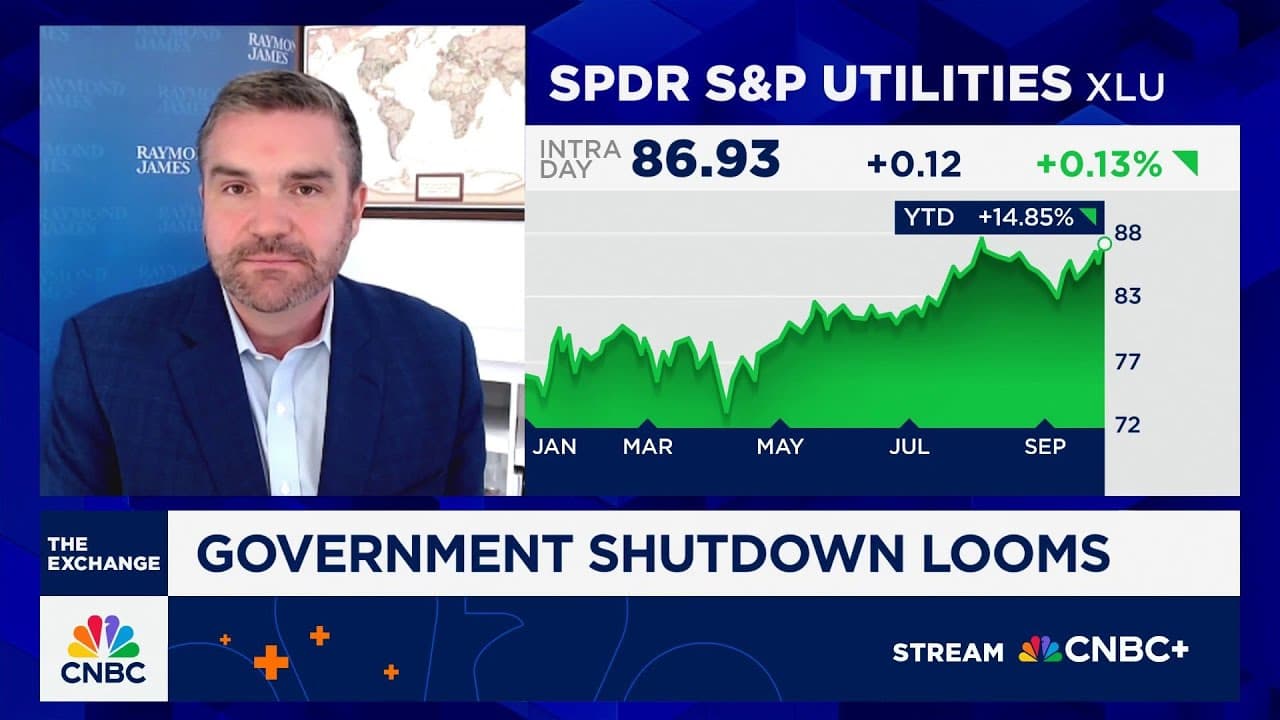
CNBC's “The Exchange” team discusses the potential impact of a government shutdown with Ed Mills, Washington policy analyst at Raymond James.

IBD's specialty consumer products industry group, which is predominantly made up of cannabis stocks, rose 3% midday Monday.
Market Catalysts host Julie Hyman breaks down the latest market moves for September 29, 2025. The US dollar is moving lower as a government shutdown looms.

CNBC's “The Exchange” team discusses whether the stock market has reached a turning point with Michael Kantrowitz, chief investment strategist at Piper Sandler.

The US economy has been a mixed bag as of late — GDP (gross domestic product) grew by a 3.8% revised annualized rate in the second quarter, while the labor market faces some challenges month-by-month. So, how well is the US economy actually doing?