
加载中...
共找到 25,004 条相关资讯

US stocks ended mostly lower on Monday as rising oil prices and escalating geopolitical tensions in the Middle East weighed on investor sentiment, offsetting optimism around diplomatic signals from Washington. The S&P 500 fell about 0.4%, moving closer to correction territory and extending its decline to roughly 9.3% from its recent peak.

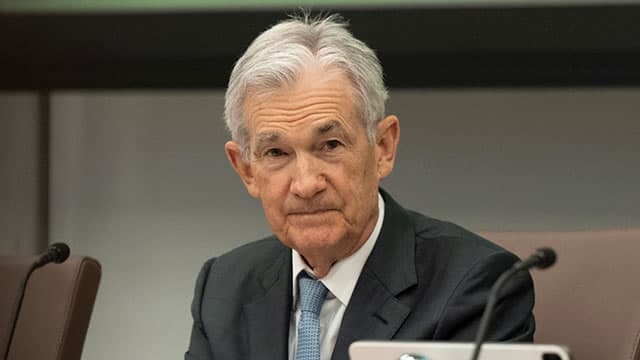
Federal Reserve Chair Jerome Powell said during a Harvard University event Monday that policymakers should look past rising energy prices amid the war in Iran – adding that there is no need to hike interest rates now.

The Iran war will likely push inflation higher in coming months, a senior Federal Reserve official said Monday, but he signaled the central bank's current interest-rate setting gives it room to wait and see if those pressures last.

While equities are struggling to pick a direction as of midday, the weakness at the end of last week has marked fresh lows for the broad market and some of the most influential names: the Magnificent Seven. While it is not yet a bear market, this is now the most severe drawdown since the tariff tantrum last spring and the 2022 bear market before that.

So far, I haven't seen a real capitulation in the broader markets. I am not buying the dip, and I'm planning to raise even more cash this week.
Operator: Hello, and welcome to the Americas Gold and Silver Fourth Quarter 2025 Conference Call. [Operator Instructions]. I will now turn the conference over to Paul Huet, Chairman and CEO. Please go ahead. Paul Huet: Thank you, and good morning, everyone. I'd like to welcome you to our fourth quarter year-end 2025 conference call. This call will be recorded and available to watch on our website event page later today. Please note that all dollar figures will be expressed in U.S. dollars throughout this call, unless otherwise noted. We will also be referencing a slide deck that will be shared during the webcast for this call. Joining me today are Warren Varga, our Chief Financial Officer, who will walk through our fourth quarter and full year financials; and Oliver Turner, our Executive Vice President of Corporate Development. I'll start off with a few key updates before turning it over to Warren. Before I begin, I would like to remind you to review our cautionary statements regarding forward-looking information and non-IFRS measures. These statements are included in our year-end MD&A, news release and in the presentation slides. Let me start by saying how excited I am about the massive transformation we have delivered at Americas Gold and Silver throughout 2025 and into early 2026. But before I outline our progress at the mines, I would like to announce a very significant milestone for our company. Just a few weeks ago, our Galena team achieved a major safety milestone. We have completed one full year in over 550,000 man hours of work. During that year, we had no lost time accident. Nothing is more important than the safety of our miners. And I would like to congratulate the team on the culture around safety we are building at Galena and in Mexico as well, well done team. 2025 was a year of transformation for our business, and we delivered exactly that. In 2025, we achieved a massive 52% increase in attributable silver production, up to 2.65 million ounces. At Galena, this was accomplished despite a total of 20-plus days of planned shutdowns for significant upgrades to both #3 and core shafts in addition to many other derisking optimization projects that I will discuss later on this call. So a massive increase in production while we're shutting down and growing the operation is quite impressive. 2025 was also highlighted by a production record year of 1.2 million ounces set by Cosala, where our team delivered the highest annual and quarterly silver output in operation in history, while successfully ramping up the EC120 to commercial production. This is another remarkable milestone and a testament to the exceptional execution by our entire team at Cosala. Congratulations to everyone at the operation for achieving these record-breaking numbers while setting the table for a very strong future. At Galena, consistent productivity gains came alongside our focus on major capital projects and the integration of the newly acquired Crescent Mine. I'm proud of our team for advancing key operational initiatives, including the introduction of long-hole stoping. The expansion of our underground mining fleet the upgrades to #3 and core shaft, all of which position us to support increased development and accelerate mining rates moving forward. Over the course of 2025, we have made major progress in mining, infrastructure and in development at Galena, our transition to long-hole stoping is going exceptionally well. To date, we have mined 7 to 9 long-hole stope panels designed at specific width, while three new long-hole stopes are currently being developed at the moment. I think it is very worthwhile noting that in 2024, we had 0 long-hole stopes, so this is an extremely exceptional step in the right direction and where we're wanting to head at Galena. In Q4 of 2025, we accelerated upgrades by installing the new 2,250 horsepower motor and a redundant motor at the core shaft, further derisking the operation and supporting our growth plans. Phase 2 of the #3 shaft upgrades remain on track for completion in Q2 of 2026. With the arrival of all the parts coming in this month, in March and early April, needed to complete the upgrades on the braking systems and the lillies. This will bring the total hoisting capacity to over 100 tonnes per hour, representing a 160% increase compared to the 40 tonnes per hour achieved in 2024 and when we started this project. We have all seen major productivity improvement. In '25, we had about a 200% improvement on mucking operations. We're now seeing around 200 tons of ore move per ship up from around 50 tonnes of ore when we were doing conventional mining. This is through the use of remote control mucking. Other significant achievements at Galena included a new Alimak ventilation rate, new declines in place that are debottlenecking mining areas. We made major investments into our underground mining fleet replacing and upgrading a large portion of our year with more expected in 2026. Lastly, we are bringing Galena into the modern era of mining, we are currently installing a modern fiber optic communication that will allow us to remotely monitor and optimize pieces of equipment in the mine. In just 1 year, we have completed a large number of projects and upgrades to the mine, and we will continue this strong progress in 2026. At present, we're off to extremely fast start there as well with key infrastructure and equipment upgrades in place within a few short weeks of closing the acquisition in December. Firstly, we added line power to all three audits and are actively setting up the operation to deliver ore to the Galena mill later this year after commissioning the secondary egress. Our updated mineral resource estimate has shown a larger and higher grade ore body at Galena, a tremendous result in our first year of drilling. Even when excluding the historical resource at present, our 2P is over 25 million ounces; M&I over 115 million ounces; and in third is over 133 million ounces of silver. And I just want to remind folks, this is not silver equivalent. This updated resource gives us even greater confidence in the quality and longevity of our assets. I also want to note that our operations in the Silver Valley are still among some of the shallower and we know there is more silver to be found here. We are quite excited to continue drilling and exploring these previously underexplored properties, both in Mexico and in Idaho. As a company, we recently launched the largest exploration program in history, with approximately 64,000 meters of drilling planned across the Galena complex, including Crescent and Cosala. This follows the discovery of 10 new high-grade silver, copper, antimony and silver lead veins at Galena. Highlighted by intercepts of approximately 4,900 grams per tonne of silver, 4% copper over with of 1.3 meters and 2,600 grams per tonne silver and 1.4% antimony, over 0.7 meters wide. The continued discovery of these high-grade veins like 34 veins, 149 veins and the newly discovered 520 vein announced today are strong examples of the tremendous potential of Galena to continue to grow with high-grade discoveries. Something the mine has been doing consistently for well over 100 years. This February, we announced a landmark joint venture with United States antimony to build and operate a new antimony facility at the Galena Complex, creating the first fully U.S. mine to finish antimony solution and creating additional downstream value for our shareholders. Our full year antimony and copper byproduct production from the Galena Complex further demonstrates the value potential of our unique position as the largest active U.S. antimony mine. Beginning January 1, '26, we finally started receiving revenue from these byproducts under the new offtake agreement negotiated with Ocean Partners at NTEC Resources as earlier announced in June of 2025. Looking ahead, we're extremely excited about the opportunity in antimony production as we continue test work initiatives and evaluate numerous pathways to unlock the substantial byproduct value of antimony at the Galena complex. Moving forward, Americas remains squarely focused on playing a leading role in strengthening U.S. critical minerals supply chains. Finally, we introduced our formal 2026 production, cost and capital guidance. For the full year, we expect consolidated silver to be 3.2 million to 3.6 million ounces at an ASIC of $30 to $35 per ounce sold. This is yet another 30% increased production over last year. The last year, 50%, another 30% as we continue along that trend that we're heading towards over that 5 minutes. It keeps us well on track and on course to return Galena back to those historical production and record levels. These are big, big step-ups year after year. Our cost guidance reflects deliberate investments in advancing operational improvements at Galena and Crescent, including the completion and commissioning of the new surface past fill plant, as we've been discussing for some time, as well as the planned transition in our mining methods over the next few years to getting 60% to 70% long-hole stoping and a mixture of 30% under hand capital. These changes will drive higher productivity, lower cost over the medium and short-term time. Consolidated capital expenditures are targeted between $90 million and $120 million, including Crescent development while exploration capital is targeted between $15 million to $20 million. 2026 will be another pivotal year for infrastructure upgrades that Galena and our complex so desperately needs, building directly on the strong foundation we've established in 2025. Overall, I'm extremely pleased with the progress we have made over the last year, which has laid a strong foundation for a very -- for a continued growth of 2026 and beyond across both Idaho and Mexico. I'll now turn the call over to Warren for our financial highlights. Warren Varga: Thank you, Paul. This morning, we released our Q4 and full year 2025 financial results. Our audited financial statements and MD&A for the 12 months ended December 31, 2025, are available on our website and under Americas Gold and Silver profile on both SEDAR+ and EDGAR. For the full year, our consolidated revenue increased to $118 million, up 18% from $100 million in 2024, driven by higher silver production and strong realized prices. We achieved consolidated attributable silver production of 2.65 million ounces with approximately 3.4 million ounces of silver equivalent, including 9.3 million pounds of lead and 2 million pounds of copper in addition to 561,000 pounds of antimony. As for our cost structure, cost of sales per silver equivalent ounce and cash costs and all-in sustaining cost per silver ounce produced averaged $25, $26 and $33 respectively. On the earnings front, we reported a net loss of $87 million or $0.33 per share in 2025 compared to a net loss of $49 million or $0.46 per share in 2024. Our adjusted earnings loss for the year was $35 million or $0.13 per share compared to $34 million or $0.32 per share in 2024. Adjusted EBITDA for 2025 was a loss of $4 million or $0.02 per share compared to $1.5 million or $0.01 per share in 2024. We remain optimistic about the future with silver production expected to grow as we advance the restart of the Crescent mine and continuing optimizing the EC120 mine at our Cosala operations. To support this growth, we closed a $133 million bought deal financing in December 2025, which also funded the cash portion of the Crescent acquisition. With that, I'll now turn the call over to Oliver Turner. Oliver Turner: Thank you, Warren, and good morning, everyone. The past year has been an incredibly active and productive period for the entire Americas team. From completing the Crescent acquisition, delivering strong exploration successes, announcing the U.S. antimony joint venture for the antimony processing facility in Idaho and delivering strong operational results across all sites, we've made significant progress in many different areas. On the market side, we've continued to see strong institutional support and interest. The tightly held ownership of our shares has increased from just 7% in late 2024 to over 65% presently, certainly a strong signal of market support. This level of alignment continues to be a key differentiator for Americas. And over the past year alone, our team has conducted more than 400 institutional investor meetings. We've also seen meaningful index inclusions with Americas being added to the VanEck's GDXJ and SIL ETFs, along with a significant increase in the SILJ ETF shareholding. Over the course of the year, we've also added five new analysts covering our name, and we greatly appreciate their support, bringing our total coverage universe to seven research analysts. With increased generalist interest, we've also seen increased Tier 1 media interest as highlighted by recent interviews with both FOX Business and Bloomberg following our U.S. antimony joint venture announcement. Since the beginning of our transformation in late 2024, USA shares that significantly outperformed the Silver peer group, yet we still trade at a significant discount to NAV compared to our peers providing a rare combination of both silver growth and value in a single stock with nearly 80% of revenue exposed to silver, a growing antimony revenue stream, major new exploration discoveries and a strong growth profile ahead of us, we believe the market is up to fully recognize the value we are building, which makes an exciting opportunity for investors interested in investing in silver today. Looking ahead, our 2026 calendar is filled with conferences, media engagements and meetings week to week. And we look forward to keeping the market and our shareholders updated as we execute on our strategy to scale a premier Americas-focused silver and critical metals producer. With that, I'll turn the call back over to the operator for questions. Operator: [Operator Instructions]. Your first question comes from the line of Justin Chan of SCP Resource Finance. Justin Chan: Congrats on a transformational year. My first question is just on your production guidance for the year. Could you give us maybe a bit more breakdown between what you think the ranges are for Cosala and Galena? And then any guidance on sort of how to model that on a production ramping up basis as you commission the shaft, the past plan, et cetera? Paul Huet: Sorry, Justin. I think I heard the question here -- it's Paul here. I think the breakup between the guidance between Mexico and Idaho, and then the update on the shaft. Was that the question? I think that's it. Justin Chan: Yes, first the breakdown between the assets and then the cadence. Paul Huet: Yes. So look, we're going to be in the ranges, obviously. So this year is another huge step up for us, right, as we're transitioning into long haul, we did 9 stopes -- 7 to 9 stopes last year, depending on how you measure panels. We're going to be stepping that up again this year. So looking at 2026, we're looking at a range of $2.2 million to $2.6 million out of Galena and then the rest is coming out of Mexico, again, Mexico is going to have another big year as we step up about 1.2 to 1.4. So bringing us into that guidance that we put out forward with the projects we've got for the shaft, those are big steps. We've got two big projects we've got to finish up this year. And that's in order to sustain the long haul and fill the stopes property. We've got to get that batch plant in place. And that's been one of our projects from day 1, and we're expecting to have that done this year, which is another big milestone. With respect to the shaft, the parts are almost on site, actually, half of them are. Some of the parts are on site, we're going to be -- we have a -- we want to make sure everything is on site so we can make sure that we do a scheduled planned outage. We'll be planning to be down for 12 days as we upgrade the shaft. These are things that have to get done in order for us to maintain the new product, the new tipping rates that we want to do at that 100 tonnes per hour. So April, those -- those will be done. Justin Chan: Got you. So just to reiterate, so the shaft upgrade basically should be in April and model that into Q2? Paul Huet: Yes. So, the shaft upgrade done. And then the biggest -- our biggest thing is -- so that's about a 10-, 12-day shutdown. The biggest one that's the back plant in Q4. That's always been the biggest one because it allows us to fill the stopes much faster. It takes us maybe 6 to 8 days to fill a stope today. We'll be filling stopes in 24 to 36 hours once those new complexes are built. It become the site to all the construction going on for the new facilities, there's a lot of work going on at the moment to prepare for that new facility. Justin Chan: Absolutely. Another one is just with -- I guess for the balance sheet and all your CapEx plans, can you give us your capital allocation split for this year? I know 30 to 40 is at Crescent, but maybe there's more detail you can give. Warren Varga: Yes, I'm happy to just take that line, it's all over here. So on the growth side of things, total of -- so the $90 million to $120 million includes about $60 million to $80 million growth. That's growth across all assets. A significant portion of that is going into Crescent this year. We also have about $30 million to $40 million in sustaining that includes some capitalized infill, but the majority of the exploration budget is going to be expensed and will be in that $15 million to $20 million number that we talked about. Justin Chan: Okay. Got you. And then maybe just one on some of your growth projects that are maybe less into people's models right now. Do you have an update on Relief Canyon in Nevada? Do you have any plans for that. And then maybe one on the antimony JV? Paul Huet: Yes. Look, when it comes to Relief Canyon this year, we're going to be doing a pretty internal study. At the moment, we're going to be squarely focused at making sure our silver district in Idaho is running where we needed to be. Relief Canyon is going to undergo more of a study this year that we're looking at. Justin Chan: Got you. Like a scoping level study something like that? Paul Huet: Yes, it's going to be an internal study. So last year, we didn't have any -- we didn't do any studies. We want to understand some of the ore, some of the resource and some of the freight grabbing stuff. Look, a lot of that stuff is almost identical to what I had me and Mike at Hollister. That material appears to be very, very similar to what we mined before. The grades different so we want to understand it. We're going to do an internal study led by our COO, Mike Dylan, and we're going to come back to the market. And we're going to come back to our board first and decide what's the best thing to do. We're getting a lot of inbound calls on it. There's a lot of interest on it. It needs metal prices. I don't think we're ready to just give it away to anybody. It would be crazy to just give this away. There's opportunity here. Justin Chan: Got you. And then on the antimony JV, I guess are there any kind of updates or milestones that we should expect in the next, I guess, over the course of this year to account for. Paul Huet: Yes. So the team has developed. I'm actually here taking this call right now from Bolivia, and you visiting the new plant that was built, I'll be at the site in probably about 12 hours to go visit a new plant that is feeding the product already into Montana. We're building something identical to this thing. So the purpose of us being here in Bolivia is to actually see the process, understand it and see what it is we're trying to replicate in Idaho. So it's moving out of speed that it was faster than I expected that for sure. Operator: Your next question comes from the line of Nicolas Dion of ATB Cormark Capital Markets. Nicolas Dion: Congrats on the progress at both of your minds. Just 2 questions for me. I guess I'll start by following on the questions on the guidance. Does your 2026 guidance include anything from Crescent? And then second to that, how should we think about the trajectory of production and costs at Galena looking beyond 2026? Paul Huet: Yes. I'll start a bit on the Crescent, and Oliver, you can go on the cost. So Crescent what just need to be reminded that we we're going to be drilling a lot of Crescent this year. Crescent will have some very small amount, by the way, a small amount because we have to put in secondary egress. The reason this thing can't go into production yet is because the ramp's got to be connected. There's got to be raises and those take us -- it's going to take us a bit of time. At the moment, we're going to be looking at extending on all -- on the vein systems and doing like we did at Fire Creek, just extending the veins understanding the geology. But for now, this year, the tonnes are going to be low. We'll be mining just on vein, no stoping. We can't stope until the secondary gas are put in, and that's probably a third quarter thing. But we'll be getting tonnes for sure and ounces out of Crescent just smaller amounts. And then on the costs, Oliver, you can talk a bit about the future. Oliver Turner: Yes, happy to, Nick. And so just a couple of things in -- as we step into the years ahead. We've been out there talking about taking Galena back to its historical record production levels, which was, of course, in 2002, the mine did 5.2 million ounces and we said that would take us a couple of years to get there. That firmly remains in place, and that growth plan is still there, so nothing has changed there. And as we do scale production, like a bunch of the things you talked about with respect to the transition to long hole stoping we're already talking about a 70-30 split that's progressing extremely well. We've got additional byproduct credits, obviously, that are now payable with the new contract in place from tax that will also being netted out against our all-in sustaining cost numbers. So a steady decline from here onwards as we execute over these next couple of years at Galena is certainly expected in terms of where things can get, we'll put a guidance at the appropriate period of time for those numbers. But significant cost decreases as we ramp towards that historical production number. Crescent as well as Paul just talked about lots of work going on there. Once we're into full production there. We expect that to be contributing ore to the Galena mill. That historical PEA that's out there on Crescent, obviously, not RPEA the prior owner's PEA from 2015. However, that gives you a good indication of the potential of Crescent. We think we can potentially do better than that, but we need to get in there and do more work. And then, of course, down at Cosala, we're fully into EC120 now. Last year, we had a record year despite some limitations geographically in the state, which the team navigated through excellently. We expect another strong year that's going to be in line with last year at Cosala, but then what we identified here with [ Alikrane ] just north of San Rafael, San Rafael is the mine that we "depleted" last year. Well, now we've got a new discovery just north of it, which looks extremely interesting. We haven't really been able to drill to the extent that we would like to at Cosala. Obviously, we're allocating some meters there this year, and we're excited to get in there, but there's numerous targets, just similar to the Alikrane discovery that we'd like to get into at Cosala and then, of course, really get in there to evaluate the impact on optimizing mining activities. So Cosala will grow from here as well Galena. So we still expect that ramp up over the years to come. Nicolas Dion: Okay. That's helpful. And my second question was going to be on Alikrane at Cosala. Can you maybe elaborate on that discovery a bit more in terms of, I guess, the potential you see there? And how close it is maybe the San Rafael development, et cetera? Oliver Turner: Yes. So it's like it's a brand-new discovery. One of the key things that we really enjoyed in our due diligence of this company was when we went down to Mexico in 2024 during our due diligence several times, obviously, prior to taking over management of the company. We are really impressed by the exploration potential at Cosala. There's been numerous outcrops that have been drilled there. And I believe the last five of them turned into five mines at Cosala. Of course, that's not a poor projection on turning future outcrops into mines, but it certainly bodes well for the prospectivity of the region. There are 7 outcropping areas that have been identified that are just screaming to be drilled. And one of those areas in Alikrane has yielded the sort of first discovery under this team, which is a really strong start. It's only 600 meters north of San Rafael. Look at the whole district down there, it's not stretched out over a large area in terms of where these mines are, and they obviously all feed centralized milling. So that's an area as we continue to drill into it this year could potentially be feeding the milling center there in the years to come. This year we'll be focused entirely on EC 120 from a production standpoint. That's the higher grade silver copper. But other metals can come back into the mix there with exploration success like we've seen at Alikrane. Nicolas Dion: Okay. Very good. And last one, I don't know if it was mentioned, but what was the split of your exploration program between the two mines? Oliver Turner: Yes. But 3/4 of that will be spent in Idaho and about 1/4 of it we said in Mexico. So give or take, the $5 million would be in Mexico and $15 million in Idaho. And that's across both at Crescent and at Galena will be drilling aggressively. We're going to have north of 10 drills drilling across both sites there, which is a huge step up. Those sites haven't seen more than a couple of drills turning at them for many, many years now. So this is the largest exploration program in this company's history, 64,000 meters as a reminder for everyone listening. Those are all drilled from underground. So those are essentially short holes in Idaho. So you get a lot of peers points, a lot of data points for that meters there. And we've already seen some strong results with 34 Vein discovery, which went into the new resource, which helped to boost those grades. We saw a grade increase there. 149 is not yet in the resource, but we're looking to get it in there as well. And then, of course, the new 520 discovery, which is over near the core mine, which is connected to Galena underground is another high-grade discovery. And this mine has been doing this for well over 100 years and certainly looking like it's going to continue for a long period of time. Operator: Your next question comes from the line of Amanda Lewis of Desjardin. Amanda Lewis: So first, we saw a major increase in resources at Galena. Can you just walk us through what drove that change and what it applies to the long-term mine life at Galena, especially with the present integration? And then just also what drove the large grade increase at Galena. Oliver Turner: Yes, happy to. Go ahead, Paul. Paul Huet: Go ahead, Oliver. Go ahead. You go ahead, Oliver. But the one thing that as we're talking about great, I just want to remind people, one of the things that about last year in the drilling and everything we had. When I think back of 2025, and I think while we actually mined 9 stopes last year. And almost every conference I go into or all that goes into people ask us about the grades, the grades and how the impact of those 9 stopes. We're carving these things out surgically with long hole we have seen the best grade at Galena in 2 decades. The best grade this mine has seen in 20 years was last year, a record year, the best grade in 20 years while we're carving out long-hole stopes. I'll go ahead and talk about the resource, but I think I just wanted to inject that because a lot of the questions we were asked throughout the year were about how will it impact the resource? How will it impact the grade? And will we see a tremendous drop in grade because of ad evolution. The opposite occurred for us, yes, the best grade in 20 years. So go ahead on the resource. Oliver Turner: That's a very good point. I mean one of the key considerations here is as we're integrating more long-hole stopes in this mine plan, right? We're shifting from 100% underhand cut and fill or conventional mine to a blend of mechanized long-hole stoping, and there will always be some cut and fill in this mine, but about a 70-30 split. As we baked more of those long-hole stopes into the reserve, we haven't seen a major impact on grades there, right? So we're applying long-hole mining stopes there. and the grade is staying very high. Reserve grade is over 500 grams, over 520 grams actually in the silver at Galena. So maintaining very high grade. And one of the key factors for that is the fact that we're able to mine extremely narrow with these long-hole stopes. That first stope we took was 1 meter live. We've taken numerous narrow long-haul stopes there with the same basically with that we'd be able to mine with cut and fill. So that means that plan dilution is exactly the same as what we're getting with cut and fill. So really strong performance by the team there. And the mine looks well positioned. One other thing to mention here too is, Galena is in the top 5 highest grade silver mines in the world, and we're only increasing grades with these discoveries. So one of your questions there was what drove the grade increases. The 34 vein discovery, which we announced midway through last year, when we first drilled that off with that headline hold as 983 grams, well over 3 meters there and widths, triple or minimum mining width. We initially had a 1 million to 2 million-ounce target on that vein. We put another update out about a month and a bit ago, and we ended up expanding that to 6 million to 7 million-ounce target across multiple different veins plays. That vein system continues to grow. And it's just an example of what's been happening with Galena for over 100 years here and will happen well into the future. So we're quite excited about that inclusion that was included in the resource and helped drive grades up even net of depletion, even with incorporating those long-hole stopes there. We had the 149 vein, 25-kilogram hit, 20 centimeters wide, but you dilute that 5 times, you're down to a 5-kilogram intercept or cut there. That was not yet included in the resource. So there's still more great upsides to come there. And of course, the 600-gram plus hits that we've seen at 520 in the core also not included. So the good news on grade improvements in drill it's being increased with intercepts with the drill bit. That's real data feeding that that's increasing those grades, not just in manipulation of cut-off grades in either direction. So very excited about that. Down at Cosala, you also saw reclassification resources. We moved some resources into inferred from M&I, not impacting the mine life whatsoever that we have at EC120. We're going to be infill drilling those areas and bringing them back into M&I this year. We've applied very stringent controls, both in Mexico and in Idaho with this resource, and we've done this at multiple different companies before where we build our own resource. But of course, now we can build our mine plans around going forward. So strong results across the board of both and feeding it with the drill bit and look, we're going to be doing a ton of drilling this year. So excited about what that can mean for the year-end resource a year from now. Amanda Lewis: Okay. Great. That's very helpful. And then just lastly, could you just provide a bit more color on how the long-hole stoping is going? I'm specifically wondering how the mining teams are performing and what areas do you still want to work on? Paul Huet: Yes. Oliver, I can talk about that. So as we've been talking about, we've taken out depending on how you look at a 7 or 9 panels already, we are changing up a bit of the way we're drilling to make sure that we're very consistent in our blast patterns. We're this mine hasn't seen a long-hole for us. So depending on where we are in the mine, we are quickly recognizing and this is not uncommon in any of the mines I've worked out in my life. By domain, if the areas are very steep, 89, 90 degrees. We might need one less hole. So we're just improving or improving are optimizing our drill patterns, our blasting patterns, if we're down to 72 degrees, we need an extra hole. But what we're seeing is we're determining our stope height, our length. And the intent is that 70% of everything we do going forward will all be long-hole. All we're doing right now at the moment is optimizing it, though. We just continue to get better and better and better. In the first couple of stopes we have done. And the more efficient we get, we'll just be moving more tons per day using remote controls instead of drilling and blasting jackwave, which has been done forever. So long-hole is like most people understand. It's not a complicated thing. It just needs to be done right. You've got to have your top that's good. You got to have your bottoms, that's good. And we want to make sure that you can check in our case, we check our breakthroughs. So they're not in the footwall or hanging on and we don't have a lot of deviation and unnecessary additional dilution. So pretty simple game in our world, given we've done it all over the world. Operator: [Operator Instructions] Your next question comes from the line of Wayne Lam of TD Cowen. Wayne Lam: Maybe just wondering on the new discoveries, obviously, some positive elements that could support a further increase in production. Maybe if you might be able to give us some color on the new 520 vein and the time line on that and whether the core Shack upgrades put the infrastructure and positioned to be ready for production and it's just a function of drilling and development. But no actual constraints on the processing infrastructure? Paul Huet: So that upgrade we did in the core motors at the very end of December 2025 was the first time that we ever have redundant motors. So we're preparing ourselves for using that shaft. There's still some work to do in the loading pockets and other areas that we have identified. But the new vein 520 has been part of a drill program at core. So given that it's a brand-new discovery or we've got quite a few holes into it already, we're going to drill it quite a bit and see. Can we access it from the #3 shaft? Or can we access it from core? One of the advantages we have in this district is that core and #3 shaft are connected. In fact, that's our secondary egress. So we travel across to get out in the event that the #3 shaft is down. So we will be able to mine that 520 vein from the #3 shaft even when the upgrades come into the #3 shaft, this quarter in March and April as we're doing these upgrades. So once again, more drilling into it, we're going to start looking at it. How do we mine it from the best location? So it's very fresh. It's very new. We're quite excited about it. It's not going to be the only discovery we have. There will be many more. We have 10 new veins here. There's no doubt there will be more discovery. One of the biggest things we always saw about these assets, they were underexplored, and we needed money and we're drilling them now. So 520 needs more drilling. We have optionality to mine it from either shaft or #3 shaft and skipping it up either one pause a bit out there because of the work that needs to be done. Wayne Lam: Okay. Great. Yes. Sounds like a pretty big opportunity. And then maybe at San Rafael, just wondering with the higher silver price than as EC120 ramps up? Is there potential for continued mining there and to add incremental tonnage to the production profile? Paul Huet: Oliver, let you take that one, I believe. Oliver Turner: Yes. So San Rafael particularly the higher-grade upper areas, which we were mining towards the end of last year. There are still some portions there that can come into the into the mill there down at Cosala. But the majority of mill feed this year is related to the EC120. Of course, all of this subject to improvement based on drilling and exploration results. And obviously, we're not going to be putting Alikrane into there within the next 6 months or anything like that, but continued positive drilling intercepts there in the upper portions of San Rafael can add some more feed and then also continued drilling success from underground at EC120 will allow us to get into some of the higher grade areas there as well. So coastal the team executed excellently there last year with a record production for the asset. Looking for similar this year with upside pending drill success there this year? And then obviously, we'll be scaling it in the years to come. Operator: Your next question comes from the line of Heiko Ihle of H.C. Wainwright. Heiko Ihle: Most of them have been answered, but just two quick ones. The 55 170 decline, obviously, should provide a decent amount of efficiencies. When should that fully -- I assume this is already in effect, but is there like a bit of a period over when we should see those impacts? And then also just from a cash point of view, given that there is less work now getting done, is there a -- should that impact cash costs at all? Paul Huet: Sorry, Oliver, you're going to take that I'm not sure I heard the question at all. Go ahead, Oliver. Oliver Turner: No problem. Yes. So on the decline, that's currently under development. So we'd expect that to be getting those multiple access points here towards the end of the second quarter. So expect that to have an impact. I mean this is all part of our 2026 mine plan anyways. So it all based into the guidance that we have. Certainly, when it comes to cash costs, I think your -- the way that you're thinking is right there, Heiko, we do expect cost to continue to decline as we go quarter-over-quarter this year. So you'd expect more of a back-end weighting to improvement in cash costs as we ramp up ounces, but also some of these projects that we've been working on start to impact the bottom line. One of the things that we did see in the first -- what's it been 14, 15 months, that we've been at the helm here. We did highlight in the release there is on mucking efficiencies. The company was in 2024 and prior moving about 50 tonnes per shift with conventional methods. We're over 200 tonnes per shift now used employing the remote scoops that we have, haul trucks underground. This is all the new equipment that we put in place last year. And now we actually have a fiber optic system that's being laid down #3 and it's going to be developed on different levels there that will give us basically mesh WiFi and communications access all throughout the mine. It seems like something that's sort of standard in mines these days, and it absolutely is if you're building a new mine. But this mine hasn't seen any of that modern technology installed in it. So that's another very easy target and low-hanging sort of area -- of low-hanging fruit that we can target there to improve efficiencies. That will then link in to the lot of the equipment we're using and it's not just mining equipment. It's fans, it's ventilators, it's automating all sorts of parts of the mine and monitoring it in real time. We expect that to continue to improve dispatch efficiency cycle times and productivities across the board. All of that starts to be impacted once that system is in place, which again, is the second half of the year. So you're going to see steady improvements in efficiencies over the course of this year. You're going to see costs come down at the operating level. Over the course of this year, all of that kind of works in tandem as tonnes come up ounces come up costs go down, byproducts come up, efficiencies go up. So you'll see a positive trend this year, Heiko, as we execute quarter-by-quarter, and things will get even better next year, obviously, in '27. Heiko Ihle: Fair enough. And then just one quick clarification. How much do you -- would you say you spend on fuel at Galena or even across the company per month or per quarter? Just purely out of curiosity. Oliver Turner: Warren, do you want to take a stab at that one? Warren Varga: No, I wouldn't even know at the top of my head. Heiko, I'll give you a number after the call. There's not off the top of my head. Paul Huet: Yes. I mean we just feel, given what prices have been doing, but I assume the impact is fairly small. Oliver Turner: It is, Heiko. One of the things remember there, of course, is that Galena is integrated into the grid power system, of course, in Idaho. There's not a lot of diesel consumption at site. Obviously, some of our underground equipment runs on diesel. But broadly speaking, the mine is powered by grid power. So not the same impact that you'd expect to see in a large open pit in terms of diesel cost impact, but we can get you that number. Paul Huet: And remember, we have a lot of rail, right? Our rail transport a lot of our foreign waste in the mine. Operator: With no further questions at this time. I will now turn the conference back over to Paul for some closing remarks. Paul Huet: I just want to thank Oliver and Warren for helping me on the call today. And I really want to take a moment to thank you all, our shareholders. Our teams at both sites, look, we're coming up for 1 year without an LTA in Mexico as well. That doesn't happen by accident. So great job to both sites for outstanding safety commitments. And I'm looking forward to 2026. It's a very exciting year, another big step-up again for us. we continue to deliver on our operational successes. So thank you, everyone. Have a great day, and we'll talk soon. Operator: This concludes today's conference call. You may now disconnect.

Bjorn Theijs: Hello, and welcome, everyone, to our 2025 annual results webinar. We will start today with a presentation from our CEO, Luc Tack; and our CFO, Miguel de Potter. After that, we will give some opportunity to some of our analysts to ask live questions. [Operator Instructions] Thank you. And with this, I hand over to Luc. Luc Tack: Good morning, good afternoon, and welcome, everybody, to our annual results reporting on the year 2025. Thank you for tuning in. Boy, I must say it's been a rocky ride lately. Sometimes I started working when I was 18, so that's a little while ago. And so the way we have today within Europe, sometimes I feel even that we are in South America, where I had the crisis in the '80s and the '90s one after the other. Now we are into our third crisis in Europe. We had in 2020, we had COVID, then we had 2022, Ukraine. And now we have Iran. Each time quite disruptive to businesses causing a lot of uncomfort. Having said that, we are always with our feet on the ground. So we don't panic lightly. And in light of that, I feel that as a CEO of our company, that we will be able also to navigate this now Middle East storm. Of course, it is affecting us in our company on different fields in different ways. Sometimes it has a positive effect, sometimes it has a negative effect. Every effect that we have, we have no idea how long it will last and what it will be. And therefore, I'm sure some of you people ask questions, and we understand you ask questions but you will also understand that we don't have the crystal ball on how long the Suez Canal is going to be blocked, how long energies are going to be limited. All of that, we know as much as you know, which means nothing. But having said that, as a company, what do we focus on? We focus on what we can control. But no point in us focusing on stuff we do not control, we must focus on what we can control. Yesterday, we had a lengthy Board meeting, and we debated a lot of all of this. And at the end of the day, and that will also be the guidance that you will be getting from Miguel, et cetera. We find that last year, okay, we improved our EBITDA with EUR 22 million, which is nice. Would we like to do that again this year? Of course, but today, we cannot guide you towards that. We are guiding you more results for this year in line with last year. And then we will guide you further through the year as we see more clarity and as you will see more clarity and as everybody will see more clarity. But again, in this turbulent world, our company is fit to sail these storms and to come out of it. Anyway, that's the feeling I have. So let me kick off by telling you a little bit what we have been doing and which have been key events. So Tessenderlo Group is signing a JV to combine our collagen and gelatin business with Darling. The picture that you see here was the signature in Houston of the binding agreement. And so of course, now we are going through the regulatory stuff. And -- so we are working with authorities. So we are answering questions. And we will hope -- we hope that the transaction will close in 2026. But again, that is not in our power. We need to satisfy every authority and give them the time to answer. Of course, I'm sure you can appreciate that since this is a global business, there are many, many countries involved and some of them have different time horizon [indiscernible]. Tessenderlo Kerley opens a new plant in Ohio. I was in the U.S. up to 7 days ago. I have also been traveling. I was in Phoenix, I was in Houston, I was at different places. And I'm pleased to say that today, we get a market confirmation that the Defiance plant is a good investment. Customers are complementing us on making that investment and are also happy that the product is now locally available. I think you should never underestimate the logistics that come into our business. And by having a plant within the market where people can come and get a product is definitely further supporting our development. Then this is a minor company, a smaller company that we acquired, which is Osterwalder AG. So what is Osterwalder doing? Osterwalder is making powder presses [indiscernible] it's [indiscernible] technology because in our company, Melotte, we do 3D printing. And there, you build up a piece layer by layer out of powder. Here, the process is completely the opposite, you take power -- powder, I'm sorry, and you put a high press on it. And because of very complicated molds, you can get a gear out of it for a car or whatever. It has been a company and difficulties. It has not been an easy journey so far. And again, I'm not going to bore you too much about it but we bought a Swiss company. And 6 weeks later, we were told that we had -- I forget now how much, 40% or [indiscernible] 39% of duties shipping to the U.S., our biggest market. So this was again the perfect storm because of this -- like I said, sometimes this makes me feel like when I was in the '80s and the '90s when I was a lot younger and looking nicer than today but it still gives me the same sentiment. So -- but anyhow, that's behind us now. And so we are learning to know more about the company, where the strengths and the weaknesses are, and that will be a continuing story. Then I'm very happy to announce you the acquisition of the Metam Labels in United States and Canada Eastman. I must tell you the Metam has been the origin of our Crop Protection business by first acquisition, which must be 20 years now. And so we are further strengthening our position there in the United States. And so we are very pleased that we were able to do this acquisition. So indeed, we did a share repurchase program. Also a lot of you guys suggested us to do that. And we believe that this share repurchase program is contributing to the share price for our investors in the long term as if you buy shares, at the end of the day, future profits will be divided by less shares. So at the end, it should support earnings per share going forward. So events after the balance date. So indeed, here, we have the acquisition of the Cinis plant. So to give you a little bit background on Cinis. Cinis is a company that was launched on the stock exchange in Stockholm and that was planned to have a very bright future by taking off sodium sulfate from the multibillion dollar or euro investment of Northvolt in Sweden. Now some of you probably followed that event there, and you know how that company got into problems. And then consequently, also Cinis got into problems. So this is enhancing our potassium, which is a core business. I would like to remind everybody that potassium is the second nutrient. So the first nutrient is nitrogen. The second is potassium and the third one is phosphates. So in potassium, we specialize ourselves. We do not play where the big docks play. We are more always in specialty. And so that is what we produce, that is SOP. Most of the potassium in the world used is MOP. And MOP is put straight on the field. And then -- and that's mainly used in areas where there is a lot of rain. And as the rain drops out, the chlorides evaporate and then the potassium goes to the plant. What is SOP? In SOP, we pull the chlorides out of the potassium and this is how the SOP is meant for dry area because in dry areas, people be using would be using MOP. At the end of the day, the soil would become like concrete because of the chlorides that would remain on top of the soil. So our SOP is a perfect solution for mediterranean areas, for drip irrigations, et cetera. Having said that, of course, in the potassium world, SOP is probably maximum 10% of the volumes used worldwide where 90% of the application is MOP. We have been producing SOP for a very long time, and we are producing SOP in Ham on our Mannheim furnaces. Our Mannheim furnaces are working on the basis of sulfur, high temperature. And then we get the chlorides out, which then further valorized partially in our group to produce ferric chloride partially shipping to our neighbor plant [indiscernible]. So this is one way of doing it. Cinis is a different process. Cinis is a process which is the glyceride process, which is a minority technique in the SOP world but where we believe we can create opportunity in producing more green because the SOP from the Cinis project will be produced on lower temperature with green energy, which is available abundant in Sweden. And as a byproduct, we will have then also salts available for the market for the mainly de-icing market, et cetera. This is a new venture for our company. We have been following Cinis for years. And we also had been looking -- we had been requested to participate in capital increases and what have you last year, et cetera. We thought that was not a good idea that we -- that it was better to wait, that it would be the smart thing. Because now we are a 100% owner of the plant at a good price and can now develop this company. Then in strengthening our Board, as you know, there, we are also -- we have changed the course the last 2 years where we have decided that we must bring more industry knowledge into our Board. Before, of course, we have always had a very strong Board, very good strong Board members. But nowadays, we are choosing more with people with -- in our Board with in-depth industry knowledge. So the first gentleman that came to our Board was Sebastia Pons, who is a true agro specialist. So now we are bringing in Madam Beatrice Bruey, who has a very long career with GEA Group, a DAX 40 company in Germany. And so she is joining us as a Non-executive Director, and she's been coopted in the vacancy of Mr. Karel Vinck who decided to retire last year. So there also, we are further strengthening our Board and the respect of industry knowledge. So this is then taking us to 2025, but I will hand it over to Miguel now to explain you the results of 2025. Miguel Potter: Thank you very much, Luc, and good afternoon, good morning, everyone, on the call. Happy to be here and to present you our results for 2025. So let's go first to our key figures. Our revenues climbed by 4.4% to EUR 2.7 billion going forward in 2025. And our EBITDA grew as well by 8.5% to EUR 288 million compared to last year. You will see that we have a heavy loss for the period of EUR 80 million. Most of it is related to what we call noncash items and impairments that we have taken through the course of the year and especially in the second half of the year but I will come back to that in a moment. Our CapEx amounted to EUR 135 million, about half of which was maintenance CapEx and half of which was growth CapEx. We are basically finishing a big wave of growth CapEx with new plants. You have heard Luc saying that Defiance was fully operational since August, and we continue on that trend. The CapEx guidance for 2026 is in the same range as 2025, albeit it could be a little lower than 2025. The cash flows generating from operating activities was still strong at EUR 225 million for the year. So if we exclude FX differences, the growth in EBITDA, and this is for us the prime measurement of our financial strength is about 10%, 11% going forward. The group revenue per segment in terms of the distribution is relatively stable when you compare 2025 to 2024. Our Agro division is definitely still the strongest division of the group and also the most profitable for 2025, all the other entities remain relatively similar. When we go into the group EBITDA per segment, we see that Agro has grown its EBITDA for the year to EUR 117 million, EUR 118 million. That in Bio-valorization, we had a growth as well, but it's maybe a tale of 2 stories between PB Leiner and Akiolis. I'll come back to that. Unfortunately, Industrial Solutions was not able to materialize any growth. We've had very challenging times in the construction market, especially in Europe and in France, in particular, which is definitely difficult for the growth. And Machine & Technologies in the first half of the year, you remember that Picanol had a very strong first half of the year that is completed into these figures. For T-Power, we have a full year of revenues of RWE under the tolling agreement. So when we go into our Agro segment more in detail, and I repeat our Agro segment, these are our Kerley brands, so Tessenderlo Kerley for the international business and Inc. for the American business. And we have as well Violleau, which is our organic fertilizers. Agro segment has a very strong second half of the year, as you can see, even without -- if you take off the one-offs like the impact of Tiger-Sul, which has been contributing to the figures for the first time this year. Second half revenues growth of 13% or nearly 14% on the top line and the adjusted EBITDA, as I mentioned, of just short of EUR 118 million, which is a double-digit as we like to see in the Agro segment. We had to take also some impairments in the Agro segment. One impairment was related to some inventory of crop protection products that we have in the U.S. Our second segment, Bio-Valorization segment is -- we have 2 companies there, PB Leiner, the gelatin and collagen business as well as Akiolis, which is more our rendering business in Europe. You see here actually a tale of 2 stories. First of all, the rendering has been more positive contributing to the Bio-valorization segment this year than the gelatin and collagen. The gelatin and collagen within PB Leiner has gone through restructuring. We closed our plant in the U.K. earlier in the year, which was doing bone gelatin. So there, you see definitely a drop in revenues with less products being sold. We also had an incident in our plant in Argentina, our collagen plant in Argentina, whereby we had to stop production for quite some weeks and the plant is still not 100% operational, but only, I would say, 75% operational right now. So not fully contributing to the results as we would expect. Just as a reminder, our PB Leiner business is definitely, as Luc mentioned, now up for the merger with the Rousselot business from Darling Ingredients. Industrial Solutions segment, we have 3 brands there, DYKA, Kuhlmann and moleko. DYKA is our pipes and fittings manufacturing. We had -- while you will remember, we had a very stable first half of the year, there has been a significant decrease in the second half of the year, especially on the EBITDA. You see the EBITDA overall is minus 50% compared to the year before. Several reasons for that. The slowdown in the construction sector, mainly in France but also in other parts of Europe have weighted negatively on the results. Secondly, for Kuhlmann and moleko, the first half was not great, and it continues like that in the second half with even further deterioration of the volumes, mainly, but we were able to maintain our margin in both sectors. Machines & Technologies segments, Picanol, Psicontrol, Proferro and Osterwalder as well as Melotte are part of this segment. You will remember that we had a very strong first half of the year. The second half is in line with the previous year, so less strong, unfortunately. But it's also a tale of several stories here. While the wheel machines are currently suffering from the geopolitical environment and the crisis in textile in general, Psicontrol and Proferro, as well as Osterwalder and Melotte have been able to grow outside of the Picanol Group, meaning that they are now having much more outside revenues than intercompany revenues, while they were just suppliers of the Picanol Group, which is not the case anymore. Brings us to our last segment. T-Power. T-Power has done relatively well in 2025, relatively well because of much more start stocks and much more availability, which gets some bonus payments under the tolling contract with RWE. A lot of you will ask, hey we have the question, what will happen with T-Power after RWE? Well, unfortunately, we cannot disclose anything so far. What we can disclose is that we have several options on the table. None of these options is a binding option so far. And in the current volatile environment, we will only communicate when a binding option has been done or has been signed. But we do believe that -- and we do believe that on the 1st of July, there will be a new contract in place for the future of T-Power. Let me walk you through the adjusted EBIT to profit details. As I already mentioned, we took some large impairments and noncash items in the second half of the year. First of all, our Tessenderlo Kerley International SOP plant in Ham, it's a very vintage plant, as we call it, with still a big legacy on the phosphate when the Tessenderlo Group was still doing phosphate fertilizers. This plant needs a lot of maintenance. And our maintenance and the CapEx has been building up in the book value of the plant, but doesn't really match the value in use of the plant. So we were forced to take a EUR 26 million impairment on that particular plant. You will remember as well that when announcing the merger with PB Leiner and Rousselot, the plant of Vilvoorde was typically excluded from the perimeter of the transaction. We therefore, have also impaired a big portion of the machinery and assets on the plant in Vilvoorde, which is -- which has been up for sale since the announcement of the transaction. And then we did some other adjustments in our environmental provisions and here and there, some smaller impairment losses. This amounts to EUR 78 million in total. EUR 59 million or nearly EUR 60 million are finance costs, finance costs that are related to mainly interco loans, intercompany loans between Europe and the U.S. that we have to take on a mark-to-market basis each time we publish our balance sheet. We started with a euro-dollar rate of [ 1.03, ] and we ended up the year at EUR 1.175. So mainly the largest portion of this finance cost, EUR 54.4 million is related to that. And the rest are cash expenses. If we want to do the bridge of the net financial debt, EUR 288 million of EBITDA. What did we mainly do with that? Well, EUR 135 million of CapEx, half of which growth CapEx, half of which stay in business CapEx. So that's a big portion. We spent also EUR 21 million in 2 acquisitions, one, Osterwalder AG and the second one of the Metam Eastman contract. And we distributed about EUR 80 million in shareholders value through dividends or through share buyback. Our outlook, and Luc already anticipated our outlook, it is in the current market environment for us very, very difficult to come with very precise outlook. Do we prefer to play it safe by saying we will be in line? Remember that as from the 1st of July, the very strong tolling agreement we have with RWE will not be in place anymore. So being in line with 6 months of itself. And we never know what will happen with the straight of all with the front in Ukraine. We believe that saying that full year outlook will be in line with the current figures is already good for us. PB Leiner is fully incorporated in the 2026 outlook, where we don't know when we're going to be able to close the transaction exactly with Darling Ingredients. Please note that the transaction might also give a capital gain on the merger at some point with Darling on the basis of PB Leiner. And then we would like to bring you to another topic. We have, and you have seen that we have EUR 158 million of cash on our balance sheet sitting as of the 31st of December. So it has been the intention of the group together with the Board to do and bring a new division or business units to life. The details are still being worked out as we speak, but more an investment vehicle, whereby instead of deping cash at the bank at a relatively stable rate, we believe it is better to utilize it to do some smaller investments, not only acquisitive M&As for 100%. As you know, Tessenderlo but we would be inclined and open smaller tickets investments, maybe some in -- to the extent small that can be very liquid and others where we would take a minority position in some larger companies, whereby we would limit ourselves not to the full management of the company, but to board position maybe within those strategic companies. Then we have our financial calendar. The annual report is going to be published on April 1, that's next week. The Annual General Meeting of Shareholders is May 12, and our half year figures will be published at the end of August on the '26. And I think, Bjorn, we're going to take some questions now from the audience. Bjorn Theijs: That's correct. Let me quickly check. I will give analysts the possibility. I will put them live and then they can ask their questions. I will start with Christian Faitz the first one. I'll bring you on the screen. Christian Faitz: Yes, all the best for these difficult times. I mean you guys need to manage businesses. We just look at your shares. So a couple of questions, please. First of all, how do you see the development and availability of sulfur impacting your SOP business? I believe something like 40% of sulfur -- global sulfur volumes are passing the straight. So how do you deal with that? And maybe in combination with that also higher energy costs for your Mannheim process? That would be my first question. And [indiscernible] and if you could tell us a little bit if and potentially '27. Miguel Potter: Christian, thank you very much for your question. Yes, sulfur shortage has been around for quite a while, to be honest, especially the kind of sulfur we need. But luckily enough, we have some several types of contracts with various sulfur suppliers. Long term, we don't buy a lot of spot sulfur, and we get a guarantee of supply for our facilities around the world. There are some plants that we have in the U.S. that are directly connected to a refinery and they get sulfur actually piped through -- directly to the plant. So it is an issue. The price is definitely an issue, but the availability for us for the moment is less an issue. Well, we don't know how long the crisis will last. I was reading this morning that some vessels were still sailing through [indiscernible] they will reopen it by next week, and that would be one crisis less. But indeed, we're monitoring the situation actively. The energy cost and the energy situation in general for the group, we have several hedges positions for the coming 3 years, be it on gas or be it on electricity. All hedges and all companies and all plants have different hedging mechanism because of the various geographies. We don't hedge the same way in the U.S. as we do in Europe. And we don't hedge the same way in France as we do in Germany or Belgium for that instance. But I would say that more than half of our portfolio today is currently hedged for 2026 and about 40% is hedged through 2027. Luc Tack: [indiscernible] To add some flavor to that to be sure, so determined by the index. We are a victim of the index increases or we benefit if indexes are going down. In respect of the energy costs, indeed, energy is an important factor in the chemical industry. And since you are a chemical industry expert, I think it is important to say that we, as chemical plant do not use gas as a raw material. As other fertilizer companies on the nitrogen. Gas is there raw material. They take the gas, they make the hydrogen from the hydrogen, they make the ammonia, from the ammonia, they go on to the UAN or to the urea, right? So that is for them a completely different picture than ours. Having said, of course, your questions on visit when you came for our Capital Markets Day, we were grateful that you were there. It helps you always understand it better. It is a plant where we also have exotherm processes, meaning when we make our sulfuric acid, we have steam that is coming available, which is producing electricity. So we also have some hedge there for the consumption on our side. What is though more concerning for our Ham plant is that we are connected through a pipe system to Violleau. And Violleau is taking HCL from our plants from our Mannheim, pipe it to Violleau. They then put it into VCM, which is then going into the plastics. You may be aware or you may not be aware, but currently, Violleau is under a daughter company of ICG in Germany currently under court protection. And so that would influence our business in a way that if they cannot take our AGL that might have an impact on us. We understand that the management is hard working at Violleau to find solutions. But still, we want to highlight a little bit that we -- not only to the Middle East difficulties, we are also having these difficulties of chemical companies which are interconnected with us sailing difficult times and making losses. I'm just sharing public information here, but the losses at Violleau since 2023 have been higher. And so that for sure has an impact. So I think you will understand a little bit what has been happening to us. The impairment, why do we need to take an impairment? We need to take an impairment because earnings do not support our capital employed into the business. So we do have a problem there in respect of competitiveness of the business. Now our colleague in the Mickael Chicot, who is our Chief Transformation Officer, has also been there at the plant. We are engaging in constructive constructions also with the unions on what we need to do to increase the competitiveness of our plant in Ham. The plant can, for sure, have a good future, but having to take such an impairment is, in my mind, I see it as a kind of punishment because at the end of the day, your return is not high enough to support your capital employed. And definitely, there is a high degree of urgency there to improve the situation going forward. And there, we definitely need to call on our unions to make sure that we, as a team work together and not against each other to achieve more productivity going forward. It is important to say that our Mannheim process is more labor-intensive than general chemical plants, which run on reactors and pumps like we do on our liquid fertilizers. Here, it's more builders, it's more movement, it's more people. And I have always been an investor in Belgium, me personally, and I have always been fighting for every job in Belgium. But of course, it always takes 2 to tango, and we need the support of everybody. I must say sometimes it has been difficult to bring across that sense of urgency. It looks like now we are in a better momentum. And therefore, we hope that, that impairment will be a one-off and will not reoccur in the future because it has to be said the business still need a lot of investments, Miguel highlighted there that some of the buildings are old and antiquated, et cetera. So we will need to further invest there. And so these are tough times. Having said that, we make the best SOP in the world. I want to highlight that. We make the best, and we are also recognized as such in the market. So -- but the turmoil that we went through, you should not forget that we were sourcing for 50 years, everything from Belarussia and Russia. Now we are getting it from much further away. We're getting it in Skatchewan, putting it on unit trains from Skatchewan to Vancouver and Vancouver in through the Panama Canal, it's coming to Antwerp. I do not need to tell you how much extra logistical cost that brings with it. So I'm just trying to inform the market and all of you and also why we are kind of and giving firmer outlooks with all what's going on. Bjorn Theijs: Let me put the next one. So as the next one, I will -- Wim Hoste from KBC. Let me put you on the screen. Wim Hoste: I have a couple of questions. I would like to ask them one by one. So continuing on Agro, how is your pricing power and volumes developing at the moment? We hear that, yes, there's quite some shortage. You mentioned that sulfur indexes go up. But how fast can you translate that into your own selling prices? And yes, how are volumes doing both for ATS and SOP. Can you comment on that, please? Luc Tack: Well what we are doing, of course, we are -- firstly following all our raw material costs, which are indeed going up, right? And we are passing on price increases accordingly. So in that respect, the margin is there, and we are working with customers. And I think that needs to be said that both on supplier side and on the customer side with the exception of our MOP sourcing from Russia and Belarus, which has changed. But for all our other suppliers that we have customers, we have very long relationships. And through these very long relationships, quite often 20 years and longer, we have been working with each other and everybody understands the indexes, everybody see what's happening and everybody understands we need to adapt accordingly. So on that front, we are okay. We are also -- since we are in these long-term relationships, not there to take advantage and say play customer. That's not what we do either. So we value these long-term relationships, and we want to have these relationships in the good and in the bad times -- and so things are going as they should be going, we think. Wim Hoste: Okay. Next question would be on the capital allocation. Your share buyback program has terminated end of December. You mentioned the vision that you will build regarding investments. So what are the priorities for capital allocation going into the future? Is it a possibility to restart buybacks? Or will you fully focus on building out that investment branch? Can you maybe comment a bit on that? Luc Tack: I'd be happy to comment on that. At the end of the day, it will depend on the opportunity and on the value creation. You as shareholders, you rightly expect us to maximize earnings per share to deliver that. And we will always react into a way that will help us to create that value. So going forward, we have decided to do this investor thing. I must say that is something that I was explained and told to me some 20 years ago. 20 years ago, I bought a company Atilab from Pierre [indiscernible], the CEO at the same at the time. And he explained to me at the time how he was using his shares that he was buying in big multinational companies, which were always liquid as a little bit as his bank account, where he said, if I see a big opportunity to invest into private equity, I sell shares and I invest in private equity. And then whether a private equity fund is coming to it, I have cash coming in and I buy again in shares. So we have said we prudently use our balance sheet going forward, but always having in mind liquidity. And the difference is if you do an M&A transaction, you buy something and you have no liquidity anymore, you spend the money and you have to work within it. It can go wrong or you may need money for something else but the money is locked into it. Here, what we are trying to do is we're trying to build in more flexibility in our balance sheet where then through these positions that we take, we are able to increase or to lower according to opportunities that may arise in our core businesses that we can all of a sudden buy something, like we were buying this thing. This was not a strategy and look, we need to buy, we need to buy that. We said we like the technology, we follow it. And then all of a sudden, if you need the cash, then you sell some shares, pay for it and move on. So it is creating more optionality for our company to create more income. I think that's how you should understand it. Wim Hoste: Okay. Clear. And 2 more questions. The first one is on the outlook for Picanol given the fluctuations of the yen and rising interest rates, how are order books or what's the outlook for the Picanol business, the weaving machines business? Luc Tack: Well, I must tell you, I have also been traveling. I was in India. I was in different places. So of course, we do feel today uncertainty, which has arisen in the last 4 weeks. So I must say what is encouraging in the textile business is that the mill capacity is running quite well. So when you look with our customers, they are running quite well. What we are seeing is that machines are getting older. And I think there will also need to be replacement of machines going forward. CapEx require stability and financial stability. And of course, wars are not helping to that. I must say that I'm -- despite the short time work that we are experiencing in Heber, where we unfortunately had to lay off some colleagues last week to align the production capacity more with the demand. We still have -- how you call it, if I may say, the sample days, we still have days of... Technical deployment. Yes. So we are still doing that. I can tell you that technology-wise, our leadership is still there. And it is not just me saying it, it's even the Chinese saying it in the 5-year plan that our machines to chase the Picanol technology. So there, we are -- technology-wise, we are good. And so then it is a purpose to go through these difficult storms that we are facing. Wim Hoste: Okay. Understood. And then a final question for me would be on T-Power. I recall from the past that utilization was very low. So can you maybe -- without discussing really the options on the table or potentially on the table, can you comment on what the current utilization rate of the plant is in '25, for example? Luc Tack: Well, no, we cannot do that, but I can help you in another way, I believe. We believe that the future of gas power plants is not in the running hours. The future is in the flexibility. We are going through a change in climate and climate, I mean in power generation, which is I would like to remind everybody when the sun is shining, there is free of charge and nobody pays for the sun shining and nobody pays for the wind blowing. So when the wind mills are running, when the solar panels are producing a lot of power, then the power is not running. But what do you do if there is no wind and there is no sun? And this for a prolonged like they say in Germany, . So what do you do that? But then you need the gas plants, right? And you may need them a few hours per day. You may need them at peaks and evening, et cetera. Our power plant is very flexible to be able to help in all these situations. So this is a little bit what we can tell you about T-Power. Bjorn Theijs: I think we have 7 minutes left. So I will put on Frank Claassen. Just put you on screen. Frank Claassen: I've got 2 questions left. First of all, on DYKA, the PVC prices have also risen because of the crisis recently. Could you elaborate how you're dealing with that? And what the impact could be on DYKA? That's first. And then secondly, the CapEx, well, flat in '26, which means still half of that is growth CapEx. What are the main growth projects where you spent your growth CapEx on in '26? Luc Tack: All right. I'll take the first one. Miguel can take the second one. So on DYKA, indeed, so polymer prices are going up. We using PVC polypropylene and polyethylene. As such, we are also adapting our sales prices as we have to. But for me, the biggest problem that we have in Europe is that every politician also in Holland and everywhere is talking about the housing shortage and how we should address that. To me, that is a huge opportunity for our economies if we can unleash the construction market. And I think that's really what we need. There is a shortage of -- in every country of thousands of housing yet, the release of building permits is still coming down. Figure that one out, big shortage and building permits going down. So there, of course, there is a big appeal towards governments. By the way, unleashing permits and unleashing grounds has no budgetary problems, right? It doesn't cost the government any money. just make a decision, let's free up space, let's free up permitting. Let's make sure that permitting do not take 6 or 8 years to be granted with endless appeal periods, et cetera, so that we can get the economy moving. And then to me, that is the most important that we need. Miguel Potter: Yes. And the PVC price have been quite low for quite some years right now. And so seeing the PVC price increasing, it's not a shock. It is something that we had foreseen. There is an overcapacity of PVC in Europe in general. We talked about the situation with Lenova earlier. And so yes, they gradually increase. But okay, we are also hedging our PVC supply for. So we don't need to pass on those higher prices to the customers yet. Of course, nobody knows how long the situation will last. To come back to your CapEx question, Yes, the guidance is not lower in '26. The main growth project we still have ongoing is the expansion of our ferrochloride capacity in Kuhlmann with everything that entails higher voltage transmission lines, et cetera. And the second largest project we have is the gasification plant in [indiscernible] for Akiolis, where we convert biogas into electricity basically. These are the 2 main growth projects. And then we have got plenty of small debottlenecking projects around the world that will make most of the growth initiative for '26. Bjorn Theijs: Okay. Thank you, Frank. If I look at the Q&A box, I think a lot of questions have been covered. In the meantime, maybe we take time for 1 or 2. Miguel Potter: Go ahead. Bjorn Theijs: The first one, does the dividend payment from the available share premium mean that there will be no dividends withholding tax clients? Miguel Potter: Well, it's a very good question. And actually since the morning, I think a lot of persons have texted us to ask that question. The answer is not no. There will not be any dividend -- any withholding tax to be paid. It will depend at the exact date of the dividend payment. But for the portion that is coming out of the share premium, it is in Belgium indeed free of withholding tax. A portion will still come from the provisions for which a very smaller amount normally of withholding tax will be paid. What we can say already is that about 70% of the EUR 0.75 will be coming from share premiums and 30% from provisions. So withholding tax is expected on only 30% of the EUR 0.75. Luc Tack: I think good news for the private shareholder because the net dividend will be higher. And so that's, I think, good for people that bought shares in our company that the net dividend is higher. Miguel Potter: And some people have asked me the question, what does it entail for foreign shareholders with double tax treaty, et cetera? I don't have the answer yet, but we will look to that. Bjorn Theijs: All right. Then maybe one final question. If you're expanding the ferrochloride capacity in Kuhlmann Europe, why if volumes are lowering? Miguel Potter: Well, volumes are lowering because we made a strategic choice to keep our margins at a certain level and not to go into a big fight with competition. The volumes are lowering mainly Germany and in Belgium only so far, which is good. And we kept our margin in the larger French market and the U.K. to some extent. This was a decision because we didn't know when the full expansion and debottlenecking of the plant will be 100% ready. A big portion of it will be ready in the coming months this year. So there, we will maybe adjust our pricing policy and our volume distribution policy going forward. Luc Tack: All right. Well, thank you all for dialing in today. Be assured, we will do our utmost best to run the company as good as we can. And this -- we have a long-term perspective so that we are doing a good job on the long term and not getting carried away with the of the craziness of the day. So thank you all for joining us. Bjorn Theijs: Thank you.
Unknown Executive: Good morning, and welcome to the Capricorn Energy PLC Full Year Results Investor Presentation. [Operator Instructions] Before we begin, I would like to submit the following poll. And I would now like to hand you over to CEO, Randy Neely. Good morning to you, sir. Randall Neely: Good morning, and good morning to everyone, and thank you for joining us for Capricorn's 2025 Full Year Results Presentation. I'm joined today by our CFO, Eddie Ok; and our COO, Geoff Probert. First, let me take a moment to address the evolving situation in the Middle East, particularly the conflict involving the U.S., Israel and Iran. We are closely monitoring the developments, but our operations remain stable and unaffected. It is very much business as usual for us on the ground. But before we also dive into the presentation, I want to briefly address the recent speculation regarding a potential offer for Capricorn. I understand there may be considerable interest, but due to the takeover code, I'm unable to provide any specific information beyond what was in our statement earlier this month. To reiterate, Alamadiyaf al-Masiyyah, also known as the Cafani Group, has made multiple unsolicited nonbinding proposals for potential all-cash offer for Capricorn. Discussions are ongoing, and the Capricorn Board is actively seeking further clarity regarding Cafani's funding arrangements. Under the U.K. takeover code, they have until the 8th of April 2026 to make a firm offer. At this stage, there is no certainty that a firm offer will be made nor clarity on the terms of any such offer should one materialize. So let's get into the presentation. 2025 was a significant year operationally, strategically and the financial progress made for the company, and a number of milestones were met across our Egyptian operations. 2025 marked a pivotal year for Capricorn. I believe we may have made the turn from a turnaround story to a serious growth opportunity in the Egypt and hopefully shortly, the U.K. North Sea arena. Over the past year, accounts receivable outstanding has come down materially, which allowed a significant reduction in accounts payable as well as retiring the company's senior debt. We also received the approval from the EGPC Board for the consolidation and amendment of the 8 jointly held production sharing contracts with Cheiron, our operating partner in the Western Desert. We are now only awaiting ratification, which we expect in the near term. Following EGPC Board approval, jointly with our partner, we were able to begin increasing our development activities to arrest the production declines. This, combined, of course, with the very solid technical work of our team resulted in our achieving the higher end of our production guidance. We put this graphic into our materials over a year ago to represent our base intentions and where we're going to take the company. Hopefully, our results are showing that we meant it. We now have an almost debt-free balance sheet. We have a disciplined and rigorous approach that we operate within and project on to our partner. And to be very clear, our partner has been receptive to this and has worked very collaboratively with us over the past year plus to allow a very -- sorry, to follow a very similar approach. We are now set to take advantage of all the hard work accomplished over this past 3 years, rebuilding Capricorn. In the near term, we will look to build on our base in Egypt, both organically and through acquisitions and also look to capitalize on our geographic location and capabilities in the U.K. North Sea. I'll now turn it over to Eddie, who will walk through some of our results and guidance for 2026. Eddie Ok: Thanks, Randy, and good morning, everyone. 2025 was a solid year as we not only achieved some key structural milestones in the Egypt business, but also really cleaned up our balance sheet. Production was just over 20,000 BOEs on a working interest basis, and we preserved a 40% liquids weighting in that production base. OpEx increased slightly over the prior year at $540 per BOE, driven by our fixed cost base and the currency devaluation from the prior year, having largely worked its way through the system. We're guiding to an OpEx range of $5 to $7 a BOE for 2026. A successful capital program in 2025 of $77 million invested, drove production performance in the year and set a sustainable foundation for '26's program. We had material collections in 2025 of $217 million, resulting in us ending the year with an $86 million receivables balance on $81 million in Egypt net cash flow. With only $30 million outstanding on a ring-fenced junior facility and having repaid the senior facility early, we entered '26 with a significantly improved balance sheet. The business ended 2025 with $103 million in cash, net of facility debt, which represents a year-over-year cash increase of $80 million, and we continue lobbying efforts with EGPC to return our receivables to a reasonable level. We are encouraged by the recent press from EGPC and the minister about receivables balances for IOCs and remain confident in the ultimate collection of our outstanding revenues. For 2026, the drilling activity completed in '25 and planned '26 activity will shift overall production to a slightly higher liquids weighting at about 43%, though 2 turnarounds planned for the year will impact full year production estimates as we guide to 18,000 to 22,000 BOEs per day. Capital of $85 million to $95 million this year will prioritize liquids and ratification will be critical to unlock acreage perspective for additional exploitation and development activity. Next up, Geoff is going to take you through our operational plans for the year. Geoffrey Probert: Thanks, Eddie, and good morning, everyone. Next slide. 2025 Egypt operational activity was a year of 2 halves, with the first half primarily fulfilling legacy exploration obligations and the second, pivoting the 4 rigs to development drilling. It's worth noting here that without the EGPC agreement to merge our 50-50 concessions and improvements on the payment side, we would not have been able to support much further development drilling there post the first half exploration commitments. So the timing was excellent for all parties. Development drilling was effectively reopened on BED, which supported by the ongoing reservoir management program contributed to improved production performance and a solid year-end exit rate. The legacy exploration yields success in NUMB and encouragement in Southeast Horus with the latter sufficient to move into the next exploration phase. Next slide, please. Much of this is a reiteration of what we've said on the merged concession before with improvements in concession longevity and fiscal terms a catalyst to increase Capricorn's reserves and production with value and cash flow enhanced through increased investment self-funded from Egypt. Two bullets I'd like to highlight are first, the example, approximately $5 per BOE improvement in netbacks at $80 a barrel Brent; and second, replacement of more than 250% of our 2025 production through reserve adds with the merged concession being a major contributor to that. For EGPC, our increased and more importantly, sustained investment delivers greater production over the long term for Egypt, having the potential to be a true win-win for all stakeholders. We continue to expect customer ratification in the near future with our investments since mid-2025, consistent with the application of the new terms. Next slide. This final operational slide demonstrates the impact of the new merged concession agreement on reserves and resources underlying our business. We previously highlighted the potential to convert up to 20 million barrels approximately working interest resources and reserves into reserves with the merged concession. We've achieved that as the 277% reserves replacement ratio shows. We've already identified a resource maturation runway with a further 332 million barrels of oil equivalent unrisked working interest 2C, of which around 80 million barrels of oil equivalent has been evaluated by GLJ. With some prospective resources to chase and discussions underway to improve the ASW concession, these are a bonus. All in all, the new merged concession supported by operational excellence and regular EGPC payments has helped transform the outlook for Capricorn Energy. Thanks for your time and attention. I'm now passing it back to Randy to wrap up. Randall Neely: Thanks, Geoff. So in closing, I would like to emphasize that we are now positioned to take advantage of all the hard work undertaken over the past 3 years. We are near debt-free with net cash of over $100 million at the end of 2025, thanks in part to regular robust collections of our revenues over the past 15 months and in particular, the last 6 months of 2025. We have new terms to the bulk of our concession agreements now just awaiting ratification, which we expect to happen shortly. We have a strong and collaborative working relationship with our joint venture partner, Cheiron. Our technical team has identified significant contingent resources for the JV to mature and exploit. We continue to be laser-focused on building cash flow and shareholder value. And our plan is to do that by continuing to employ technical rigor, be focused on costs and details and by seeking out opportunities to expand our operations in Egypt and realizing on our advantaged position in the U.K. North Sea. I want to thank everyone for attending. We're going to open the floor for questions, but I'll remind you that we will not be able to make any comments on the potential offer for Capricorn as mentioned in the opening. Unknown Executive: That's great, Randy, Eddie, Geoff. Thank you very much indeed for your presentation. [Operator Instructions] I would like to remind you that a recording of this presentation, along with a copy of the slides and the published Q&A can be accessed via investor dashboard. And Diana, at this point, if I may hand back to you to take us through the Q&A session, and I'll pick up from you at the end. Thank you. Unknown Executive: Thanks very much, Alex. So we have 2 questions that have been submitted. Thank you very much for submitting them. Just to say any that aren't answered on the call will be followed up via the Investor Meet platform with a written response from the company. So to our presenters, first of all, we have the question, you mentioned M&A in Egypt and the broader MENA region. What valuation thresholds or return hurdles are you applying in the current oil price environment? Randall Neely: Well, given the recent changes in oil prices, we haven't factored any change -- long-term changes into our analysis at this stage. We do, however, always look for a reasonable rate of return on any investments. And for us, that typically means kind of starting with a 25% rate of return given just generally the business itself and, of course, the region. Unknown Executive: And then we have another question asking what production and cash flow uplift do you expect from the merged concession over the next 2 to 3 years? And what key risks could delay or reduce those benefits? Geoffrey Probert: Okay. I'll take that. In terms of the cash flow at the start, at first we don't really forecast cash flow, although we do put the CPR out there. So that's a place you can go and do your own calculations, I guess. Similar, I guess, on production as well. In terms of production, the new concession agreement is focused on giving us running room and the opportunity to grow. And I mentioned the -- not just the reserve side, but the continued resources side, which is a significant underlay to that GLJ evaluated CPR. I think in 2 to 3 years -- over the next 2 to 3 years, key risks, obviously, they're geological, but that's mitigated to a large extent by some of the improvement in the runway we have land-wise. There is the new development leases, which about our small BED concession area, apart from those concession. [indiscernible] North area, too. Plus over [indiscernible], we have with an improved gas price for incremental investments, some additional running room there. So there's a lot of broader, if I say, opportunity there to allow us to mitigate any risk from a geoscience point of view. Really, the thing that drives our investment is respect we get and we increasingly and continue to get from EGPC, our operating partner in Cairo, there in terms of being paid by EGPC is critical. So we've been very fortunate that we've been prioritized along with others in the IOC space for payments, and that really drives right into this investment we see. So that's what underpins our production. Unknown Executive: And we've got just one final question here asking what's the biggest financial risk that investors may be overlooking from Rob? Eddie Ok: Yes, Rob, I think that our annual report and the section that we publish on principal risks and uncertainties adequately captures our risk management process. And as always, within the operational jurisdiction of Egypt, receivables collections with us having one customer for our oil and gas is a sort of principal risk. But given the recent press out of the ministry as well as the minister in the past 48 hours, there's been a real commitment on the part of Egypt to ensure that IOCs are getting paid and continue to get paid. And so we look forward to continuing to invest in this jurisdiction. Unknown Executive: That's great, Randy, Eddie, Geoff. Thank you for addressing those questions for investors today. But Randy, before we direct investors to provide you with a feedback, which is particularly important to you and the company, could I please just ask you for a few closing comments? Randall Neely: Well, I think I'll just reiterate, I think the company has done a lot of heavy lifting over the past few years, and I'll spare going through the storybook, but a huge amount of work has been done over the last 3 years to put the company in this position, terrific balance sheet, great working relationships with our partners, not only Cheiron, but also the government and a great future with respect to the contract renegotiation that's taken place over the past 1.5 years. And so we're now in that position to take advantage in Egypt, and we're just sort of in the beginning to try to as I said, capitalize on our geographic and capabilities in the U.K. North Sea. So we're looking forward to expanding our operations and more to come in future months. Thank you very much for attending. Unknown Executive: Perfect. Thank you very much indeed to you all for updating investors today. Could I please ask investors not to close this session as you'll now be automatically redirected to provide your feedback, which will help the company better understand your views and expectations. On behalf of the management team, we would like to thank you for attending today's presentation, and good morning to you all.
Operator: Good day, and thank you for standing by. Welcome to the Innventure Fourth Quarter 2025 Earnings Conference Call. [Operator Instructions] Please be advised that today's conference is being recorded. I would now like to hand the conference over to your first speaker today, Lucas Harper, Chief Investment Officer. Please go ahead. Lucas Harper: Thanks, operator, and thank you all for joining us for Innventure's Fourth Quarter 2025 Earnings Call. My name is Lucas Harper, Innventure's Chief Investment Officer. And joining me from the company are Roland Austrup, Chief Growth Officer; and Bill Haskell, Chief Executive Officer; and Dave Yablunosky, Chief Financial Officer. Earlier today, we issued a press release announcing our financial results, which are available on our Investor Relations website, along with the supplemental slide presentation. As referenced on Slide 6, we will be discussing non-GAAP financial measures during this call. The most directly comparable GAAP financial measures and a reconciliation of the differences between the GAAP and non-GAAP financial measures are available in our earnings release and supplemental slide presentation on our website. In addition, certain statements being made today are forward-looking statements that are based on management's current assumptions, beliefs and expectations concerning future events impacting the company. These forward-looking statements involve a number of uncertainties and risks, including, but not limited to, those described in our earnings release, Form 10-K for the period ending December 31, 2025, and other filings with the SEC. The actual results of operations and financial condition of the company could differ materially from those expressed or implied in our forward-looking statements. And now I'd like to turn the call over to Roland Austrup. Roland Austrup: Thank you, Lucas, and thank you to everyone joining us today. I am Roland Austrup, Chief Growth Officer. Before I begin, I want to note that this April, we will host an Innventure CEO Call featuring deep dive commentary from Accelsius CEO, Josh Claman, AeroFlexx CEO, Andy Meyer; and Refinity's CEO, Bill Grieco. There will be more details to follow, and I strongly encourage our shareholders to tune in. Now let me start by saying something plainly. This is the earnings call we have been building toward, not because of a single milestone, not because of a single announcement, but because for the first time in Innventure's history, every part of this platform is firing at the same time, and the results are undeniable. There is a difference between a company that tells you it is going to do something and a company that has done it. There's a difference between a thesis and a proof, and what we are presenting to you today is proof. This is not one milestone. It is not one announcement we're addressing up for you. Let me give you the headline and then I'll give you the proof. The headline is this: Innventure has crossed the threshold from potential to performance. And the proof is in third-party validation, commercial bookings at scale, operational expansion, execution milestones delivered across our family of operating companies simultaneously. What you are seeing in the fourth quarter of 2025 and the opening months of 2026 is not incremental progress. It is decisive across the board inflection in the trajectory of this company. This is what an industrial growth platform looks like when it starts to run and it is what differentiates Innventure from single asset or venture style stories. Since inception, we have deployed approximately $160 million of balance sheet capital into our operating companies. That capital has generated roughly $860 million in net asset value, including approximately $460 million distributed directly to shareholders through PureCycle. That track record matters, but what matters more is what is happening now. The platform is beginning its transition from being capital funded to be commercially self-funding. And the evidence is clear. In the first quarter of 2026 alone, our operating companies generated more than $50 million in new bookings in a single quarter. That is a commercial inflection point by any measure and a powerful leading indicator of forward revenue and enterprise value creation. Across our operating companies, the momentum is unmistakable. Accelsius is scaling with the speed and urgency the AI infrastructure build-out demands backed by institutional validation from Johnson Controls and Legrand and a growing pipeline of commercial deployments. AeroFlexx has entered prestige beauty, one of the most demanding markets in the world and expanded global manufacturing capacity to meet accelerating demand. Refinity moved from formation to pilot scale validation in just over a year, demonstrating the speed, repeatability and discipline of the Innventure model. Three companies, three proof points all at once. This is not a coincidence. This is architecture, the architecture of a platform business delivering on its promise. This momentum underpins our expectation of reaching consolidated cash flow positivity in 2028, driven by Accelsius expecting to achieve cash flow positivity this year. Each operating company is now directly raising capital, we're reducing the need for Innventure's balance sheet and fundamentally changing the financial character of this business, exactly on schedule. Our model has always been well defined. I know there are investors on this call who have been patient. I know there are investors who have been waiting for us to stop talking about what we are going to do and start showing what we have done. We appreciate your patience. I want you to hear me clearly now. The waiting is over. The results are here. They are accelerating, and the best chapters of the Innventure story are the ones we are writing right now. With that, let me pass the call to Bill Haskell to walk through each operating company and provide the specifics behind this acceleration. Gregory Haskell: Thanks, Roland. I want to start with Accelsius, and I want to start with something I think people in this market is still underappreciated. The world has decided that launch artificial intelligence. Not eventually, now. Every major technology company, every sovereign wealth fund, every hyperscaler on the planet is in a race to build compute infrastructure at a scale that has no historical precedent. And here is the part that most people have not yet fully internalized. You cannot run that infrastructure without solving the thermal problem, you cannot. The chips that power AI generate heat and densities that make traditional air cooling physically insufficient. This is not an engineering preference. It is completely thermodynamics. That is the market Accelsius is scaling into. And Accelsius is not scaling into it theoretically and is scaling into it with over $50 million in contracted backlog secured in the first quarter of 2026 alone, all tied to greenfield next-generation data center development, acted by an initial order for the first deployment by DarkNX, a vertically integrated and funded AI data center developer with a healthy tenant pipeline and the ability to build the liquid cooling, ready capacity and an accelerated time line. Now I want to be honest with you about something because I think honesty on earnings calls is more valuable than cheerleading. Data center construction is experiencing real global supply chain on strengths. Our distribution equipment, switchgear, memory and milling mechanical systems. These constraints can affect the timing of delivery and revenue recognition even when customer demand and purchase orders are firmly in hand. So while we expect to recognize the majority of the contracted backlog as revenue this year, the exact cadence is difficult to forecast with precision. Our expectation today is that revenue will be heavily back-end weighted in 2026. But I want to be very clear about what that means and what it does not mean. It does not mean demand is uncertain, it does not mean our technological improvement. It means the physical world has supply chains and supply chain set constraints. The important signal is not the quarter-to-quarter timing. It is the bookings. It is the customer commitments. It is the scale of demand we are now seeing. Those are the leading indicators of long-term value creation and those indicators are unambiguous. Based on our current trajectory, Accelsius is on a path to exit 2026, cash flow breakeven defined by cash from operations. This implies a December 2026 annual revenue run rate of approximately $100 million. And importantly, we believe Accelsius cash on hand is sufficient for the company to reach this cash flow positive threshold. Think about what that means, a company that just a short time ago was still in the early field deployment is now approaching self-funded commercial scale. Let me contextualize this further. -- because the market is telling you something important that you should be paying attention to. The recent acquisitions of CoolIT and Boyd had roughly 8 to 9x revenue and nearly 30x forward EBITDA and make it unmistakable that the industry is moving decisively toward direct-to chip liquid cooling. And here is the critical distinction. Both CoolIT and Boyd remains single phase today. Accelsius is already commercially deployed in the 2-phase architecture that the market is converting toward. Two-phased cooling is not an incremental improvement on a single phase. It is a fundamental architectural advantage. Because of the phase change that occurs, it removes far more heat with far less energy, enabling rack densities and thermal performance that single-phase water systems simply cannot reach. Industry analysis consistently show that directorship cooling is one of the fastest-growing segments of the data center thermal market, with forecasts ranging from low double digits to mid-30% compound annual growth rates over the next decade. The earliest adopters are exactly where we are seeing our strongest traction today. Greenfield, high-performance computing and AI focused data centers, where air cooling cannot keep up with the heat box of modern GPUs and accelerators. But here is what I want investors to understand about the size of the opportunity. The first one is already here, new builds, HPC, AI infrastructure. But the second wave, and this is potentially even larger is legacy data centers. Even in facilities where air cooling is technically adequate today, operators are recognizing the 2-phased school income locks higher rate lease, greater compute per square foot and significant energy savings that allows them to densify and sort of expand to deploy more complete power that new construction to reduce the energy overhead of air-based cooling. We believe that the necessity of 2-phased cooling for HPC and AI workloads, combined with the compelling economics for non-HBC environment, will cause direct to chip 2-phased cooling to become the dominant architecture for both new and retrofit data centers over the next 3 to 5 years. Accelsius is now widely recognized as a leader in direct-to-chip, 2-phased cooling, a position reinforced by our strategic investors, Johnson Controls and Legrand. Their involvement is not passive. It is a strong validation of both our technology and our commercial readiness like 2 of the most respected names in global building systems and data center infrastructure. In December 2025, Accelsius closed the second tranche of a $65 million Series B investment, led by Johnson Controls and Legrand, valuing the company at approximately $665 million post money. I want to emphasize this, that valuation was set by 2 global industrial companies deploying their own capital. not paint venture, not by internal Accelsius financial models, but by external institutional investors with deep domain expertise writing real checks. That is the kind of validation that is very difficult to dismiss. Let me turn to AeroFlexx, which operates in a completely different market but demonstrates the invention model just as clearly. There is a problem in packaging that at everyone acknowledges but almost no one has solved. The world produces an enormous amount of single-use rigid plastic packaging. Everyone agrees that is wasteful. Everyone agrees the supply chain or inefficient. And yet, the alternatives have historically forced a trade-off. You could have sustainability or it could have performance in consumer appeal, but you cannot have both. AeroFlexx changes that equation. Founded in 2018 around liquid packaging technology sourced from Procter & Gamble, AeroFlexx is an integrated packaging and filling platform that improves the consumer experience, simplify supply chains reduces virgin plastic usage and enhances e-commerce economics. Its differentiation comes from delivering all of this value simultaneously. The current side recyclable package. It uses up to 85% less virgin plastic than rigid bottles, a flat back format that enables up to 10x greater shipping efficiency, lower total cost of ownership by consolidating the supply chain and consumer testing that consistently shows a clear preference versus traditional packaging. This is not a trade-off. This is a better product. As of the fourth quarter, AeroFlexx has delivered 6 consecutive quarters of revenue across pet care, baby care, personal care, household products and industrial applications. And what is notable today is that AeroFlexx is transitioning from early market validation to large-scale adoption and volume production units. During the first quarter of 2026, AeroFlexx announced a global partnership with Aveda, part of the Estee Lauder Companies. Aveda is the first global prestige brand to adopt AeroFlexx refill packaging format with select products expected to date with early 2027. Let me tell you why that matters beyond the headline. Prestige beauty is one of the most demanding markets in the world. the brand standards, the performance requirements, the aesthetic expectations is are extraordinarily high. When Aveda backed by Estee Lauder chooses our platform, that is the statement about the maturity and credibility of our technology. Aveda is 1 of 4 anchor customer relationships that now underpin AeroFlexx's commercial momentum across distinct end markets. The other anchors include a multinational consumer packaged goods company with a signed multi-brand multimillion unit agreement, a major producer of industrial fluids and packaging services where commercialization is advancing through both equipment and back sales with the first purchase order already received in production beginning next month. a large beverage and food service partnership that was made at AeroFlexx entry into fluting beverage, the largest portion of its addressable market. Taken together, these 4 anchor customers valid the platform across premium beauty, household and personal care, industrial applications in food and beverage, and each has the potential to support line extensions geographic expansion and follow-on programs as AeroFlexx becomes more deeply integrated into long-term packaging strategies. AeroFlexx near-term commercial pipeline stands at just on the $30 million including an approximately 1/3 in final negotiations. We have not provided any guidance on the timing of revenue conversion, but the realization of these opportunities is incorporated into our assumptions or AeroFlexx to reach cash flow positivity in 2028. The company's opportunity set is broader and more diversified than at any point in its history. AeroFlexx is also in the process of launching a direct capital raise at the operating company level, targeting strategic investors that also serve as commercial partners. As our operating companies mature, they are increasingly able to raise capital independently, reducing the need for parent level funding. That is the model working exactly designed. Let me turn to Refinity, and I'll tell you candidly, this may be the most compelling industrial opportunity we have ever launched. Here is the problem. The world produces hundreds of millions of tons of plastic weighted every year. A meaningful portion of that waste has no viable recycling pathway to today. It goes to landfills, they go to incinerators, it goes into the environment. At the same time, petrochemical companies are spending enormous sums buying fossil feedstocks, ethane and naphtha to produce ethylene and propylene, 200 carbons that represent a $350 billion global market and are essential to producing polyethylene, polypropylene and a wide range of specialty materials. Refinity connects those 2 problems. It takes the portion of plastic waste stream that today have no viable recycling pathway and convert it into high-value chemical building blocks, ethylene and propylene the petrochemical companies are already buying. The substitutional loan creates a compelling economic incentives and ability to hedge against fossil price swings while meeting circularity commitments. Across the value chain, circular materials command a 30% to 50% price premium with the highest premiums closest to the consumer. This is not a sustainability story that require you to or economics. This is a sustainability story where the economics of the reason it works. Refinity's primary commercialization strategy is built around integration, co-locating plants directly at petrochemical sites such as the Dow steam cracker. This eliminates testation cost feeds directly into existing infrastructure, reduces CapEx for both Refinity and the customers -- it accelerates adoption by fitting seamlessly into the way these companies already run their assets. Beyond its core ethylene and propylene focus, Refinity sees significant opportunities in producing customized circular hydrocarbon products, including specialty high-value lubricants and sustainable aviation fuel or SAF. One of our independent directors is a C-suite executive in the aviation industry, and we have come to appreciate that SAF has become one of the most critical pathways radiation to meet its Net Zero commitments with demand going far faster than supply and U.S. production expected to scale dramatically over the next decade. Refinity's recently licensed technology from a U.S. national lab for catalytic conversion of its mixed ethylene and propylene product to SAF and SAF to crystal liquids and intends to demonstrate this conversion process late this year. The SAF market alone is growing at 38% to 50% annually and is anticipated to reach $40 billion by 2034. The ability to disrupt a $350 billion commodity market while also accessing high-growth specialty sectors like lubricants and SAF underscores just how significant the total addressable market is for Refinity. Now here is the process to get your attention. Refinity was formed in December 2024. Less than 1 year later, the team produced its first metric ton of circular product from real-world mixed plastic waste yields typically above 60% to 70% with minimal chart. That compares to about 25% conversion for competing technologies. For our technology of this complexity at speed is exceptional. Since then, Refinity has filed multiple patents on a DuoZone reactor design, expanded its IP portfolio with licenses from the U.S. University and a national lab and advanced engineering toward a 10-kiloton per year demonstration plant targeted for completion in 2028. A commercial scale plant of around 150 kilotons per year is planned for early next decade aligned with the chemical industry's expected return to growth. Refinity is hitting KPIs ahead of schedule. It is solving a real cost problem for petrochemical customers and is positioning itself to scale just as the industry reentrant and growth phase. This is the Innventure model: rapid formation, accelerated validation and a disciplined progression towards commercialization in a massive market with structural economic drivers. Before Dave gets into the financials, I want to leave investors with 3 clear takeaways. First, invention awards. PureCycle approved it and Accelsius is validating it again at a faster pace. This is not theoretical, it has been demonstrated to us. Second, we are not dependent on a single operating company. We now have 3 businesses executing simultaneously, each with independent third-party validation that is diversification with conviction, not diversification as a hedge. And third, I think this is the one that the market has been slow to absorb. The platform is transitioning structurally from capital consuming to increasingly self-funded. Operating companies are raising their own capital. They're converting commercial traction in the revenue, the architecture of this business is changing and it's changing exactly the way we expected it would. I want to say something about valuation because I think it needs to be said plainly. We believe our current share price does not fully reflect the value of meta shares. The $665 million third-party valuation of Accelsius was set by institutional investors deploying their own capital, adding 2 strategic investors to the cap table and securing more than $50 million in contracted backlog. We believe the value of Accelsius alone has materially increased, and that does not include the value of AeroFlexx or energy. We're not going to complain about the market, but we are going to stay static. In fact, suggests there is a significant gap in we were our shares create and what this platform is worth. Our focus remains on execution. We believe that if we continue to execute, value will ultimately be recognized and we intend to continue executing. When we look across our family of operating companies today, our confidence in Innventure's path to consolidated cash flow positivity in 2028 is grounded in execution, not aspiration. Accelsius is scaling into production deployments in a market where liquid cooling is becoming mandatory with third-party institutional validation and a clear line of sight towards self-funded growth. AeroFlexx has moved beyond pilot programs into repeat revenue, anchor customers and global manufacturing scale while transitioning to direct capital formation at the operating company level, and Refinity is rapidly validated its core technology, established a clear commercialization road map and has become the process of funding its next days independently. Taken together, these developments reflect a platform that is structurally maturing with the operating company is increasingly funding their own growth, corporate capital requirements declining and commercial activity translating into revenue. This is exactly how the Innventure model is designed to work, and it underpins our confidence in the enterprise's long-term financial trajectory. With that, I'll turn the call over to Dave to walk through the financials. David Yablunosky: Thanks, Bill, and good afternoon, everyone. I'll walk through our fourth quarter and full year results, but let me begin with the most important thing I could tell you. The financial profile of this company is changing, not gradually, structurally and the numbers I'm about to give you are evidence of that change. 2025 was an important proof point year for Accelsius. Revenue increased from $0.3 million in 2024 to $1.6 million in 2025, driven by successful proof-of-concept deployments with early customers. At the consolidated level, Investors 2025 revenue was $2.1 million, up from $1.2 million in 2024. Fees from our management of the Innventure ESG fund along with intercompany eliminations, were $0.5 million compared to $0.9 million in 2024. But the real step change happened in the first quarter of 2026. Accelsius generated more than $50 million in contracted backlog. These are production volume orders, not pilots, not trials. This provides strong visibility into meaningful revenue scaling in 2026. And as Bill mentioned, we expect Accelsius to exit December 2026, and with positive operating cash flow, implying an annual revenue run rate of approximately $100 million. We also expect revenue to be heavily weighted to the back end of this year. General and administrative expense. Before I get into the specifics, I want to explain something about how our cost structure has evolved because it gives important context. We have included a slide in our earnings presentation that illustrates this in granular detail. Historically, prior to the operating companies reaching commercialization, Innventure funded essentially all G&A costs from the topco level: personnel expense, special services, operating expenses, all centralized, all flowing through Innventure's consolidated P&L. That's now changing. While cost at associates and Refinity will continue to flow through the consolidated financials, a growing portion of the total operating expenses will be funded directly within those businesses. rather than buy in venture. At the topco level, our focus is increasingly on a lean corporate cost structure, funding only what's required to operate Innventure topco. Now let me give you the numbers because they're significant. G&A has decreased sequentially every quarter since Innventure went public. Consolidated G&A declined from $29.7 million in the fourth quarter 24 to $11.5 million in the fourth quarter 25, a 61% reduction. That reflects disciplined cost management across Innventure, Accelsius and Refinity, as well as the tapering of noncash expenses associated with our public listing. Professional service fees shows the same trajectory; $3.5 million in the fourth quarter 25, down 42% from their peak of $6.1 million in the first quarter, $25 million as we brought key functions in-house at lower cost. At the parent company level, Innventure's fourth quarter 25 cash G&A expenses were $5.7 million, down over 55% from $12.9 million in the fourth quarter of last year. That's not noise. That's a structural change in how this business operates. Looking ahead to 2026, we expect the venture Topco G&A to follow a trend similar to the last 3 quarters of 2025. A few income statement highlights. Excluding the $347 million noncash goodwill adjustments and other minor noncash items, adjusted EBITDA for 2025 was a loss of $78.8 million. As we look forward, the combination of a significant contracted backlog, our expectation that Accelsius will reach a revenue run rate of approximately $100 million and exit 2026 cash flow positive gives us confidence that there will be a substantial improvement in the reported adjusted EBITDA in 2026. Moving to cash and liquidity. On a consolidated basis, we ended 2025 with $65.4 million of cash, restricted cash and cash equivalents, up from $11.1 million at the end of 2024. Additionally, in January 2026, we strengthened our balance sheet with a $40 million registered direct offering as Innventure became shelf eligible. Shelf eligibility is an important milestone. It gives us efficient access to public market capital on substantially better terms than what was available previously. Just as importantly, we repaid the entire remaining $5.6 million balance on our convertible ventures, which simplifies our capital structure. Let me walk through why we believe our cost of capital will improve significantly going forward. One, we believe Accelsius is now effectively fully funded and entering rapid commercial scaling with the over $50 million in contracted backlog. Two, fourth quarter '25 G&A is down 61% from fourth quarter '24, with further efficiencies expected as we take advantage of productivity improvements. Third, shelf eligibility, which reduces reliance on higher cost financing alternatives. As our operating companies, particularly at Accelsius begin generating cash, we expect this to further extend our cash runway and move Innventure towards a self-funding ever remodel. While it is too early to discuss the details of the ongoing capital needs for Refinity and AeroFlexx. The disciplined cost actions I discussed earlier gives us visibility into in ventures needs. At the Innventure level, we estimate 2026 capital needs to be materially less as our operating companies become self-funded. This reflects a near parent company structure as expenses continue to shift to the operating companies. On the balance sheet, by way of explanation, our $28.7 million in investments represents our $19.5 million equity method investment in AeroFlexx and $9.2 million in AeroFlexx debt securities. And following the goodwill write-downs earlier this year, $23 million of goodwill still remains on our balance sheet. On the cash flow statement, you could see many of the noncash items that appear in our income statement. The cash used in investing activities primarily reflects funding to AeroFlexx and capital expenditures at cells. Let me close with this. There are companies that talked about inflection forms. And then there are companies that cross them in venture is crossing born right now. rapid commercialization, a dramatically improved cost structure, efficient access to capital, operating companies that are beginning to fund their own growth. These are not just aspirations we are sharing with you. They are facts supported by every number I just walked you through it. We believe this combination positions us to scale with far greater capital efficiency and to create meaningful long-term value for our shareholders. And every investor on this call understand we are not slowing down. We are accelerating. With that, we'll open the call for questions. Operator: [Operator Instructions] And our first question comes from the line of Chip Moore of ROTH Capital Partners. Alfred Moore: So maybe if I could start on Accelsius, the $50 million plus in contracted orders here in Q1. It sounds like DarkNX is a significant chunk of that, but maybe you can talk about the types of customers in there, other customers and what you're seeing there and then pipeline as well? Gregory Haskell: Yes, sure. So I would say this, Chip, we have literally hundreds of people in the pipeline of customers in the pipeline that are all kind of moving forward through. I mean the beginning of that is starting to drop through, as you can see. So it's fairly chunky right now. But I think what you'll see going forward is we'll have a larger framework of customers. I mean we have delivered to dozens of customers to date. So I think what you're going to see is many more groups of purchase orders fall with increasing numbers as they go forward. It's tricky marketplace, as I think we all know, just because of, again, some of the supply chain issues that have been talked about on this call and people are seeing in the marketplace. So that affects some of the timing of various both purchase orders and the prospective deliveries of those. And while I'm not predicting that we'll have any material delays in delivery, it's not something within our control. I mean, ultimately, these are things that will be determined by the pace of the build-out of the various data centers and our customers' sort of supply chain constraints. So that's kind of where we stand at the moment. But we'll have a broader and broader, more diversified pipeline of contracts as we go forward is my belief. Alfred Moore: Yes. That's helpful, Bill, and it makes a lot of sense. Obviously, a lot of things out of your control like many. And I guess for the deliveries to dozens of potential customers. Would you describe that more as sort of piloting phase? And how long do you think people want to have a look at the technology before they get fully comfortable? Gregory Haskell: Yes. Well, so last year, virtual all of our deliveries were kind of one-off pilots where people were just evaluating the technology. I think we've moved past that for most all of the customers that are in the pipeline at this stage. So the way I would frame it is this: if we were sitting here a year ago, our average proposal outstanding was probably worth a couple of hundred thousand dollars and now we're not virtual -- not everyone, but most of the purchase orders are either 8 or even 9 figures in terms of scale. I would say most are probably in the 8-figure range. So that just shows you a significant transition from evaluation units to real commercial production orders. Alfred Moore: Yes. Definitely. That's helpful. And maybe just one more on Accelsius. For me, to your point, on cadence being tougher to predict near term and some of the things that did control but it sounds like you have reasonable visibility into maybe $25 million-ish of revenue in Q4 if something that your control doesn't get held up. Is that the right way to think about it based on what I said? Gregory Haskell: Yes, like you said, that's the kind of run rate we indicated that would make the company cash generative. And I think Josh came out a couple of months ago and said that was our expectation that we would reach cash flow positivity by year-end, and that is still our belief. Alfred Moore: Yes. Okay. And just one more before I hop back in queue. AeroFlexx, a lot of momentum, data, obviously, announcement recently, but now you're talking about a $30 million pipeline and some of that getting close. Just a little more detail there. And I think I heard you say that you might be looking to do arrays with some strategics there. Just any more color you can provide. Gregory Haskell: Yes. I would say this, now that we've gotten to the point where we've proven out the technology and proven out the recyclability of the AeroFlexx package, and it's gone through its own evaluation unit phase just as we did in Accelsius. Now we're starting to see, again, same thing, commercial-sized proposals that have been asked for. And so Aveda is really a framework deal that we think can be quite significant. I don't have a number of scale yet of what that can grow to but they're a very large luxury brand within Estee Lauder, as you may know. And what we believe, based on conversations we've had with lots and lots of customers is that they'll start with a product 1 SKU, I'll call it, that they'll go out and run and assuming that's successful, they will kind of broaden the reach of that packaging solution to other brands within the same platform. So again, Aveda is one, but they're a big one. And as we mentioned, it's a very challenging customer in the sense that, again, the bar is very high across the board because aesthetics is very important. And then so they want unique shape, some different kinds of packaging and labeling that is more difficult than, say, industrial where you look -- putting a lubricants and barring chain oil, which is an opportunity for us and other things of that category. Alfred Moore: Yes. No, that's great. One last one for me before I hop back in queue, I think probably more for Dave, but the transparency around G&A and some of the expenses. I really appreciate that and the slide in there. I guess the question would be, is there much more low-hanging fruit there? Do you think G&A continues to come down? And how much more optimization do you think you could see there? David Yablunosky: Chip, thanks for the question. And certainly, we're always focused on G&A. We're always looking at ways to be more efficient, more effective, get more done with less. So while I don't want to give forward guidance on where I think that might be just going to be, I can assure you, I can assure you, it's on our radar, and we're always looking at ways to operate more efficiency. But we're pretty proud of the 5 consecutive quarters since we went public. So that's how I'd add into that. Gregory Haskell: Yes. I would just amplify that a little bit, Chip, in the following way. I mean if you we talked about when we went public that we needed to be a public company ready kind of overshoot and we relied very heavily upon outside vendors to help. And now we've brought a lot of that functionality in-house. So we've weaned ourselves off some of those outside services will quite expensive, but that wasn't all realized by the end of December. There was still some carryover. So that continues to reduce which is where I think you'll see some improvements in our cost structure going forward. Operator: Our next question comes from the line of Nehal Chokshi of Northland Capital Markets. Nehal Chokshi: I think it was a well said narrative on the transition of Innventure and proof points that the unique VC model is working. So well done there. There are some questions, though, that I think need to be asked. So I got a bunch, and let me just go through them real quickly. The COGS to revenue ratio continues to inch up I understand that we're still in basically pilot base. But at what point in time -- why is it continuing to inch up? And at what point in time do you expect that to start to get normalized? Gregory Haskell: Yes. So I would say we're building some things to inventory based on projected orders, Nehal, so the cost of goods is ahead of delivery, right? So I think that's a the primary issue, right, where we have customers that know what they're going to want in terms of product mix. And so we've developed some inventory which, of course, all that cost goes in, but the revenue is yet to be realized in certain areas. David Yablunosky: Yes, I'll jump in, and that's accurate, right, really cost element to COGS as well. So you got to keep that into account. It's not all variable. Gregory Haskell: Certainly, later this year, that will -- that should even out as we start delivering at scale, you'll see all of that really flush out. Nehal Chokshi: Okay I mean when I look at the COGS relative to revenue. I mean it's roughly scaling, but it's increasing a little bit, right? It's not like a massive increase. So it almost looks like the variable cost structure is close to 100% if I were just to look at what the pure analytical lens of COGS to revenue ratio. So can you help me understand like what percent of these COGS is actually fixed versus rambled then? Gregory Haskell: Care to answer that one, Dave? David Yablunosky: I do. It gets into the margins and the cost structure of Accelsius and probably don't want to go into too many details on there. But we're amortizing intangible assets, right? So for the R&D development took place and the other things that are attributable to cost of goods sold, that amortization is going through. It's fixed. It doesn't vary with each unit produced. And the second thing is there's been a shift in Accelsius right to the higher-capacity cool units to a different MR250s and demand by the customer. So that generated a little bit more cost than just doing straight math on units and per unit cost. So those will be the 2 things I'd point you to. Gregory Haskell: But it's a very nice margin business. I'm not going to give you the projected margins at this stage later as we -- as revenues get to scale, I think we'll be able to share more in terms of that. but the margins are attractive margins in this business, in my view, on a comparative basis to kind of other vendors out there. Nehal Chokshi: Okay. And then -- so the fixed cost element within these COGS that has been going up each quarter then. Is that correct? David Yablunosky: Well, well, again, I mean I think the fixed portion is fixed. I just think there's a lot of different things happening as we're scaling as we're getting customer orders and costs are getting booked to COGS. And again, I think as we scale, then you start to see it more normalized where you could say, hey, burn units produced. This is the cost per unit you'll start to make more sense. When your number's at this level, I think you have to be careful drawing those kind of conclusions. Gregory Haskell: And we are a brand-new manufacturing facility, too. I don't aware of that in the hall, but we've opened another -- I think it's 25,000 in the facility there in Austin in addition to the -- where we had before. So we just materially increased our manufacturing footprint. So there are obviously some costs associated with that. Nehal Chokshi: Okay. Okay. still going on this slide here. Inventory was down about $5 million Q-over-Q on less than $2 million of revenue recognition in the quarter. Can you help me understand that there? David Yablunosky: Yes, I can answer that. Again, as we transition to different products, there was some inventory write-downs. And that's flowing through COGS as well. So there was a little bit of obsolescence, a little bit of manufacturing costs, some more heads allocated to cost of goods sold. It's all kind of related, but that's why you saw that inventory. Gregory Haskell: Yes. And I can give you some more to that. So this market has evolved very rapidly. And our initial belief was that a sort of 70-kilowatt rat was sort of 10x the average rack size and that was going to be kind of where the market was headed. -- really leapfrogged over that. And so we have about 150-kilowatt or a 250-kilowatt product as well. And that's really more of a sweet spot of what the market seems to warrant. So that's where the obsolescence really came in is just writing off a lot of that 70-kilowatt inventory. Nehal Chokshi: Got it. That makes a lot of sense. That's very helpful. Okay. A couple of other questions, and then I'll see the floor here. You said that DarkNX is funded. Can you give us a -- it's hard to find information on this company. Can you give us a sense as to where these funding sources are coming from for DarkNX? Gregory Haskell: Roland, do you want to fill that one? Roland Austrup: Sure, I can, Nehal. I mean all I can tell you is, I mean, coincidentally, of course, I'm in Toronto, which is where they are. So I've met with them, a handful of them already got to know them. I didn't go through the formal qualification that was done by Accelsius themselves, and I believe JCI did that as well because they're part of the chillers for that facility. All I can tell you is they are funded and they represented to me directly that they're funded, but it was formally done when they were qualified by both Accelsius and Johnson Control. A key part of that was determining that they did have funding. I don't know the source though, to tell you truth. Nehal Chokshi: Okay. All right. And then my last question, and I'll get back in the queue for the rest of my questions here. So companies are raising company capital independently, which then means that Innventure will get diluted relative to these operating companies. So does that also represent a change in philosophy on whether to fund the operating companies or not rather than just evidence of operating company maturation? I do agree that there is evidence of operating company maturation, but I'm also saying, hey, does it also represent a change in funding philosophy as well? Gregory Haskell: Yes. So let me field that one for you, Nehal. So in the early days of Innventure, most of the companies were funded not off the balance sheet of Innventure, but there was subsequent funding we had a fund that code invested within Innventure. We have some outside investors that funded a lot of those, so we ended up with relatively small stakes in each of PureCycle and AeroFlexx. When we evolved with the conglomerate model, our goal was to own more. But the balancing at the trade-off there is until we, Innventure, are cash generative at the opco level, which we projected for 2028, you'd have to take permanent dilution at the Innventure level, which would affect not only the companies that we currently have, but future companies going forward. So the thought was if these companies are in a position, you're mature enough to be able to raise capital independently, let's raise some capital for each of AeroFlexx and Refinity directly in the marketplace. And yes, we'll take some dilution there. but we saved the permanent dilution at the Innventure level for our shareholders in doing that. But when we're cash generative at the top level of veto-proper level, they would love to be able to fund as much as possible of our own balance sheet to retain full ownership. So it's kind of a trade-off between taking care of investor positions today and taking a little bit of dilution at the opco level versus kind of having to suffer permanent dilution for all future companies. And as we mentioned, certainly, Accelsius already has the requisite capital it needs to get to a cash generative position. So we're not funding anything more from there, and they're not raising any further capital. So it's really at the AeroFlexx and Refinity level. And AeroFlexx, as you know, is not a consolidated asset. We own a minority stake in it. So we're a little less sensitive to dilution at the AeroFlexx level. And we believe now that it had done this deal with beta and is seeing contraction that raising the smallish amount of capital they need going forward is imminently doable. Operator: Our next question comes from the line of Aashi Shah of Sidoti. Aashi Shah: My question is related to Accelsius and the $50 million bookings in the first quarter. They are all tied to the greenfield data center. When do you expect meaningful traction from brownfield deployments and that could accelerate adoption much quicker than greenfield in my assumption because they're going -- the growth over there is slower and riskier as to when the data centers will be ready. So any thoughts on when the brownfield deploy -- like when you start seeing traction from brownfield deployments? Gregory Haskell: Yes. It's a tricky question to answer. I'll do my best, Aashi, and thanks for the question. So we do have customers, obviously, that have the existing data centers, and some of those that would like to retrofit at least part of their data centers with a different technology. But at the moment, as you know, liquid cool data center is a relatively small number. It's, I don't know, 5% or something like that of data centers have a coin today. growing very rapidly and evidenced by a lot of the M&A activity in the sector. But we are talking to customers that have many data centers, some new builds and some existing. And the nice thing about the technology is that it drops in very nicely into an existing data center because each rack is self-contained in the sense that you have a cooling solution and a CDU all contained together with one or multiple racks. So you can replace a rack, a row whole facility or any combination thereof in a relatively straightforward way. So I don't just hard to know what the definitive answer to your question is, but I would expect some blend of that even later this year as things move forward. Just with the ones that have the most acute need of those that are mirroring up specifically for HPC and AI workloads, where they're acquiring the latest and greatest as possible. But as we migrate to agentic computing, you're going to see, I think, a big change. 2026 is really supposed to be the inflection point where we go from 80% of the computing being for training these large volume models to 80% being sort of consumer directed for generative AI. This is what's happening. People are starting to use these various AI agents, and it's a very steep curve of adoption. I mean most of it now uses it every day now, and you're going to see that continuing to grow. So if they switch over from again, these LLMs and the compute horsepower goes the other way, then it's more of a CPU game versus a GPU game. And then you're going to have clusters of large computes for CPs in, I'd say, big clusters. And that will also require liquid cooling just because of the density that they want to be able to put forth in one data center. So I mean, just in the last 2 years watching this market evolves, it's gone well ahead of the pace that it had anticipated. So I think we're going to see continue to see a shift. And I think that will drive more to the brownfield sites as trying to get back around to answer your question here because a lot of those... Roland Austrup: I can probably add to that a little bit. Gregory Haskell: Yes, go ahead. Roland Austrup: Yes. Because I mean I pretty long conversations about that with Accelsius and kind of the view I get. When you have the CEO call, I think it's a good time to ask that question exactly, by the way, to Josh. But right now, there's a need for greenfields to adopt the technology. So need drives adoption there. But in the real legacy center, really what they want to see is they want to see a mature industry develop that there's plenty of supply. And I think where you're going to see the adoption inflection point is when you see that there's a robust industry supplying or more of the greenfield developments, then the brownfields will become comfortable, I think, making switchovers. Aashi Shah: It makes sense. Understood. And another question I had was on the Aveda partnership. Can you just give us a ballpark on what the expected annual volume is going to be for that launch in 2027? And if this is going to be like a pilot program or is it a full commercial rollout? Gregory Haskell: Yes. So we've been dealing with the data for quite a long time. I don't have the direct answer to your question. I'm not ducking that, I just don't know the answer to the question. But Aveda has big brands, big luxury brands and the reason it's taken until 2027 before they roll out the scale is to figure out which particular product lines they want to use in the packaging making sure we tailor the packaging to what they want to see in the labeling and all the various things that they require. So I just don't know the answer, Aashi, but we'll be learning more over the next 6 months in terms of the details of what we would expect to see. Roland Austrup: Yes. I mean you can look at the potential, too, Aashi, I mean, there's not a lot of published data available on Aveda. But if you do any search out there, you'll find that Aveda is in the tens of millions of packages a year is what the brand is estimated to have in the marketplace. So it could be significant. But as with any brand rollout, you don't expect to get the whole thing, but it's definitely not a pilot launch. It's a global commercial launch that's targeted for 2027. Operator: And our final question comes from the line of Nehal Chokshi of Northland Capital Markets. Nehal Chokshi: Yes.So another part of the narrative here is improving corporate governance. And you guys did announce that you'll be, I think, nominating some independent Board of Directors and some existing, I guess, so-called insiders are going to be stepping down. Could you just say what percent is independent now? And what percent do you expect to be independent once these changes are made? Gregory Haskell: Sure. So today, we have 5 independent directors and 4 executive directors. And what we're targeting is to go to 7 independents and 2 executive directors. And so we have our AGM in June. So I would anticipate in that window of time that we will have migrated to 7 independents. That's the target. Nehal Chokshi: Great. Also, can you give an update on the Accelsius pipeline? I believe a quarter ago, you said it was a little bit over $1 billion. Gregory Haskell: Yes. I mean I don't have any updated information directly. I will tell you that the pipeline has a lot of different levels to it. There is, I'll call it, high conviction things in the pipeline, there's things that we think are probable, and there are things that we think are possible and then there are new things coming in all the time. So I don't have a competitive number, but we can figure that out and certainly when we do the CEO call, that's a fair question to ask them, Josh, but I just don't have the number in front me. I just haven't seen it yet. Nehal Chokshi: Got it. Understood. And then how much of the greater than $50 million of Accelsius bookings in 1Q 2026 correspond to in terms of megawatts to coal? Gregory Haskell: Say that again? Nehal Chokshi: The $360 million of Accelsius bookings in 1Q '26, what does that correspond in terms of megawatts to coal? That's a good. Gregory Haskell: Yes. I would just say this because I think we're trying to be a little bit careful about ascribing dollars per megawatt, which I think is probably where you're headed. I will say that we've part of that, a fraction of that is a small portion of the DarkNX prospective build-out, what had been announced before was 300 megawatts. And then there was another announcement saying that they had the funding for the first 2 phases of 65 megawatts each. That is not what our bookings represent today a smaller fraction of that. So again, I think when we do the CEO call, maybe we'll provide a little bit more granularity on just how many megawatts we've been contracted to roll out. But it's -- and it's going to grow. It's going to grow pretty materially between now and the next couple of quarters. again, a lot of things in the pipeline that we think will close over the next couple of quarters. But we haven't announced that some of we'll see if we can get clear information from that for the call that we do with the companies. Roland Austrup: Nehal, that's the whole point of doing a separate CEO call was that we want to have the CEOs to be able to go into greater granularity here on the earnings call, we're really just trying to sort of at the macro overview of where it's going and that we're having an acceleration across all companies and a dramatic decrease in G&A, where you can get into the technicals, I think, is going to be on the CEO call. Nehal Chokshi: Okay. All right. I'll save my additional questions for them. Operator: This concludes the question-and-answer session. Thank you for participating in today's conference. This concludes the program. You may now disconnect.
Operator: Thank you for standing by. My name is Jordan, and I'll be your conference operator today. At this time, I would like to welcome everyone to the Spruce Power Fourth Quarter 2025 Earnings Results Conference Call. [Operator Instructions] I would now like to turn the conference over to Julia Gasbarre, Corporate Development and Investor Relations. You may begin. Julia Gasbarre: Thank you, operator. Good afternoon, everyone, and welcome to Spruce Power's Fourth Quarter and Full Year 2025 Earnings Conference Call. Joining me today are Chris Hayes, Spruce's Chief Executive Officer; and Tom Cimino, the company's Chief Financial Officer. Before we begin, I would like to remind you that we will comment on our financial performance using both GAAP and non-GAAP financial measures. Important information about these non-GAAP financial measures, including reconciliations to the most comparable GAAP measures is included in our earnings release for the fourth quarter of 2025, which is available on the Investor Relations section of our website. Our discussion today will also include forward-looking statements that reflect management's current expectations and are subject to risks and uncertainties that could cause actual results to differ materially. Please refer to our earnings release and SEC filings for a discussion of these risk factors. With that, I will now turn the call over to Chris Hayes, Chief Executive Officer of Spruce Power. Chris? Christopher Hayes: Thanks, Julia. Good afternoon, everyone. 2025 was a breakout year for Spruce and our fourth quarter capped it with exceptional momentum across the business. I could not be prouder of what our team accomplished. We delivered strong growth, significantly expanded margins and fundamentally improved the efficiency and scalability of our platform. For the fourth quarter, revenue was approximately $24 million, up 19% year-over-year, and operating EBITDA exceeded $17 million, reflecting both portfolio growth and meaningful cost improvements. For the full year, revenue increased 36% versus 2024, underscoring the strength of our platform and the impact of the NJR acquisition. Importantly, this growth was accompanied by substantial operating leverage. In the fourth quarter, O&M expense declined 64% year-over-year and SG&A declined 16% as we executed on our cost optimization initiatives. These gains are structural in nature and position us to drive continued margin expansion as we scale. We saw a meaningful inflection in cash generation. Adjusted cash flow from operations was positive $5.1 million in the quarter compared to negative $4.1 million in the prior year period, reflecting both improved operating performance and the growing contribution from our portfolio. At the same time, we continued to delever, repaying $35.1 million of debt during 2025, increasing our enterprise value. The shift in our operating income underscores our breakout year. For the full year 2025, income from operations was positive $17.9 million compared to negative $50.4 million in the prior year. Operating EBITDA was $80.1 million for the full year 2025, a 49% increase versus 2024. Taken together, these results demonstrate the strength of our model, a growing base of long-term contracted cash flows, improving unit economics and a platform that becomes more efficient as it scales. Before turning to our strategy, I want to address our financing process and the going concern disclosure you will see in our upcoming 10-K. As part of our capital strategy, we made a deliberate decision to extend our existing SP1 facility to create additional flexibility as we evaluate a broader refinancing opportunity. Rather than a near-term single portfolio solution, we chose to position the company to execute a more comprehensive transaction that could include SP1, SP2 and SP3. With the SP1 extension now complete, we are moving aggressively on a more comprehensive solution. We believe this approach maximizes optionality, enhances long-term financing efficiency and better aligns our capital structure with the scale of the platform we have built. The going concern disclosure is driven by accounting requirements related to the timing of this process. It is not reflective of our operating performance or lender engagement. We are encouraged by the level of interest and support we have seen and remain confident in our ability to execute a financing solution that strengthens the business and supports future growth. Looking ahead, our strategy remains focused on 3 key growth drivers. First, acquiring installed residential solar portfolios where our platform can unlock incremental value through operational improvements; second, expanding programmatic partnerships with developers and originators, allowing us to efficiently grow our asset base; and third, scaling Spruce Pro, our capital-light servicing platform, which we believe represents a significant and underappreciated opportunity to grow revenue and expand margins without deploying capital. Across each of these areas, our operating capabilities, cost structure and experience managing distributed solar assets position us to execute at scale. In closing, we exited 2025 with strong momentum, improved profitability, solid cash position and a clear path to continued growth. We are confident in the trajectory of the business and excited about the opportunities ahead in 2026. With that, I'll turn the call over to Tom. Thomas Cimino: Thanks, Chris, and good afternoon, everyone. I'll begin with our fourth quarter financial results. For the fourth quarter 2025, revenue totaled $24 million compared to $20.2 million in the fourth quarter 2024. The increase was again primarily attributable to the residential solar portfolio acquired from NJR in November 2024 as well as higher solar renewable energy credit revenue. Sequentially, revenue declined from the third quarter, which is consistent with the seasonal pattern of solar production and customer payments, particularly during the winter months when solar generation is lower. Turning to expenses. Total operating expense was $21.8 million for the quarter compared to $26.7 million in the year earlier period. Core operating expenses, which include SG&A and O&M totaled $14.9 million compared with $20.7 million in the fourth quarter of 2024. Breaking that down further, SG&A expenses were $13 million. O&M expenses were $1.9 million. The year-over-year improvement reflects the early stages of our project streamline and its impact on SG&A as we focus on reducing recurring costs. Regarding O&M costs for the year-over-year period, both the completion of our meter upgrade activities as well as continued efficiencies and cost discipline across the business contributed to the favorable variance. Operating EBITDA for the quarter was $17 million, up from $10.8 million in the fourth quarter 2024, primarily reflecting the contribution of the NJR portfolio as well as improvements in the company's operating cost structure. Now moving on to the balance sheet and liquidity. Adjusted cash flow from operations was $5.1 million for the quarter compared with a negative $4.1 million in the prior period -- prior year period. Cash flow from operations can fluctuate quarter-to-quarter due to both seasonal solar generation patterns and timing of certain debt service payments. Despite these fluctuations, the underlying cash generation from our portfolio remains stable and continues to support the ongoing paydown of debt principal. We continue to repay debt principal, paying $10.1 million during the quarter and $35.1 million for the year. We closed the year with a total of $93.1 million in cash. That compares to $98.8 million at the end of the third quarter and approximately $90 million at the end of the second quarter. The modest sequential change primarily reflects the timing of debt service as we pay the mezzanine debt service semiannually. Total outstanding principal debt as of December 31, 2025, was $695.5 million with a blended interest rate of approximately 6.1%, including the impact of our hedge arrangements. As Chris discussed earlier, we strategically entered into an extension of our SP1 facility, which gives us maximum optionality and a runway to focus on a broader refinancing transaction across multiple portfolios. We extended the terms to January 30, 2027, with the stipulation that we have a term sheet by October 30, 2026. Looking ahead, we intend to build on the momentum we established in the second half of 2025. We look to continue to reduce costs and further improve our recurring run rate core expense profile as we fully implement our streamlined savings while pursuing modest disciplined growth. With that, I'll turn the call back over to Chris for closing comments. Christopher Hayes: Thanks, Tom. To summarize, our fourth quarter and full year results reflect continued progress executing our strategy. We remain focused on generating stable cash flow from our operating portfolio, improving the efficiency of our platform and pursuing disciplined growth opportunities through portfolio acquisitions, programmatic partnerships and the continued expansion of Spruce Pro. We appreciate the continued support of our investors and look forward to updating you again next quarter. Operator, please open the line for any questions. Operator: [Operator Instructions] Our first question comes from the line of Will Hamilton from Kestrel Merchant Partners. William Hamilton: Congrats on the strong cash flow. I just wanted to see if I could get a little bit more color on the revenue buckets. How much was SREC during the quarter and the services revenue since those have been larger growth contributors? Christopher Hayes: Yes. You got it, Tom. Thomas Cimino: Yes. Well, appreciate it. Thanks for the compliment on the quarter. The K, you'll see we break out the revenue by component. The SREC revenue for the year was $21 million and the system, either leases or PPA revenue was $78 million. But keep in mind, the SP4 revenue is consistent with every quarter. That revenue is recorded below the line as interest income, and that's just due to the accounting nuance and the requirements to record that revenue as actually interest income. But you can see it in the cash flow statement as cash coming in. So that's the breakdown. William Hamilton: Okay. And then -- on with Spruce Pro, how would you characterize like sort of the pipeline of adding new business there to grow that? Christopher Hayes: Yes. I would say, overall, we have a robust pipeline that's made up of kind of what we call a few large whales and sort of some smaller opportunities. So we've been super active in the market. Obviously, we didn't announce anything in the quarter, but we are hopeful there will be announcements in the near term and are very aggressive in that space. William Hamilton: Okay. And then last question is more on M&A, which is hard to answer, but you haven't done anything too recent. I was just wondering what is the pipeline like for that. But is it also now kind of tied to the debt consolidation deal that you're working on? Christopher Hayes: Yes. So I'll answer them separately, but talk about any interplay between the two. So we do have a super active pipeline. I mean we've done 13 acquisitions over a number of years. So having been active in the market, we get phone calls. We're always beating the bushes. We are underwriting a number of deals, whether we get to closing remains to be seen, but that is certainly the objective. As it relates to the SP1 strategic extension that we chose, no, there is not an interplay with that and either helping or hurting any strategic growth acquisitions that sort of operate independently. Operator: There are no further questions. I'd like to now turn the call back over to Julia Gasbarre for closing remarks. Julia Gasbarre: Thanks, operator, and thank you to everyone for joining us today and for your continued support. If you have any questions, please reach out to the Investor Relations team. This concludes our call. Operator: This concludes today's meeting. You may now disconnect.
Bjorn Theijs: Hello, and welcome, everyone, to our 2025 annual results webinar. We will start today with a presentation from our CEO, Luc Tack; and our CFO, Miguel de Potter. After that, we will give some opportunity to some of our analysts to ask live questions. [Operator Instructions] Thank you. And with this, I hand over to Luc. Luc Tack: Good morning, good afternoon, and welcome, everybody, to our annual results reporting on the year 2025. Thank you for tuning in. Boy, I must say it's been a rocky ride lately. Sometimes I started working when I was 18, so that's a little while ago. And so the way we have today within Europe, sometimes I feel even that we are in South America, where I had the crisis in the '80s and the '90s one after the other. Now we are into our third crisis in Europe. We had in 2020, we had COVID, then we had 2022, Ukraine. And now we have Iran. Each time quite disruptive to businesses causing a lot of uncomfort. Having said that, we are always with our feet on the ground. So we don't panic lightly. And in light of that, I feel that as a CEO of our company, that we will be able also to navigate this now Middle East storm. Of course, it is affecting us in our company on different fields in different ways. Sometimes it has a positive effect, sometimes it has a negative effect. Every effect that we have, we have no idea how long it will last and what it will be. And therefore, I'm sure some of you people ask questions, and we understand you ask questions but you will also understand that we don't have the crystal ball on how long the Suez Canal is going to be blocked, how long energies are going to be limited. All of that, we know as much as you know, which means nothing. But having said that, as a company, what do we focus on? We focus on what we can control. But no point in us focusing on stuff we do not control, we must focus on what we can control. Yesterday, we had a lengthy Board meeting, and we debated a lot of all of this. And at the end of the day, and that will also be the guidance that you will be getting from Miguel, et cetera. We find that last year, okay, we improved our EBITDA with EUR 22 million, which is nice. Would we like to do that again this year? Of course, but today, we cannot guide you towards that. We are guiding you more results for this year in line with last year. And then we will guide you further through the year as we see more clarity and as you will see more clarity and as everybody will see more clarity. But again, in this turbulent world, our company is fit to sail these storms and to come out of it. Anyway, that's the feeling I have. So let me kick off by telling you a little bit what we have been doing and which have been key events. So Tessenderlo Group is signing a JV to combine our collagen and gelatin business with Darling. The picture that you see here was the signature in Houston of the binding agreement. And so of course, now we are going through the regulatory stuff. And -- so we are working with authorities. So we are answering questions. And we will hope -- we hope that the transaction will close in 2026. But again, that is not in our power. We need to satisfy every authority and give them the time to answer. Of course, I'm sure you can appreciate that since this is a global business, there are many, many countries involved and some of them have different time horizon [indiscernible]. Tessenderlo Kerley opens a new plant in Ohio. I was in the U.S. up to 7 days ago. I have also been traveling. I was in Phoenix, I was in Houston, I was at different places. And I'm pleased to say that today, we get a market confirmation that the Defiance plant is a good investment. Customers are complementing us on making that investment and are also happy that the product is now locally available. I think you should never underestimate the logistics that come into our business. And by having a plant within the market where people can come and get a product is definitely further supporting our development. Then this is a minor company, a smaller company that we acquired, which is Osterwalder AG. So what is Osterwalder doing? Osterwalder is making powder presses [indiscernible] it's [indiscernible] technology because in our company, Melotte, we do 3D printing. And there, you build up a piece layer by layer out of powder. Here, the process is completely the opposite, you take power -- powder, I'm sorry, and you put a high press on it. And because of very complicated molds, you can get a gear out of it for a car or whatever. It has been a company and difficulties. It has not been an easy journey so far. And again, I'm not going to bore you too much about it but we bought a Swiss company. And 6 weeks later, we were told that we had -- I forget now how much, 40% or [indiscernible] 39% of duties shipping to the U.S., our biggest market. So this was again the perfect storm because of this -- like I said, sometimes this makes me feel like when I was in the '80s and the '90s when I was a lot younger and looking nicer than today but it still gives me the same sentiment. So -- but anyhow, that's behind us now. And so we are learning to know more about the company, where the strengths and the weaknesses are, and that will be a continuing story. Then I'm very happy to announce you the acquisition of the Metam Labels in United States and Canada Eastman. I must tell you the Metam has been the origin of our Crop Protection business by first acquisition, which must be 20 years now. And so we are further strengthening our position there in the United States. And so we are very pleased that we were able to do this acquisition. So indeed, we did a share repurchase program. Also a lot of you guys suggested us to do that. And we believe that this share repurchase program is contributing to the share price for our investors in the long term as if you buy shares, at the end of the day, future profits will be divided by less shares. So at the end, it should support earnings per share going forward. So events after the balance date. So indeed, here, we have the acquisition of the Cinis plant. So to give you a little bit background on Cinis. Cinis is a company that was launched on the stock exchange in Stockholm and that was planned to have a very bright future by taking off sodium sulfate from the multibillion dollar or euro investment of Northvolt in Sweden. Now some of you probably followed that event there, and you know how that company got into problems. And then consequently, also Cinis got into problems. So this is enhancing our potassium, which is a core business. I would like to remind everybody that potassium is the second nutrient. So the first nutrient is nitrogen. The second is potassium and the third one is phosphates. So in potassium, we specialize ourselves. We do not play where the big docks play. We are more always in specialty. And so that is what we produce, that is SOP. Most of the potassium in the world used is MOP. And MOP is put straight on the field. And then -- and that's mainly used in areas where there is a lot of rain. And as the rain drops out, the chlorides evaporate and then the potassium goes to the plant. What is SOP? In SOP, we pull the chlorides out of the potassium and this is how the SOP is meant for dry area because in dry areas, people be using would be using MOP. At the end of the day, the soil would become like concrete because of the chlorides that would remain on top of the soil. So our SOP is a perfect solution for mediterranean areas, for drip irrigations, et cetera. Having said that, of course, in the potassium world, SOP is probably maximum 10% of the volumes used worldwide where 90% of the application is MOP. We have been producing SOP for a very long time, and we are producing SOP in Ham on our Mannheim furnaces. Our Mannheim furnaces are working on the basis of sulfur, high temperature. And then we get the chlorides out, which then further valorized partially in our group to produce ferric chloride partially shipping to our neighbor plant [indiscernible]. So this is one way of doing it. Cinis is a different process. Cinis is a process which is the glyceride process, which is a minority technique in the SOP world but where we believe we can create opportunity in producing more green because the SOP from the Cinis project will be produced on lower temperature with green energy, which is available abundant in Sweden. And as a byproduct, we will have then also salts available for the market for the mainly de-icing market, et cetera. This is a new venture for our company. We have been following Cinis for years. And we also had been looking -- we had been requested to participate in capital increases and what have you last year, et cetera. We thought that was not a good idea that we -- that it was better to wait, that it would be the smart thing. Because now we are a 100% owner of the plant at a good price and can now develop this company. Then in strengthening our Board, as you know, there, we are also -- we have changed the course the last 2 years where we have decided that we must bring more industry knowledge into our Board. Before, of course, we have always had a very strong Board, very good strong Board members. But nowadays, we are choosing more with people with -- in our Board with in-depth industry knowledge. So the first gentleman that came to our Board was Sebastia Pons, who is a true agro specialist. So now we are bringing in Madam Beatrice Bruey, who has a very long career with GEA Group, a DAX 40 company in Germany. And so she is joining us as a Non-executive Director, and she's been coopted in the vacancy of Mr. Karel Vinck who decided to retire last year. So there also, we are further strengthening our Board and the respect of industry knowledge. So this is then taking us to 2025, but I will hand it over to Miguel now to explain you the results of 2025. Miguel Potter: Thank you very much, Luc, and good afternoon, good morning, everyone, on the call. Happy to be here and to present you our results for 2025. So let's go first to our key figures. Our revenues climbed by 4.4% to EUR 2.7 billion going forward in 2025. And our EBITDA grew as well by 8.5% to EUR 288 million compared to last year. You will see that we have a heavy loss for the period of EUR 80 million. Most of it is related to what we call noncash items and impairments that we have taken through the course of the year and especially in the second half of the year but I will come back to that in a moment. Our CapEx amounted to EUR 135 million, about half of which was maintenance CapEx and half of which was growth CapEx. We are basically finishing a big wave of growth CapEx with new plants. You have heard Luc saying that Defiance was fully operational since August, and we continue on that trend. The CapEx guidance for 2026 is in the same range as 2025, albeit it could be a little lower than 2025. The cash flows generating from operating activities was still strong at EUR 225 million for the year. So if we exclude FX differences, the growth in EBITDA, and this is for us the prime measurement of our financial strength is about 10%, 11% going forward. The group revenue per segment in terms of the distribution is relatively stable when you compare 2025 to 2024. Our Agro division is definitely still the strongest division of the group and also the most profitable for 2025, all the other entities remain relatively similar. When we go into the group EBITDA per segment, we see that Agro has grown its EBITDA for the year to EUR 117 million, EUR 118 million. That in Bio-valorization, we had a growth as well, but it's maybe a tale of 2 stories between PB Leiner and Akiolis. I'll come back to that. Unfortunately, Industrial Solutions was not able to materialize any growth. We've had very challenging times in the construction market, especially in Europe and in France, in particular, which is definitely difficult for the growth. And Machine & Technologies in the first half of the year, you remember that Picanol had a very strong first half of the year that is completed into these figures. For T-Power, we have a full year of revenues of RWE under the tolling agreement. So when we go into our Agro segment more in detail, and I repeat our Agro segment, these are our Kerley brands, so Tessenderlo Kerley for the international business and Inc. for the American business. And we have as well Violleau, which is our organic fertilizers. Agro segment has a very strong second half of the year, as you can see, even without -- if you take off the one-offs like the impact of Tiger-Sul, which has been contributing to the figures for the first time this year. Second half revenues growth of 13% or nearly 14% on the top line and the adjusted EBITDA, as I mentioned, of just short of EUR 118 million, which is a double-digit as we like to see in the Agro segment. We had to take also some impairments in the Agro segment. One impairment was related to some inventory of crop protection products that we have in the U.S. Our second segment, Bio-Valorization segment is -- we have 2 companies there, PB Leiner, the gelatin and collagen business as well as Akiolis, which is more our rendering business in Europe. You see here actually a tale of 2 stories. First of all, the rendering has been more positive contributing to the Bio-valorization segment this year than the gelatin and collagen. The gelatin and collagen within PB Leiner has gone through restructuring. We closed our plant in the U.K. earlier in the year, which was doing bone gelatin. So there, you see definitely a drop in revenues with less products being sold. We also had an incident in our plant in Argentina, our collagen plant in Argentina, whereby we had to stop production for quite some weeks and the plant is still not 100% operational, but only, I would say, 75% operational right now. So not fully contributing to the results as we would expect. Just as a reminder, our PB Leiner business is definitely, as Luc mentioned, now up for the merger with the Rousselot business from Darling Ingredients. Industrial Solutions segment, we have 3 brands there, DYKA, Kuhlmann and moleko. DYKA is our pipes and fittings manufacturing. We had -- while you will remember, we had a very stable first half of the year, there has been a significant decrease in the second half of the year, especially on the EBITDA. You see the EBITDA overall is minus 50% compared to the year before. Several reasons for that. The slowdown in the construction sector, mainly in France but also in other parts of Europe have weighted negatively on the results. Secondly, for Kuhlmann and moleko, the first half was not great, and it continues like that in the second half with even further deterioration of the volumes, mainly, but we were able to maintain our margin in both sectors. Machines & Technologies segments, Picanol, Psicontrol, Proferro and Osterwalder as well as Melotte are part of this segment. You will remember that we had a very strong first half of the year. The second half is in line with the previous year, so less strong, unfortunately. But it's also a tale of several stories here. While the wheel machines are currently suffering from the geopolitical environment and the crisis in textile in general, Psicontrol and Proferro, as well as Osterwalder and Melotte have been able to grow outside of the Picanol Group, meaning that they are now having much more outside revenues than intercompany revenues, while they were just suppliers of the Picanol Group, which is not the case anymore. Brings us to our last segment. T-Power. T-Power has done relatively well in 2025, relatively well because of much more start stocks and much more availability, which gets some bonus payments under the tolling contract with RWE. A lot of you will ask, hey we have the question, what will happen with T-Power after RWE? Well, unfortunately, we cannot disclose anything so far. What we can disclose is that we have several options on the table. None of these options is a binding option so far. And in the current volatile environment, we will only communicate when a binding option has been done or has been signed. But we do believe that -- and we do believe that on the 1st of July, there will be a new contract in place for the future of T-Power. Let me walk you through the adjusted EBIT to profit details. As I already mentioned, we took some large impairments and noncash items in the second half of the year. First of all, our Tessenderlo Kerley International SOP plant in Ham, it's a very vintage plant, as we call it, with still a big legacy on the phosphate when the Tessenderlo Group was still doing phosphate fertilizers. This plant needs a lot of maintenance. And our maintenance and the CapEx has been building up in the book value of the plant, but doesn't really match the value in use of the plant. So we were forced to take a EUR 26 million impairment on that particular plant. You will remember as well that when announcing the merger with PB Leiner and Rousselot, the plant of Vilvoorde was typically excluded from the perimeter of the transaction. We therefore, have also impaired a big portion of the machinery and assets on the plant in Vilvoorde, which is -- which has been up for sale since the announcement of the transaction. And then we did some other adjustments in our environmental provisions and here and there, some smaller impairment losses. This amounts to EUR 78 million in total. EUR 59 million or nearly EUR 60 million are finance costs, finance costs that are related to mainly interco loans, intercompany loans between Europe and the U.S. that we have to take on a mark-to-market basis each time we publish our balance sheet. We started with a euro-dollar rate of [ 1.03, ] and we ended up the year at EUR 1.175. So mainly the largest portion of this finance cost, EUR 54.4 million is related to that. And the rest are cash expenses. If we want to do the bridge of the net financial debt, EUR 288 million of EBITDA. What did we mainly do with that? Well, EUR 135 million of CapEx, half of which growth CapEx, half of which stay in business CapEx. So that's a big portion. We spent also EUR 21 million in 2 acquisitions, one, Osterwalder AG and the second one of the Metam Eastman contract. And we distributed about EUR 80 million in shareholders value through dividends or through share buyback. Our outlook, and Luc already anticipated our outlook, it is in the current market environment for us very, very difficult to come with very precise outlook. Do we prefer to play it safe by saying we will be in line? Remember that as from the 1st of July, the very strong tolling agreement we have with RWE will not be in place anymore. So being in line with 6 months of itself. And we never know what will happen with the straight of all with the front in Ukraine. We believe that saying that full year outlook will be in line with the current figures is already good for us. PB Leiner is fully incorporated in the 2026 outlook, where we don't know when we're going to be able to close the transaction exactly with Darling Ingredients. Please note that the transaction might also give a capital gain on the merger at some point with Darling on the basis of PB Leiner. And then we would like to bring you to another topic. We have, and you have seen that we have EUR 158 million of cash on our balance sheet sitting as of the 31st of December. So it has been the intention of the group together with the Board to do and bring a new division or business units to life. The details are still being worked out as we speak, but more an investment vehicle, whereby instead of deping cash at the bank at a relatively stable rate, we believe it is better to utilize it to do some smaller investments, not only acquisitive M&As for 100%. As you know, Tessenderlo but we would be inclined and open smaller tickets investments, maybe some in -- to the extent small that can be very liquid and others where we would take a minority position in some larger companies, whereby we would limit ourselves not to the full management of the company, but to board position maybe within those strategic companies. Then we have our financial calendar. The annual report is going to be published on April 1, that's next week. The Annual General Meeting of Shareholders is May 12, and our half year figures will be published at the end of August on the '26. And I think, Bjorn, we're going to take some questions now from the audience. Bjorn Theijs: That's correct. Let me quickly check. I will give analysts the possibility. I will put them live and then they can ask their questions. I will start with Christian Faitz the first one. I'll bring you on the screen. Christian Faitz: Yes, all the best for these difficult times. I mean you guys need to manage businesses. We just look at your shares. So a couple of questions, please. First of all, how do you see the development and availability of sulfur impacting your SOP business? I believe something like 40% of sulfur -- global sulfur volumes are passing the straight. So how do you deal with that? And maybe in combination with that also higher energy costs for your Mannheim process? That would be my first question. And [indiscernible] and if you could tell us a little bit if and potentially '27. Miguel Potter: Christian, thank you very much for your question. Yes, sulfur shortage has been around for quite a while, to be honest, especially the kind of sulfur we need. But luckily enough, we have some several types of contracts with various sulfur suppliers. Long term, we don't buy a lot of spot sulfur, and we get a guarantee of supply for our facilities around the world. There are some plants that we have in the U.S. that are directly connected to a refinery and they get sulfur actually piped through -- directly to the plant. So it is an issue. The price is definitely an issue, but the availability for us for the moment is less an issue. Well, we don't know how long the crisis will last. I was reading this morning that some vessels were still sailing through [indiscernible] they will reopen it by next week, and that would be one crisis less. But indeed, we're monitoring the situation actively. The energy cost and the energy situation in general for the group, we have several hedges positions for the coming 3 years, be it on gas or be it on electricity. All hedges and all companies and all plants have different hedging mechanism because of the various geographies. We don't hedge the same way in the U.S. as we do in Europe. And we don't hedge the same way in France as we do in Germany or Belgium for that instance. But I would say that more than half of our portfolio today is currently hedged for 2026 and about 40% is hedged through 2027. Luc Tack: [indiscernible] To add some flavor to that to be sure, so determined by the index. We are a victim of the index increases or we benefit if indexes are going down. In respect of the energy costs, indeed, energy is an important factor in the chemical industry. And since you are a chemical industry expert, I think it is important to say that we, as chemical plant do not use gas as a raw material. As other fertilizer companies on the nitrogen. Gas is there raw material. They take the gas, they make the hydrogen from the hydrogen, they make the ammonia, from the ammonia, they go on to the UAN or to the urea, right? So that is for them a completely different picture than ours. Having said, of course, your questions on visit when you came for our Capital Markets Day, we were grateful that you were there. It helps you always understand it better. It is a plant where we also have exotherm processes, meaning when we make our sulfuric acid, we have steam that is coming available, which is producing electricity. So we also have some hedge there for the consumption on our side. What is though more concerning for our Ham plant is that we are connected through a pipe system to Violleau. And Violleau is taking HCL from our plants from our Mannheim, pipe it to Violleau. They then put it into VCM, which is then going into the plastics. You may be aware or you may not be aware, but currently, Violleau is under a daughter company of ICG in Germany currently under court protection. And so that would influence our business in a way that if they cannot take our AGL that might have an impact on us. We understand that the management is hard working at Violleau to find solutions. But still, we want to highlight a little bit that we -- not only to the Middle East difficulties, we are also having these difficulties of chemical companies which are interconnected with us sailing difficult times and making losses. I'm just sharing public information here, but the losses at Violleau since 2023 have been higher. And so that for sure has an impact. So I think you will understand a little bit what has been happening to us. The impairment, why do we need to take an impairment? We need to take an impairment because earnings do not support our capital employed into the business. So we do have a problem there in respect of competitiveness of the business. Now our colleague in the Mickael Chicot, who is our Chief Transformation Officer, has also been there at the plant. We are engaging in constructive constructions also with the unions on what we need to do to increase the competitiveness of our plant in Ham. The plant can, for sure, have a good future, but having to take such an impairment is, in my mind, I see it as a kind of punishment because at the end of the day, your return is not high enough to support your capital employed. And definitely, there is a high degree of urgency there to improve the situation going forward. And there, we definitely need to call on our unions to make sure that we, as a team work together and not against each other to achieve more productivity going forward. It is important to say that our Mannheim process is more labor-intensive than general chemical plants, which run on reactors and pumps like we do on our liquid fertilizers. Here, it's more builders, it's more movement, it's more people. And I have always been an investor in Belgium, me personally, and I have always been fighting for every job in Belgium. But of course, it always takes 2 to tango, and we need the support of everybody. I must say sometimes it has been difficult to bring across that sense of urgency. It looks like now we are in a better momentum. And therefore, we hope that, that impairment will be a one-off and will not reoccur in the future because it has to be said the business still need a lot of investments, Miguel highlighted there that some of the buildings are old and antiquated, et cetera. So we will need to further invest there. And so these are tough times. Having said that, we make the best SOP in the world. I want to highlight that. We make the best, and we are also recognized as such in the market. So -- but the turmoil that we went through, you should not forget that we were sourcing for 50 years, everything from Belarussia and Russia. Now we are getting it from much further away. We're getting it in Skatchewan, putting it on unit trains from Skatchewan to Vancouver and Vancouver in through the Panama Canal, it's coming to Antwerp. I do not need to tell you how much extra logistical cost that brings with it. So I'm just trying to inform the market and all of you and also why we are kind of and giving firmer outlooks with all what's going on. Bjorn Theijs: Let me put the next one. So as the next one, I will -- Wim Hoste from KBC. Let me put you on the screen. Wim Hoste: I have a couple of questions. I would like to ask them one by one. So continuing on Agro, how is your pricing power and volumes developing at the moment? We hear that, yes, there's quite some shortage. You mentioned that sulfur indexes go up. But how fast can you translate that into your own selling prices? And yes, how are volumes doing both for ATS and SOP. Can you comment on that, please? Luc Tack: Well what we are doing, of course, we are -- firstly following all our raw material costs, which are indeed going up, right? And we are passing on price increases accordingly. So in that respect, the margin is there, and we are working with customers. And I think that needs to be said that both on supplier side and on the customer side with the exception of our MOP sourcing from Russia and Belarus, which has changed. But for all our other suppliers that we have customers, we have very long relationships. And through these very long relationships, quite often 20 years and longer, we have been working with each other and everybody understands the indexes, everybody see what's happening and everybody understands we need to adapt accordingly. So on that front, we are okay. We are also -- since we are in these long-term relationships, not there to take advantage and say play customer. That's not what we do either. So we value these long-term relationships, and we want to have these relationships in the good and in the bad times -- and so things are going as they should be going, we think. Wim Hoste: Okay. Next question would be on the capital allocation. Your share buyback program has terminated end of December. You mentioned the vision that you will build regarding investments. So what are the priorities for capital allocation going into the future? Is it a possibility to restart buybacks? Or will you fully focus on building out that investment branch? Can you maybe comment a bit on that? Luc Tack: I'd be happy to comment on that. At the end of the day, it will depend on the opportunity and on the value creation. You as shareholders, you rightly expect us to maximize earnings per share to deliver that. And we will always react into a way that will help us to create that value. So going forward, we have decided to do this investor thing. I must say that is something that I was explained and told to me some 20 years ago. 20 years ago, I bought a company Atilab from Pierre [indiscernible], the CEO at the same at the time. And he explained to me at the time how he was using his shares that he was buying in big multinational companies, which were always liquid as a little bit as his bank account, where he said, if I see a big opportunity to invest into private equity, I sell shares and I invest in private equity. And then whether a private equity fund is coming to it, I have cash coming in and I buy again in shares. So we have said we prudently use our balance sheet going forward, but always having in mind liquidity. And the difference is if you do an M&A transaction, you buy something and you have no liquidity anymore, you spend the money and you have to work within it. It can go wrong or you may need money for something else but the money is locked into it. Here, what we are trying to do is we're trying to build in more flexibility in our balance sheet where then through these positions that we take, we are able to increase or to lower according to opportunities that may arise in our core businesses that we can all of a sudden buy something, like we were buying this thing. This was not a strategy and look, we need to buy, we need to buy that. We said we like the technology, we follow it. And then all of a sudden, if you need the cash, then you sell some shares, pay for it and move on. So it is creating more optionality for our company to create more income. I think that's how you should understand it. Wim Hoste: Okay. Clear. And 2 more questions. The first one is on the outlook for Picanol given the fluctuations of the yen and rising interest rates, how are order books or what's the outlook for the Picanol business, the weaving machines business? Luc Tack: Well, I must tell you, I have also been traveling. I was in India. I was in different places. So of course, we do feel today uncertainty, which has arisen in the last 4 weeks. So I must say what is encouraging in the textile business is that the mill capacity is running quite well. So when you look with our customers, they are running quite well. What we are seeing is that machines are getting older. And I think there will also need to be replacement of machines going forward. CapEx require stability and financial stability. And of course, wars are not helping to that. I must say that I'm -- despite the short time work that we are experiencing in Heber, where we unfortunately had to lay off some colleagues last week to align the production capacity more with the demand. We still have -- how you call it, if I may say, the sample days, we still have days of... Technical deployment. Yes. So we are still doing that. I can tell you that technology-wise, our leadership is still there. And it is not just me saying it, it's even the Chinese saying it in the 5-year plan that our machines to chase the Picanol technology. So there, we are -- technology-wise, we are good. And so then it is a purpose to go through these difficult storms that we are facing. Wim Hoste: Okay. Understood. And then a final question for me would be on T-Power. I recall from the past that utilization was very low. So can you maybe -- without discussing really the options on the table or potentially on the table, can you comment on what the current utilization rate of the plant is in '25, for example? Luc Tack: Well, no, we cannot do that, but I can help you in another way, I believe. We believe that the future of gas power plants is not in the running hours. The future is in the flexibility. We are going through a change in climate and climate, I mean in power generation, which is I would like to remind everybody when the sun is shining, there is free of charge and nobody pays for the sun shining and nobody pays for the wind blowing. So when the wind mills are running, when the solar panels are producing a lot of power, then the power is not running. But what do you do if there is no wind and there is no sun? And this for a prolonged like they say in Germany, . So what do you do that? But then you need the gas plants, right? And you may need them a few hours per day. You may need them at peaks and evening, et cetera. Our power plant is very flexible to be able to help in all these situations. So this is a little bit what we can tell you about T-Power. Bjorn Theijs: I think we have 7 minutes left. So I will put on Frank Claassen. Just put you on screen. Frank Claassen: I've got 2 questions left. First of all, on DYKA, the PVC prices have also risen because of the crisis recently. Could you elaborate how you're dealing with that? And what the impact could be on DYKA? That's first. And then secondly, the CapEx, well, flat in '26, which means still half of that is growth CapEx. What are the main growth projects where you spent your growth CapEx on in '26? Luc Tack: All right. I'll take the first one. Miguel can take the second one. So on DYKA, indeed, so polymer prices are going up. We using PVC polypropylene and polyethylene. As such, we are also adapting our sales prices as we have to. But for me, the biggest problem that we have in Europe is that every politician also in Holland and everywhere is talking about the housing shortage and how we should address that. To me, that is a huge opportunity for our economies if we can unleash the construction market. And I think that's really what we need. There is a shortage of -- in every country of thousands of housing yet, the release of building permits is still coming down. Figure that one out, big shortage and building permits going down. So there, of course, there is a big appeal towards governments. By the way, unleashing permits and unleashing grounds has no budgetary problems, right? It doesn't cost the government any money. just make a decision, let's free up space, let's free up permitting. Let's make sure that permitting do not take 6 or 8 years to be granted with endless appeal periods, et cetera, so that we can get the economy moving. And then to me, that is the most important that we need. Miguel Potter: Yes. And the PVC price have been quite low for quite some years right now. And so seeing the PVC price increasing, it's not a shock. It is something that we had foreseen. There is an overcapacity of PVC in Europe in general. We talked about the situation with Lenova earlier. And so yes, they gradually increase. But okay, we are also hedging our PVC supply for. So we don't need to pass on those higher prices to the customers yet. Of course, nobody knows how long the situation will last. To come back to your CapEx question, Yes, the guidance is not lower in '26. The main growth project we still have ongoing is the expansion of our ferrochloride capacity in Kuhlmann with everything that entails higher voltage transmission lines, et cetera. And the second largest project we have is the gasification plant in [indiscernible] for Akiolis, where we convert biogas into electricity basically. These are the 2 main growth projects. And then we have got plenty of small debottlenecking projects around the world that will make most of the growth initiative for '26. Bjorn Theijs: Okay. Thank you, Frank. If I look at the Q&A box, I think a lot of questions have been covered. In the meantime, maybe we take time for 1 or 2. Miguel Potter: Go ahead. Bjorn Theijs: The first one, does the dividend payment from the available share premium mean that there will be no dividends withholding tax clients? Miguel Potter: Well, it's a very good question. And actually since the morning, I think a lot of persons have texted us to ask that question. The answer is not no. There will not be any dividend -- any withholding tax to be paid. It will depend at the exact date of the dividend payment. But for the portion that is coming out of the share premium, it is in Belgium indeed free of withholding tax. A portion will still come from the provisions for which a very smaller amount normally of withholding tax will be paid. What we can say already is that about 70% of the EUR 0.75 will be coming from share premiums and 30% from provisions. So withholding tax is expected on only 30% of the EUR 0.75. Luc Tack: I think good news for the private shareholder because the net dividend will be higher. And so that's, I think, good for people that bought shares in our company that the net dividend is higher. Miguel Potter: And some people have asked me the question, what does it entail for foreign shareholders with double tax treaty, et cetera? I don't have the answer yet, but we will look to that. Bjorn Theijs: All right. Then maybe one final question. If you're expanding the ferrochloride capacity in Kuhlmann Europe, why if volumes are lowering? Miguel Potter: Well, volumes are lowering because we made a strategic choice to keep our margins at a certain level and not to go into a big fight with competition. The volumes are lowering mainly Germany and in Belgium only so far, which is good. And we kept our margin in the larger French market and the U.K. to some extent. This was a decision because we didn't know when the full expansion and debottlenecking of the plant will be 100% ready. A big portion of it will be ready in the coming months this year. So there, we will maybe adjust our pricing policy and our volume distribution policy going forward. Luc Tack: All right. Well, thank you all for dialing in today. Be assured, we will do our utmost best to run the company as good as we can. And this -- we have a long-term perspective so that we are doing a good job on the long term and not getting carried away with the of the craziness of the day. So thank you all for joining us. Bjorn Theijs: Thank you.
Xia Yangfang: Dear investors, analysts, friends from the media, good morning. CMB 2025 Annual Result announcement will now begin. I am Head of the Office of the Board of Directors of China Merchants Bank, Xia Yangfang. We have released the 2025 annual results last Friday. And this conference will be carried out both offline and online webcasting. Now please allow me to introduce the attendee of today's on-site meeting. Sitting on the podium, they are Mr. Miao Jianmin, Chairman; Mr. Wang Liang, President; Mr. Peng Jiawen, Executive Vice President, CFO and Secretary of the Board of Directors; Mr. Xu Mingjie, Executive Vice President and Chief Risk Officer; Mr. Zhou Tianhong, Chief Information Officer. Joining on-site and online, we also have Non-Executive Director, Mr. Zhu Liwei; Independent Director, Mr. Tian Hongqi, Mr. Li Chaoxian, Ms. Li Jian, Mr. Wong Yuk Shan, and Mr. Lu Liping, and also relevant Heads of Department of CMB. On behalf of CMB, I would like to extend a warm welcome to your participation, and thank you for your long attention, support and investment in CMB. Today's meeting will have 2 sessions. One, we will invite Mr. Miao, Mr. Wang to introduce the bank's 2025 result, which takes around 30 minutes. And the second part is the Q&A session, which takes around 1 hour and 30 minutes. The meeting will be provided with Chinese to English simultaneous interpretation. Now we will have the floor to Chairman, Miao; and President Wang on CMB's 2025 performance. Jianmin Miao: Dear investors, analysts, friends from the media, good morning. Welcome to CMB's 2025 Annual Results Announcement. Today's results announcement will be introducing contents of 3 parts. First, I will introduce group's 2025 annual results. And then I'll give the floor to President Wang to introduce the operational information and then I will briefly introduce our outlook and strategy for the year 2026. In 2025, we seek to quality, efficiency and scale, coordinated development and strive to build a world-class value creation bank and speed up our transformation towards the full initiative development and promote high-quality development, maintain good operations amid stability and strong resilience and innovation vitality, which was reflected in 5 parts. First, we remain steady in terms of our operation, and we cope with the downward trend of the interest rate in sufficient demand and growth pressure. Our revenue and profit realized both dual growth ROAA and ROAE maintain a leading in the industry. Net operating income RMB 337.2 billion, up by 0.05%. Net profit attributable to the bank's shareholder RMB 150.2 billion, up by 1.21%. ROAA, 1.19%; ROAE, 13.44%, down by 0.09 ppt and 1.05 ppt year-on-year. Net interest income, RMB 215.6 billion, up by 2.04%. NIM was 1.87%, down by 11 bps year-on-year, with a narrower reduction and maintain a leading level in the industry, influenced by the fluctuation in the bond market. Non-interest net income, RMB 121.7 billion, down by 3.31% year-on-year, among which net fee and commission income increased by 4.39% year-on-year, which is recording the first positive growth since the year 2022. We seek to refine management and continue to promote reduction in cost and maintain a cost-to-income ratio of 32.01%. Secondly, we maintained growth in asset and liability and maintain our advantages in low funding cost. Assets exceeding RMB 13 trillion; total loans and advances, RMB 7.26 trillion, up by 5.37%. General loan RMB 6.94 trillion, up by 6.57%. Total liability, RMB 11.79 trillion, up by 7.98%. Total customer deposit RMB 9.84 trillion, up by 8.13%. Demand deposits daily average balance account for 49.4% remain at a high level. Interest-bearing liabilities average cost ratio 1.26%, down by 38 bps year-on-year, and we maintain our advantages in low funding costs. Thirdly, we consolidate our structural advantages and have strong capital strength. Non-interest income accounts for 36.08%, maintained leading in the industry. Net fee and commission income accounts for 61.85% of the total non-interest income. Retail finance makes over half of the contribution. Its net operating income and pretax profit account for 56% and 50% of the total. And we also maintained quite good level of CAR under the advanced measurement approach. Core Tier 1 CAR, Tier 1 CAR and CAR were 14.16%, 16.51% and 18.27%, down by 0.7, 0.97 and 0.81 percentage points compared with the end of last year. Under the weighted approach, the core Tier 1 CAR, Tier 1 CAR and CAR were 11.92%, 13.9% and 15% down by 0.51, 0.73 and 0.73 percentage points compared with the end of last year. All levels of CAR's decrease was mainly influenced by the interim dividend payout and the reduction of OCI. Fourth, asset quality remained stable and risk compensation capability remained to be robust. NPL balance, RMB 68.2 billion, up by RMB 2.6 billion. NPL ratio, 0.94%, down by 0.01 percentage point. Credit cost 0.6%, down by 0.05 percentage points. Allowance coverage ratio 391.79%, down by 20.19 percentage points. Loan loss reserve 3.68%, down by 0.24 percentage points, maintaining a high level of risk compensation capability. Fifthly, we strive to build a digital and intelligent CMB and actively practice ESG philosophy. We focus on AI, increased IT input and talent reserve. In 2025, our IT input was RMB 12.9 billion, accounting for 4.31% of the bank's net operating income. R&D personnel exceeded 11,000 people accounting for over 9% of our total employees. We have an open mindset and embrace cutting-edge technology rollout and implement application and strive to build up our AI systematic advantage. We construct a leading, intelligent, computing infrastructure, model performance and computation efficiency continue to increase. Our core computing rate, our token cost has reached an industry-leading level. Our average token throughput has increased by 10.1x compared with that of 2024. Our bank-wise large model developers exceed 10,000 people, and we continue to introduce the cutting-edge model and implement domain-specific model as many as 183. Our average iteration cycle significantly shortened as well. We deeply implement this technology into our business ecosystem and implement over 800 applications and realize both tech and business value. We build our intelligent era, organizations and teams and construct talent pipeline that are cross functional. We promote deep integration of technology and business and build such intelligent organizational ecosystem. We incorporate ESG philosophy into the bank's development strategy and decision-making and promote sustainable development. We promote the development of green finance and enhance our green operation capability. Green loan, green leasing balance grew by 21% and 23.89%. We assist enterprises to issue nearly 100 ESG bonds and raise their firms to support energy conservation, clean production, clean transportation and other industries. We attach great importance to green investment. Our companies and subsidiaries are holding more and more balance of green loans, green bonds and ESG products. We continue to strengthen our green operation and deepen the carbon emission reduction and enhance our own carbon management refined level. We continue to enhance the quality and efficiency of serving real economy, tech, green, inclusive and manufacturing loan balance have taken up more and more proportion. And mentioned, MSCI ESG rating has received the highest level of AAA rating for 2 consecutive years. This is my brief overview of the 2025 result. Now I'll give the floor to President Wang on the bank's operational information. Ying Wang: Thank you, Chairman Miao. Now I'll introduce the bank's 2025 operational information. The year 2025 is an extraordinary year facing multiple challenges under the leadership of the Board Directors, we have with good pressure, maintain determination and promote the international comprehensive, differentiated and intelligent transformation and maintain a good trend of operational results and our business are moving towards new and better direction and building up our own strength and competitiveness, which were mainly reflected in the following 5 parts. We continue to consolidate our customer base and our business development are both directing towards good volume and quality. We remain customer-centric and strengthen high-quality customer acquisition and strive to build our -- build ourselves into clients' principal bank and first bank to approach. Retail customers totaled 224 million, up by 6.7%, among which Golden Sunflower and above clients, 5.93 million, up by 13.29%. Customers holding wealth products amount to 64 million, up by 10.15%. For corporate customers, it was totaled 3.62 million, which was up by 14.4%, among which corporate customers newly acquired reached 657,000 serving tech clients as many as 350,000. And for corporate withholding customers, their amount was 1.53 million. We also optimized category asset allocation. Total loans and advances account for 55% of the total asset. Retail loan accounts for 51% of the total loans and advances and investment assets accounts for 31.77% of the total assets. Interbank assets account for around 7.36%, down by 0.02 percentage points. Bill discounting account for 4.43%, down by 1.09 percentage points. We continue to strengthen liability management and enhance the proportion of high-quality liability. Total deposits account for 83.43% of the liability, up by 0.12 percentage points. Core deposits daily average balance account for 87% of the total customer deposits daily average balance, up by 1.17 percentage points. Interbank deposits grew rapidly. Its demand deposit account for 93.77%. Customer deposit cost ratio 1.17%, down by 37 bps. Interbank deposit cost ratio, 1.02%, down by 29 bps. Secondly, our 4 major segments are developing in a balanced and coordinated manner, and we are showing stronger development resilience. First, we secured a dominant position of retail finance and our leading advantage were further consolidated. Retail AUM balance exceeded RMB 17 trillion, up by 14.44%. Year-round increment reached RMB 2.16 trillion, hitting a record high. Retail customer deposits totaled RMB 4.5 trillion, up by 11%. Retail demand deposits, daily average balance accounts for 47% of the total. Retail loan, RMB 3.72 trillion, up by 2.07% market share growing steadily. We strive to overcome adverse factors such as weak demand and consumption, our credit card business continued to grow in their market share. Active credit card users surpassed 70 million, developed against the trend. The transaction value was RMB 4.08 trillion, down by 7.62%. Credit card loan amounted to RMB 939.1 billion, down by 0.92%. The credit card transaction value and loan balance remain leading in the industry. And secondly, we speed up to build our characteristic in corporate finance and build up our strength in specialized segments. The FPA balance was RMB 6.73 trillion, up by 11.08%. Corporate loan balance, RMB 3.22 trillion, up by 12.29%. We focus on modern industrial system. We prioritize our loan granting in tech, green, inclusive manufacturing and other industries and increase our competitiveness. Corporate deposit balance RMB 5.34 trillion, up by 5.46%. Corporate deposits are accounting for 50% of the total. And retirement finance improve in both quality and efficiency. Annuity and trust surpassed RMB 300 billion pension fund under custody RMB 1.55 trillion. Private pension accounts exceeded RMB 15 million and contribution was among the top in the industry. Transaction banking focused on the trade finance and treasury management needs of the corporate customers. The number of customers using treasury management cloud further specialized. Third, Investment Banking and Global Market business further specialize and innovate. FPA contributed by IB business grew by 10.38%. The bank, as lead underwriter that instrument was RMB 579.16 billion. Number of clients in GM business of client flow trading and transaction volume both grew. RMB bond investment transaction value grew by 1.96x. Bill discounting business grew by 12.89% ranking second in the market. Fourth, wealth management and asset management continue to expand. We enhanced asset allocation capability grasp opportunities arising from the capital market and the wealth management business experienced robust growth. Three asset allocation clients was amounted to RMB 11.76 million, up by 13.31%. Retail wealth management product balance grew by 12%. Agency distribution of non-money market fund, trust scheme and premium -- insurance premium grew by 18.13%, 150.65% (sic) [ 155.65% ] and 25.93%. (sic) [ 25.96%. ] Corporate wealth management product balance reached RMB 524.9 billion, up by 31.28%. Asset Management business totaled RMB 4.71 trillion, up by 5.13% as a custody scale, it ranks among the top in the industry, reaching RMB 26.09 trillion. Extensive wealth management income grew by 16.91%, top for the past 3 years and accounting for 52% of the total fee and commission income and increased by 5.78 percentage point. Fifth, we speed up the business development in key regions and enhanced the contribution brought by the branches in these areas. We have 16 branches in key areas and their customer base, AUM, core deposits and other key indicators are having higher level of growth than the average level of other branches. And retail AUMs proportion increased by 0.79 percentage points, and the corporate loan balance account as proportion was up by 0.12 percentage points. Third, for international and comprehensive development, we actively build up our new strength. We actively serve Chinese enterprises going global and resident needs of making global allocation of their assets enhance our service capability. The overseas contributions are making more and more contribution. Their total asset grew by 12.88%, and the net operating income grew by 33.78%. Institutions in Hong Kong grasp opportunities and make good performance. Their total assets grew by 13.84%. Net operating income grew by 36%. Net income grew by -- net profit grew by 63% and CMB Wing Lung Bank's retail AUM grew by 22.14% for CMBI. The number of Hong Kong IPO underwritten and sponsored actually ranked #2 and #4 respectively. For cross-border business, it shows strong momentum. Number of corporate customers in respect of international BOP exceeded 100,000 and the volume of international BOP grew by 12%. We deepened our comprehensive development and subsidiaries delivered various performing highlights. Their total asset was RMB 952.8 billion, up by 11%. Their operating income accounted for 12.26% of the group's total, up by 1.96 percentage points. Net profit, RMB 16.38 billion, up by 41%. CMB leasing focused on new energy, new infrastructure, new tech, new mobility, and new intelligent manufacturing and new material, aka to 6 new industries to build their service mechanism. Their total asset was RMB 325.3 billion, up by 5%. CMB Wealth Management's product scale, RMB 2.64 trillion, up by 6.88%, maintained the top in the industry and equity-related products actually increased in their market share. CMB Fund has managed a total scale of RMB 961.5 billion, up by 9.29%. CIGNA & CMAM insurance found under Fiduciary Management RMB 223.3 billion, up by 23%. CMB Investment commence operations, and we make new breakthrough in the layout of our comprehensive development. Fourth, we upheld bottom line of risk and compliance, enhance risk management capability and have an even stronger solid foundation for development. We strictly classify assets and fully expose risks, actively resolve risk assets and maintain a good management of credit, market, operational liquidity and compliant risks and other type of risks. Our asset quality remains stable. Special mention loan ratio 1.43%, up by 0.14 percentage points. Overdue loan ratio, 1.25% down by 0.08 percentage points. NPL to loans overdue for 60 days ratio was 1.18%. NPL formation ratio, 1.03%, down by 0.02 percentage point. As we are facing with the profound adjustment of the real estate market and rising individual risk, some mismatch in supply and demand in some industries, we seek to risk-oriented approach and dynamically adjust risk strategy and resolve risk in key indicators. Corporate NPL ratio, 0.89%, down by 0.17 percentage points. Property NPL ratio 4.78%, down by 0.16 percentage points. Manufacturing NPL ratio, 0.43%, down by 0.06 percentage points. Retail NPL ratio 1.06%, up by 0.1 percentage point. Residential NPL ratio was -- residential mortgage NPL ratio 0.51%. Retail SME NPL ratio 1.22% and credit card loan NPL ratio, 1.74% and consumption loan NPL ratio, 1.02% all remain at a relatively low level in the industry. Fifth, we strengthen the management and innovation to promote a high-quality development and we have strong core momentum for future growth. First, on one hand, we consolidate our foundation and conduct refined management. We consolidate our management to strengthen asset liability, forecast, operations, service and team management so as to guarantee our high-quality development. On the other hand, we continue to promote our innovation capability and maintain a leading technological capability. We consolidate our technological foundation. The overall accessibility or availability of the cloud has surpassed 99.99%. We use hybrid deployment, elastic scaling and other technologies to increase the input/output ratio of cloud. Big data service has covered over 76% of the business personnel. We have been implemented large model in 4 business scenarios and saving 15.56 million men working hours and effectively enhance our efficiency. We upgrade retail Xiao Zhao, intelligent service and construct AI Xiao Zhao service for the corporate clients. We speed up to build our AI organization. Over 98% of the personnel has already passed the preliminary level of competency certificates and adapt to the change of the technological risk condition in the AI era. The above mentioned is the major operational information of the year 2025. Now I'll give the floor to Chairman, Miao, on the 2026 outlook and operational strategy. Jianmin Miao: Now I will briefly introduce the company's outlook and strategy of 2026. Looking into 2026, for the banking industry, challenges and opportunities coexist. On the one hand, the external environment are exerting greater impact. And we see a pricing risk and in geopolitical condition, the world economy are sluggish, multilateralism, free trade are under severe threat. The new and growth driver continue to switch, and there are strong imbalance between supply and demand. The market expectations tend to be weak, and the bank are continuing to face with the 3 lows: low interest rate, low interest spread and low fee rate, and they are taking pressures in their profitability. On the other hand, for Chinese economy, the supporting condition and the future condition has not changed, that the economy will continue to be developing in a good momentum, along with more proactive fiscal policies and monetary policies, we seek to make domestic demand in the dominant position, build up strong domestic market, and we believe that there will be more favorable factors for the operation of commercial bank. In the year 2026, we will stick to our value creation bank strategy and continue to promote our 3 capabilities of wealth management, digital and intelligent technology and risk, expand our moat and explore a new layout of high-quality development. Firstly, we will maintain our strategic determination and follow the developing principle of the banking industry focusing on high-quality tech self-reliance, strengthening the domestic market and high level of opening up and other key areas to seize opportunities and seize the customer need, strengthen the capability of innovation and promote professional differentiated, comprehensive financial service to clients and maximize our value that we can bring to customers, employees, shareholders, partners and the society. Secondly, we will focus and sell through the cycle and maintain our competitive edge. In the low interest rate cycle, we will make sure that we will pay more attention to stabilizing the NIM and maintain industry-leading level. Secondly, we will build up our strength and make up for what we are not good at and strengthen our asset allocation capability, maintain our strength in wealth management business. Third, we pay special attention to the pricing and risk management of credit assets and maintain good asset quality. Fourth, we will promote the reasonable growth of RWA, optimize the capital allocation and maintain high level of CAR. Thirdly, we will seize opportunity to speed up the transformation of the 4 initiatives and build up the new strength, speed up international development and promote overseas institutions to achieve high-quality development, build up our cross-border business and help enterprises going global, promote the comprehensive development of our subsidiaries and increase their contribution to the bank. So to build up our differentiated competitive edge, consolidate our systematic advantages in retail finance and speed up to form a new growth pool in key areas. And we will also speed up our digital and intelligent transformation, stick to AI-first philosophy and build up an intelligent bank, realize the model upgrade and construct our new mode in the new era of AI. Fourth, we will build up our resilience to promote the balanced and coordinated development of the 4 business segments. We'll consolidate the dominant position of retail finance, build up our strengths in corporate finance and promote a stronger and better IB and Global Markets business and speed up the development of Wealth Management and Asset Management business and promote these 4 segments to promote each other and support each other in a higher level and construct a more resilient and competitive business development layout. Fifthly, we will guard our bottom line to consolidate a fortress-style risk and compliance management system. We will stick to prudent and steady risk culture, enhance our capability to judge -- to understand the market, prevent credit risk, market risk, operational risk, liquidity risk and other risks and strengthen AML and internal control management to make sure that CMB could remain steady and resilient in the path of high-quality development. Thank you. Xia Yangfang: Thank you, Chairman and President. Now we will enter into the Q&A session. We will have the questions from the investors and analysts first and then from the media. As we have many participants today, please follow the instruction given by the operator to raise your question, and please limit your question to 1 only. Please raise your name and the agency you represent before having the question. Operator: Now we'll have the first question. [Operator Instructions] The first question, please, from this gentleman. Richard Xu: I'm Richard Xu from Morgan Stanley. And congratulations first for the brilliant results that you have achieved in 2025. And also you have achieved very good results in retail even within this very turbulent external environment. So my question is for the Chairman first. So this year is the start year of the 15th 5-year plan. And what is the plan or strategic vision or expectation from the Board to China Merchants Bank. And nowadays, we have seen very same very fierce competition among the banking sector. So against this backdrop, how can Board ensure the market-oriented mechanism of China Merchants Bank so as to expand its advantage -- competitive advantage? Jianmin Miao: Currently, I think the banking sector is still in a downward cycle. So banks are facing very down mounting challenge. And during the 15th 5-year plan, our requirement from the Board to China Merchants Bank is to stick to the high-quality development and accelerate innovation. It means the high-quality development and stay to the true course. It means to be professional to be market-oriented road. And this is a key to the high-quality development. And also, at the same time, need to have innovation so as to consolidate our strength and also to be differentiated from the peers, and also to accelerate the transformation so as to responding to the challenges, which has been brought out by the downward cycle of the market. And also, what we have seen is to be internationalized and to be more comprehensive operation and also digitalization intelligent banking and also to be differentiated from the peers. These are very 4 key elements of the banks. In terms of internalization, we have achieved quite obvious results in the past 2 years. In terms of the comprehensive operating management, the subsidiaries of the banks are contributing more to the bank's operating income. So this is a very good advantage of CMB as well. And differentiated positioning is also CMB's advantage. From the Board, the business model for CMB will be, that we have advanced business model and also innovation driven and also to have the distinctive feature and also to be the first-class bank, which can create value for -- create value. So this is very important also the moat for CMB. Finally, there will be the digitalization and an intelligent bank. In the past, we have been advanced and also better than peers in terms of technology. Now our -- we want to build up the first digitalization bank among the industry. And later on, we will have our Chief Information Officer, who can supply more. So, market-oriented mechanism is the backbone of CMB. And I think that the reforms of the remuneration system will not affect CMB's market-oriented system. So for CMB, the gene or internet is the corporate culture of CMB. So this is the moat of CMB. And in the past, some of our analysts and also customers are expecting or thinking that different -- have CMB has different moats such as the low cost income -- low-cost funding source, some say that is the retail. But I think the very basic one of our moat is the customer-centric culture, and this has been our corporate culture and is the key our foundation of our business, because we are customer-centered and customers have good experience with the bank. That is why they want to bank with CMB, also deposit with CMB. And the deposit with CMB doesn't mean that they only want to put some money in CMB, but they want to do the financial trading and financial asset management with the CMB. That is why we have the lowest funding cost among the banks. We have the highest demand deposit ratio among the banking peers. So the Board's requirement is to deepen reformation and accelerate internalization and also differentiation. And these are to be intelligent and to be comprehensive operation. So this is very important for CMB. And then I would like to invite Mr. Zhou to supply more for the intelligent banking. Tianhong Zhou: So for the past years, we -- one of the very key issue strategy for CMB is to have technology leading bank. And from last year, we also have made a plan for the next 5 years technology development. So -- and we have fully arrangement plan for the next 5 years. And I think in the next 5 years, the key is to be technology-leading is one of our key strategy. And we all know that AI has been a very important trend. And from -- at the end of 2022, the Chairman has a requirement for CMB is to build ourselves into one of the first intelligent bank among the industry. So we have made quite a lot of efforts on that front. Now in terms of large model, we have made quite good achievement in 2024. We have more explorations and have experience -- has gathered experiences. And Mr. Wang Liang put out the idea of the AI-first strategy, saying that among the whole bank to expand the application and also the mindset of the AI-first strategy. So firstly, we have upgraded our organization and team, which are more applicable to the AI era. And especially large model is a very big breakthrough in the technology history. But it cannot substitute fully the human intelligent. And to some extent, it can be replaced. So we have a kind of analyze about what people are more good at and what AI models are better at and how AI can assist or to be separately work together with our human staff. We have analyzed around 1,580 projects and to analyze how AI can assist on how AI can help with the work. And we have quantitative data on that and some are, say, high-value projects and some are mid-value and some are low value. So, for those high-value projects, which AI can assist more, then we will have more resources to put on. So 69% of them have been already implemented. Altogether, there will be 856 projects that have been implemented or we can call it a scenario that have already been applied among the whole bank. And just now we have in the results announcement brief, the Chairman said we have already implemented this AI application in 856 scenarios. And now we are accelerating the place, so as to analyze and improve the important business procedures. And secondly, I think that AI development is very -- have a very big difference to the traditional software engineer software. So it means that there will be high uncertainties where we are upgrading AI model. So for CMB's experience that we think that 6x of upgrading before we can really put the large model into practice into real work or into real practice. So last year, we have made quite good results in the application of the large model. The upgrading period has been shortened to around 8 days of this model. So -- which means that it's faster for us to apply this large model. And for 2025, so we have achieved quite results in 2024, which shows that for the large model application in CMB, the depth and the width of the application of AI has been expanded in a very fast manner. And I also would like to share with you why important data in this regard. In 2024, the daily throughput of the token is around 10.1x of what we have in 2024. So it's a very fast speed. And daily average token throughput is RMB 25.6 billion. And in important areas, the AI large -- the application of the large model has already exerting -- have taken effect is serving around 10,000 Sunflower customers. And we have over 10,000 assistants for our Sunflower relationship manager and also for how our corporate manager help them to improve the customer recharge ratio by around 14%. And and also for corporate credit loan business and also the AI model is also helping them before loan granting and during the loan lending and also after that, especially for micro loans, around 82% of the micro loan, loan submission and also credit approval is done by AI and large model. So -- and they also -- and also accelerated the approval process of the micro loans, which is 44% faster than what we have last year. And also in the past, for the -- how we can implement the credit approval, approval conclusion in the past that has been done by human beings by the human staff, but now it's assisted by the AI at large model and the system will kind of follow how the credit approval conclusion has been really implemented. And also, it has speed up of our early warning system that is also better than our human staff. And I think the early warning is 42 days faster than what we have in the past. So which you can see that it's both helping us in all fronts, improving business development quality and also improving efficiency. In terms of improving efficiency that for the whole year, it has saved around 15.56 million human -- working hour, has saved that. So this is efficiency improvement of the efficiency. But we all know that AI is improving or is kind of upgrading in a very fast manner, but there is illusion. There's forge that the models are doing. So banks are the area that is highly regulated and need very prudent risk management. So we are fully kind of alert to the illusion of the AI. So and controlling risk is a very important aspect of AI. So, very importantly, we need to be very prudent in developing AI models, which can be reliable and also we have achieved quite good results in 2025. In 2026, I think we will move on and doing more efforts in this regard, better to implement our digitalization and intelligent banking strategy. Xia Yangfang: Thank you. The second question, please. Meizhi Yan: Yan Meizhi from UBS. First of all, congratulations on the very good results in 2025, especially against this very complex environment. And last year, our operating income and profit are both have recorded positive growth is very good. My question is, if we look into 2026 or even forward, how we can expect the growth rate of the operating income and the profit growth such as to be accelerated to around 3% to 5%? And also another question is about our ROE. I know, CMB's ROE has been higher than other banks. Last year, it's around 13.44%. The average banking level is around 9% to 10%. So in the past years, for the ROE side, we are seeing the ROE has been declining for CMB as well. So if we look ahead for the next 2 or 3 years, how will you expect the ROEs bottom? So will be the bottom be around 10% to 11%? So my question is for Mr. Wang -- Mr. Wang Liang. Thank you. Liang Wang: Thank you for your confirmation in our -- of our 2024 results. Before going into your question, I think this year is the 20th year when we first IPO-ed in H-share. We have financed around RMB 31.3 billion in our H-share market raised fast fund. And our total dividend payout is around 2.6x of the fund financing that we have got in the H-share market. And the total CAR ratio of the share pricing is around 15.07%. So I think that even though there is volatilities of our share price, especially during the financial crisis, I think for long-term investors, I think you can make quite a good return from CMB and also we continue to be very firm in creating value for our customer and also to have the return for the investors. And thank you for the long-term trust and long-term investment for our -- for the shareholders in CMB. And that is why we can see our H-share's PB is higher than our A-share's PB. Thank you very much for the overseas investors, especially for our H-share investors. And just now your question was about how we expect the operating and profit growth of our -- in 2026. I think that for the past years for operating income, we have been facing very big pressure over the past years. And this year is 0.01% growth rate. It's kind of the first time that we have recorded a positive income from 2023 and 2024. Finally, it's a positive growth, even though it's a very small growth, but it's a very hard earned one. The small growth can also illustrate or demonstrate that we have been very resilient in our business growth. And this year, why we are facing such a big challenge or pressure? I think, one of that is that, while our traditional advantage lies in retail, but retail business has been affected -- highly affected by the policy side and also highly affected by the external environment. So we try to make up the shortfall from the retail sector by moving up or have more growth on the other business sectors. And this year, we have a slight positive growth this year. But whether we can continue to have the 3% or 5% growth in the next years, I think from the business indicators, we will be very proactive and to make efforts to achieve growth and also such as for the customer base growth and also asset and liability growth as well as especially AUM growth. So these are the preconditions for how we can make growth on the financial data. And in terms of the financial data for this year, our expectation is that -- we think that stable -- we will have stable growth. And also, we want to make improvement. We will try to make improvement in the stable growth, whether we can achieve that goal. It's hard to tell, but we will make efforts to own that, such as in the NIM sector, last year, we stood at 1.87%, 11 bps year-on-year decline. And this year, I think that the year-on-year decline of the NIM will be stably -- will be stably declined, but the magnitude of the decline will be smaller than last year. Last year was a year-on-year decline of 11 bps. This will -- the decline will be smaller than that. The main reason is that from the policy side, I think that we are expecting more rate cuts and also the RRR cut this year. If there will be more rate cut, it means that it will affect our asset yield as well. And the second reason is that when we are looking on the credit side, we are seeing that quite weak credit demand. There is very fierce challenge or competition for the credit. So people are trying to grow more volume. Banks are trying to grow more volume to make up the shortfall from the decline in interest rate. That is why we cannot see the end to a rebound of the interest rates. So this will also pose a challenge to our NIM to our interest income. And the other sector is on the -- factor is on the liability side. On the liability side, last year, the funding cost has been down by 38 bps. Last year funding cost is already one of the lowest among banks. But among the peers, the room for us to further decline will be smaller, and that is why we are still facing pressure on the NIM side. And in terms of the non-interest income, last year, we have seen fast growth on the wealth management fee income so as to make up the shortfall from other non-interest income. But this year, we'll continue to see other fee rate cut policies on such as a mutual fund. So this will also affect our fee income from the agency sales of mutual funds and challenge, that is also a challenge on the fee-based income. And also the third uncertainty comes from risk sector. For the corporate sector is under control and also stably declining. But still, we are facing mounting pressure on the retail side, especially for micro loan consumption loan. So we try to control the risk so as to reduce the credit cost and to maintain a stable profit growth. These are the negative factors that we are facing. And why I say that growth on the operating income and also profit side, we are still under pressure. But last year, we are trending into a better direction. It's more kind of contributed by our active -- where we have active believe we tackled the challenges, how we have responded to that. So we have quite good results last year, which is -- you are seeing it stably turning to a better trend. And as for the question about -- you also asked about the ROE, like this year, we have slower profit growth, but the growth rate for our equity and after the dividend payout, we still have quite a big volume of the equity, which is supplemented to the existing one. That is why equity is -- growth rate is faster than the profit growth rate, which lead to a decline on our ROE side. And ROE this year is 13.44%. And from the Board and also from the senior management, we highly emphasize the level of the ROE. As long as we have high ROE, we can have a relatively stable return to our shareholder. We are strengthening the management on our ROE to improve the return on our capital. But my judgment is that, still we are facing the pressure on ROE decline or the trend will continue. Whether it will bottom out at around 10% or 11%, I think we will control the speed of ROE. I think 10% will be depending on the future external circumstances and also interest rate, I think the 10% will be a bottom for us to have a better control of our ROE because I think a bank if can maintain ROE of 10%, it means a good return for the shareholder. But we also compare that our bank's ROE and also the advanced banks in the world, we think that CMB is still in a leading position. So I think that we will try hard to maintain a sustainable ROE. Jianmin Miao: And for 2026 and for the next few years, I would like to conclude what we have Mr. Wang has just said. The first one is that the cycle is the same, namely the CMB's business cycle is the same, in line with the sector cycle, but we are -- the marginal performance of CMB is better than peers. No matter it's in a downward cycle or upward cycle, I think we are trending toward a more a better trend. And thirdly, we still have our existing advantage during this cycle, even though our business cycle is in the same trend with the sector trend. But marginally, we can see we are improving and also, we have a very obvious advantage. This is a conclusion of our performance. This is my conclusion for CMB's performance in 2026 and continue forward. Xia Yangfang: We'll have another question from the on-site participant. Jia Wei Lam: I am Gary from HSBC. I have a question about NIM outlook. We noticed that in the fourth quarter, your NIM was experiencing quarter-on-quarter growth, which is for the first time for the past 3 years, I would like to learn from the senior management. Do you expect the trend to be continuing in 2026? And when do you expect the turning point of NIM to be up here? How do we understand that? Jiawen Peng: Thank you for your question. So just now President Wang has mentioned a bit about the judgment about NIM. I fully commit that the direction is correct. In 2025, our NIM was 1.87%, down by 11 bps. To see from quarter-on-quarter change, quarter 1 -- 1.91%, 1.86% and 1.83% and 1.83% in quarter 1, 2, 3, 4. There are some characteristics of our NIM. The declining trend continue, but the magnitude actually shortened. In 2025 the reduction was 70 bps. In the annual operation of our NIM, we see some rebounds in the fourth quarter. But there are 3 bps up on quarter-on-quarter change. And for the group-wise, that was 2 bps. You can also see from our external change of the interest rate environment, there are some contribution given by these factors about our NIM. So there are quarter-on-quarter increase for the bank wise in terms of the NIM in the fourth quarter, in asset and liability management of the bank, we have made great achievement. In pricing, we have been quite following the self managing mechanism, and we have strictly followed the principle to give the loan pricing. So generally, we have improving the loan pricing condition. The second perspective is that we have made achievement in improving our structure. We have increased the proportion of assets that are earning higher asset yields. Even though in the demand side, we are experiencing some pressure, but we strive our best to promote the growth in assets, and it has also contributed to the final results. In the fourth quarter, for instance, for some low earning assets, for instance, like bills, we have been reducing its proportion. So all-in-all, that factors contribute to the rebounds of our NIM in the fourth quarter. You just asked about us whether this trend will be continued in the year 2026. So generally, I think my -- our judgment of the development of 2026, we believe that NIM will still decline, but we are having this wish. And we are having this judgment that the magnitude of decline will be smaller. I think this is a trend for the past several years as well. You may expect to see the first quarter data that also was the beginning of the year. But when it comes to our judgment, generally speaking, the NIM will be somewhat lower than that of the quarter 4 indicator. The mainly influencing factors are still those external factors such as weak demand in assets, and it further leads to the declining in the loan pricing. And there are also some technical reasons behind. Last May, there are some LBR cut, and we have some floating pricing loans that will be repriced in the first quarter. That accounts for around 78%. There are around 78% of the loans that are to be repriced in the first quarter. So in the first quarter, it will be a concentrated period of time when we see the most amount of loans to experience repricing. The other part is that deposits. The deposit repricing has not yet complete for the past year. But just now, President Wang also mentioned that deposit repricing for CMB, we should not neglect that CMB has quite a high proportion of demand deposit. We have not that much room to further decline in our deposit cost. So that in the liability side, the cost reduction will attribute less comparatively speaking. In 2026, NIM will continue to reduce, decline, but the magnitude of decline will be better than that of the past year. We will take further measures of liability and asset management. We have made a very accurate and very comprehensive management. We have been asked by our Board to maintain a leading level in NIM and we aim to achieve these goals in the year 2026. The first is to realize the magnitude of decline of NIM to be smaller than that of the past year. And the second is to achieve the stability of NIM as soon as possible. We wish that we could achieve this goal in the second half of the year. And third, we can maintain a leading level in the industry about our NIM. Thank you. Xia Yangfang: Thank you. President, Peng. Let's just wait a second, and we have also got some questions from online. And I think the next question will be given to an online participant from Guotai Haitong Security, Zhu Chenxi. Zhu Chenxi: Can you hear me? I have a question for President Wang. You have just mentioned that CMB has been listed for over 20 years. And you have taken us go through the history, for the past 20 years, such a long period of time, CMB is actually begin to develop -- think about its development model ever since the financial crisis in 2006. I think by that time, you actually penetratedly choose Retail and Wealth management as your development priority. And as we take a look back, this choice has made CMB a leading position ahead of our peers around 1 decade. We have deeply plotted our choice to deeply develop retail finance. And we have experienced a glory brought by the retail strategy in the year 2017 to '21, which was also shown in the evaluation in the capital market. We have also experienced some pressure due to the change in the external environment. Standing in this time point and looking into the future, we are now in a new phase of economic development. How do you consider -- how does CMB consider a new competitive edge for yours in the future? Liang Wang: Thank you for your question. As you say, CMB has been listed -- has been adopting the retail strategy since the year 2004. We have forge our systematic strengths. And this strategy has bring us a lot of contribution in our overall development and retail finance has made over half of the contribution for us in terms of net operating income, in terms of profit and et cetera. And of course, we have overcome some difficulties and experienced some pressure. The retail credit and the credit card business, they are all under external environment pressure and Wealth Management business, the agency distribution of fund management and about insurance policies, we are also experiencing challenges brought by the fee reduction. So this year for CMB, how to adjust ourselves, how to adapt to this new environment and maintain sustainable development, we need to have some new mindset. So on one hand, we have been developing a coordinated and balanced development of the 4 major segments. The 4 major segments are Retail, Corporate, Investment Banking and Global Markets and also Wealth Management and Asset Management. So by consolidating the systematic advantages brought by retail finance, we will consolidate its contribution to CMB and speed up to build up our strength in corporate finance and corporate finance, especially for cross-border finance, manufacturing finance, tech finance and et cetera. They have all made good achievements. For IB and Global Markets business, they are becoming our new growth pole. Asset Management and Wealth Management business, they are all showing good growth momentum. So these 4 major segments, they are coordinated and balanced and supporting each other. And for the second aspect, we will speed up our four initiative development, especially for the international development. For CMB, we propose to develop cross-border business overseas business, FX business. These 3 businesses will be the pillar of our cross-border finance development, our international development. In comprehensive development, we will give full play of our full licensed characteristic and enlarged our subsidiaries development and to make sure that these subsidiaries are the top players in their areas. We have also made good results in these fields. Fourth, we will -- we are also sticking to our differentiated regional development philosophy. Beijing, Shanghai and Shenzhen used to be the 3 core cities that makes the most contribution to us. We will be driven by these 3 core cities and to and transform into the 3 major regions: Yangtze River Delta, Greater Bay, and the Bohai Rim, the 3 key regions will serve to be the new 3 core regions of our business development so as to make us more sustainable in development. We can make sure that by developing these 3 regions, the business in these 3 regions, we can maintain a good momentum in the future development. I think by leveraging on these several aspects, we can transform from the previous retail-driven strategy to a multi-segment balanced and coordinated development of our new development model so that they can support each other, promote each other. For the past 2 years, all our domestic and overseas branches, our subsidiary branches have both -- have all realized product making and our business tend to be more balanced, more sustainable, and we are walking towards an era with multiple contribution given by different sources of revenue. And to answer your question, I think -- these are the measures that we have been taken and what are the positive results that we have achieved. Xia Yangfang: We have a question from on-site participants. Shuo Yang: I am Yang Shuo from Goldman Sachs. I noticed that you have been experiencing fast in retail finance. I noticed some risk in the retail finance -- retail loan business. For the second half of 2024, you have quite a fast growth rate of the non-mortgage loan. And I would like to understand the risk about this part of loans? And could you further elaborate? And could you also provide more details about the provision in these part of loans? Xu Mingjie: Thank you for your question. So just now President Wang have mentioned that the retail credit asset quality. Since 2019 after the pandemic happened, credit card risk begin to arise. And then until the year 2022, we observed that the corporate property loan risk begin to expose and then it continues to rise in terms of its risk. Excluding the credit card loan, the rest of the retail loan, for instance, the mortgage, the consumption, the micro loan, ever since the year 2024, we also see their risk begin to rise. Until now, the rising pace of their risk tend to be slower. So for some specific number, I think I will leave it behind. But for special mention, NPL and overdue loan, their balance and the ratio both increased in terms of micro loan. For consumption loan, its NPL ratio, it decreased a bit compared with the end of last year. Special mention loan ratio rise a little bit. Well, in terms of the future outlook, in the short run, property market is still under a deep adjustment so that the residents income, whether or not it could be improved for consumption, for micro finance loan, they are still under pressure. Well, along with the path that the government are playing a bigger role in terms of their proactive fiscal policy and monetary policy and with the external environment tend to be trending towards a good direction ever since this year, micro finance loan and consumption loans, this NPL balance increment are now tend to be slower marginally. In the low interest rate environment, some profit-making products, they're actually experiencing some slowdown in the profit-making level in their risk variance level. So in the following pace, we will further optimize our structure and stick to a collateral-based business, especially for consumption loan. And consumption loan, we will strictly got our bottom line of onboarding these clients and further optimize our customer structure, which will have early warning, early risk exposure and take proactive measure to lower the risk of arising from retail credit and to guarantee that the retail assets tend to be good -- maintain good in its asset quality. For allowance -- for allowance and provision for the past year, the allowance coverage ratio was down by 20 ppts compared with that of last year. The main reason is the NPL balance increased. The NPL balance increased by RMB 2.5 billion, a growth rate of 4%. The provision balance tend to be lower. So the numerator decreased and the denominator increase so that the allowance coverage ratio decreased for personal credit, but for personal loan, in classification, we tend to follow our strict manner. In the overdue days, entering into the doubtful level into the subdue level, we still keep our very strict classification management. In provision, we are making the provision one case by one case. The main reason is that the overall balance of the personal loan continue to increase, and the allowance, the provision tend to decrease. That is the major reason. So looking into the future, the major reason is that the NPL balance need to decrease, so that our allowance coverage ratio could be better. So actually, this indicator is quite sensitive to its numerator. If CMB under this external environment, if we can control our balance of retail NPL, we could maintain a good condition of this allowance coverage ratio. We are still under challenges in the year 2026. Retail credit risks are a market problem or an industry challenge that every banking peers are facing. The retail assets are under pressure so that it's not just CMB are facing this question. By responding to this challenges, we will maintain and take proactive measures to guarantee the retail asset quality to be stable. We will conduct very strict asset classification and make very adequate and accurate provision. Our allowance coverage ratio is now 391%, which is 20 percentage points lower than that of the previous year, but the absolute level of this indicator is still higher than that of our peers. We will maintain a very steady and prudent provision strategy and make sure that we have abundant coverage of our NPL to guarantee that we are having a good provision level compared with our peers. Xia Yangfang: Next question, please. Shuaishuai Zhang: I'm from CICC, Zhang Shuaishuai. My question is about the intelligent -- follow-up question. Just now I think Chairman and also President and also Mr. Zhou has already have very specific answers on that. And I see that we have more disclosures on the intelligent part. So my question is, from the financial data, how we can evaluate the effect from the application of the investment into AI because you have put a lot of resources in AI? And another question is that you want to build up into the first intelligent bank. So how we can evaluate that, how we can compare you with other Chinese banks? Now CMB want to do more, AI want to be best among the banking industry. How we can -- we evaluate the advantage of CMB in this spectrum? Tianhong Zhou: As for the large model from its birth to now it's 3 years. So it's not a long period. The application of this technology and every day, we are -- we can see news from the media that is improving. And I think the real impact of the technology on the society is still in the process. Currently, the very -- the industry, which have been deepened reform by the AI technology don't have much. We don't have much industries on that. But overall, we can say there's not many industry that have been deeply reformed by the AI technology and banking sector is quite a different sector and the regulator's attitude towards the application of AI in banks, not only the Chinese regulator, but the overseas regulators such as Singapore regulators, they are quite prudent on that front. And as well as -- such as the Singapore authority, they have also made very strict regulations on the application of AI. So for the Chinese regulator, the requirement is that the apply of the AI technology should be taken account from the human staff. So it means that the application of the AI among the banks should be human staff plus AI application is a requirement from the regulator as well. And from CMBs, we think that in the width and depth of the application of AI, we are faster than peers. But currently, for 45 kind of the areas, we have analyzed what human staffs are doing. For the projects that human staffs are doing is around 3,400 done by human staff, but amounted around 1,500 could be assisted by AI. So it's a dynamic process that we are kind of analyzing and also improving. And from a very macro perspective, we see that AI is taking effect in many areas. But I know that the question you have raised is also something that I'm thinking about. And what changes or big changes that the AI application has been done to CMB. I think there are some changes but still in the process. There's changes in the macro side, such as for the Sunflower customer, the customer reaching out ratio has been improved by 14% for our relationship manager. So it's taking effect. And for customer transaction volume has been increased by 20%. So it's also quite a good number. So overly, I think it's taking effect. But from this kind of up -- so we think that the technology is still improving and moving forward, there's great potential on that. And we are firm in this AI-first strategy. This is to your first question. Second question is, well, how can we say that -- how can we evaluate intelligent back? This is something we are done. And I think that we are starting what are the indicators that can evaluate -- how we can evaluate digital intelligent bank? The first intelligent bank in terms of -- I think that from these aspects such as for the application of the large model like the research technology and research capability in terms of the application, we can -- we are ahead of the peers. And also, we need to improve the efficiency of the usage of chips. And in China, we are more use the domestic chips and how we can better improve the efficiency and how we can improve the computing efficiency. We're still improving, but it's not very mature yet. And it relies on the entity that is using the chips. We are very strong in terms of cloud, and we have around a team of 300 people, who are engaging in the cloud technology. And also, we have a reasoning platform as well. And for the computing around 35% are done by ourself is quite the level of the top Internet companies is like 19% of us to make use of a cluster of chips and responding very fast and do not have much delay. There are many difficulties in technology, but we have done quite well. And the width of the application, we have already applied large model to 859 scenarios and more of them are contributed -- concentrated in the high-value scenarios. So we have a very big width on that. And for CMB, we have a special area even compared with advanced banks in the world, we have a very good fusion of technology and business. And technology could be better applied to business. So CMB has done quite well in the fusion integration of business and technology. And there are some concerns that maybe AI can substitute human being. So I think the people who will be phased out in the future are the ones who cannot use AI. So, we are encouraging our staff to use AI. So that is why we can see a very fast speed of the usage of token. And people are -- staff in our bank have very -- have been very open-minded, and they're trying to use the new technology. So we are ahead of the peers in this regard. But what can we say about the, what is -- what is intelligent bank. I think we are still studying how we can evaluate that. And just now, I mentioned about the illusion elution and these are also challenges where kind of input more -- to put more investment on that. And what we are trying to do is to reduce the illusion and to build a more reliable agent. And for CMB, we think there are some top companies like the AI, OpenAI and Anthropic. They are not open sourcing and they do not say anything about that. So how we can limit the illusion of AI application, and there's -- let's talk on that. It means that we need to input by ourselves, and we have made quite good progress on that, especially in the past 6 months. And also, we have made quite a good target on that. Thank you. Liang Wang: From the investment and output perspective, because if you want to build an intelligent bank, there will be much impact for CMB. Our investment into the -- investment is to optimize the resources allocation. It's not the same as other companies. Other banks may have not invested in this regard and need to increase a lot of CapEx in this regard. But for CMB, we have been continuously increased resources into that. So we are optimizing resources. It doesn't mean to increase much capital investment into that. So it doesn't have much impact on the cost side. So banks, IT -- I can see that we are -- in terms of business perspective, we have already built up our advantage. So next phase, we are building our advantage and our moat in the technology area, so that CMB can have a long-term and sustainable competitive edge. Jianmin Miao: And I have one more -- one more point, point to that. I think a good question is better than a good answer. This is the same question that I asked Mr. Zhou. So today, I think that he has answered my question before, but it's not a very, very good point and doesn't satisfy me. Today, I think he made quite a good point today. Feifei Xiao: Just now, for the retail -- my question is about the retail business for this year, both for asset size and also for asset quality. And CMB is regarded as the best retail bank among the industry. How you can continue to grow your retail business and also consider the change of the environment to upgrade your retail business. Could you please explain from the perspective of retail credit and also for the retail credit business, how you can -- what is your short-term and mid- and long-term change and also how you can arrange that? Jianmin Miao: Thank you for your question. And as you mentioned, that just now I mentioned that CMB's retail business is facing quite big challenge, and we have made -- we have tried to be more comprehensive operating as to make up the shortfall. But even though we are growing our other business, we didn't forget the retail. Retail continue to be our strength and can be our advantage. So everyone in the CMB talks about retail and knows about retail and trusts retail business. So this is a culture has been embedded into CMB -- embedded in the mind of everyone of CMB. So we will continue to expand our advantage on the retail front. So for this year, the retail contribution to our income has been quite stable. It's not growing very fast, like in the past. But the business actually have changed. In terms of structure, such as you can see the customer base, like that we have a very big retail base to 224 million, especially the high-end customer growing faster. Secondly, our AUM is growing very fast last year, reaching around RMB 17 trillion and up by RMB 2.6 trillion. So the growth rate is a high ratio. In the past years, annually increment is around over RMB 1 trillion, but last year, it's over RMB 2 trillion. And thirdly, even though we have seen a quite a big decline in the growth rate of our retail credit growth. But last year, we are continuing to see more market share in the market share in terms of the retail credit. So this shows that the strength of our CMB's retail business is actually expanding. In order to consolidate our strength of our retail business, we continue to expand the customer base; secondly, to improve the product system; thirdly, to upgrade the service system like we are combining online and offline service channels, so as to improve the customers' experience with us; and also fourthly, distribute our ecosystem, such as we work with the mutual funds and also trust companies as well as asset management companies to build up our friendship with the ecosystem. So we have more better products that we can provide to our customer and create value for the customer. And fourthly, very important, is to prevent risk to improve our system kind of strength in the retail side so that we can see the contribution from the retail side is still around 50% to our operating income and also profit. Just you also mentioned about the retail credit and also the Wealth Management business. For retail credit, we have the credit card, we have a mortgage. We have consumption loan and micro loan, the 4 major projects -- products. So last year, we have negative growth on credit card. But our strategy is that we maintain a stable and low volatility trend to prevent the risk. So we think that some of the decline in our revenue or the business growth in order to maintain a stable asset quality last year, the credit card's NPL ratio is around 1.74%. It has been stable over the past years and be better than the peers. In terms of mortgage, we continue to grow the secondary housing facing the decline in the demand side. And so that is why we have slight growth on the mortgage side. The growth rate cannot be compared with a fast growth rate in the past. So for micro loan, we are doing inclusive financing. And -- so inclusive financings and also micro loan, 80% of them have collateral with the property as a collateral. So the risk -- overall risk is under control. And consumption loan, we think that we are centered on the retail customer that we have already salary payout and also AUM. And this kind of short-term demand for us. So it's -- the asset quality is also stable. So for our total retail credit, quality totaling around RMB 3.6 trillion and around 50% of our total asset. So it's continued to be an important area that we allocate our credit resources for. We will continue to namely to kindly to take advantage of the -- advantage of retail credit and its small ticket size and also the risk is more diversified. These are the advantage of the retail credit card -- retail credit business. In terms of Wealth Management business, I think that we will seize the opportunity brought by the capital market, especially people's demand for -- to allocate more of their assets to the financial products. And so for product side, we need to be more advanced, and we have mutual private fund and also for precious metal and also overseas investment, and as said and also Wealth Management products, we have different product lines. And also, we need to upgrade our product system to better satisfy our customers' needs. And secondly, very important is how we can improve the service -- so how we service our customer. Online together with the offline is combining them together, very important. This year, we are more allocating our offline relationship manager service the high-end customer, and this is a better resources allocation of the relationship manager. So in terms of Wealth Management, we will continue to maintain our fast growth strength. So the total income of the Wealth Management can also continue to grow. And I have a goal for CMB, namely for a restart of the retail business and also faster growth of the corporate business. So for Retail, it means that Wealth Management should be strong and also continue to build, maintain the -- one is to improve the asset quality and secondly is to maintain the solid advantage of the funding source and also to strengthen our advantage in Wealth Management. Xia Yangfang: We'll have next question from an on-site participant. Lincoln Yu: I am Yu Lihan from JPMorgan. I have a question regarding the capital. We have noticed that in 2025, CMB's RWA growth rate was 10%, which was faster than the 8% asset growth rate. I would like to understand the underlying reason behind. Is that a one-off reason? Or is a normalized influencing factor that will continue? Looking ahead, how do we look at the RWA growth rates as a loan growth rate for the future 1 to 2 years? And what is the trend of the CAR? Will we continue to face downward pressure? What's the influence to return of the shareholder and also the cash dividend payout? Liang Wang: Thank you for your question. I will answer first on RWA. So every year, when we are discussing about RWA, we have been emphasizing that we aim to lower the volatility and maintain stability. So for many years, our RWA, the level of it was around 9% to 8%. And it's overall stable, but we will adjust it a little bit according to the external environment. It's more or less around 9%. So just now you mentioned that in the year 2025, the RWA growth rate, 8.8% under the weighted approach, 9.5% under the advanced approach. Generally, it's following our philosophy. Compared -- but compared with our asset growth, you might think that it would be a little bit higher. So I would like to explain more a little bit. So I think the influencing factors are, in the year 2024, the swift from the new capital regulation is actually conserving some capital for us. So that, that will be having a low base effect comparing the year '24 and '25. And the second reason is that when the credit loans are under pressure, the corporate loans are taking higher proportion and these type of loans are having higher risk weights. So to some extent, it will enhance the RWA. And then the 3 influencing factor is that as we have quite strong capital strength, we could use it to support some off-sheet business, for instance, the bill discounting business and et cetera. And the fourth reason is that, in bond investment, we have enhanced our bond investment and enhanced the market risk assets. So these 4 reasons above mentioned, generally contribute to our higher growth rate of RWA. But I once again want to emphasize our philosophy. We would like to lower the volatility of our asset allocation. And I think it's also a capability to help us to sell through the cycle. We will maintain our mid-level of RWA growth to 9% to 10%. And there will be some slight changes according to the external environment. We have also noticed that our CAR experienced some slight decrease, but the reason is mostly about some one-off reasons. For instance, we have had 1 interim dividend payout in the year 2025. And last year, due to the market volatility, we have experienced some volatile influence in our OCI account. This is also another factor influencing our capital strength. But excluding this factor, our CAR continued to be stable. But when our CAR tend to be more and more abundant and when we are facing more and more pressure from the capital, it's quite difficult for us to see a continuous increase in the CAR. But even though I still wish that we can leverage our own efforts to achieve a balance in business development, capital growth and et cetera. So I think that for the dividend payout question, I have also just answered that we tend to be stable. I think it's a triangle balance that we aim to achieve that is business development, dividend payout and capital strength. Xia Yangfang: We will have another question. Leon Qi: I am Qi Leon from CLSA. I have an asset quality question. We noticed that in the fourth quarter, CMB's NPL formation has been increased. I would like to understand the reason behind. Is it because of the micro or consumption loan you mentioned before? Is it about some quarterly reasons? And we also noticed that President Xu, you have mentioned about the decrease of the allowance coverage ratio and our principal to manage this indicator. I would like to understand that how do we balance the product growth and allowance coverage ratio? How to achieve the balance between them two? Xu Mingjie: So for the fourth quarter, our NPL formation was RMB 21.1 billion. There are some slight increase compared with the third quarter, an increment of RMB 5.9 billion, mostly from corporate loan, that is RMB 4.6 billion. So corporate loan NPL formation saw an increment of RMB 4.3 billion compared with that of the third quarter. And for retail loans, the NPL formation was around RMB 6.3 billion. And for credit card, the new formation is RMB 10 billion. So generally, the fourth quarter, the increase in the fourth quarter in terms of NPL formation are mostly from corporate loan. So the corporate loan -- so these NPL formation loans are mostly from corporate property industry. Some existing risk identified risks. And there are some exposure of individual cases and individual clients. And some individual event cases or clients risk exposure, they will cast influence on the NPL formation for a single quarter. So there will be some fluctuation during quarter-on-quarter indicator. But overall speaking, if you take a look at our corporate NPL loan, we are experiencing some improvement. So for us, since the year 2022, we begin to expose risk in the real estate sector. Ever since the year 2022, the real estate NPL, NPL formation tend to decrease. And in the year 2025, our real estate NPL formation continue to decrease. And it's also at the lowest point for the past 5 years. To see from the first quarter of 2026, the corporate loan and asset quality remains stable and they are in order. For those risks that have already been exposed, especially for those real estate groups, we have made quite adequate and abundant provision. So the average level of LRR was 3x higher than the average level of those of the general corporate loan. You have mentioned about the allowance coverage ratio. In the year 2025, the figure is 391%, which is 20 percentage points lower than that of the previous year. The fourth quarter NPL, we have made some provision, 14.14% higher than that of the previous quarter. But you can still see that the absolute level of our allowance coverage ratio is still quite leading in the industry. So making provision is being influenced by many factors. We would make provision case by case, and we should take several factors into consideration. First, scale, the product structure, the corporate loan and the retail loan were different in terms of their weighted risk and customer quality and customers' internal ratings are still factors that will influence the provision we made, including how do we take a look at the external macro environment. If we consider the external environment tend to be stable or do we expect there are more uncertainties in the future, we will also consider this factor into consider -- make this consideration and then to make a relevant provision. One very important factor is that during the phase of the post-pandemic era and the deep adjustment of real estate property, these 2 periods of time are the major reason why we have been making abundant provision. So generally speaking, these 2 adverse factors, they are fading out. The real estate market are hitting the bottom -- are in the process of hitting the bottom. So we don't see the necessity to make even more provision for this industry. You can also take a look at our absolute level of the provision. It's quite abundant. In the year 2021, the figure was RMB 37 billion. And for the last year, the level was RMB 42.6 billion. But compared with our loan scale, the ratio experienced a slight decrease. The allowance coverage ratio is not a figure that we used to balance profit. It is calculated based on our expected credit loss, based on our loan scale, based on our internal credit rating. So we will still make very abundant provision. But if the NPL balance increase, it will cash influence on our provision. If one day, our NPL balance stop to increase, I think we will see some uptick in our provision and in our allowance coverage ratio. Xia Yangfang: In order to ensure the rights of the individual participant, we have collected beforehand through e-mail about their questions. And as most of the questions actually overlap with what we have also discussed previously, so we will have 1 representative questions read out by our staff. The question is CMB last year have received approval to establish AIC. I would like to understand what is the major business of this company. And except for debt-to-equity transfer business, do you consider to make equity investment? What is the function of this company's role in CMB's comprehensive development? Jianmin Miao: Thank you for the question. Last year, approved by the regulator, now we have set up our investment company, namely the AIC. And last year, we have opened the AIC successfully. And this is a very important milestone of our comprehensive operation in order to have a better integration of investment banking, and also commercial banking to better service those start-up companies. And now we have a more -- we can provide more comprehensive service and have coordinated business in terms of investment banking and also commercial banking. According to the regulator that want this to -- in 2018, there is a policy that -- in 2018, there was a batch of the AIC company that have been set up to do the business, namely to convert the debt into equity. And nowadays, business are also changing. So more are doing toward the equity investment directly. So CMB's AIC will be both for the debt conversion to equity business and also at the same time, equity investment services. So for Commercial Banking doing equity investment is kind of a very big transition of the business model. So we need to have the right person and right business model in place and right purpose in place. So from the regulators' perspective, they are For newly opened AIC, the regulator need to have new approval for the business qualification on that. And we are also have a conversation with the regulator and communicating with the regulator because we have very good foundation in terms of equity investments, like we have the CMB International and also CMB International Capital. We have done equity investment in the past. We have around a team of 200 people. We have many successful investments in the past. And many of the enterprises have been successfully IPOed. So -- and have done quite good results. So for equity investment, if we can get the approval from the regulator, then means that AIC together with CMB Leasing can have a better integration of the business and to -- based on the business foundation that we have and the team that we have to better have a development of our AIC. Xia Yangfang: And now for second section for a question from the media. Yes, please. Unknown Attendee: I'm from the Security Times. My question is for the Chairman. Just now you mentioned about the moat. You have mentioned that for many times. And also in your speech, in our annual report, you also said we need to have a differentiated moat. So a follow-up question about the moat is that, in the past, people are talking about retail service and brand name. These are the moat also funding source of CMB. So entering into the new era, what will be the difference of the new moat for CMB. Will that be technology, talent or ecosystem? If you have some key words to conclude CMB's next 5 years core competitiveness, what would you quote, which keywords will you use? Jianmin Miao: So the so-called moat is the core competitiveness. What we are -- in which area that we are stronger than other people and which we are far ahead of other people. So just now I mentioned in the past, the moat for CMB, many people are saying, is retail is the moat and fintech was the moat. But I think the real moat is that our philosophy, namely customer-centric, which has been integrated already internalized into our corporate culture and has become a routine of our staff. This is the biggest difference between CMB and other enterprises. If you go to the other branches of CMB, after the working hour, if you -- after working hours, you go to the branches there. You see -- you can see the difference between CMB and other people. Our staff never off work on time. Just now before the results, I asked the office of the -- office of the Board. So after the results announcement, they have passed the information to me about the information they get for the communication between them and the investors. So I think this is the culture, and this is the biggest moat that we have. And no matter is the concept, no matter is the philosophy of all technology. So by -- it's all done by human beings even without this culture, without this dedication spirit to work, other moat is nothing that will be fall down. This is a keystone that support our moat that CMB is customer-centric is the most that we have built up. No matter it's talent, no matter it's technology or other co-committees. I think the keystone is the culture. As long as culture is there, then we have moat. So one day, we changed our culture, customer-centric culture, then I think the other moat will also be diminished. So in the past, in the downward cycle of the banking industry, why we also have seen some downturn, but still, we are better -- continue to have a better performance than the peers. This relies on the culture of CMB. Xia Yangfang: The next question. Unknown Attendee: I'm from the 21st Century. My question is about -- for the deposit movement. Many -- there are many institutions saying that in 2029, there will be around RMB 5 billion to RMB 7 billion deposits mature in 2026. Some may go to Wealth Management, fixed income and other products. So from the liability perspective, whether you are facing some pressure. So when this kind of term deposits mature, what is your observation? Whether they will be go to other aspects? Just now you mentioned about your subsidiaries and how you can get the deposits which are mature in 2026? Jianmin Miao: Thank you for your question. Recently, there's a lot of talks and discussions on that. My understanding on that is currently for the matured term deposit, the outflow of the matured term deposits, there will be 2 key elements, how much will mature and second, whether there will be an outflow. For the media have calculated an amount. And for CMB, for the amount that will be mature, the term deposits this year will be a little bit higher than what we have in the last year, but it's not an extraordinary number. I think it's still in a normal range. And I think more people are more caring about in this low interest rate environment, if the deposit rate cannot satisfy customers' demand on the asset yield, so how -- where the deposit will go. And some say, it may go to the capital markets, some say it may go to Wealth Management and also mutual fund products. There are many discussions on that. So for the outflow of deposits, I think from a different angle is that, from the customers' perspective, if the deposit outflow, where it will go. If it goes to the wealth management or mutual fund products, then we think that we can provide service to maintain the AUM with CMB. Maybe it may not be shown as a liability, but it's still the customer funds is with us. So we can see an outflow of deposits based not an outflow of customer. And that is why we emphasize the definition of AUM. So that is why you see last year, our AUM is up to RMB 17 trillion and a growth rate of 14%. So this is also a way of retention of the deposit and we are not worried about that. And the second angle that can provide is from the funding perspective. Some funding are going from the deposits go to capital market as the stock, which in return can be deposit as a third-party deposit with us. So these are recorded as interbank deposit for us. So from a funding perspective, if we can provide a service and then can continue to have an inflow from the interbank market, it means that outflow of deposits, but funding is not outflowing. So from this perspective, we think from these 2 perspectives, outflow or maturing of the term deposit is not a terrible thing. The first one what we are trying to do is not to prevent an outflow of deposits, namely to have abundant products in place and also to prevent the deposit outflow. Secondly if deposit really outflows, then we have product in place to retain the customers' AUM with us. Just now you mentioned about the subsidiary of CMB, we have Wealth Management subsidiary. This is also a test of the professionalism of our subsidiary and it means that taking the funding to continue to be within the bank. And secondly we will service our financial institution customer, namely the fund can return inflow into CMB from the capital market. And fourthly, very important. And I think the outflow of the deposit is also a reshuffle of the banking sector for -- if we can use our advantage and service and product to retain or regain the market share with us to have more funding from our -- from the market. This is something that we are working for. Xia Yangfang: Next question? Unknown Attendee: I'm from [ Xinda ] report. My -- the first one is for cross-border business in 2025 for CMB has actually has the funding between the CMB and also the overseas margin can have a connection on that. So what is the plan for CMB's plan for the Bay Area? In 2026, how you can use the platform in Hong Kong to have a better cooperation with the institution in Hong Kong? Secondly, is for Wealth Management. My question is for Mr. Peng. Wealth Management is regarded as an area of the growth of CMB. So how do you expect the fee income from Wealth Management and also that overall fee income for 2026. Jiawen Peng: I will answer your first question. Just now I mentioned that CMB is highly emphasized on the cross-border business and highly emphasized in the Bay Area busines -- economic integration of the Bay Area, and we want to have a bigger play in the Bay Area. So CMB's headquarter is in Shenzhen. And for the mid- and large-sized enterprises, we are the very few banks that have headquartered in Shenzhen. And secondly, in Hong Kong, we have Wing Lung Bank. We have CMB International. We have CMB branch. And also in Macau, we also have our branch. So we have covered major cities in the Bay Area. This is our geographical advantage. And thirdly, we -- from the national policy also support the growth of the Bay Area and to improve the influence of the Bay Area and to have a better connection between the 3 cities in the Bay Area, especially the funding connection between the cities. And it means that we can have more business in this area, such as for the Wealth Connect and our market share of the Wealth Connect of CMB is leading. And also, we are promoting the capital market and to strengthen such as Hong Kong is improving, stance and positioning as a financial center. So we are strengthening our cooperation with the financial institutions in Hong Kong. So there are many Hong Kong -- many China domestic enterprises are going IPO in H-share. So our CMB International is playing a bigger role on that, such as for IPO and IPO underwriting, and IPO sponsor, they are leading the market. And also for commercial banks, we have Wing Lung bank. And also Wing Lung Bank can also be a collection bank for the IPO. So this -- the comprehensive service that we can provide to the enterprises that go into the overseas market. And also domestic residents are having more investments, investment in Hong Kong because Hong Kong, the overseas products have a better yield for customers. Some of the customers would like to allocate, have some overseas allocation, and we are strengthening our capability in this regard. And I think that these are also paying off and taking quite good results. So -- these are the advantage that we have taken from the external environment and also from what we have our own institution, I do think that in the future, there will be a very big opportunity, especially in our major Bay areas in the world that will be tough in financial institutions, which will merge. In Bay Area, there are already some very leading financial institutions among the Bay areas. CMB even though have only a history of 39 years old, but I think we have the advantage in terms of geographical advantage and we have a coordination between the domestic and also overseas platforms. So we will have a better play in this regard to support the integration of the Bay Area to support the prosperity of Hong Kong. A brief answer to your second question. Last year, fee income was up by 4 -- or over 4%. This is mainly driven by wealth management products. which is up by 21%. The contribution is from the agency sales of the wealth management, up by 19% and 40% for mutual funds. And also, we have seen growth on other agency sales of the trust products. There's a small decline on the agency sales fee of the insurance products is mainly because of the change of our product structure. If you look at the premium, it's up by 27% up. But due to the structural change, the realization of the fee income that we get from -- of insurance products is changing namely from -- we are -- that is what have led to a decline on that front. So I think the external environment has been quite beneficial to the fee income of wealth management. So in 2026, we are more optimistic on that, especially the -- from the national policy also regarded regarding consumption is very important, have played a key role in the future. So these are the positive factors for fee income, but there are also challenges as well as you can see geographical conflicts having quite a posting risk to the economy. And also secondly, there's a policy side for fee rate card for mutual fund as well. And also thirdly, from the consumption side, even though there are major policies, but still depending on the real effect, whether you can drive -- whether you can drive our credit card fee income or not. So we think that the fee income from the -- we hope that it will be better than last year, but there are also structural problems like the credit card is so facing great pressure on that. We hope that the decline of our credit card magnitude will be better than last year. And also for fee-based income, we hope that it can continue to have a good growth. Thank you. Xia Yangfang: Due to the time constraint, I think the last question from the media. Unknown Attendee: Dear senior management, I am Shanghai Securities. [indiscernible] I have a question for Mr. Wang. In such a backdrop of narrowing NIM, you proposed a value creation bank strategy and deepened 4 initiative transformation, I would like to understand these strategies, what changes have it brought for CMB in specific business development? Liang Wang: Thank you for your question. So in the interest rate declining environment, fee reduction and narrower NIM, these challenges have brought pressure for our development. We proposed a value creation bank strategy and that is our philosophy to create value for customer, shareholder, partners and the society and to realize common prosperity of all. This is a philosophy. It's also a guiding principle for us, to serve as an underlying principle to create value instead of expanding scale separately. It requires us to provide better service to our clients to increase volume, increase value to make a good judgment of what business is good business and how to cash our business development into return to the society. So this will contribute to the bank's sustainable development. So value creation bank strategy is bringing changes for us in our methodology, in our philosophy of operation. We are more reasonable, and we tend to respect the principle of banking operation. In international development, in comprehensive development, we all see contribution brought by these initiatives. In financial indicators, the full initiatives have also contributed to our capability of making sustainable development. I think digital and intelligent development and comprehensive development, these will help us to find our strength and to make up for what we are not good at. So the full initiative bring us business returns, but also enhance our capability. Xia Yangfang: Thank you, President Wang. Due to time limit, we have now conclude today's meeting. For more information and details, you may refer to the annual report we released online. If you have more questions or comment, you are more than welcome to contact the CMB IR team. Thank you again. Goodbye. [Statements in English on this transcript were spoken by an interpreter present on the live call.]
Operator: Good morning, and welcome to the PAVmed's Fourth Quarter 2025 Business Update Conference Call. [Operator Instructions] This call is being recorded on Monday, March 30, 2026. I would now like to turn the conference over to Matt Riley, PAVmed's Vice President of Investor Relations. Please go ahead. Matthew Riley: Thank you, operator. Good morning, everyone. Thank you for participating in today's business update call. Joining me today on the call are Dr. Lishan Aklog, Chairman and CEO of PAVmed; along with Dennis McGrath, Chief Financial Officer. The press release announcing our business update and financial results is available on PAVmed's website. Please take a moment to read the disclaimers about forward-looking statements in the press release. The business update press release and the conference call all include forward-looking statements, and these forward-looking statements are subject to known and unknown risks and uncertainties that may cause actual results to differ materially from statements made. Factors that could cause actual results to differ are described in the disclaimer and in our filings with the SEC. For a list and description of these and other important risks and uncertainties that may affect future operations, see Part 1, Item 1A entitled Risk Factors in PAVmed's most recent annual report on Form 10-K filed with the SEC and any subsequent updates filed in quarterly reports on Forms 10-Q and subsequent Forms 8-K. Except as required by law, PAVmed disclaims any intentions or obligations to publicly update or revise any forward-looking statements to reflect changes in expectations or events, conditions or circumstances on which the expectations may be based or that may affect the likelihood that actual results will differ from those contained in the forward-looking statements. I would now like to turn the call over to Dr. Lishan Aklog, Chairman and Chief Executive Officer of PAVmed. Lishan? Lishan Aklog: Thank you, Matt, and good morning, everyone. Thank you for joining our quarterly update call. Before we get into our recent operational highlights, I'd like to kind of frame where PAVmed is today. On our last quarterly call, I described how over the past now 2 years, we've undertaken a series of very deliberate and systematic actions to effectively permanently fix PAVmed's legacy capital structure and ultimately strengthen its balance sheet and improve our ability to execute on our strategic plan. I had mentioned that time, we have one more step to go, and that step was completed in February with the completion of a restructuring recapitalization and financing. The toxic convertible securities that had held down -- have held us down for a while were removed. And we -- upon completion of this financing exercise, we'll have a very clean cap table. So with PAVmed now fixed, we believe we are now very well positioned -- exceptionally well positioned to execute on our founding mission. What's that mission? It's to operate as a high-growth, diversified commercial life sciences company with multiple independently financed subsidiaries that are operating under a shared services model. With that work now complete, we're executing that model across our core businesses, which you can see here in 3 different buckets. The most prominent one, of course, is Lucid, which is a publicly traded diagnostic company. Lucid continues to succeed at raising its own capital. It's obviously our strongest and most advanced asset. As we discussed in the Lucid earnings call, and we'll highlight later today, Lucid is on the cusp of transformative milestones, which include a very important recent VA win and a pending Medicare coverage. A reminder that PAVmed remains Lucid's largest shareholder, holding approximately 31 million shares of Lucid common stock. And as such, it's positioned now under this new capital structure to benefit from Lucid's upcoming major value inflection points. Moving on to Veris. Veris is our majority-owned digital health company that's advancing a cancer care platform that's designed to enhance personalized cancer care along with an implantable physiologic monitor. As again, we'll discuss in more detail, we are continuing to see early commercial traction with our major strategic partner and are advancing the implantable towards FDA submission planned for later this year. We're poised to accelerate the execution of that strategic -- of an expanded strategic plan as we'll discuss in a bit. Having completed the steps to fix PAVmed with the new capital structure and resources available, a very important part of our future plan is to relaunch our MedTech portfolio. For those of you who've been with us for a long time, we started in medical devices, and we've always intended to reengage in that sector. So we've taken a couple of steps towards doing that. The most important of which is that we've engaged a new leader, Chief Business Officer that will have oversight over this portfolio, and that will involve bringing in the technology that we've licensed from Duke, an endoscopic imaging technology, reinvigorating PortIO and looking at an exciting pipeline of opportunities in the medical device space that we really do believe will enhance long-term shareholder value. Again, more on this in a bit. So let's start with Lucid's operational highlights from the fourth quarter and recent weeks. As always, I encourage you to listen to Lucid's business update call for greater detail on each of these areas, and I'll keep these comments high level. Lucid reported fourth quarter 2025 EsoGuard revenue of approximately $1.5 million and EsoGuard test volume of 3,664 EsoGuard tests. The volume has increased by 29% from the third quarter and revenue has increased by 24% over the third quarter. The volume exceeded our target range of approximately 2,500 to 3,000 tests per quarter, and we're entering 2026 with really solid momentum on that front. A very important highlight that we're incredibly excited about at Lucid is that Lucid was awarded a U.S. Department of Veterans Affairs contract for EsoGuard that expands our access across the nation's largest integrated health care system, that gives Lucid the opportunity to engage with numerous medical centers across the country and target the 9 million enrolled veterans who have a particularly high elevated risk of GERD and esophageal cancer. Another exciting development that we discussed is the announcement of positive data for the largest real-world experience of esophageal precancer detection that evaluated EsoGuard and EsoCheck. And as we discussed in these 12,000 patients, we were able to show excellent performance across multiple metrics, technical success, the procedural times, safety, et cetera, and also the appropriateness of physician use. And we contrasted that with other technologies that purport to be capable of operating in this space. So now let's discuss Veris. So Veris is now well -- the commercial phase of our engagement with Ohio State University is well underway, and it just initiated when we -- during our last call. An important -- very important step of that in recent weeks, we completed the full Epic integration with OSU. The feedback in this early phase has been extremely positive, starting from the senior leadership all the way down to the clinician leaders and the clinicians in the individual departments within OSU. The integration with Epic is really a critical part of this. This is a bidirectional flow of information. So Veris data is available to the clinicians within Epic. But as importantly and perhaps more importantly, the patient -- the clinician and the patients can access their record within the workflow that we offer within our platform. And so that's been really helpful in improving engagement with the clinical team, and we expect to really leverage that and show increasing growth and increasing adoption across an increasing number of departments within the OSU cancer center. In addition, as we discussed at the last earnings call, we're making really solid progress with the implantable physiologic monitor and expect to have a launch date in late submission in the latter part of this year to the FDA under the 510(k) designation. Right around the time of our last call, we had engaged with a new vendor that was capable of not just the design and development of all aspects of the electronics and the structure of the device itself of the implantable device, but is also the entity that will be the early manufacturer of this device. That work is going extremely well. It's under budget, and it's focused on completing all of the success -- all of the design work to capture the physiologic signal. We are -- and put us in a position to enter design freeze, completion of the development process and submission to FDA for clearance and subsequent commercial launch. Veris is sufficiently capitalized to fund that development as Veris raised capital last year to do so. In addition, to highlight, again, the topic we've discussed before, as we're gearing up to, on the commercial phase with our strategic engagement with OSU and as we're making solid progress on the development of the implantable device, we're developing and looking forward to executing on an expanded strategic vision for Veris. Really fundamentally, this is a transformation of Veris from a pure-play remote patient monitoring company to one that's more broadly focused on AI and AI-based tools, clinical decision tools. We have a project that we're launching on developing a risk stratification tool for cancer patients to identify those at risk of developing complications and readmissions. And in addition, we're expanding the offering to include clinical support services so that will -- our own clinical team will be able to provide the ability to offer triage services for alerts as they come into the system. We've learned that, that's an important part of adoption as physicians -- sorry, the clinicians are already somewhat overwhelmed with data. That activity as well as the learnings and our experience with OSU will put us in a position later this year to begin leveraging that commercial success to additional systems, initially additional large cancer centers in the form of OSU, we're also looking to explore engagements with PE-backed networks of smaller oncology practices. So that work is ongoing. And again, we're really excited both on the development of the implantable on expanding our activities with OSU and putting us in a position to execute on this expanded strategic vision as we enter the latter half of the year. Now let's talk about some details of our relaunching of our MedTech portfolio. As I mentioned, we feel like a key aspect of this, a key element of this has been hiring the right leader for this. And so we're excited and we'll announce this in more detail in the coming days that Joe Virgilio is joining us as Senior Vice President and Chief Business Officer for Medical Devices for PAVmed, and he will lead as Chief Executive Officer, the Medical Device subsidiaries under PAVmed. That will start with 2 companies, PortIO, which we've talked about before. We've made some effort to raise capital there, but we clearly realized that in order to do so, in order to reboot PortIO and reengage on the IDE study that will lead to FDA submission, clearance and commercial launch that we need a dedicated leadership for that. And with Joe, we now have that. We have previously announced that we had engaged with Duke University to license exciting technology in the endoscopic space, in the GI endoscopy space that allows the operator to diagnose late-stage precancer stages without the need for biopsy. That license agreement has now been fully executed, and it's now resides within a new subsidiary called [ Arcteris ], and we'll be providing additional details on that. And Joe Virgilio will be running that project as well, which is now proceeding along a sponsored research agreement with the laboratory at Duke that's been developing this technology. And our vision here is goes beyond these 2 entities. So we have an active and expanding pipeline. I do have to say upon completion of the restructuring that we immediately started getting inbound inquiries from bankers, from other companies that have sought to partner with us on various medical technologies, and we are actively evaluating those and looking for ones that fit nicely within our pipeline, and those will enter our pipeline and our portfolio under Joe Virgilio's leadership. And with that, I'll hand the call over to Dennis for an update on the financials. Dennis McGrath: Thanks, Lishan, and good morning, everyone. Our summary financial results for the fourth quarter and the year were reported in our press release that has been distributed. On the next 4 slides, I'll emphasize a few key highlights from the fourth quarter and the year, but I encourage you to consider those remarks in the context of the full disclosures covered in our annual report on Form 10-K as filed with the SEC. A couple of reminders as our financials, particularly the income statement with year-over-year comparisons will for this last annual report, illustrate periods before September 10, 2024, with Lucid's operating results being consolidated into the presented PAVmed results versus the 2025 periods without Lucid's operating results being consolidated into the PAVmed financials. We do present some supplementary information in Footnote 4 of the 10-K that will provide some help in the comparisons. So with regard to the balance sheet, you'll recall from our investor update call since this time last year that the company has engaged in a multistep process to regain compliance with the NASDAQ listing standard for minimum equity, which it did in February of last year and again this year in January for compliance with the minimum bid price standard. Our focus throughout was to position the company for longer-term financial stability. This was a multistep process that Lishan highlighted that spanned nearly 18 months with 3 key recapitalization steps landing PAVmed on firm financial footing with its recent financing that closed on February 3rd. The steps included deconsolidating Lucid from PAVmed's consolidated financial statements in September 2024 and an interim phase of restructuring our convertible debt in January 2025 whereby we exchanged about 80% of our outstanding convertible debt for a new Series C preferred equity. And lastly, just recently in February, redeeming the convertible debt and the Series C with an infusion of equity capital plus some long-term debt. This slide reflects the balance sheets for year-end 2025 and 2024, both after deconsolidation, which occurred on September 10, 2024. So a couple of key things to point out on each of these balance sheets. Cash burn rate of $1.5 million for the fourth quarter reflects the Veris operating costs, including approximately $600,000 of outside contractor development costs associated with the implantable device, which has been funded by the two Veris-related financings, namely $2.3 million in the first quarter of '25 and $2.5 million in the second quarter of '25 to support the development toward the FDA submission of Veris' implantable device. Additionally, there was approximately $200,000 in Delaware franchise taxes and $300,000 of annual compensation expenses that were paid. The equity method investment balance of $34 million at the end of last year reflects the 31.3 million Lucid shares mark-to-market and shows an $8.5 million year-over-year increase consistent with the 33% increase in Lucid's stock during 2025. At present, PAVmed continues to be the single largest shareholder of Lucid Diagnostics with ownership of approximately 18% of the common shares outstanding. Although PAVmed no longer has voting control of Lucid, PAVmed, together with its Board and management still have significant influence over Lucid with approximately 25% voting interest. Shares outstanding today, including unvested RSAs are approximately 6.4 million shares, including approximately 4.6 million shares issued upon the conversion of the Series D upon the approval from the shareholders this past Friday. The GAAP year-ending outstanding shares of 900,000 are reflected on the slide as well as on the face of the balance sheet in the 10-K. GAAP shares do not reflect unvested RSA amounts. Approximately 433 shares were issued, reflecting conversions of the Series C preferred prior to the redemption on February 3rd. Next slide, please. We thought it might be helpful to walk you through how the recent financing changes the financial strength of the company. So we put this non-GAAP pro forma balance sheet together to illustrate the changes. What you see in the first column is a condensed balance sheet derived directly from the published 10-K without change. Next, we highlight the 2 securities and their balances that were redeemed and replaced with $30 million of equity in the form of short-term preferred security that has been converted into common concurrent with the shareholder approval. Additionally, $15 million of long-term 15% interest-only 3-year debt was put in place to complete the redemption of the convertible securities. Accompanying the Series D preferred security is a $30 million warrant with an exercise price of $6.50 per common share. The warrants are callable 30 days after the CMS publication of the draft EsoGuard coverage policy. Additionally, Veris has about $2.5 million of warrants that are exercisable after the implantable device is FDA cleared. We added a Veris column to show the recent pre-money value of $35 million, reflecting the valuation at the time of the direct financing into the subsidiary. Comparatively, the GAAP financials in the 10-K reflect $38 million of assets, which are completely offset by the sum total of the convertible debt and the Series C preferred. After the financing in February, the far right column now illustrates a company with total assets over $100 million and $15 million of long-term debt. There were 6 key investment themes that were attractive to the investors in this transaction, including valuation disconnect, which presented an opportunity, PAVmed's market cap did not reflect the sum of the parts of the underlying assets. Second, there was an overhang from legacy securities driving mispricing. The structure of these legacy securities no longer aligned with the company's future development plans. Investors also saw that with recapitalization, they believe that it would unlock value. A clean cap table would align market cap and enterprise value combined with a limited supply of stock in the market. Fourth, inexpensive leverage to Lucid Diagnostics. This is a pure arbitrage opportunity in advance of the Medicare announcement. Fifth, additional optionality across high potential health care assets was a driving interest, Veris, [ Arcteris ], PortIO and others. And lastly, a balanced capital structure to maximize strategic flexibility. The right mix of equity, $60 million in this case for the exercise of the warrants and debt $15 million, was a key premise in financially engineering for future success while extending the cash runway of the company to be opportunistic while also developing and commercializing the non-Lucid asset portfolio. Next slide on the P&L. Similar to past presentations, this P&L slide provides some GAAP and non-GAAP year-over-year and quarterly and annual comparisons. As cautioned earlier in my comments, there are some significant differences in how the information is compared between the comparative periods, given the changes in PAVmed's financial control of Lucid and importantly, the GAAP construct for deconsolidating Lucid on September 10, 2024, which somehow somewhat blurs the historical understanding of the information for PAVmed as a stand-alone entity. GAAP does not allow the presentation for prior periods on the face of financial statements to be similarly adjusted. Although as mentioned, there are some supplemental information in the footnotes of the financials in the 10-K. So on a pro forma basis and purely for illustrative purposes on this slide only, the Veris revenue and the Lucid management fee are combined, collectively more than $3 million per quarter. It visually aligns PAVmed's income sources versus its operating expenses. For SEC reporting purposes, the MSA income is below the line item. Furthermore, for the fourth quarter, you see on the slide a GAAP net loss of $2.8 million before NCI, noncontrolling interest and preferred dividends. This includes noncash charges of about $1 million, which then reconciles to a non-GAAP loss of $942,000. That loss is comprised of about $500,000 of Veris contractor development costs for the implantable device and about $200,000 of annual Delaware franchise taxes that occurs once a year. Happy to answer any detailed questions on the slide in the Q&A, but I think it's more informative to look at the fourth quarter stand-alone information presented not only in the slide, but in the full fourth quarter information presented in our press release that shows the company baseline bias of operating at near cash flow breakeven and incurring incremental PAVmed expenses for development activities that are offset by dedicated financing or funding. Next slide. With regard to the non-GAAP operating expenses. On this slide, you see a graphic illustration of our operating expenses over time as presented in more detail in our press release. Total non-GAAP OpEx since the Lucid deconsolidation in 2024 has been nearly flat for the 4 previous quarters. The fourth quarter OpEx were offset by approximately $1.2 million in a onetime reimbursement for Lucid for annual compensation expenses allocable to Lucid with the balance reflecting the franchise taxes and the Veris R&D costs just mentioned. OpEx increases moving forward are likely to simply be tied to the R&D efforts to get the Veris implantable device submitted and cleared by the FDA for which the 2025 Veris-related financings are supporting. With that, operator, let's open it up for questions. Operator: [Operator Instructions] Your first question comes from Jeremy Pearlman with Maxim Group. Jeremy Pearlman: So just first, I wanted to focus on the commercial relationship with OSU. You said you're well underway. What are some of the key metrics you're trying to keep track of and learn before you feel comfortable rolling this out to other large institutions? Is there a time frame for that? Maybe help us understand how -- what you hope the current commercial relationship to become before you roll it out to other institutions. Lishan Aklog: Yes. That's great. Thanks for the question. Happy to elaborate on that a bit. So in terms of the clinical value of the Veris platform, we established that during a pilot that occurred, and that's actually last year, and that was what led to the commercial engagement. The commercial engagement has fairly high expectations. It involves a target of 1,000 -- a minimum of 1,000 patients within the first year. And we are in a very structured plan on rolling out the platform across various departments, starting with the 3 departments that were under the pilot program and then expanding to new departments along the way. So our internal engagement with OSU as to how that's proceeding as it really relates to executing on that project plan, bringing on the new departments and according to that plan and also the trajectory towards that goal of 1,000 patients during the first year. We call this a strategic partnership because beyond just simply utilizing the platform in a commercial setting, it's also -- we've also developed a registry. So those patients will be enrolled and data will be collected, and we'll be able to provide future target -- commercial targets data on this adoption during the commercial phase beyond the pilot phase. So that's -- we're not -- we haven't been reporting sort of month-to-month numbers with regard to that, but I can tell you at a high level that we're on track and on schedule to do so. The planning on that was, in fact, based on when we completed EHR integration. So it should be clear to everybody being integrated, EHR is really a central depot for the flow of information within -- particularly within large medical centers. And so now that we are on the platform, there's a full visibility of the Veris data on Epic as well as our preferences for the clinicians to use our platform as a primary portal to the patient's care because it provides the real-time physiologic data that comes through our platform and it does so in a cancer-specific way beyond what they can get using Epic. And so that's -- that launched fairly recently, and we expect with that launch that they'll be able to now start accelerating the trajectory towards that target 1,000 and again, their goal -- that's a minimum, the goal and expectation is that we will exceed that. I would just -- to your second point about how that relates to expanding our commercial team, we have the information that we need. We have the data -- initial data from the pilot program in terms of the clinical benefit that we would need to expand to other sites. What's holding us back on that is really, we're focusing our limited capital resources at this point to getting the implantable across the finish line to FDA submission and clearance. And that's what we -- the capital that we raised last year was really targeting that. And we will -- although we have some legacy engagements with some other -- a dozen or so other academic cancer centers, we're not deploying kind of the commercial resources and hiring the commercial resources that would be necessary to really do a broader commercial launch, and we would expect to do that in full force after the clearance of the implantable, although we're not ruling out some limited expansion of that over the interval of time between now and then now that things are well off the ground. One aspect of that, that we think will be important, and I've mentioned this in engagement with other centers and will require some capital resources, although we believe we can charge for this service is the clinical support side of things. OSU has a very sophisticated call center mechanism. So they already have resources in place that can triage and screen alerts and information so that the individual care and clinicians are not overwhelmed. And many other centers, including major other cancer centers don't necessarily have that full-fledged system. So one of the things that we've concluded and we've learned from our experience with OSU and in previous discussions with other cancer centers is to have that functionality available so that we can offer our -- members of our own clinical team to provide sublevel to various levels depending on what's desired by the center, various levels of triage. And so that's something we have -- we do have a clinician already on our team that's helping us build that. That's learning from the -- from her engagements with interacting with OSU as to how to develop that. But that's something that would be really a predicate to a broader expansion, and that's something we intend to develop over time. So a bit of a long-winded answer, but hopefully gives you some perspective on what -- how we're viewing our future commercial expansion. Jeremy Pearlman: Yes. That was really helpful. Great information. Then maybe just one more question related to the -- you said you mentioned there's new risk stratification tools and other tools that you could integrate into the system to the Veris platform. Is that -- are those -- I don't know, whenever they -- whenever these tools -- when they're ready, are they -- as part of the contract with OSU to allow them you to integrate them into already the patients that are using the device? Or do you have to amend or you're planning on finalizing those and then rolling those out maybe further down the line? Lishan Aklog: Yes. So there's -- I think there's two aspects to your question. One is kind of the development work, and that's not trivial. So I don't want to give the impression that we have these tools ready to go and to implement and to integrate within our platform. Those AI-based tools require data -- extensive data, and we are in discussions with OSU on how exactly to utilize the data that we're collecting as well as legacy data they have to inform the development of these technologies. And part of our strategic engagement with them contemplated a partnership on the development of these kinds of tools. So the way I would view this perspective is really a broader kind of strategic vision to evolve Veris from its original vision of being primarily focused on remote patient monitoring, which is really just serving as a conduit for important physiologic and symptomatic data from the patient to the clinicians to do so in a very timely way to bring up -- to highlight potential risks that may arise. And we know from our experience to date that Veris works extraordinarily well at doing that. But we believe that in this era, the value added from going beyond just as being a conduit for information, but to provide truly sophisticated AI-based clinical decision support tools are really becoming standard practice when it comes to digital health offerings, and that's what we're seeking to do. That requires time and that does require resources and capital. And so we're in the early stages of that. So I would view that as articulating sort of a near-term and medium-term vision, partnership with OSU on the development of that. Certainly, at the time we would launch that, whether it's in a preliminary phase on the research side, any patient that was already on the platform would be obviously -- we would integrate it within the platform, and they would have -- their care could be impacted by those additional support tools. Jeremy Pearlman: Okay. Understood. Great. And then just maybe just last question, jumping to the new imaging technology that you licensed from Duke. I know you mentioned you're going to provide some more information shortly, but maybe you could just right now on the call, is there anything clinically that needs to be done with that technology? And then what -- before you could roll it out? And then maybe what type of commercial plans you might have for that? Lishan Aklog: Yes. That's still in the early phases. So let's be clear about that. That's a technology as we described in the sort of the press release when we entered into the letter of intent, we will provide a full press release announcing the full license agreement that was executed and Joe Virgilio's role in overseeing [ Arcteris ] falls under that. But just as a reminder, that's a little bit more detail on our technology. The technology is an optical technology that combines well-established technology called OSC with newer technology called a/LCI. And the combination of the two implemented at the end of an endoscope, a tool that can be deployed through an endoscope can at the time of an endoscopy of the lower esophagus can image abnormal tissue, tissue that has -- that appears to be -- to have Barrett's esophagus, the precancerous condition in order to discriminate between early and late precancer. So non-dysplastic Barrett's esophagus, which is the earliest precancer to dysplastic Barrett's esophagus, which is the later precancer that requires intervention to prevent cancer. Obviously, those of you who follow along on Lucid understand how an important part of the paradigm of the management of esophageal precancer that distinction is that when someone has this precancerous condition. So it's critical to distinguish in early and late because late is where we intervene. Right now, that distinction is made purely on a biopsy. And so the patient gets a biopsy and then they come back. If the biopsy comes back for dysplasia for the late-stage precancer, they undergo a definitive ablation or eradication therapy to prevent cancer. The promise of this technology is that it's capable with a very, very high sensitivity in their early clinical experience as a part of a partnership between Duke and UNC at detecting using these optical techniques, dysplasia. It does that by measuring the diameter of the nuclei in a very clever and sophisticated way with incredibly excellent performance that, frankly, will likely outperform any molecular diagnostic test based on the initial data. And the advantage of that is that if you can diagnose it on the spot, on endoscopy then you can, in the future, prove that you can bypass biopsies and do an ablation on the spot. So that would be very transformational for how esophageal precancer is managed. You would look, you would have visible evidence of precancer. You would use this technology, the [ Arcteris ] technology to image and determine whether that patient had a high likelihood of that area being dysplastic and then right off the -- right there, do the ablation procedure on the spot. So that would be transformational. So this work is still in the early phases. It was used in the clinical setting that documented in real patients with real precancer, its efficacy. That data is published now. And so there is work to be done to modify the technology to be more where the form factor size and form factor can be more applicable to a broad commercial launch. So that was the first step, and that's happening under a sponsored research agreement in the laboratory, Dr. Wax's Laboratory at Duke, where those revisions and that redesign of the probe is underway. Once that's done, then the probe will be deployed in another round of patients in partnership with Dr. Shaheen at UNC. And once we have design freeze and have demonstrated that, then we'll complete the product development process, secure what we believe is a 510(k) FDA pathway for clearance and then subsequent commercialization. So that's a bit down the road. Operator: [Operator Instructions] Your next question comes from Ed Woo with Ascendiant Capital. Edward Woo: Yes. Congratulations on all the progress. I had a quick question. You mentioned that you guys are now ready to kind of engage in expanding your medical device portfolio with new technology. Is there any particular areas or products that you might be interested in? Lishan Aklog: Yes. Thanks, Ed. Glad you gave me a chance to kind of maybe flesh out my previous comment about that. It's been -- it was really quite remarkable, honestly, after we closed the last restructuring and financing frankly, within days, we were getting calls. And I'll actually highlight something that wasn't clear in my prepared remarks. It's not just in the medical device side, it's actually across the board. We've gotten inquiries on really interesting diagnostic companies, molecular diagnostic companies, medical devices as well as pharma assets. So a good number. And just -- I believe it's just been a month since we completed that transaction. And it's really because this really goes back to the roots of PAVmed where we were also in a position where people contacted us as possible partners. That's what led to Lucid and Veris of us having access to those technologies. And it's really exciting that folks now view us in a position to be able to continue that legacy that brought those other assets into the fold. I would say on the medical device side, we are -- there's obviously interest in technologies that align with the GI space, right? So our interest in [ Arcteris ] and the interest of the folks at Duke in inquiring about that obviously has to do with the fact that we have in Lucid extensive experience with esophageal disease, with Barrett's esophagus and otherwise. And so I would say we're open for inquiries across the board. PortIO is in the vascular access space. There's been activity in a broader sense. So we're not limiting ourselves to any particular specialty, but certainly, GI things related to gastroesophageal reflux to Barrett's esophagus and so forth, obviously capture our attention because we have obviously a substantial amount of internal expertise there. Operator: There are no further questions at this time. I will now turn the call over to Dr. Lishan Aklog for closing remarks. Lishan Aklog: Great. Thanks, operator, and thank you all for taking the time and for your attention this morning. We appreciate, as always, the thoughtful and informed comments and questions from our covering analysts. And hopefully, you found those -- that discussion useful as well. Really, I hope my goal and our hope is that you leave today with a pretty clear set of takeaways here that PAVmed's corporate structure and balance sheet is now fixed. It was a long and somewhat painful process to get here, but we're here. It's two subsidiaries, commercial subsidiaries are both making strong commercial progress and approaching key milestones. Obviously, they're at different points in their corporate life cycles, but really good progress on both of those. Both of them have been also capable of showing their ability to raise capital independent of PAVmed over time. The new -- obviously, news that we're focused on today is that our medical device portfolio is relaunching. We're really excited to have Joe on board and his leadership not only to move [ Arcteris ] and PortIO forward, but also puts us in a really good position to evaluate the inflow of opportunities that have been brought to us already in hardly a month after we've been in a position to do so. And so the fact that we're getting those inquiries both from banks and from innovators and from academic medical centers, I think, is a testament to the hard work that's gone into fixing the structure and the balance sheet and the sort of sense of confidence that we're in a good position to go back to our roots there. So all I can say is that we believe PAVmed the back that our founding mission and our structure of subsidiaries and our shared services model and the economies of scale that go with that, that we really feel like we're now in a really good position to take advantage of that structure of that history and of the opportunities that are coming before us. So with that, as always, we encourage you to continue to keep abreast of our progress. And please follow our news releases, our quarterly updates and calls in the future as well as through our website and social media. And of course, always feel free to reach out to us if you have any specific questions. So with that, I hope everyone has a great day. Thank you very much. Operator: Ladies and gentlemen, this concludes your conference call for today. We thank you for participating and ask that you please disconnect your lines.
Operator: Thank you for standing by and welcome to the MediPharm Labs conference call to discuss its 2025 full year and fourth quarter results. Our speaker on today's call is Greg Hunter, Chief Financial Officer and Interim Chief Executive Officer. [Operator Instructions] The conference is being recorded. [Operator Instructions] The information during this call should be considered together with the more detailed information disclosure, financial data and statements available on the company's website and on its SEDAR+ at sedar+.ca. As set out on the webcast slide, I would like to note that remarks during this earnings call may contain forward-looking information and forward-looking statements within the meaning of applicable securities laws. This includes, without limitation, statements about MediPharm Labs and its current and future plans, expectations, intentions, financial results, operations, levels of activity, performance, goals or achievements and other future events, trends, probability, business growth or development. All statements other than statements of historical fact are forward-looking statements. The statements made are based on the company's current expectations, estimates and beliefs as of today's date. The company's remarks may also contain reference to non-IFRS financial measures, including adjusted EBITDA. These measures do not have any standardized meaning according to International Financial Reporting Standards or IFRS and therefore, may not be comparable or similar measures presented by other companies. Please review the company's most recent disclosure materials filed on SEDAR+ for the risks associated with forward-looking information and the use of non-IFRS financial measures including the section titled Reconciliation of non-IFRS measures in the company's most recent MD&A available on SEDAR+. Please note that all dollar amounts mentioned on today's call are in Canadian dollars unless otherwise noted. And now I would like to turn the call over to Mr. Greg Hunter. Please go ahead. Greg Hunter: Thank you, operator, and good morning, everyone. This morning, I'll provide context on the CEO transition, cover the fourth quarter and full year 2025 results, spend time on what differentiates MediPharm Labs and how that was executed during 2025, and then walk through the financial performance and our 2026 priorities. As announced earlier this year, David Pidduck stepped down from the CEO role, and I've assumed the role of Interim CEO while continuing as CFO. Our Board of Directors is actively engaged in determining the next CEO for MediPharm Labs, and we will keep you informed once the decision has been made. I want to sincerely thank Dave for his contributions to MediPharm over the past several years. Under his leadership, the company strengthened its international footprint, improved financial discipline and built the regulatory and operational foundation that supports the business today. Dave remains on the MediPharm Labs' Board of Directors, providing continuity of governance, institutional knowledge and strategic alignment. In 2025, MediPharm generated full year revenue of $45 million, representing 8% growth year-over-year despite a Canadian market that remained under sustained pressure from pricing, competition and shifting reimbursement dynamics. The growth was driven primarily by our international medical cannabis business, which grew 43% year-over-year and accounted for the majority of our revenue mix. This international medical mix did not happen because of a single contract, a onetime shipment or a short-term market opportunity. It reflects years of investment in regulatory capability, quality systems, international partnerships and pharmaceutical grade manufacturing. At the same time, we were very deliberate about what not to do in 2025. In Canada, where pricing pressure and competitive behavior remain aggressive, we chose not to chase volume at the expense of margin, cash or long-term viability. Instead, we focused on discipline, simplification and capital preservation. As a result, we exited 2025 with a more resilient and diversified revenue mix, a simplified operating footprint, a balance sheet that remains stronger than many of our peers in the sector and no material debt and a cash position of over $10 million. Let me take a moment to remind you what differentiates MediPharm Labs. MediPharm is not a single market, single product cannabis company. We operate across 4 distinct verticals, supported by a regulatory and licensing foundation that is difficult, time-consuming and expensive to replicate. From a regulatory standpoint, MediPharm Labs holds a unique combination of licenses, including a Health Canada Drug Establishment license, EU-GMP certification, ANVISA GMP certification from Brazil, TGA compliance in Australia, and FDA-inspected facility with prior shipments of pharmaceutical-grade APIs into the United States for research and use in clinical studies and we maintain licenses and registrations that support natural health product development should that pathway evolve in Canada. These are not nice to have credentials. They are operational enablers that determine where you can sell, what you can sell and who you can partner with. As a result, MediPharm Labs is often selected because we are a trusted, compliant and dependable partner, not because we are the lowest cost option. In regulated medical and pharmaceutical channels, that distinction matters and it underpins both our commercial relationships and our long-term strategy. Strategically, MediPharm competes across 4 verticals. International medical cannabis, now our largest revenue stream, supplying both branded and white label products in key regulated markets such as Germany, Australia, the United Kingdom and other global jurisdictions, including France. Canadian medical cannabis, including direct-to-patient platforms and clinic infrastructure where continuity of care and product reliability are critical to our patients. Pharmaceutical and B2B, including APIs, clinical trial materials, contract manufacturing and advanced delivery technologies, areas where regulatory capability and consistency are nonnegotiable. Adult use and wellness, where we remain disciplined and margin focused rather than competing in loss-leading volume segments. Very few companies in this sector have the licensing depth, manufacturing quality, balance sheet and operational discipline to compete meaningfully across all 4 at the same time. That diversification is intentional. It gives us optionality, resilience and the ability to allocate capital where returns are most attractive. In 2025, International Medical cannabis represented greater than 50% of total revenue through Q1 to Q3, and this trend continued in Q4 with it representing 55% of total revenue. The execution was evident throughout the year. In Q1, Q2 and Q3, we reported double-digit year-over-year revenue growth. This performance was driven by repeat demand from existing partners and new market entries, rather than one-off transactions. Importantly, this growth was supported by disciplined operating decisions, continued development of key partnerships and sustainable pricing, not chasing volume at the expense of profitability. In Q2, we completed the $4.5 million sale of our noncore Hope British Columbia facility to strengthen our balance sheet and reduce expenses. We invested capital into our EU GMP Napanee facility to expand growth capacity by roughly 30%, which is now operational. Internationally, we executed on new market pathways, completing first commercial shipments into France, delivered first purchase orders in Brazil under sanitary authorization with an ANVISA licensed pharmaceutical partner and securing approvals with a partner in New Zealand, positioning entry into another tightly regulated medical market. These market entries were complemented by continued validation from partners and regulators. During the year, we strengthened our position as a reliable pharmaceutical grade supplier by consistently meeting quality, delivery and regulatory requirements across multiple jurisdictions, a factor that continues to differentiate MediPharm Labs in highly regulated medical markets. Globally, regulatory standards continue to rise, particularly in Europe and Australia. This environment tends to favor companies with established pharmaceutical grade systems and licenses, and we believe MediPharm is well positioned as those standards continue to tighten. On the product side, we continue to commercialize differentiated pharmaceutical grade formats, including the expansion of our metered dose inhaler platform globally and the launch of a CBN THC nighttime inhaler in Canada, responding directly to demand for smoke-free, precisely dosed delivery format. During Q4, we expanded our Australian product portfolio with the launch of 4 metered dose inhaler products and introduced a high CBD inhalation cartridge designed to provide a non-THC alternative for patients. These were not isolated announcements. They reflect steady, repeatable execution aligned with our regulatory and operational strengths. I also want to briefly acknowledge the upcoming changes to Veteran Affairs Canada medical cannabis reimbursement program. Effective April 1, 2026, Veteran Affairs Canada will reduce the maximum reimbursable price for medical cannabis from $8.50 per gram to $6 per gram. We were made aware of these changes as part of the 2025 federal budget and have incorporated them into our planning and operating assumptions. Our focus remains on continuity of care and supporting patients with a particular focus on veterans within the framework established by regulators and payers. We expect this change to negatively impact direct-to-patient revenue beginning in the second quarter of 2026. However, we do not view this change as altering our overall strategy. It may also create opportunities for further consolidation within the direct-to-patient channel. We will continue to work constructively with all stakeholders while remaining focused on disciplined revenue growth and profitability while maintaining the highest level of patient care. Turning to the P&L performance for the fourth quarter. Revenue for Q4 was $11.1 million compared to $12 million in Q4 of 2024, reflecting timing and mix differences largely in the International medical business. International medical cannabis revenue was $6.1 million and represented 55% of total revenue in the quarter. Canadian medical cannabis revenue was $3.2 million for the quarter and increased 8% sequentially versus Q3 2025. Canadian adult-use and wellness revenue was $1.4 million for the quarter. Gross profit for the quarter was $3.9 million or 35%, which increased from Q4 2024 gross profit of $3.6 million or 30%, driven by product mix and cost reductions. We remain focused on optimizing product mix and production efficiency to improve margins. A key part of this strategy is the introduction of innovative products, such as our metered dose inhalers, which represent a novel pharmaceutical grade delivery technology that offers patients a precise smoke-free option. Total operating expenses, which include G&A, marketing and selling and R&D was $5.4 million in Q4 and increased $0.3 million versus prior year. Q4 2025 included a severance expense of approximately $1 million. When adjusting for severance and other discrete items, Q4 operating expenses were $4.2 million and declined $0.3 million or 8% versus prior year. Management continues to focus on further expense reduction opportunities. Adjusted EBITDA loss of $0.1 million improved $0.9 million versus Q3 2025, driven by improved gross margin from product mix. Net loss for the quarter was $2 million versus $1.7 million from prior year. As previously discussed, Q4 2025 includes a $1 million severance expense. For the full year 2025, revenue was $45.1 million, which increased 8% versus prior year, largely driven by a 43% growth in International medical. Gross profit for 2025 was $14 million, representing a 31% margin, an increase versus 2024 gross profit of $12.8 million or 31%. Gross profit margin improvement was driven by product mix and expense reductions. Total operating expenses for 2025 was $20.9 million and decreased $0.7 million versus prior year. When adjusting for severance, costs related to the proxy contest and other discrete items, year-to-date operating expenses were $16.8 million, which decreased $2.7 million or 14% versus prior year. Adjusted EBITDA loss for 2025 improved to $1.6 million from $1.9 million in 2024. Net loss for 2025 was $8.3 million versus $10.7 million in 2024. 2025 was impacted by $2.5 million in expense related to the proxy contest and $1.3 million in severance expense. Turning to our balance sheet and liquidity. We ended the year with $10.8 million in cash, up $0.2 million from Q3 2025. Trade and other receivables were $7.5 million with 85% age 60 days or less. Trade and other payables were $9.2 million and unlike many other cannabis companies, we are up-to-date on cannabis excise duties, sales taxes and trade payable obligations. The company has virtually no debt and owns two production facilities with an appraised value exceeding $15 million. Before concluding, I want to briefly summarize the key financial takeaways for the year. First, we delivered full year revenue of $45 million, the highest in 5 years despite a challenging market with International medical now representing over 50% of our business. Second, we maintained a 31% gross margin even as our mix shifted further towards regulated international medical markets, reflecting product quality and operating discipline. Third, we continue to make progress on profitability. Adjusted EBITDA improved year-over-year to a loss of $1.6 million and net loss narrowed to $8.3 million, driven by revenue growth and meaningful cost reductions. Finally, we exited the year with a strong balance sheet, including $10.8 million in cash, virtually no debt and being current on excise taxes, sales taxes and trade payables. With a strong balance sheet and improved operating discipline, we continue to evaluate opportunities that would enhance our platform. Any such opportunities would be approached selectively with a clear focus on strategic fit, regulatory alignment and shareholder value. It is also important to highlight that these results were achieved without sacrificing balance sheet integrity. During 2025, we monetized noncore assets, reduced operating complexity and continued to fund growth internally, reinforcing the sustainability of our financial model. Taken together, these results reflect a business that is more focused, more resilient and better positioned than it was a year ago. Looking ahead, while we don't provide formal guidance, our priorities for 2026 are clear. We will continue to grow international medical revenue in markets such as Germany, the United Kingdom, New Zealand, Brazil, France and Australia. Build our brands internationally to accelerate organic growth, expand pharmaceutical and B2B opportunities where returns justify the investment, maintain strict cost discipline while protecting quality, compliance and reliability and drive disciplined execution and financial performance to enhance long-term shareholder value. Our focus remains on profitable sustainable revenue, prudent capital allocation and preserving optionality as the industry continues to mature. In closing, 2025 was a year of steady, deliberate progress from MediPharm Labs. We strengthened our international footprint, executed on key commercial milestones, improved profitability metrics and maintain the balance sheet that provides flexibility in a volatile industry. I'd like to thank our employees for their continued commitment and our shareholders for their ongoing support. Operator, we'll now open the line for questions. Operator: Our first question comes from the line of Aaron Grey with Alliance Global Partners. Unknown Analyst: This is John on for Aaron. So on the gross margin improvement, could you provide more detail on the specific mix of products that help drive the expansion and how you expect the gross margin to trend going forward? Greg Hunter: John, thanks for the question. So I think you're probably referring to the sequential improvement of our gross margin from as I indicated in Q3, I think I termed it as the low watermark. And so we saw a significant improvement in Q4, and there's a couple of reasons for that. One, as we talked about in Q3, we did have our traditional summer shutdown in Q3, which impacts margin. And then from a product mix perspective, there are a couple of things that helped our margin in Q4 is one with international oil where we enjoy higher margin. Two, with our inhalers, our metered-dose inhalers that we've talked about a fair bit that we enjoy higher margin with it. And then we saw some mix shift where we had a little bit -- we've exited some lower flower segments in International. And picked up some tolling business. So the combination of those different items helped with the margin. And again, we expect to continue to focus on margin improvement as we go forward here. Unknown Analyst: Okay. Great. And how should we think about the ability to position yourself to capitalize on the International growth trends? Do you feel the company has the right pieces and partnerships in place today? Greg Hunter: Yes. So on the International front, we feel quite good about it. I mean, as I talked about in the prepared remarks with the suite of licenses that we have, whether you talk about our drug establishment license, EU GMP, Brazilian ANVISA. So the suite of licenses, I think, is one that separates us. I think as well, we have a strong foothold in Germany with key partners such as STADA. Obviously, as well, Australia, a key market for us. We're one of the top brands with our Beacon brand. And then as I talked in the prepared remarks, as we look to expand into markets like France, which is a very large market and in the early stages, where we expect some additional shipments here in 2026. And then with our new entry into New Zealand, although New Zealand being a smaller market, still expansion opportunities where, in fact, we did ship product into Q1. And that will be available to patients starting in Q2 and expect to do some more. And then finally, as well with Brazil, where we're expecting more shipments into Brazil this year with two of our pharmaceutical partners. So I think [Technical Difficulty] Germany and Australia as well. Within those markets, we're also launching or have launched our own branded products. As I said, in Australia, we have the Beacon brand, but we're also [Technical Difficulty] value segment. And then in Germany, we're also launching some branded products. So I think the combination of all those additional markets, additional products will help continue to strengthen our international presence. Unknown Analyst: Great. And then finally, in anticipation of the potential rescheduling of cannabis to Schedule III drug, are there any steps or conversations that you could be taking to ensure you're positioned for opportunities that could open up as an API provider or otherwise? Greg Hunter: Yes. I think of the Schedule III is still obviously early days. And I mean the biggest impact there is obviously the tax relief, which doesn't impact MediPharm. That's for the MSOs. The biggest impact for us is really around the ability for expanded research access, whether it be universities and pharma companies accelerating clinical research and drug development. [Technical Difficulty] I think cannabis accepted in medical use and [Technical Difficulty] in 11 clinical trials today. So that's really the opportunity for MediPharm in the near term is additional participation in clinical studies. Operator: Your next question comes from the website. It is from Troy Larson, and he asks, we've seen more Canadian and international cannabis companies move into the regulated medical and pharma adjacent space. How has increased competition in medical cannabis, including EU-GMP and clinical trial supply, changing the market landscape and what durable advantages does MediPharm have to defend or expand its position in that environment? Greg Hunter: Yes, great. Thanks for the question, Troy. I think I touched on some of that with John, but let me elaborate a little bit. So in Germany, we are certainly seeing increased competition and that is resulting in some pricing compression that we are seeing. And as I touched on, some of the things that we're doing is one launching our branded products deeper with our Beacon brand and our Wildlife brand. And the other piece is with our flagship partners, as I've talked about, with STADA. The other piece that we're seeing in Germany is some regulatory changes where they're looking at moving to less dependence on telehealth and mandatory in-person physician consults and restriction on mail order. And that can also help -- can benefit MediPharm because of the partners that we have like STADA, which rely on your traditional more bricks-and-mortar pharmacy. So I think that ultimately benefits MediPharm in the long term as well and again, with the suite of licenses. The other market as well where we're seeing changes is in Australia as well, where we are seeing some pricing compression and the development of a value segment, which, as I touched on earlier, MediPharma, we're launching products into the value segment as well. And then there is some tighter regulatory enforcement being looked at in Australia as well, which is creating some price compression, as I mentioned, on the value segment. As well as looking for more oversight of products coming into Australia which, again, our view is that ultimately benefits providers like MediPharm with the suite of licenses, GMP compliance and pharmaceutical operators like ourselves. So we think all these regulatory changes will also benefit MediPharm. Operator: That concludes our question-and-answer session. I will now turn the call back over to Greg Hunter for closing remarks. Greg Hunter: Great. Thank you. And thank you, everybody, for joining the call today, and we look forward to seeing you again at our Q1 earnings call, and we'll talk then. Thank you. Operator: Ladies and gentlemen, this concludes today's call. Thank you all for joining. You may now disconnect.
Operator: Dear investors, analysts and friends from the media, good afternoon. Welcome to the 2025 Annual results release of the Bank of China. I'm Liu Chenggang, Vice President and Secretary of the Board of BOC. Today's press conference is co-hosted by Ms. [Ko Margaret], spokesperson of BOC and myself. This event is being live streamed online, and we also extend a warm welcome to all participants who are joining us online. First of all, let me introduce to you the leaders attending today's conference. Mr.Zhang Hui, Vice Chairman, President and also Chief Compliance Officer; Mr. Hui Zhang, Vice President; Mr. Liu Chenggang, Vice President; and Mr. Yang [indiscernible], Vice President; Ms. Wang [indiscernible] Ling, member of the Party Committee and Vice President. In addition, some directors participating online. The bank's 2025 annual results have been announced to the public today. The performance presentation slides are now available for download on the bank's official website or can be viewed at the bottom of the live stream page. All financial figures presented today are prepared in accordance with IFRS, unless otherwise specified. Today's conference consists of 2 sessions, a performance overview and a Q&A session. First of all, let's give the floor to Mr. Zhang Hui to deliver the speech. Hui Zhang: Dear investors and guests -- good afternoon. And first of all, a big welcome to all of you to our annual results release. I want to thank all of you for your longer trust, attention and support for our bank. I will first provide a brief overview of our 2025 operating performance and outlook for the next stage. After that, I will join the senior management present here to have an in-depth exchange on issues that you care about. 2025 was the final year of the 14th 5-year plan period, facing a complex environment. Our bank rigorously implemented the decisions of the Party Central Committee and the State Council. We accelerated transformation under a low interest rate environment, achieved steady and improving operational results, improved quality as we progressed and met our expectations and delivered stable and satisfactory returns to our shareholders. First, operating efficiency steadily improved. Operating income reached about RMB 659.9 billion, an increase of 4.28% year-on-year. In the past 3 years, the cumulative year-on-year growth over 11 quarters ranked among the top in the main peer groups and financial efficiency improved marginally with preprovincial profit growth increasing 2.62 ppt compared with 2024. Net profit and net profit attributable to shareholders grew by 2.06% and 2.18%, respectively, with growth improving quarter-by-quarter. NIM stood at 1.26%, remaining stable quarter-by-quarter since mid-2025. The cost-to-income ratio fell 0.93 ppt year-on-year and operating efficiency further improved. Second, resilience of development significantly enhanced. We have consistently promoted high-quality transformation under a low interest rate environment and achieved noticeable results. Net interest income improved quarter-by-quarter and a single quarter year-on-year growth in the second half of this year turned positive. Noninterest income increased 19.21% year-on-year and maintained a high proportion of 33.21% of operating income, up by 4.16 ppt year-on-year. Income sources were further broadened with rapid growth in wealth management settlement and clearing custom financial market trading of [indiscernible] and integrated operation, which strongly supported overall performance. 3, balanced asset and liability growth. Group total assets reached RMB 38.36 trillion, up by 9.4% from last year. The proportion of high-yield assets such as loans and investment increased 0.93 ppt. Total liability reached about RMB 35.15 trillion, up by 9.47%, while RMB deposits increased by RMB 1.37 trillion and foreign currency deposits grew by 15%, further consolidating our leading advantage. Fourth, asset quality remained stable and excellent NPL ratio stood at 1.23%, down by 0.02 ppt from last year-end, maintaining the best level among peers. The watch list ratio remained 1.47%, which is very stable. Provincial coverage ratio was about 2.37%, maintaining a reasonable adequate level. NPL balances and ratio for overseas institutions both declined. We completed the first batch of capital replenishment of RMB 165 billion, and CAR reached 18.85%, the highest year-end level historically with continuous improvement in risk buffer capabilities. Sixth, our market recognition and shareholder returns remained high. Our unique operational advantage and business development have been widely recognized by the market. S&P, Moody's and Fitch all red BOC at the highest level among Chinese peers in 2025. We formulated and implemented market value management measures and the value enhancement and quality return plan, striving to convert steady performance into substantial returns for investors, we efficiently completed both the 2024 year-end and 2025 midterm dividend distributions with a per share dividend of RMB 0.2310 and our payout ratio maintained at 30%. For 4 consecutive years, we have delivered double-digit store investment returns to shareholders. Over the past 1 year, we have been persistent in our positioning, and we have also been fully integrated into national strategy in serving the real economy, preventing financial risks and deepening our innovation has further enhanced our high-quality development. First, firmly supporting high-quality development of the real economy, domestic RMB loans increased by RMB 1.81 trillion, up by 9.9%, intensified support for major national strategies, key sectors and weak links, including technology, innovation, technical upgrades, inclusive finance, elderly care, et cetera. And we have also made great efforts in developing the 5 key areas of finance. We also increased about 18.78% in our technology loan balances, leading the peers. Green loan balance grew by 27.83% and green bond underwriting led Chinese peers. Inclusive finance expanded in scale and quality, inclusive small and micro enterprise loan balances and account numbers increased by 21.32% and 22.86% year-on-year, respectively. We built the BOC Silver Age Pension Financial brand enterprise annuity individual accounts ranked high in the market and the pension industry loans achieved double-digit growth. We promoted breakthrough in digital industrialization and deep transformation of industrial digitalization with digital economy industry loan balances exceeding RMB 880 billion. We supported consumption recovery through the RMB 10,000 billion benefit in the people initiative, effectively implementing physical interest subsidy policies. Domestic personal consumption loan balances increased by 28.35% by contributing to stabilizing the real estate market with personal housing loans exceeding RMB 500 billion. Secondly, firmly expanding global advantage and supporting high-level opening up. Our global operations advantage continued to consolidate with global deployment and international competitiveness further strengthened. Overseas pretax profit contribution increased to 27.99%. We actively supported stable foreign trade and investment. Domestic institution handled international settlement of USD 4.45 trillion, up by 9.56%. Cross-border e-commerce settlement reached USD 1.18 trillion, up by 45.07%. We established the first Chinese global custody bank, the custody network covered over 100 countries and regions, maintaining the top scale among Chinese peers. We actively served going out and bring in initiatives. We tracked over 1,400 Belt and Road corporate credit projects with cumulatively credit support exceeding USD 4.39 billion. We closely followed key foreign invested projects, providing loans, [panda] bonds, cash management and supply chain financing services. We became one of the first bond connect Northbound repo market makers, bond trading volumes with foreign investors consistently exceeding trillions over the past 3 years. We launched cross-border payment channels for Mainland Hong Kong transfers becoming the preferred channel for routine small value remittances. We supported offshore tax refund services covering the widest regions with the number of cases for foreign investors increasing more than 150%. We vigorously supported RMB internationalization. Our London and Colombo branches were successfully qualified as RMB clearing banks, bringing the total number of clearing banks to 18. Cross-border RMB corporate loans continue to grow with cross-border RMB settlement of panel banks and offshore RMB bonds maintaining market leadership. We conducted various multinational central bank digital currency bridge transactions exceeding RMB 350 billion. And for 3 consecutive years, we acted as a main participating bank, enabling efficient cross-border capital flows. Third, firmly consolidate the client end base and enhance competitiveness in key businesses. We classified corporate clients and implemented targeted strategies, increasing corporate clients by 13.88%. We built a comprehensive financial service ecosystem for government, military, education, health care, insurance, securities and infrastructure clients, forming well-integrated collaboration in government, military, school, hospital, insurance, securities and infrastructure sectors. We developed a digital service system for individual clients. Total personal clients approached 554 million, and mobile banking monthly active users exceeded 100 million. We continuously improve the quality and efficiency of wealth management services. Agency sales of personal wealth management products and public mutual funds increased by 11.8% and 12.73%, respectively. We provided full life cycle and full process comprehensive products and service for clients. Link financing projects increased 25% year-on-year. Comprehensive operating profit contribution has increased for 3 consecutive years, maintaining leading position among main domestic peers. Fourthly, firmly coordinated development and safety, safeguard risk and compliance. We continued to deepen the comprehensive risk management system and proactively prepare for various risk prevention. We adhered to the [indiscernible] approach of strict control of new NPLs and strict management of write-offs, ensuring the entry gate and exit gate of asset quality was strictly managed to maintain steadily in asset quality and adequate risk buffer capability, we strengthened overseas risk management, assisted clients in coping with external environment changes to ensure the safety of their overseas funds and assets. We responded prudently to market volatilities with liquidity risk and market risk maintained at a controllable level. Internal control and compliance management were strengthened and compliance operation improved effectively. Fifthly, firmly promote digital transformation and deepen intelligent environment. We accelerated the transformation and upgrading of technology architecture. The total number of cloud service exceeded 51,000. We implemented AI+ initiative and formulated AI+ construction plan, deploying over 400 intelligent assistants across credit operations, risk and client services for deep empowerment. Enterprise-level RPA covered over 3,600 scenarios, expanding the effectiveness of digital tools to reduce workload and empower frontline teams. Sixth, firmly practice in sustainable development and fulfill social responsibility. We officially released our first sustainability report, reviewing the significant achievement of BSC in serving social development, improving people's livelihood and contributing to ecological and environmental protection with world carbon emission measures for high carbon clients within credit portfolios, oddly reducing portfolio carbon intensity. For 26 consecutive years, we have provided national student loans benefiting more than 2 million students. We actively supported employment stability and livelihood loans to maintain and expand jobs increased over 63%. 2026 is the first year of the 15th 5-year plan period. We will implement the deployment of the State Council and also to focus on our main businesses and also hold fast to our risk bottom line and continue to build ourselves into a very strong financial institution. In accelerating China's effort to build a strong power of finance, we are going to make our contribution to high-quality development. We will mainly focus in the following 5 areas. First, high-quality support for the real economy, deepen the 5 key areas of finance, intensify support for technology, innovation, strategic emerging industries, manufacturing, SMEs and other key sectors and follow the national strategy to expand domestic demand, promote consumption potential and optimize investment structure. Second, high-quality support for opening up, deepen the one access point global response service model, build a financial platform for Chinese enterprises to go global and increase support for Chinese enterprises going global and foreign invested companies bringing in enhanced RMB internationalization services and accelerate integrated company operations. Thirdly, promote high-quality value creation, strengthen proactive lean management and pricing capabilities, consolidated income structure advantages continuously improve noninterest income contribution, optimize application of EBA and RWA in resource allocation, promote cost reduction and efficiency enhancement and enhance sustainable development capability. Fourth, high-quality digital and intelligent empowerment will be improved. We'll apply smart contracts, blockchain and AI in cross-border payments, wealth management, client operations and internal management. We will also enhance online and offline, domestic and overseas integrated services and improve total factor productivity. Fifthly, high-quality foundation for development. will strengthen monitoring and management of key industries and clients, control credit and compliance costs effectively, enhance risk prevention and resolution capacity and ensure stable and safe financial services. Dear friends, in 2026, BOC will also celebrate the 20th anniversary of A+H share listing. Since listing, our total assets have increased 6.2x and cumulative dividends have exceeded RMB 970 billion, providing substantial returns to the country and shareholders. Standing at a new starting point and position, all BOC employees will unite, act pragmatically and continue to work hard to deliver steadily improving operating performance, repaying the trust and support of clients, investors and all walks of life of society. Thank you. Chengwen Zhuo: Thank you, President Zhang. Now we move on to the Q&A session in order for more friends to have a chance to raise questions. Each person only can ask 1 question. Before that, please identify yourself and your organization first. Chengwen Zhuo: [Operator Instructions]. First row on the right hand side, in the middle, gentlman, please. Unknown Analyst: I'm [indiscernible] from Citi Securities. Congratulations on the excellent performance. I have a question regarding strategic planning and business strategy. It is a top level -- a top-down question. So 2026 marks the first year of the 15th 5-year plan. We would like to ask the management to share BOC's overall layout for the new development stage of the 15th 5-year plan period as well as its business philosophy and goals for 2026. Chengwen Zhuo: Thank you. It is a very comprehensive question. I'd like to invite President Zhang to answer the question. Hui Zhang: Thank you for your question. As I introduced at the results released just now in 2025, facing the complex and volatile external situation, BOC forged the head under pressure and pursued progress while maintaining stability and successfully concluded the 14th 5-year plan with good results. laying a solid foundation for the development of the 15th 5-year plan period. Looking ahead to the 15th 5-year plan period, in terms of the overall strategic goal, BOC will align with the strategic deployment for building a strong country -- country strong in finance, aimed to develop into a powerful financial institution and continue to act as a door in implementing the decisions and arrangements of the Party Central Committee, a major force in serving the real economy [indiscernible] supporting high-level opening up a practitioner in enhancing the strength of the large-scale large state-owned financial institutions and the balance for maintaining financial stability, thus promoting its own quality development while serving the high-quality development of the economy and society. This strategic position and goal is a solemn commitment made by the Party Committee of BOC to the party and to the country, to all customers and investors and all countries and employees of the bank in 2024, which has effectively guided and promoted the achievement of all the bank's business goals during the 15th 5-year plan period. That is about the overall strategic goals. And in terms of the business practices during the 15th 5-year plan period, we will adhere to the consistent implementation of the overall plan and continue to effectively carry out its strategic goal and positioning from the perspective of operational management. During this new period, BOC will focus on its core responsibilities and main business, mainly 6 capability improvements and 2 transformation promotions. About the 6 capabilities. First, we build a strong capability to serve the real economy, adhere to taking financial services for the real economy as the fundamental purpose closely focus on major strategic tasks and projects such as the construction of China's modern industrial system and coordinated regional development during the 15th FYP period, optimize financial supply and improve service quality and efficiency. We will solidly carry out the 5 key tasks of the financial sector, place high-tech finance in a prominent position in the group's overall development and build a service model that empowers the innovative development of industries. Second, build a strong global layout capability and international competitiveness. We will resolutely take globalization as a core development strategy and top priority, continuously consolidate the advantages in key regions such as Hong Kong and Macau, accelerate the strategic layout in key emerging markets and create new growth drivers for profit contribution. We will play the main role of BOC in facilitating international use of the RMB and supporting the construction of the 2 international rich financial centers of Shanghai and Hong Kong. Third, we'll build a strong comprehensive customer service capability. We will adhere to customer centricity, give full place to the characteristics of comprehensive operation, improve the ecological construction of circles, chains and groups, optimize the comprehensive financial services of equity, loan bond insurance and lease, continuously enhance ecological and integrated service capabilities to drive the improvement and strengthening of medium-sized credit customers and take multiple measures to improve the quality and efficiency of customer service. Fourth, build a strong risk resistance capability, optimize the comprehensive risk management system, strengthen asset quality control, improve the quality and efficiency of recovery and resolution, ensure the basic stability of the group's asset quality keeps the NPL ratio at a low level among peers and firmly hold the bottom line of preventing systematic financial risks. Fifth, build a strong integrated operation capability. We will strengthen the organic integration of business data and technology and enhance the agile and collaborative channel operation capability, intensive and shared operational support capability and data empowerment. Digitally empowered management and sharing capability. Sixth, we'll build a strong team of financial talents. We will adhere to high political standing, excellent work style and strong professional capability, clearly establish a correct orientation for talent selection and improvement and employment improve the talent system mechanism, encourage countries and employees to take on responsibilities and strive to cultivate a team of countries and talents with global competitiveness. Regarding the 2 transformations, first, accelerate digital intelligent transformation. We will increase tech investment in digital intelligent business, build an AI+ finance ecosystem, strengthen tech empowerment in key areas such as key business, channel construction and risk management, build differentiated market competitiveness and create a power engine for high-quality development. Second, accelerate the transformation of sustainable business development. Last year, NIM was 1.26%, greatly shortening the gap with our peers. We are confident that in terms of the net interest income fundamentals, we'll be able to make more contributions. We'll optimize the asset liability structure and firmly hold the basic foundation of net interest income. We'll promote the high-quality development of noninterest business and increase efforts to expand noninterest income, which account for a large proportion of our income. We will also strengthen refined management and promote cost reduction and efficiency improvement. And here, we also continue to adhere to light asset intensive development, strive to alleviate the pressure of the tight balance of capital and funds and effectively respond to the low interest rate environment. So that is our overall strategy and for the 15th 5-Year Plan period, 2026 is the first year of the 15th 5-Year Plan period. The bank will firmly establish and practice a corrective view of performance, serve national strategies and the development of the real economy, adhere to focusing on main business, improving governance and achieving differentiated development, maintain a good development momentum and go all out to ensure a good start for the 15th 5-year plan period. Our business philosophy and goals for 2026 can be summarized as the 6 orientations. The first orientation is adhere to innovation-oriented development, serve the overall national interest and increase support for the development of new product -- new quality productive forces. We will continuously improve the product and service system, highly adapted to new product -- new quality productive forces, boost and empower the construction of the modern industrial system and help smooth the innovation chain, supply chain, industrial chain and capital chain increase -- will also increase support for the construction of a strong domestic market, serve the expansion of domestic demand and boost consumption, implement the policies of 2 major categories of projects and 2 new types of infrastructure and help improve the transmission efficiency of fiscal and financial policies. We will also increase support for areas such as upgrading traditional industries, cultivating and expanding emerging industries and future industries, expanding capacity, improving the quality of the service industry and creating a new form of intelligent economy so as to improve the quality and efficiency of comprehensive financial services. Second orientation adhere to the advant-oriented development, consolidate advantageous features and provide all-around services for high-level opening up. We will continuously improve the global layout and financial service system and maintain a high level of overseas profit contribution. We will vigorously expand the international use of the RMB and maintain rapid growth of RMB assets and liabilities of overseas institutions. We'll also serve the going global of Chinese-funded enterprises and the layout of the global industrial chain and build a benchmark brand for supporting the overseas development of Chinese-funded enterprises. We will also improve and expand global custody products and services and the proprietary custody network and provide higher quality global custody services for various cross-border investment and financing customers. Third, we will adhere to the value-oriented development focused on value creation and effectively respond to the challenges of the low interest rate environment. We will strengthen refined management and drive the steady improvement of net profit to a level comparable with peers. We will enhance the capability of overall allocation of domestic and overseas funds, strengthen the forward-looking management of net interest margin and drive the stabilization and recovery of net interest income. We will increase efforts to expand intermediary business, steadily raise the scale of settlement and clearing, deepen wealth management business and optimize comprehensive financial services. We will expand the scale of customer-driven transactions and promote the development of other net interest rate -- net interest businesses. We also strengthen cost reduction and efficiency improvement. Fourth, adhere to the foundation-oriented development. We'll strive to consolidate the fundamentals and improve the quality and efficiency of key business products and services. We will closely focus on customer needs, give full play to the advantages and characteristics of globalization and comprehensive operation and continuously improve the full life cycle and full process comprehensive service system will enhance the market competitiveness of the key business segments, continue to focus on key products such as salary payment agency, express payments, third-party custody and cash management and actively expand the sources of low-cost liabilities. Also the fifth orientation is adhere to the stability-oriented management development. We'll build a solid risk defense line and better balance development and security. We will effectively respond to internal and external risks and challenges and adhere to prudent and compliant operation. We will also strengthen asset quality control focused on the 2 main lines of strictly controlling newly generated nonperforming assets and increasing substantive recovery, continuously save credit costs and keep the group's nonperforming loan ratio stable. And sixth, we will adhere to the intelligence-oriented development, strengthen digital intelligent empowerment and accelerate the improvement of tech operation efficiency. We will accelerate the implementation of the AI+ plan, optimize the high-efficiency technology supply system, promote the value transformation of data assets and create AI application paradigms, focusing on scenario needs of key areas such as credit marketing and operation. That's all for my answer, thank you for the question. Chengwen Zhuo: Thank you, President Zhang. Now we move on to the next question. Second row, lady in the middle, please. Juan Shen: I'm Shen Juan from Huatai Securities. First of all, congratulations on the excellent performance of BOC. I have a question related to deposits. Since the beginning of the year, the market is highly concerned about the large-scale maturity and repricing of time deposits in the banking industry. How does the management of BOC view the growth trend, structural changes and room for cost improvement of deposits in 2026? At the same time, we can see that the market has noticed the fierce competition, be it competition among peers or the flow of deposits to other areas. So what measures has the bank taken in active liability management in the face of fierce deposit competition? Chengwen Zhuo: I would like to ask Vice President Zhang to answer the question. Hui Zhang: Thank you for your question. I would like to answer from 2 perspectives. One is our view on the growth trend of deposits. And second is how to promote the high-quality development of liability business. First of all, our view on the growth trend of deposits. In terms of total volume in recent years, M2 has maintained steady growth. Over the past 3 years, average growth rate was 8.5%. It is estimated that this year, this trend will be sustained. About the customers' deposits, they have shown a steady and sound momentum. In 2025, domestic RMB deposits achieved a year-on-year increase in increment. Regarding the issue of the maturity of bank time deposits concerned by the market, the scale of the bank's maturing time deposits has indeed increased since the second half of 2025. For these maturing time deposits, we have honestly done a good job in deposit retention services. And if you look at the actual results, most of the deposits are still retained in the form of deposits. With a high rollover ratio of time deposits. It is expected that the maturity of time deposits will have a limited impact on the bank's deposit growth this year and the momentum will continue. The interest rate is lower than the time deposit interest rate 3 years ago. The repricing of the above deposits will drive down the deposit interest payout rate, bringing a positive impact on stabilizing the bank's interest margin level. In terms of structure, it is estimated that social funds will continue to gather towards individuals and nonbank institutions. However, with the implementation and effectiveness of the package of policies for physical and financial coordination to boost the domestic demand, which supports the sustained sound development of economy and improves corporate liquidity the growth of corporate deposits will improve. And this will create a good foundation for the bank to consolidate the liability base and support the development of the real economy. Secondly, how to promote the high-quality development of liability business. Customer deposits are the core business for improving liability quality and an important guarantee for banks to maintain the steady growth of assets. The bank has always adhered to the customer centricity driven by the dual wheels of wealth management and asset management, allocating products and services around customer needs and improve the efficiency of deposit precipitation by providing customers with full process services first, consolidate the customer base and improve liability quality. For corporate customers, establish hierarchy and classified service system actively give play to the traditional advantage cross-border business and further expand the customer base by providing customers with international trade and cross-border RMB settlement services, relying on digital platforms such as corporate online banking, mobile banking and WeChat work to improve the coverage and the convenience of customer services carry out targeted marketing for various customer groups such as [indiscernible] enterprises, multinational corporations, listed companies, micro and small enterprises, industry leaders and continuous to improve customer service capabilities. For individual customers, continues to optimize the hierarchical operation strategy, steadily promote the 3-level customer management model and provide precise services for customers at different levels, strive to improve customers' transaction. Secondly, improve the product and service system and enhance the quality and efficiency of customer service. We adhere to win-win value creation concepts for both banks, and we have also provided the diversified professional products services so as to drive the steady growth of deposits. For instance, in 2025, the bank optimized global cash management system and realized 724 real-time receipts of multicurrency funds on the basis of security leading the industry, give play to the capability advantages of BOC Wealth Management and Bank of China Hong Kong to provide customers with rich and high-quality selection of products adapted to the wealth management needs of multi-asset, multi-strategy and multi-region, build the group's exclusive pension product system, BOC Silver age long-lasting care, provide exclusive wealth management services for pension preparation and elderly care. Thirdly, promote ecological operation and facilitate the closed-loop retention of funds, focus on the policy orientation of investment in physical assets and human capital, follow up the capital flow of finance, social securities, housing, major projects, construction, technological transformation and industrial and supply chains, build a finance plus nonfinance service network for customers and integrate financial services into customers' ecological operation scenario through the in-depth integration with customers' capital flow, information and logistics flow, promote closed loop management of customers' funds, drive deposit precipitation and improve stability of deposits. Fourthly, optimize active liability management and enhance resilience of operation and management with the continuous decline of interest rates center, banks can obtain stable funds with relatively controllable costs. We are going to seize favorable market opportunities, issue bonds and interbank certificates of deposit at the right time, enrich the source channels of liabilities and also achieve cross-cycle high-quality development by supplementing capital and improving the total loss absorbing capacity. Thank you so much. Chengwen Zhuo: Thank you so much. Now we can invite more questions. Okay. The lady who are sitting on the second row on the left-hand side. Unknown Analyst: I'm [indiscernible] from Guotai Haitong Securities. I have a question about NIM. Faced with the challenge of low interest rate environment. Can you introduce us on the specifics? Looking ahead of 2026, what is the trend of NIM and what are the main pressures and the supporting factors, respectively? Chengwen Zhuo: I'm going to answer your question. Actually, according to Mr. Zhang, you already mentioned that it's a very important task for us to maintain our good development and performance in the low interest rate environment. As for Bank of China, we have our own advantages. So we will make good use of both domestic and overseas markets coordinate both RMB and foreign currencies. And we already achieved good results in 2025. And our net interest margin was 1.26%, a decrease of 14 basis points over the previous year. Since the second half of the year, the group's foreign currency net interest margin has stabilized and rebounded. The group's net interest margin was the same as that in the first half of the year and the net interest income achieved positive year-on-year and month-on-month growth. Specifically speaking, first, we increased asset investment and improved efficiency of asset allocation and strengthened our self-disciplinary management of loan interest rate. In 2025, the bank's domestic RMB loans increased by about RMB 1.8 trillion. Credit supply maintained steady and balanced growth, adhered to the principle of risk pricing and reasonably determined the interest rate level of newly issued loans according to operating costs. We also actively seized domestic and overseas market opportunities. The proportion of the bond investment in interest earning assets increased by 21 percentage points year-on-year, of which the growth rate of foreign currency bond investment exceeded 20%, flexibly arranged the term of bond investment. Secondly, continuously optimized liability structure and effectively reduce liability costs. maintain the rapid growth of domestic RMB deposits, appropriately absorb interbank nonbank demand deposits, solidly promote the self-disciplinary management of deposits, drive the group's liability interest payout rate down by 37 basis points with the improvement amplitude hitting a new high in recent years. Third, give play to the advantage of global business and improve efficiency of foreign currency fund utilization. The asset scale of overseas institutions has grown steadily and the proportion of core assets in total assets has increased by 0.9 percentage points. And looking ahead to 2026, it is expected that the year-on-year decline of bank's net interest margin will narrow significantly and the net interest income will achieve positive growth. Currency was faced with a lot of uncertainties, as you may know, that now the geopolitics landscape has actually shrink -- has already give pressure to the interest rate decline of many currencies. We have confidence that we will seize the market opportunities brought by implementation of the package of incremental policies give full play to the advantage of globalization and the characteristics of comprehensive operations solidly achieved the comprehensive balance of volume price risk and efficiency for the 2026, we will do great efforts in the following aspects. First, optimize the basic foundation of asset and liability business and effectively control the decline of interest margin of RMB business. In terms of assets in the first year of 15th 5-year plan period, the bank will grasp with the more proactive macro policies to act ahead of schedule and reasonably arrange the pace of credit supply and bond investment. And also in liability, we will strengthen technological empowerment focused on key scenario and products, remote digital operation of corporate non-loan customers, settlement accounts and individual long-tail customers and facilitate precipitation of demand deposit funds. Meanwhile, we will also actively seize the favorable opportunities of the gradual maturity of time deposits to effectively hedge against the downward pressure of asset income. And besides, secondly, we will strengthen the global service system and maintain the overall stability of interest margin on foreign currency basis. Business, the bank will continue to steadily expand the customer base of going global, promote sustainable growth. Meanwhile, the rapid growth of low-cost domestic deposits has provided competitive capital support. Currently, the expectation of U.S. dollar interest rate cut has weakened significantly. If the U.S. dollar interest rate is cut, it will have basically no adverse impact on the bank. If the Hong Kong dollar interest rate declines, it will bring certain pressure on our income. We will strengthen interest rate sensitivity management and take multiple measures to elevate the adverse impact. Thirdly, refine the requirements for interest rate pricing management and consolidate the foundation for steady development. We will follow closely policy development, adhere to the bottom line of compliant interest rate operation and improve efficiency and effectiveness of pricing management through institutionalized and standardized management methods. And we will also set the reasonable deposit and loan interest rate. Thank you so much. And today, we have a lot of friends who are with us today, especially some share investors who are also joining us online. So now we will invite the friends who are online to raise questions. [Operator Instructions]. Richard Xu: I'm Xu Ran from Morgan Stanley. I have a question regarding the growth of the commission rate. Well, the ratio of the noninterest income is also quite high. So I want to ask a question about the reasons and also whether in 2026, will it continue to grow? And what are the driving factors? Chengwen Zhuo: And we will invite Vice President, to take this question. Hui Zhang: Thank you so much for your question. Bank of China has played its advantage of globalization and comprehensive business and actively promote the source of noninterest income effectively tackle the market. And Also, we have the total noninterest income of RMB 219.2 billion, a year-on-year increase of 19.2%, while the net fee and commission income was RMB 82.2 billion, a year-on-year increase of 7.4%. And also, this is the historical high in terms of the contribution ratio of noninterest income, mainly in 3 areas. First, gas the development trend of transformation and upgrading of resident asset location and enhanced wealth management capabilities. We continuously built a full market plus for improved product shelf improved product selection and management capabilities with more than 7,500 on sale and agency sold public funds and wealth management products, benefiting from the recovery of the capital market in 2025, the investment assets of domestic individual customers increased by 15%. The customer-driven stock trading volume of Bank of China, Hong Kong increased by 85% and the management scale of BOC fund increased by 12.8%, driving the group's agency fees up by 26.67%. At the same time, accelerate the construction of global custody capabilities. The group's custody asset scale increased by 21%, driving the growth of relevant fees by 7.74%. Secondly, optimize comprehensive finance and continues to provide high-quality payment and settlement services. Bank of China has solidly expanded customer and account base. The total number of corporate customers and corporate settlement accounts have both achieved double-digit growth and international settlement volume has increased by 9.56%, driving the group settlement and clearing fees up by 2.03%, achieving positive growth for 5 years in a row. The corporate domestic settlement fees achieved remarkable performance with a year-on-year increase of 7.2%. The development foundation was further consolidated and the leading advantage in international settlement was further expanded. Thirdly, they play to the advantage of a global market business and steadily expand trading and investment business. As you may know that in 2025, the global financial market experienced a large fluctuations, relying on the global 24-hour [indiscernible] service network, we served the global customers' need for [indiscernible] and value preservation and the customer-driven trading business achieved a steady growth. Gas was the trend of RMB and foreign currency bond markets, dynamically optimized the investment portfolio and realize effective growth in financial investment income. Looking ahead in 2026, the domestic economy has a good start. The transformation of old and new growth drivers are accelerating and the demand for transaction banking, wealth management, investment banking business will further grow. We will take customer as the first as a [indiscernible], taking service customers through the entire chain as its mission and strive to maintain the steady and healthy development of noninterest business. In terms of wealth management, and we will continue to coordinate the management and to build a full spectrum product system and achieve a win-win situation for both customers and bank in terms of values. In terms of settlement business, we will seize the incremental business space brought by expanding domestic demand and boosting consumption, consolidate the foundation of traditional business such as payment and settlement and cross-border settlement and deeply embed settlement services into industrial chain scenarios. In terms of financial market business, we will further give play to the advantages of global layout and continuously enhance the competitiveness of financial market business. We'll also fully play out the role of the main channel to facilitate the international use of the RMB. Against the background of complex and volatile geopolitics will serve customers' needs for exchange rate risk management and cross-border investment and financing in response to their needs for risk aversion, value preservation and appreciation. We also enriched the global custody product system and provide customers with reliable global custody services. We also strengthened the research and judgment of macroeconomy and the market, make good arrangement for RMB and foreign currency investment and effectively balance risk returns. In a word, the in-depth advancement of China's high-quality economic development has provided many structural opportunities for the bank's noninterest business development. BOC will see the opportunities to achieve better development. Chengwen Zhuo: Thank you, VP Zhang, for your answer. Now we move on to the next question online. Yen Madam Yen. Unknown Analyst: Thank you, VP Liu for the opportunity to raise a question. And I congratulate BOC for such excellent performance in the complex environment. I have a question related to asset quality. In 2025, BOC's asset quality remained generally stable and robust, but the market has also noticed that risks in the banking industry as a whole continue to emerge in certain areas. We would like to ask the management about its outlook, the senior management outlook on the bank's asset quality performance this year and what pressures the corporate and retail business are facing, respectively. Chengwen Zhuo: Thank you, Madam Yen. I would like to invite VP Liu Chenggang, to answer the question. Unknown Executive: Thank you for your question. In 2025, facing the profound and complex changes in both domestic and international situations, China's economy forged ahead under pressure, developed towards innovation and improvement, successfully completed the socioeconomic goals and concluded the 14th 5-Year Plan with remarkable achievements. At the same time, BOC has continuously strengthened the active management of credit risks, taken more proactive and effective measures, further improved the level of refined management, constantly raised the quality and efficiency of recovery and disposal, achieved a good result in risk control throughout the year, made new progress in risk prevention and control in key areas and maintained stable asset quality. As President Zhang has mentioned, by the end of 2025, the group's NPL ratio was 1.23%, a decrease of 0.02 PBT from the end of previous year, continuing to maintain the lowest level among comparable peers. The provision coverage ratio was 200.37% with a reasonably adequate risk mitigation capacity. Going forward, in 2026, we are confident in maintaining the stability of the group's asset quality. Domestically, the NPL ratio of corporate loans has maintained a downward trend for 7 consecutive years. The asset quality of key industries such as manufacturing sector has continued to improve and the business structure has been further optimized. About the newly generated NPL personal loans have improved quarter-by-quarter since the second half of 2025. Overseas, the asset quality control is effective. The nonperforming balance and NPL ratio achieved a double decline in 2025 and the globalization advantages are continuously consolidated. These have provided confidence and strength for us to further improve asset quality control in the following -- in the coming -- forthcoming period. And of course, we'll also focus on the following aspects. First, the real estate market is in a period of transformation from the old model to the new one. Some indicators fluctuated in 2025, but the phased adjustment has been reflected in the asset quality data. With the release of risks, we estimate that the real estate market will operate steadily. Second, the personal loan business still faces certain pressure against the background of the macroeconomic cycle and the adjustment of employment structure. Third, the repeated changes of U.S. tariff policies, frequent geopolitical conflicts and the downturn of commercial real estate in some overseas regions have brought potential challenges to asset quality control. Although the impact of changes in the external environment is deepening, the supporting conditions and basic trend of China's economy for long-term sound development have not changed. The bank will continue to balance development and security, pay close attention to the new trends and characteristics of risk resolution at all times, strengthen the forward-looking research and judgment and effectively respond to risks and firmly hold the bottom line of preventing systematic risks. By taking the following measures, it is expected that the impact of the above challenges on BOC's asset quality will be relatively limited. First, solidly carry out the 5 key tasks of the financial sector, further optimize the credit structure, improve the credit business in the field of a strong domestic market, modern industrial system, green transformation and development, high-quality opening up and rural revitalization and strengthen the risk management of structural problems in real estate, local debt and key industries. Second, hold the bottom line of asset quality firmly, resolve potential risks in key areas, adhere to the 2-way refined control strategy of newly generated nonperforming assets and recovery and disposal and conduct coordinated control of asset quality from both the inflow and outflow aspects. Third, we will restructure and upgrade the group's comprehensive risk control system, improve the level of risk governance, enhance global risk management capabilities, strengthen the control of high-risk products and make forward-looking risk prevention and control in nontraditional fields. Fourth, we will deepen the digital and intelligent transformation of risk control, consolidate system functions, build a solid risk support, create standardized full process management capabilities and improve the level of digital and intelligent risk control driven by data and supported by new technologies. Thank you. Chengwen Zhuo: Now let's go back to on site and take another question from another analyst. First from left, gentlemen, please. Yingqi Lin: I'm Lin Yingqi from CICC. So looking ahead to 2026 and the 15th 5-year plan period, what development opportunities and challenges does the management believe BOC's global operation is facing? And what is the outlook for the relevant financial performance and risk trends? Chengwen Zhuo: Thank you, Mr. Lin. Globalization is a big feature of BOC and as the market would like to know the investment value of BOC. I would like to ask President Zhang to answer the question. Hui Zhang: First of all, thank you for your attention to BOC's globalization strategies implementation. Globalization is the inherent gene and the heritage of the past century of operations of BOC, I mean, 114 years. It is also the biggest differentiated development advantage compared with other Chinese funded banks. This strategy has not been changed. We established overseas institutions that have sustained operations for close to 100 years. So globalization, as I have mentioned just now, is the inherent gene and the heritage of BOC's past 114 years of operations. It is also the biggest differentiating factor and advantage for us. So it provides very effective support for our operations management and performance for the whole bank. In terms of globalization, overseas institutions pretax profit contribution ratio is close to 28%. I mean, overseas institutions contribution, 28% very high. DOC will deem globalization as an important component of the development strategy and differentiating element of BOC and implement it very well. You mentioned the question about opportunities and challenges. I think we can -- about the opportunities, first of all, we are highly aligned with the national development plan. And for example, the National 15th 5-year plan. The National 15th FYP clearly proposes to adhere to open cooperation and mutual benefit and win-win results, expand high-level opening up and make specific arrangements from aspects such as promoting the innovative development of trade and the high-quality Belt and Road initiative cooperation. So this is a very good opportunity in terms of the overall national opening up for BOC to promote its own high-quality development. Second, the accelerated flow of foreign investment and foreign trade releases policy dividends. The 3 national brands of buy in China, export from China and investing in China continue to exert their strength, building an important bridge for the global flow of factors and market integration. BOC's traditional advantages in trade finance, payment, facilitation and other fields have a broad stage for us to play. Third opportunity is the changes in the world economy and trade also greet development opportunities. Last year, the world's economic and trade landscape has witnessed great changes. China's import and export volume in terms -- with ASEAN, with Europe, with Africa has all increased by a large margin, very quick increase. And BOC has made a lot of important deployments and enjoy a very solid foundation with good potentials for very promising growth. And Fourthly, RMB internationalization is being accelerated. Now RMB has become China's largest settlement currency for external payments and receipt and the world's third largest trade finance and payment currency and enterprises' willingness to use RMB for transactions has increased significantly. And BOC's business growth in cross-border RMB payment, RMB financing and bonds and other aspects has shut in a very important window of time. And fifthly, the overseas development of Chinese-funded enterprises also spawns cross-border financial needs. With the in-depth adjustment and optimization of China's industrial structure, the pace of Chinese-funded enterprises going global has been continuously accelerated and the demand for diversified financial services such as cross-border financing, global cash management and interest rate and exchange rate risk management is also increasing day by day. BOC's International services meet these diversified financial needs. And the sixth opportunity is the global demand for asset security also give first to a blue ocean for custody business. The complex and volatile international situation has increased the enterprises demand for asset risk aversion. BOC has strived to promote the construction of global custody capabilities and we have become the first Chinese funded global custody bank and can provide safe and efficient asset custody solutions for Chinese enterprises and global customers. So that is the opportunities for our globalization strategy in BOC. Of course, we're also facing some challenges in terms of globalization, mainly 2 challenges. First, the external environment is full of uncertainties and global economic growth is slowing down, and there are changes in -- sharp changes in geopolitical situations and trade policies are also unstable in many countries. This has brought challenges to risk control and compliance. Second, frequent regional conflicts and tensions threaten the safety of some overseas branches to a certain extent, and the disruption of industrial and supply chains also have affected the safe development of Chinese enterprise customers. However, facing the opportunities and challenges under the -- in the century as the only Chinese funded bank with a century of global operation, BOC has the responsibility, confidence and ability to build the global Golden brand into a performance pillar. We have our comparative advantages. First, mainly 5 aspects. First, our institutional network covers the whole world. BOC's overseas institutions cover 64 countries and regions, out of which 45 are Belt and Road countries or regions with institutions in all major international financial centers, and having a significant first-mover advantages in the international financial centers of Shanghai and Hong Kong. And they cover a proprietary overseas institutions ranked second in world and first in China. Secondly, the customer base is solid and stable. Our banks overseas institutions of about 28,000 Chinese founded going global customers and more than 330,000 fully invested enterprises in China. The service coverage ratio of Fortune 500 foreign enterprises in China exceeded 90%. And this has also provided a very solid foundation for our globalization. Thirdly, cross-border business leads the industry. In terms of international sentiment and foreign exchange purchase and sales we have very obvious competitive advantage with nearly 410,000 cross-border settlement customers and maintained steady growth. Our major cross-border Renminbi business ranked first in the world and our SIP business accounts for more than half of the entire market. By 2025, our bank has been awarded the best RMB clearing bank in the Asia Pacific region award 12x. Fourthly, overseas risk control is steady effective. Over the past century, we have faced with many historical processes such as changes in the international situation and the restructuring of the global economic and trade network relying on firm strategic results reach development experience and a solid effective risk control capabilities, we have never had a major risk incident and the nonperforming asset balance and the nonperforming loan ratio have always been maintained at a reasonable level. And also since [indiscernible], we have never encountered any major risk incident. And we do know that the overseas risk control needs very long-term and a solid foundation, and that's also one strengths of BOC. Fifthly, our talent team has maintained very strong strength. We have very sufficient reserve for global talent with 25,000 employees overseas. And has built an overseas talent pool of more than 8,000 people reserving professional talents in multiple minority languages. There is a galaxy of talent in fields such as international settlement, foreign exchange trading and risk compliance, which is our greatest confidence in seizing opportunities and coping with challenges. Of course, we could not be very over complacent. And in these 5 advantages, we shall continuously improve our capabilities of operation and the management for the next step, we will mainly focus on the following 4 areas. First, adhere to globalization development strategy and continues to enhance our global layout capabilities and international competitiveness that can strengthen forward-looking research and judgment and effective response to risks, pay close attention to the new trend and the characteristics of the evolution of international market risks, improved monitoring and early warning system and ensure the safety of overseas assets. Thirdly, increased efforts in the construction of regional headquarters continuously enhance through several layout capabilities and competitiveness. And then fourthly, improves overseas digital and intelligence level, accelerate application of new technologies such as smart contracts and blockchain, increased intensity of intensive construction and continues to improve operational efficiency. The client also asked me to look ahead to 2026 regarding our strategies and also the risk trend. First of all, I want to say that we are confident in promoting the continued sound development momentum of our global businesses. And also to maintain great momentum of our international business. Our goal is that the contribution of overseas institutions in profit will remain at a high level and also, the asset of our overseas institutions will also be very good and stable. Thank you so much for your question. Chengwen Zhuo: Thank you so much, President. Zhang, in the interest of time, that will be the end of the Q&A session of investors and analysts but if you have further questions, feel free to contact our Investor Relations team. Now we will give the floor to Ms. Erica to moderate the Q&A session of the journalists. Yu Ke: Thank you so much. Hello, everyone. I'm Yu Ke. I'm the spokesperson of BOC. First of all, I want to give a big welcome to all the friends from the media. Over the past 1 year, you have reported the story of BOC in integrating in our national strategy and carry out our historical responsibilities. Now we are going to the Q&A session. [Operator Instructions] Unknown Attendee: Congratulations. I'm [indiscernible] from CCTV. My question is that the five-year plan proposed to accelerate the high levels of scientific and technological self-reliance and self-improvement lead the development of new productive forces. Would you please share with us your experiences in developing fintech? Yu Ke: Thank you so much the report from CCTV. We will invite Mr. Zhang Hui to answer your question. Hui Zhang: First of all, I want to thank you for your interest in our work in fintech. In recent years, we have continuously increased efforts to serve high level scientific and technological self-reliance and improvement and has formed a new differentiated business advantage in sci-tech and fintech, becoming a new engine driving the high-quality development of the bank, mainly we have the following full features. First, the structural advantage continues to stand out. By the end of 2025, the balance of Bank of China's sci-tech loans exceeded RMB 4.8 trillion, accounting for more than 1/3 of our corporate loans, ranking first among our comparable peers. Second, the customer base is continuously consolidated. The total number of credit, good customers exceeds 170,000, among which the credit coverage rate and the customer increment of sci-tech enterprises are at the leading level in the market. Thirdly, the effect of comprehensive services is remarkable. The cumulative comprehensive financial supply, including investment, bonds, insurance and leasing has reached about RMB 900 billion, building a full life cycle and a full process comprehensive service system for sci-tech enterprises. Fourthly, the asset quality remains sound in the recent years, the NPL balance of sci-tech loans has remained stable and the NPL ratio has been continuously lower than the overall NPL rate of the group. Overall, our sci-tech finance business has achieved remarkable improvement and has become the new advantage driving our competitiveness in the market. I want to thank you for your attention and support. Specifically speaking, in the 4 areas, we will continue our efforts. First, pursue innovation-oriented development in service models and systematically build our sci-tech finance ecosystem. The needs of sci-tech enterprises are diversified. They need not only credit funds, but also a series of comprehensive financial support, including equity investment, debt financing, insurance protection and listing services with commercial banking as the hub, we connect various financial resources for enterprises. We have further promoted the BOC Sci-tech Innovation Ecosystem Partner Program, building an efficient platform for sci-tech enterprises to connect with technology, industry, capital and talents. It has already attracted about 7,500 enterprises and over 800 investment institutions. At the end of 2025, we further launched the BOC Sci-tech Innovation End-to-End Customer Cultivation program, fully coordination and the comprehensive operation resources within the group building an equity loan relay financial support plan for the next 3 to 5 years for key core technology enterprises, such as high technology enterprises and creating a sci-tech finance model of coordinated investment lending, risk sharing and benefit sharing. And this has realized a more continuous and predictable comprehensive equity loan financial support for high-tech companies. In the 3 months since the launching pilot projects have been carried out in 8 regions, including Beijing, Shanghai and Shenzhen. About 28 projects have entered this channel. Secondly, promote the in-depth development in industrial layout and continuously enrich the supply of sci-tech financial resources, we have made precise layout and key breakthrough and continuously increased its layout in the field of AI. In 2025, we took the lead in issuing the action plan for supporting the development of AI, industrial chain, proposing to provide special comprehensive financial support of no less than RMB 1 trillion for AI industry chain within the next 5 years and also launched the innovative product, Computing Power Loan to provide credit supply for enterprises with computing power needs. Through one year's effort, we have established cooperation with nearly 405,000 core enterprises and with a new increase of over RMB 150 billion in credit balance and a growth rate of 39% and provided comprehensive financial services such as equity bond insurance et cetera. Last Friday, we together with China Academy of Information and Communications Technology and the China Securities Index Corporation, officially launched the research on AI industry index and our subsidiary BOC fund simultaneously released the BOC Double Innovation AI index fund, providing more reference guidelines for financial support to the AI industry. Thirdly, align with precision-oriented in policy implementation and continues to enhance momentum of the sci-tech finance development facing the opportunities brought by the package of incremental policies and the physical and financial coordinated policy to boost domestic demand issued by the state. We have actively responded and promoted the conversion of policy dividend into the quality and efficiency. By the end of 2025, the balance of loans for scientific and technological innovation and equipment renewal exceeded USD 190 billion and the relending balance ranked fast among comparable peers. Focusing on product innovation, we have actively responded to the new pilot policy for M&A loans and through the integrated for chain, extended service of M&A loans and M&A consulting and equity investment. We have helped scientific tech companies strengthen and supplement industrial chains. And also provided financial support for M&A transaction exceeding RMB 190 billion. Follow the leader pilot test. We also provided the support of these companies and launched the pilot test insurance finance, and we already worked with 190 national and ministerial-level pilot test platforms with a coverage rate of nearly 80%. Focusing on patient capital, we optimized the AIC Equity Investment Fund and the BOC Sci-tech Innovation Fund with a total subscribed scale exceeding RMB 40 billion. It has launched landmark equity projects in fields such as commercial aerospace, biomedicine, AI and integrated circuits and actively participated in the establishment of the Beijing-Tianjin-Hebei Venture Capital Guidance Fund. Fourthly, make pragmatic efforts in mechanism and optimization to effectively consolidate the foundation for sci-tech finance development. In response to the features of sci-tech innovation, enterprises such as high investment and light assets, we have continuously promoted mechanism innovation and actively addressed the blocking pain points and difficulties in financial services. To improve professional service capabilities. We have continuously improved. The 3-dimensional sci-tech finance organizational structure of head office, branch, sub-branch and configured the exclusive sci-tech finance credit model for growing sci-tech enterprises solving the credit bottlenecks in the process of transforming from micro and small inclusive customers to large enterprises. And we have also launched the construction of an external expert database, introduced the cloud review model to provide empowerment for efficient credit approval to improve precise service, we have innovatively developed BOC sci-tech innovation quantum system and used digital technology to integrate multiple factors such as enterprise innovation capabilities, operating conditions to form a multidimensional evaluation system. Now we have already used this system to serve more than 10,000 businesses to support international cooperation, relying on the one-point access global response service mechanism, which supports sci-tech enterprises to go global and innovative resources to be brought in. In the next step, we will give full play to our globalization advantage and strengthen the level of opening up and cooperation. Looking ahead, we will continue to improve the system compatible with scientific and technological innovation, promote in-depth integration and mutual promotion of globalization advantage, comprehensive characteristics and sci-tech finance business development and form a high-level cycle of technology industry finance and contribute more strength to supporting high-level scientific and technological service reliance and the improvement and help the development of new productive forces. Yu Ke: Thank you so much. Now we want to invite the gentleman in the second row on the right-hand side. Unknown Attendee: Xinhua News Agency. I'm [indiscernible]. My question is that in 2025, consumption continued to play the role of the main engine of economic development. Could you elaborate on the measures taken by BOC to actively cooperate with implementation of the special action and what efforts will you make? Yu Ke: Thank you for your question. This is a question related to boosting domestic consumption. I would like to invite VP, Zhao Cai to answer the question. Zhao Cai: Thank you for your question. In this year's government work report striving to build a strong domestic market is placed at the first of this year's work tasks and implementing a special action to boost consumption is placed in a prominent position. This is the second consecutive year that the government work report has taken expanding domestic demand as the top priority. BOC has actively responded to the national strategy deployment. We have taken boosting consumption and expanding domestic demand as a key task of our whole bank systematically arranged to improve the quality and efficiency of financial services, made coordinated efforts from both the supply and demand sides, not only strengthening financial supply in the consumption field, but also consolidating the foundation of residents' income and consumer confidence, that is to enable people to make money and spend the money well. In 2025, BOC launched on Wan Qian Bai Yi 10,000 -- 1,000, 10,000, 100 million consumer benefit campaign with 10 major gift packages, injected more than RMB 20 trillion in credit funds into key consumption areas, created more than RMB 250 billion in property income for customers and provided over RMB 10 billion in consumption subsidies and fee reductions benefiting hundreds of millions of people and helping to warm our consumption with real financial support. First, we help the residents increase their income to make consumption more confident. We strengthened professional wealth management services, enrich the diversified product shelf. We have also improved the pre-investment and post-investment customer experience through full process wealth management companionship. We have also promoted people's livelihood and inclusiveness of wealth management services. We help customers share the dividends of the capital market and increased residents' property income. By the end of 2025, the scale of financial assets of the group's total personal customers exceeded RMB 170 trillion. We issued more than RMB 560 billion in entrepreneurial guaranteed loans and special loans for employment, stabilization and expansion providing financial support for stabilizing employment and promoting entrepreneurship. Second, we served consumption upgrading to make consumption more high quality. In 2025, the consumption volume of credit card national subsidy trading increased by more than 100% year-on-year, and the balance of personal consumption loans increased by 28%. BOC promptly implemented the fiscal interest, the subsidy policy for consumption loans, benefiting a total of more than 600,000 -- 700,000 customers. In terms of service consumption and focus on supporting industries such as accommodation and catering, cultural tourism and pension. In 2025, the loan growth rate in key areas of service consumption was about 20%. It launched inclusive products such as famous, special, high quality and new loans and issued more than RMB 660 billion in operating loans to individual industrial and commercial loans to individual industrial and commercial hospitals allowing financial flows to benefit thousands of stores. In terms of new consumption covered with the payment platforms to carry out preferential activities such as instant consumption discounts. The annual express payment and marketing activities drove transaction volume of more than RMB 80 trillion. Third, smooth cross-border services to make consumption more efficient. We have addressed blocking the choking points in inbound consumption services with 100% coverage of foreign car cash withdraw at ATMs and the foreign card acceptance and foreign currency exchange business remained at the forefront of the market. By the end of 2025, the agency tax refund service covered 21 provincial regions ranking first among peers. The number of tax refund transactions for overseas stores coming to China increased by more than 150% year-on-year in 2025. We also launched the Laihua Tong app, an exclusive platform for overseas personnel coming to China, providing one-stop services for food, accommodation, transport, travel and shopping. Going forward, in 2026, BOC will continue to give full play to its globalization advantages and comprehensive characteristics, we will continue to carry out the Wan Qian Bai Yi consumer benefit campaign, optimize and implement financial services in the consumption field, serve the overall national interest with financial strength, fully meet the diversified consumer financial needs of residents and contribute BOC strengths to a good start of the 15th Five-year plan period. First, will help entrepreneurship and increase income to enhance consumption capacity. We will make every effort to optimize wealth management business, improve professional levels such as product selection, asset allocation and customer companionship. We'll also improve product full life cycle management capabilities, help residents manage their money bags and broaden the income channels of urban residents. We will support the production and operation of enterprises that stabilize and expand employment, strength and passion financial services, optimized products and services for groups such as new citizens and college graduates, help improve the multi-level social security system and contribute and release consumption potential from the source. Second, we'll focus on key areas to support consumption upgrading. We will implement the action to improve the quality and benefit of service consumption, optimize labor services based on specific consumption scenarios, refined cultural tourism experiences and expand characteristic brands such as BOC Hui Chu You and we'll also implement policies such as relending for service consumption and pension and fiscal interest subsidies and promote the direct transmission of policy dividends to the terminal. We'll continue to carry out the special national subsidy that is the trading activity, strengthen cooperation with new energy vehicle enterprises, key merchants and leading platforms and launch activities such as renewal, installments and full payment discounts to promote the expansion and upgrading of commodity consumption. Third, optimize the consumption environment to improve consumption experience. Thank you. Yu Ke: Let's move on to another question. The lady in the middle. Unknown Attendee: Dear management team, for the opportunity to ask a question. I'm from Shanghai Securities, [indiscernible]. In 2025, BOC completed the supplementary capital, the capital replacement of RMB 165 billion for common equity Tier 1 capital. Next what are the BOC's arrangements for loans supply in terms of total volume structure and direction and how will it combine the globalization and comprehensive advantages to accurately allocate the capital of a platform to key areas of the real economy and national strategic tracks? Yu Ke: Thank you. I invite VP, Liu to answer the question. Unknown Executive: Thank you for your question. We in 2025 successfully realized capital replacement for the BOC to serve the real economy. By the end of 2025, our group's loan balance reached RMB 235 trillion, an increase of RMB 19 trillion or 8.6% compared with the beginning of the year. Our group's bond investment balance reached RMB 93 trillion, an increase of RMB 30 trillion or 15.7% compared with the beginning of the year. The growth rate of corporate and consumer loans both exceeded the average level of the whole society. In terms of corporate banking more than half of the newly issued loans were invested in industries such as manufacturing, energy and transportation. At the same time, key support was given to fields such as green credit and sci-tech finance. The balance of private enterprise loans exceeded RMB 50 trillion. The growth rates of inclusive green and strategic emerging industry loans all exceeded 20%, and there were more than 300 comprehensive operation-linked financial projects. In terms of retail banking, it expanded consumption scenarios and the balance of personal consumption loans increased by 28%. At the same time, we supported the implementation of a more proactive fiscal policy, the investment scale of national bonds and local bonds increased steadily and continue to increase bond investments in key areas such as sci-tech innovation bonds, green bonds and private enterprise bonds leading the marketing, in green bond investment scale. Overseas, the globalization advantages continue to be consolidated. In 2025, China's total import and export exceeded RMB 450 trillion, a record high and outward direct investment increased by 7.1% year-on-year ranking among the top in the world. Foreign trade has shown strong resilience and vitality. And these positive results have been achieved in international use of the RMB. All these have endowed BOC's globalization development with new missions and tasks and provided broader business development space. First, expand the scope of customer services. We will fully serve enterprise going global, help the cross-border layout of industrial and supply chains. Loans are not only investing in traditional industries, but also expanding to emerging fields. We will also increase the marketing and renewal efforts of personal mortgage business. Second, we'll broaden the currency scope. We actively help the international use of the RMB, tailor RMB financing solutions for customers overseas. RMB loans have maintained a double-digit growth rate for 3 consecutive years, significantly higher than the overall overseas loan growth rate. Third, we have enriched the cross-border financial product system. We issued service plans to support the facilitation of cross-border trade and proactively help realize foreign trade and foreign investment. We also launched a new generation of BOC Smart Treasury Management System. As you have mentioned, capital is a valuable resource for banks to achieve high-quality development. In the process credit supply, we also pay great attention to capital conservation and refined management of RWA. The risk density further decreased in 2025. In 2026, the bank will adhere to the requirements of high-quality development, continue to give play to the guiding rule of capital in the allocation of credit resources and connect reasonable credit supply. We'll do well in the following. First, maintain a steady and balanced growth of total credit volume. The group's loan growth rate will remain stable compared with the previous year. The domestic RMB loan growth rate will outperform the market and overseas commercial bank loans will maintain steady growth among which overseas RMB loans will grow faster. In the first 2 months of this year, BOC's RMB credit balance has shown a good growth momentum, laying a solid foundation for achieving the annual credit supply target. Second, the BOC's credit structure will continue to be optimized. We will further carry out the 5 key tasks of the financial sector in depth. Sci-tech Finance will solidly promote the service connection section of the end-to-end customer cultivation program. In terms of green finance, we will further support fields such as key energy, energy conservation and envision reduction and ecological protection. In terms of inclusive finance, we'll focus on customer groups such as sci-tech, innovation, international settlement, cross-border e-commerce and industrial chain, upstream and downstream. In terms of pension finance, we increased support for high-quality projects in fields such as elderly care, elderly products and smart pension. In terms of digital finance, we'll actively integrate into digital economy ecosystem in solutions and meet the full life cycle financial needs of enterprises. We also fully support expanding the demand and boosting consumption, support the expansion of effective investment, make forward-looking reserves of national major strategic projects during the 15th FYP period, cease the opportunities of supporting financing business of new policy based, the financial tools and actively connect with key local projects. We will steadily expand personal housing loans and non-housing consumer loans business, promote the coordinated development of products, customer groups and scenarios and build complete scenario consumption ecosystem. Thirdly, we will adhere to the core position of the globalization strategy. We will vigorously improve the quality and efficiency of services for business going global, closely attract the active regions of China's foreign investment, focus on industrial needs of intelligent manufacturing, new energy, new material balancing, et cetera. We will also help enterprises explore the global market and improve the industrial chain layout, we'll also actively provide financial services for foreign-invested enterprises and provide comprehensive financial service support for Fortune 500 foreign invested enterprises and local leading enterprises in their global operations and investment and operation in China. Fourth, we will implement the package of policies for fiscal financial coordination to boost the domestic demand. In the first 2 months of this year, the BOC deployed in advance and took the lead in the amount of newly issued loans related to SMBs and equipment renewal ranked among the top in the industry. We will also fully utilize structural monetary policy tools, solidly carry out credit supply fields such as sci-tech, innovation and transformation and carbon emission reductions to benefit more enterprises and projects. Yu Ke: Now next question. First row, left side, second lady. Unknown Attendee: I'm from Phoenix TV, we can see currently the status and influence of the RMB in global payments, reserves and pricing continue to rise. How does the management evaluate the new stage of this process. As the main channel bank for cross-border RMB services, what explorations and innovations has BOC made in the field -- in this field? Yu Ke: Thank you, Phoenix TV journalist, promoting RMB's international use is a very potent effort of BOC to build China into a stronger country. VP Yang, please answer this question. Yang Jun: Thank you for your question. The continuous rise of the RMB status and influence is supported by a solid economic foundation. First, China's economy is playing an increasingly important role in global economic and trade activities, laying a solid foundation for the international use of the RMB. China is the world's second largest economy and the largest trading nation. It is also the main trading partner of more than 160 countries and regions around the world. In 2025, China's total import and export value of goods trade reached about RMB 454.7 trillion, achieving growth for 9 consecutive years and has been the world's second largest import market for 17 years in a row. RMB has become the world's second largest trade finance currency. Secondly, RMB has a stable value and reliable credit. More and more countries and market entities are willing to accept and use RMB. Based on the full caliber calculation, RMB has become the world's third largest payment currency. Presently, central banks or monetary authorities of more than 80 countries and regions have included RMB in their foreign exchange reserves, making RMB a new safe and reliable choice. Thirdly, infrastructure for the international use of RMB is increasingly improved, providing an important guarantee for expanding the international use of RMB. BOC, Bank of China has authorized the establishment of RMB clearing banks in 34 countries and regions, basically covering countries and regions with close trade times with China. SIPs has more than 190 direct participants and over 1,500 indirect participants covering more than 120 countries and regions. Fourthly, the scenario for the international use of RMB are becoming more and more abundant. Products and services continues to innovate, upgraded. The multi-natural central bank digital currency bridge budget has provided a new solution that balances efficiency and security for cross-border payments. The cross-border QR code payment has further expanded international use of RMB to the retail industry. The cross-border payment connect project, provide efficient, convenient and safe cross-border the payment services for mainland residents and overseas residents. As the main channel bank for cross-border RMB services for a long time, BOC has actually promoted various business areas and achieved a series of positive progress. First, continuously expand the service network and build a global ecosystem for the international use of the RMB. Just now, President Zhang also mentioned that we covered about 64 countries and regions overseas and carried out RMB businesses in 58 countries and regions and 46 served as direct CIPS participants, serving more than 760 indirect participants. It has opened more than 1,600 RMB clearing accounts for overseas participating banks, and the cross-border RMB clearing volume has grown rapidly. We can also support the overseas investment opportunities and investors to join our capital market. Secondly, continuously improve the efficiency and convenience of cross-border RMB payment and the settlement. In 2025, BOC's domestic branches handled cross-border RMB settlement volume of about RMB 180 trillion, accounting for over 25% of the entire market, and the cross-border RMB settlement under goods trade accounted for more than 30%. The service coverage rate of leading cross-border e-commerce customers exceeded 80%. The RMB settlement volume exceeded RMB 10 trillion, accounting for over 90%. We successfully implemented China-Indonesia cross-border QR code payment project, and was appointed as the sole pilot clearing bank for digital RMB in Laos. Thirdly, support more market entities to issue RMB bonds. In 2025, we helped more than 30 overseas entities issue panda bonds in China with an underwriting scale of nearly RMB 38 billion, ranking first among panda bond underwriters for 12 years in a row. We also assisted Hungary in issuing RMB 5 billion of panda bonds, setting a record for the largest issuance and scale by a sovereign institution. We helped more than 80 entities issue offshore RMB bonds with an underwriting scale of over RMB 110 billion ranking first among offshore bank underwrites for the third consecutive years. We also assisted mutual finance in issuing the first green sovereign bond. Fourthly, seize on market opportunities to provide cross-border RMB loans for enterprises. By the end of 2025, the balance of cross-border RMB corporate loans and trade finance provided to enterprises was about RMB 400 billion. We took the lead in arranging an RMB syndicated loan valued at RMB 14.2 billion for Fortescue Metals Group, the world's leading iron ore producer, which is the largest RMB international syndicated loan to date. We also provided a five-year RMB 3 billion loan to Turkish Airlines, which is the largest single RMB loan in the Turkish market. Fifthly, we actively promote the scenario and advantage of the international use of the RMB to the market and customers. Actively played the role of the Chinese leading unit in multilateral and bilateral trade and investment promotion mechanism and chambers of commerce association. We have 23 overseas institutions serving the present units of overseas Chinese-funded enterprises, chambers of commerce associations, and we also hold RMB internationalization forum in Shanghai and Hong Kong many times and carried out 19 high standard RMB roadshows overseas in 2025, covering key regions such as Asia, Pacific, Europe, Africa, and Latin America. In the future, we will further highlight our globalization advantage, continuously improve our product and service capabilities, continuously improve the basic conditions, and serve Chinese enterprises going global and foreign companies bringing in China, and act as the main channel of cross-border business, the main force for offshore market development, and a leader in business innovation, and better serve high-level opening up. Thank you. Yu Ke: Thank you, VP Yang. We have the last question to be asked, so please raise your hand. Second row left, third lady, please. Unknown Attendee: Thank you management. Good afternoon. I'm from China Business Daily. Thank you for the opportunity to ask the last question. I have a question related to digital finance. What are the breakthroughs that BOC has made in digital finance? And going forward, how will BOC further improve customer experience or personal efficiency through digital finance? Yu Ke: Thank you for the question. Now I would like to invite VP Cai Zhao to answer the question. Zhao Cai: In 2025, BOC resolutely implemented the decisions and arrangements of the Party Central Committee, balanced the development security, strived to do a good job in the five key tasks, further implemented regulatory requirements such as the implementation plan for the high-quality development of digital finance in banking and insurance industry, and has made the following aspects. First, consolidate the foundation for digital finance development. We optimized the computing power layout and accelerated the construction of independent, controllable, safe and efficient financial infrastructure. We deepened data governance and completed the data brand-new storage project and accumulated 94,000 data tablets connected to the group's data lake. We promoted the full application of AI, formulated the AI+ construction plan, focused on the work idea of building platforms, aggregating data, promoting applications preventing risk -- mechanism. We built a large model platform, deployed more than 10 mainstream large models and empowered the entire bank with APIs, agents, education paradigm, et cetera, achieving 3 coverages. First, covering all levels; second, covering all institutions; and third, covering middle, front and back offices. We also focused on promoting the application and popularization in fields such as marketing, operation and customer service. The intelligent marketing assistant has covered customer managers at all levels. The intelligent Q&A assistant has benefited all network branches and the remote customer service system has covered 90% of business scenarios. We fully used AI for document recognition and review supporting a total of more than 270 types of document recognition and with a daily average call value volume of 1.5 million times, effectively improving operational quality and efficiency. We replaced the repetitive work through automated means covering more than 3,600 scenario applications with an average of nearly 300,000 tasks executed per month. Sci-tech R&D has achieved intelligent transformation with the number of R&D assistant users exceeded 10,000. Digital and intelligent empowerment for the group's globalization development, relying on overseas information centers to build a global AI empowerment system and effectively improved the regulatory compliance and risk prevention. Second, we empowered the improvement of quality and efficiency of financial services. We continuously upgraded the experience of corporate online service channels. Domestic corporate online banking has added products such as electronic invoices and shipping express services. Overseas corporate online banking covers 56 countries and regions, providing services in 14 languages. The monthly active users of personal mobile banking exceeded 100 million, a year-on-year increase of 7.11%. Overseas personal mobile banking covers 31 countries and regions around the world, providing services in 12 languages. We have actively promoted the use of digital RMB with a cumulative consumption amount of RMB 27.762 billion and a cumulative number of effective merchants of 13.69 million households in the year. We have also created the cross-border e-commerce settlement product, BOC Cross-border E-commerce Connect with annual transaction volume exceeding the RMB 1 trillion mark for the first time. We promoted overseas institutions to connect with local clearance systems and directly participate in 96 overseas local clearance systems in 2025. We basically built a global custody service network and took the lead among Chinese funded peers in building a centralized clearing business model for global capital pools and 724 operation guarantee mechanisms realizing real-time receipt of overseas fund transfers. Third, we established an intelligent risk prevention and control system. We established an integrated mechanism of intelligent risk control for head office branches and subbranches and strengthened the control of unified credit system. We have also built a concentration risk review risk view display to provide digital support for concentration risk management and asset quality management. We created a group comprehensive risk management portal with a daily average call volume of more than 200,000 times providing intelligent tools for comprehensive risk management. We have also built an intelligent risk control 1+N model system and optimize the digital intelligent transformation mechanism. Going forward, BOC will fully implement the direction of the national 15th FYP, the spirit of the Central Financial Work Conference and the overall strategic deployment of the Group 13th FYP, promote the high-quality implementation of the FYP-related plans for digital finance and fintech take data plus technology as a dual drivers focus on the full process digital transformation of financial services, continuously deepen the integration of business data and technology and fully empower the 5 key tasks. First, fully implement the AI+ initiative, drive the digital and intelligent transformation of the entire bank. And we have established agile and reliable AI governance mechanism and created AI application paradigm focusing on the needs of core business scenarios. Secondly, we have deeply participated in the Data Factor X initiative in the financial field to deepen large-scale application of data in fields such as operation, risk control and decision-making and fully release the value of data factors. Third, we will actively integrate into the digital economy ecosystem, improving industrial digitalization and digital public service capabilities promote the construction of open banking and slightly develop digital RMB to better serve the economic and trade development of China. Thank you. Yu Ke: Due to the time constraints, that's all for the Q&A session for our media. If you have further questions, please contact us at a time convenient for you. This is the first year for the 15th Five-Year plan. BOC will continue to work hard and undertake our responsibilities for the implementation of the plan. Please also pay attention to our efforts in serving real economy and high-quality opening up and our results in doing so. We are more than ready to tell the stories of the new journey together with you. That's all for today's press conference. Thank you.
Operator: Good afternoon, and welcome to the Sangamo Therapeutics Fourth Quarter and Full Year 2025 Teleconference Call. Please be advised that today's conference is being recorded. I would now like to turn the conference over to your speaker today, Louise Wilkie, Head of Investor Relations and Corporate Communications. Please go ahead. Louise Wilkie: Thank you. Good afternoon, everyone. Thank you for joining us on the call today. On this call are several members of the Sangamo executive leadership team, including Sandy Macrae, Chief Executive Officer; Nathalie Dubois-Stringfellow, Chief Development Officer; Nikunj Jain, Interim Chief Financial Officer; and Greg Davis, Head of Research and Technology. Slides from our corporate presentation can be found on our website, sangamo.com, and under the Presentations page of the Investors and Media section. This call includes forward-looking statements regarding Sangamo's current expectations. These statements include, but are not limited to, statements related to Sangamo's cash runway, Sangamo's plans to obtain additional capital and its ability to continue to operate as a going concern, the therapeutic and commercial potential and value of Sangamo's product candidates and technologies; Sangamo's ability to establish and maintain collaborations and strategic partnerships, including for its Fabry disease program, the anticipated plans of Sangamo and its collaborators for clinical trials, regulatory submissions and regulatory approvals and other statements that are not historical fact. Actual results may differ materially from what we discuss today. These statements are subject to certain risks and uncertainties that are discussed in our filings with the SEC, specifically in our annual report on Form 10-K for the fiscal year ended December 31, 2025, and subsequent filings and reports that Sangamo makes from time to time with the SEC. The forward-looking statements stated today are made as of today, and we undertake no duty to update such information, except as required by law. Please note that all forward-looking statements about our future plans and expectations are subject to our ability to secure adequate additional funding. Now I'll turn the call over to our CEO, Sandy Macrae. Alexander Macrae: Thank you, Louise, and good afternoon to everyone joining the call today. Sangamo continued to make significant pipeline progress in 2025 and into the first quarter of '26. Set against a backdrop of regulatory and market uncertainty and with limited cash resources. In June, we announced positive top line results from the registrational STAAR study in Fabry disease, including a positive mean annualized estimated glomerular filtration rate or eGFR slope at 52 weeks across all those patients in the study, which is the U.S. FDA reiterated in October 2025 may serve as the primary basis of approval under an accelerated approval pathway. The rolling submission of a biologics license agreement or BLA, to the FDA is in progress, seeking ST-920 approval, Sangamo's first-ever wholly owned BLA submission. We transitioned to become a clinical stage neurology company with 6 clinical sites activated in the Phase I/II STAND study in chronic neuropathic pain. In April, we continue to demonstrate that we're a collaborator of choice for neurotropic capsids with the announcements of a third neurology capsid license agreement this time with Eli Lilly to deliver genomic medicines for up to 5 central nervous system disease targets. And we have raised over $130 million in funding since the start of 2025 through nondilutive license fees and milestone payments as well as equity financing. These are important achievements, and I would like to sincerely thank everyone at Sangamo for their hard work, dedication and continued focus on our mission to help patients in need. I would now like to hand directly over to Nathalie Dubois-Stringfellow, our Chief Development Officer, to provide recent business updates from our prioritized pipeline. I will then close the call by summarizing the key broader business takeaways from this quarter. Nathalie? Nathalie Dubois-Stringfellow: Thank you, Sandy. First, I am pleased to share updates from our registrational Phase I/II STAAR study evaluating Isaralgagene Civaparvovec or ST-920, our investigational gene therapy for the treatment of adults with Fabry disease. In December, we were happy to initiate the rolling submission of a BLA to the U.S. FDA seeking approval of ST-920 under an accelerated approval pathway. Rolling submission allows for completed module of the BLA to be submitted and reviewed by the FDA on an ongoing basis rather than waiting for the entire BLA to be submitted at once. We have now submitted both the nonclinical and the clinical modules to the FDA. In addition, the antibody assay companion diagnostic, which is designed to screen patients for eligibility with ST-920 has been submitted to and accepted by the FDA Center for Devices and Radiological Health, or CDRH, seeking premarket approval. These are significant milestones for Sangamo and for Fabry patient in knee. I would like to sincerely thank everyone at Sangamo involved for their significant efforts in getting us to this point. The next key milestone is completion of the chemistry, manufacturing and controls or CMC module. We are very pleased to have completed manufacturing and testing of the process validation lots with acceptable results achieved and to have completed method validation. We are also excited to have manufactured our first commercial lot. We are working hard to advance the remaining required activities and anticipate completing submission of the BLA as early as this summer, subject to our ability to secure adequate additional funding. In February, we presented detailed clinical data via 4 platform and poster presentation in the 22nd Annual WORLDSymposium that took place in San Diego, California. We believe this encouraging data continue to demonstrate the potential for the endogenous production of alpha-Gal A activity following ST-920 administration to transform the Fabry treatment landscape. With a positive mean annualized eGFR slope at 1 year across all those patients in the study and at 2 years for 19 patients, we continue to see improved kidney function, which marks a notable departure from the historical renal decline characteristic of the disease. The stabilization in cardiac function, including stability of cardiac structure and cardiac biomarkers is also especially encouraging, given that cardiovascular disease is the most common cause of death in Fabry disease patients. And we were pleased to give a platform presentation dedicated entirely to this important topic, showcasing new cardiac-specific data. In addition to a well-tolerated safety profile, the ability to withdraw from enzyme replacement therapy and a range of other clinical benefits, the data continue to demonstrate how ST-920 shows potential as a onetime durable treatment option for Fabry disease that could fundamentally shift the current treatment paradigm. At WORLD, we also presented platform presentation on pharmacology and immunogenicity outcomes from the STAAR study alongside a fertility, embryofetal development, AAV integration and germline transmission risk study in mice. All 4 presentations are available on the Sangamo website. Next, I'd like to focus on our prioritized neurology pipeline. As in December, we were thrilled to receive Fast Track designation for ST-503, our investigational epigenetic regulator for Fabry with -- for patients, sorry, with intractable pain due to small fiber neuropathy or SFN. As a reminder, Fast Track designation aims to facilitate the development and expedite the review of new therapeutics that are intended to treat serious or life-threatening conditions and that demonstrate the potential to address unmet medical needs. Company granted this designation are given the opportunity for more frequent interaction with the FDA. This clinical program may also be eligible to apply for accelerated approval and priority review if relevant criteria are met. SFN is a debilitating chronic pain disorder with limited effective current treatment options. So this designation underscores the high unmet patient need in SFN and the urgency to develop safe and effective non-opioid treatment alternatives. Since the last update, we have activated an additional 4 clinical sites in the Phase I/II STAND study evaluating ST-503 to achieve a total of 6 active sites. These sites are working on identifying patients. Last week, we were also pleased to have a manuscript published in Science Translational Medicine, detailing the preclinical safety and pharmacology of ST-503 in human neurons, mice and nonhuman primates. These promising results provide the preclinical foundation for our Phase I/II STAND study. Finally, moving to ST-506, our epigenetic regulator for the treatment of preowned disease to be delivered intravenously using our neurotropic STAC-BBB capsid. This quarter, we continue to advance clinical trial application or CTA-enabling activities. The good laboratory practice or GLP toxicology study has been completed and analysis is ongoing. I would like to hand back to Sandy to provide a broader business and financial update. Sandy? Alexander Macrae: Thank you, Nathalie. In closing, in times of regulatory change and careful financial management, we are pleased with the pipeline progress we have made since the start of 2025. A positive top line readout in our Fabry disease program alongside continued productive engagement with the FDA have resulted in a rolling submission of the BLA for ST-920 with the first 2 modules submitted. We became a clinical stage neurology company with the initiation of the Phase I/II STAND study in SFN, and we received Fast Track designation from the FDA for this program. And we have continued to show Sangamo as a collaborator of choice for neurotropic capsids with the announcements of our third STAC-BBB license agreement. These are important advancements. However, we will not be satisfied until we solve our long-term cash runway. Securing a commercial partner for Fabry remains our #1 focus, and we continue to engage in Fabry business development discussions with multiple potential partners. Like me, I know many of you feel frustrated that this process is taking so long. Discussions of this nature are complex and facilitating the extensive due diligence required by potential partners takes time as they assess the regulatory environment for gene therapies. We also continue to seek ways to raise additional capital, including an assessment of all strategic options for each of our assets and are in discussions with multiple potential partners, including alongside our focused efforts to secure a Fabry commercialization partner. We will share more information as soon as we are able. Operator, please open the line for questions. Operator: [Operator Instructions]. Our first question comes from Maury Raycroft with Jefferies. James Stamos: This is James on for Maury. Just to start off, can you provide more color on the revised timing for the Fabry BLA submission? What PPQ and other CMC-related activities are the primary gating factors here? And separately, I know you just touched on the Sandy, but can you comment on the status of the Fabry partnership discussions, whether the same counterparties previously engaged remain in dialogue with Sangamo and whether recent leadership changes at [ CBER ] have had any impact on those discussions? Alexander Macrae: Thank you, Maury. An important set of questions. So when we were given guidance that we could file for accelerated approval with a single study, the clinical data time lines were very clear because the patients were already in the study. We then had to hustle to complete the CMC activity that would normally be performed over Phase II and Phase III. And so the CMC has always been the piece that has been on the critical path for our filing. We've also had a number of very, very helpful interactions with the CMC group at the FDA. And most recently, they've given us very clear detailed pages of guidance on what was needed to complete the submission and maximize its chance of success. And of course, we are following those to the letter and making sure that we do all the right things for CMC, which is often the piece that is most challenging for cell and gene therapies. And then there's a third bit that we haven't spoken about as much, which is we are managing our cash very carefully. We're managing our spending, and we want to ensure that our runway gives us the best possible time to fulfill a Fabry partnership. And that wise prudent spending compared -- combined with the agency's requirement has just led to the time line for the CMC being a little longer than it previously was. You asked about the partnerships. We have been talking to people for 18 months, a variety of people. Most of the ones we spoke to last year have now gone. And many of the times, it was because of regulatory uncertainty. We are now speaking to multiple partners and are having good conversations with them. But these are -- these 3 are new to the discussions, and so we need to go through the process of due diligence, management presentations and then negotiations. And Maury, trust me, the team are doing everything possible to find the right partner and get this to patients when we are so close to a filing of a medicine that is going to fundamentally change the way Fabry patients are treated. Operator: [Operator Instructions]. Our next question comes from Patrick Trucchio with H.C. Wainwright. Luis Santos: This is Luis Santos in for Patrick. I was wondering if you have had any additional interactions with the FDA recently or have any additional FDA interactions planned, specifically relating to the acceptance of the eGFR slope as a primary endpoint? And if anything has changed given the recent FDA changes? Alexander Macrae: Thank you, Luis. So we spoke to the agency last October of last year and feel that they reiterated that the eGFR at 1 year could be used to file for accelerated approval. We haven't gone back to them. It's always a question of fulfilling what they've asked and submitting it, and we're now halfway through the rolling submission for -- we've submitted the clinical module and the preclinical module. We've submitted the companion diagnostic. The CMC is in process, and then there's a final piece that kind of pulls it all together and gives the full summary. So we haven't -- we don't plan to go to the agency again because we're already partway through the process. If the agency changes or their way of dealing with gene therapy changes, we would, of course, address that. But at the moment, we feel we have enough guidance from them to move ahead. Operator: I'm showing no further questions at this time. We do have a question from Luca Issi. Unknown Analyst: This is [ Kathy ] for Luca. On [ prime ] disease, maybe quickly, you mentioned that this is your first in-human trial for STAC-BBB capsid. Does that time line also account for your partnered programs that BBB's clinical proof of concept will be -- the prime one will be the first and your partners' entrants into clinic are behind that? And related to it, when we look at which programs has the STAC-BBB capsid, is there an aspect of the approach that makes it more suitable for some indication versus others or the decision to use the intrathecal AAV9 for neuropathic pain, for example, is just a matter of timing. Alexander Macrae: So I'm not sure I understood -- I heard all the parts of that, but let me try and answer what I think you were asking. I think you asked why did we use AAV9 for neuropathic pain. And that program was started 4 or 5 years ago before the STAC-BBB capsid was known and AAV9 is very effective when given intrathecally at dosing the dorsal root ganglion. So it would be the logical choice. And AAV9 has been used and been seen to be safe and effective. Our STAC-BBB, we are very pleased, and we're very pleased to have such eminent neurological companies choosing STAC-BBB and taking it forward. They are fortunate to have great resources, and we are working with each one of them to help them to understand the capsid and take it forward. And we are -- we feel we have good relationships with all of the 3, and we're encouraged by their enthusiasm to move their programs forward. Operator: And I'm showing no further questions at this time. I would now like to turn the call back to Louise Wilkie for closing remarks. Louise Wilkie: Thank you once again for joining us today and for your questions. As a reminder, you can access our presentation on the Investor Relations section of the Sangamo website. We look forward to keeping you updated on our future developments. Operator: This concludes today's conference call. Thank you for participating. You may now disconnect.
Operator: Dear investors, analysts and friends from the media, good afternoon. Welcome to the 2025 Annual results release of the Bank of China. I'm Liu Chenggang, Vice President and Secretary of the Board of BOC. Today's press conference is co-hosted by Ms. [Ko Margaret], spokesperson of BOC and myself. This event is being live streamed online, and we also extend a warm welcome to all participants who are joining us online. First of all, let me introduce to you the leaders attending today's conference. Mr.Zhang Hui, Vice Chairman, President and also Chief Compliance Officer; Mr. Hui Zhang, Vice President; Mr. Liu Chenggang, Vice President; and Mr. Yang [indiscernible], Vice President; Ms. Wang [indiscernible] Ling, member of the Party Committee and Vice President. In addition, some directors participating online. The bank's 2025 annual results have been announced to the public today. The performance presentation slides are now available for download on the bank's official website or can be viewed at the bottom of the live stream page. All financial figures presented today are prepared in accordance with IFRS, unless otherwise specified. Today's conference consists of 2 sessions, a performance overview and a Q&A session. First of all, let's give the floor to Mr. Zhang Hui to deliver the speech. Hui Zhang: Dear investors and guests -- good afternoon. And first of all, a big welcome to all of you to our annual results release. I want to thank all of you for your longer trust, attention and support for our bank. I will first provide a brief overview of our 2025 operating performance and outlook for the next stage. After that, I will join the senior management present here to have an in-depth exchange on issues that you care about. 2025 was the final year of the 14th 5-year plan period, facing a complex environment. Our bank rigorously implemented the decisions of the Party Central Committee and the State Council. We accelerated transformation under a low interest rate environment, achieved steady and improving operational results, improved quality as we progressed and met our expectations and delivered stable and satisfactory returns to our shareholders. First, operating efficiency steadily improved. Operating income reached about RMB 659.9 billion, an increase of 4.28% year-on-year. In the past 3 years, the cumulative year-on-year growth over 11 quarters ranked among the top in the main peer groups and financial efficiency improved marginally with preprovincial profit growth increasing 2.62 ppt compared with 2024. Net profit and net profit attributable to shareholders grew by 2.06% and 2.18%, respectively, with growth improving quarter-by-quarter. NIM stood at 1.26%, remaining stable quarter-by-quarter since mid-2025. The cost-to-income ratio fell 0.93 ppt year-on-year and operating efficiency further improved. Second, resilience of development significantly enhanced. We have consistently promoted high-quality transformation under a low interest rate environment and achieved noticeable results. Net interest income improved quarter-by-quarter and a single quarter year-on-year growth in the second half of this year turned positive. Noninterest income increased 19.21% year-on-year and maintained a high proportion of 33.21% of operating income, up by 4.16 ppt year-on-year. Income sources were further broadened with rapid growth in wealth management settlement and clearing custom financial market trading of [indiscernible] and integrated operation, which strongly supported overall performance. 3, balanced asset and liability growth. Group total assets reached RMB 38.36 trillion, up by 9.4% from last year. The proportion of high-yield assets such as loans and investment increased 0.93 ppt. Total liability reached about RMB 35.15 trillion, up by 9.47%, while RMB deposits increased by RMB 1.37 trillion and foreign currency deposits grew by 15%, further consolidating our leading advantage. Fourth, asset quality remained stable and excellent NPL ratio stood at 1.23%, down by 0.02 ppt from last year-end, maintaining the best level among peers. The watch list ratio remained 1.47%, which is very stable. Provincial coverage ratio was about 2.37%, maintaining a reasonable adequate level. NPL balances and ratio for overseas institutions both declined. We completed the first batch of capital replenishment of RMB 165 billion, and CAR reached 18.85%, the highest year-end level historically with continuous improvement in risk buffer capabilities. Sixth, our market recognition and shareholder returns remained high. Our unique operational advantage and business development have been widely recognized by the market. S&P, Moody's and Fitch all red BOC at the highest level among Chinese peers in 2025. We formulated and implemented market value management measures and the value enhancement and quality return plan, striving to convert steady performance into substantial returns for investors, we efficiently completed both the 2024 year-end and 2025 midterm dividend distributions with a per share dividend of RMB 0.2310 and our payout ratio maintained at 30%. For 4 consecutive years, we have delivered double-digit store investment returns to shareholders. Over the past 1 year, we have been persistent in our positioning, and we have also been fully integrated into national strategy in serving the real economy, preventing financial risks and deepening our innovation has further enhanced our high-quality development. First, firmly supporting high-quality development of the real economy, domestic RMB loans increased by RMB 1.81 trillion, up by 9.9%, intensified support for major national strategies, key sectors and weak links, including technology, innovation, technical upgrades, inclusive finance, elderly care, et cetera. And we have also made great efforts in developing the 5 key areas of finance. We also increased about 18.78% in our technology loan balances, leading the peers. Green loan balance grew by 27.83% and green bond underwriting led Chinese peers. Inclusive finance expanded in scale and quality, inclusive small and micro enterprise loan balances and account numbers increased by 21.32% and 22.86% year-on-year, respectively. We built the BOC Silver Age Pension Financial brand enterprise annuity individual accounts ranked high in the market and the pension industry loans achieved double-digit growth. We promoted breakthrough in digital industrialization and deep transformation of industrial digitalization with digital economy industry loan balances exceeding RMB 880 billion. We supported consumption recovery through the RMB 10,000 billion benefit in the people initiative, effectively implementing physical interest subsidy policies. Domestic personal consumption loan balances increased by 28.35% by contributing to stabilizing the real estate market with personal housing loans exceeding RMB 500 billion. Secondly, firmly expanding global advantage and supporting high-level opening up. Our global operations advantage continued to consolidate with global deployment and international competitiveness further strengthened. Overseas pretax profit contribution increased to 27.99%. We actively supported stable foreign trade and investment. Domestic institution handled international settlement of USD 4.45 trillion, up by 9.56%. Cross-border e-commerce settlement reached USD 1.18 trillion, up by 45.07%. We established the first Chinese global custody bank, the custody network covered over 100 countries and regions, maintaining the top scale among Chinese peers. We actively served going out and bring in initiatives. We tracked over 1,400 Belt and Road corporate credit projects with cumulatively credit support exceeding USD 4.39 billion. We closely followed key foreign invested projects, providing loans, [panda] bonds, cash management and supply chain financing services. We became one of the first bond connect Northbound repo market makers, bond trading volumes with foreign investors consistently exceeding trillions over the past 3 years. We launched cross-border payment channels for Mainland Hong Kong transfers becoming the preferred channel for routine small value remittances. We supported offshore tax refund services covering the widest regions with the number of cases for foreign investors increasing more than 150%. We vigorously supported RMB internationalization. Our London and Colombo branches were successfully qualified as RMB clearing banks, bringing the total number of clearing banks to 18. Cross-border RMB corporate loans continue to grow with cross-border RMB settlement of panel banks and offshore RMB bonds maintaining market leadership. We conducted various multinational central bank digital currency bridge transactions exceeding RMB 350 billion. And for 3 consecutive years, we acted as a main participating bank, enabling efficient cross-border capital flows. Third, firmly consolidate the client end base and enhance competitiveness in key businesses. We classified corporate clients and implemented targeted strategies, increasing corporate clients by 13.88%. We built a comprehensive financial service ecosystem for government, military, education, health care, insurance, securities and infrastructure clients, forming well-integrated collaboration in government, military, school, hospital, insurance, securities and infrastructure sectors. We developed a digital service system for individual clients. Total personal clients approached 554 million, and mobile banking monthly active users exceeded 100 million. We continuously improve the quality and efficiency of wealth management services. Agency sales of personal wealth management products and public mutual funds increased by 11.8% and 12.73%, respectively. We provided full life cycle and full process comprehensive products and service for clients. Link financing projects increased 25% year-on-year. Comprehensive operating profit contribution has increased for 3 consecutive years, maintaining leading position among main domestic peers. Fourthly, firmly coordinated development and safety, safeguard risk and compliance. We continued to deepen the comprehensive risk management system and proactively prepare for various risk prevention. We adhered to the [indiscernible] approach of strict control of new NPLs and strict management of write-offs, ensuring the entry gate and exit gate of asset quality was strictly managed to maintain steadily in asset quality and adequate risk buffer capability, we strengthened overseas risk management, assisted clients in coping with external environment changes to ensure the safety of their overseas funds and assets. We responded prudently to market volatilities with liquidity risk and market risk maintained at a controllable level. Internal control and compliance management were strengthened and compliance operation improved effectively. Fifthly, firmly promote digital transformation and deepen intelligent environment. We accelerated the transformation and upgrading of technology architecture. The total number of cloud service exceeded 51,000. We implemented AI+ initiative and formulated AI+ construction plan, deploying over 400 intelligent assistants across credit operations, risk and client services for deep empowerment. Enterprise-level RPA covered over 3,600 scenarios, expanding the effectiveness of digital tools to reduce workload and empower frontline teams. Sixth, firmly practice in sustainable development and fulfill social responsibility. We officially released our first sustainability report, reviewing the significant achievement of BSC in serving social development, improving people's livelihood and contributing to ecological and environmental protection with world carbon emission measures for high carbon clients within credit portfolios, oddly reducing portfolio carbon intensity. For 26 consecutive years, we have provided national student loans benefiting more than 2 million students. We actively supported employment stability and livelihood loans to maintain and expand jobs increased over 63%. 2026 is the first year of the 15th 5-year plan period. We will implement the deployment of the State Council and also to focus on our main businesses and also hold fast to our risk bottom line and continue to build ourselves into a very strong financial institution. In accelerating China's effort to build a strong power of finance, we are going to make our contribution to high-quality development. We will mainly focus in the following 5 areas. First, high-quality support for the real economy, deepen the 5 key areas of finance, intensify support for technology, innovation, strategic emerging industries, manufacturing, SMEs and other key sectors and follow the national strategy to expand domestic demand, promote consumption potential and optimize investment structure. Second, high-quality support for opening up, deepen the one access point global response service model, build a financial platform for Chinese enterprises to go global and increase support for Chinese enterprises going global and foreign invested companies bringing in enhanced RMB internationalization services and accelerate integrated company operations. Thirdly, promote high-quality value creation, strengthen proactive lean management and pricing capabilities, consolidated income structure advantages continuously improve noninterest income contribution, optimize application of EBA and RWA in resource allocation, promote cost reduction and efficiency enhancement and enhance sustainable development capability. Fourth, high-quality digital and intelligent empowerment will be improved. We'll apply smart contracts, blockchain and AI in cross-border payments, wealth management, client operations and internal management. We will also enhance online and offline, domestic and overseas integrated services and improve total factor productivity. Fifthly, high-quality foundation for development. will strengthen monitoring and management of key industries and clients, control credit and compliance costs effectively, enhance risk prevention and resolution capacity and ensure stable and safe financial services. Dear friends, in 2026, BOC will also celebrate the 20th anniversary of A+H share listing. Since listing, our total assets have increased 6.2x and cumulative dividends have exceeded RMB 970 billion, providing substantial returns to the country and shareholders. Standing at a new starting point and position, all BOC employees will unite, act pragmatically and continue to work hard to deliver steadily improving operating performance, repaying the trust and support of clients, investors and all walks of life of society. Thank you. Chengwen Zhuo: Thank you, President Zhang. Now we move on to the Q&A session in order for more friends to have a chance to raise questions. Each person only can ask 1 question. Before that, please identify yourself and your organization first. Chengwen Zhuo: [Operator Instructions]. First row on the right hand side, in the middle, gentlman, please. Unknown Analyst: I'm [indiscernible] from Citi Securities. Congratulations on the excellent performance. I have a question regarding strategic planning and business strategy. It is a top level -- a top-down question. So 2026 marks the first year of the 15th 5-year plan. We would like to ask the management to share BOC's overall layout for the new development stage of the 15th 5-year plan period as well as its business philosophy and goals for 2026. Chengwen Zhuo: Thank you. It is a very comprehensive question. I'd like to invite President Zhang to answer the question. Hui Zhang: Thank you for your question. As I introduced at the results released just now in 2025, facing the complex and volatile external situation, BOC forged the head under pressure and pursued progress while maintaining stability and successfully concluded the 14th 5-year plan with good results. laying a solid foundation for the development of the 15th 5-year plan period. Looking ahead to the 15th 5-year plan period, in terms of the overall strategic goal, BOC will align with the strategic deployment for building a strong country -- country strong in finance, aimed to develop into a powerful financial institution and continue to act as a door in implementing the decisions and arrangements of the Party Central Committee, a major force in serving the real economy [indiscernible] supporting high-level opening up a practitioner in enhancing the strength of the large-scale large state-owned financial institutions and the balance for maintaining financial stability, thus promoting its own quality development while serving the high-quality development of the economy and society. This strategic position and goal is a solemn commitment made by the Party Committee of BOC to the party and to the country, to all customers and investors and all countries and employees of the bank in 2024, which has effectively guided and promoted the achievement of all the bank's business goals during the 15th 5-year plan period. That is about the overall strategic goals. And in terms of the business practices during the 15th 5-year plan period, we will adhere to the consistent implementation of the overall plan and continue to effectively carry out its strategic goal and positioning from the perspective of operational management. During this new period, BOC will focus on its core responsibilities and main business, mainly 6 capability improvements and 2 transformation promotions. About the 6 capabilities. First, we build a strong capability to serve the real economy, adhere to taking financial services for the real economy as the fundamental purpose closely focus on major strategic tasks and projects such as the construction of China's modern industrial system and coordinated regional development during the 15th FYP period, optimize financial supply and improve service quality and efficiency. We will solidly carry out the 5 key tasks of the financial sector, place high-tech finance in a prominent position in the group's overall development and build a service model that empowers the innovative development of industries. Second, build a strong global layout capability and international competitiveness. We will resolutely take globalization as a core development strategy and top priority, continuously consolidate the advantages in key regions such as Hong Kong and Macau, accelerate the strategic layout in key emerging markets and create new growth drivers for profit contribution. We will play the main role of BOC in facilitating international use of the RMB and supporting the construction of the 2 international rich financial centers of Shanghai and Hong Kong. Third, we'll build a strong comprehensive customer service capability. We will adhere to customer centricity, give full place to the characteristics of comprehensive operation, improve the ecological construction of circles, chains and groups, optimize the comprehensive financial services of equity, loan bond insurance and lease, continuously enhance ecological and integrated service capabilities to drive the improvement and strengthening of medium-sized credit customers and take multiple measures to improve the quality and efficiency of customer service. Fourth, build a strong risk resistance capability, optimize the comprehensive risk management system, strengthen asset quality control, improve the quality and efficiency of recovery and resolution, ensure the basic stability of the group's asset quality keeps the NPL ratio at a low level among peers and firmly hold the bottom line of preventing systematic financial risks. Fifth, build a strong integrated operation capability. We will strengthen the organic integration of business data and technology and enhance the agile and collaborative channel operation capability, intensive and shared operational support capability and data empowerment. Digitally empowered management and sharing capability. Sixth, we'll build a strong team of financial talents. We will adhere to high political standing, excellent work style and strong professional capability, clearly establish a correct orientation for talent selection and improvement and employment improve the talent system mechanism, encourage countries and employees to take on responsibilities and strive to cultivate a team of countries and talents with global competitiveness. Regarding the 2 transformations, first, accelerate digital intelligent transformation. We will increase tech investment in digital intelligent business, build an AI+ finance ecosystem, strengthen tech empowerment in key areas such as key business, channel construction and risk management, build differentiated market competitiveness and create a power engine for high-quality development. Second, accelerate the transformation of sustainable business development. Last year, NIM was 1.26%, greatly shortening the gap with our peers. We are confident that in terms of the net interest income fundamentals, we'll be able to make more contributions. We'll optimize the asset liability structure and firmly hold the basic foundation of net interest income. We'll promote the high-quality development of noninterest business and increase efforts to expand noninterest income, which account for a large proportion of our income. We will also strengthen refined management and promote cost reduction and efficiency improvement. And here, we also continue to adhere to light asset intensive development, strive to alleviate the pressure of the tight balance of capital and funds and effectively respond to the low interest rate environment. So that is our overall strategy and for the 15th 5-Year Plan period, 2026 is the first year of the 15th 5-Year Plan period. The bank will firmly establish and practice a corrective view of performance, serve national strategies and the development of the real economy, adhere to focusing on main business, improving governance and achieving differentiated development, maintain a good development momentum and go all out to ensure a good start for the 15th 5-year plan period. Our business philosophy and goals for 2026 can be summarized as the 6 orientations. The first orientation is adhere to innovation-oriented development, serve the overall national interest and increase support for the development of new product -- new quality productive forces. We will continuously improve the product and service system, highly adapted to new product -- new quality productive forces, boost and empower the construction of the modern industrial system and help smooth the innovation chain, supply chain, industrial chain and capital chain increase -- will also increase support for the construction of a strong domestic market, serve the expansion of domestic demand and boost consumption, implement the policies of 2 major categories of projects and 2 new types of infrastructure and help improve the transmission efficiency of fiscal and financial policies. We will also increase support for areas such as upgrading traditional industries, cultivating and expanding emerging industries and future industries, expanding capacity, improving the quality of the service industry and creating a new form of intelligent economy so as to improve the quality and efficiency of comprehensive financial services. Second orientation adhere to the advant-oriented development, consolidate advantageous features and provide all-around services for high-level opening up. We will continuously improve the global layout and financial service system and maintain a high level of overseas profit contribution. We will vigorously expand the international use of the RMB and maintain rapid growth of RMB assets and liabilities of overseas institutions. We'll also serve the going global of Chinese-funded enterprises and the layout of the global industrial chain and build a benchmark brand for supporting the overseas development of Chinese-funded enterprises. We will also improve and expand global custody products and services and the proprietary custody network and provide higher quality global custody services for various cross-border investment and financing customers. Third, we will adhere to the value-oriented development focused on value creation and effectively respond to the challenges of the low interest rate environment. We will strengthen refined management and drive the steady improvement of net profit to a level comparable with peers. We will enhance the capability of overall allocation of domestic and overseas funds, strengthen the forward-looking management of net interest margin and drive the stabilization and recovery of net interest income. We will increase efforts to expand intermediary business, steadily raise the scale of settlement and clearing, deepen wealth management business and optimize comprehensive financial services. We will expand the scale of customer-driven transactions and promote the development of other net interest rate -- net interest businesses. We also strengthen cost reduction and efficiency improvement. Fourth, adhere to the foundation-oriented development. We'll strive to consolidate the fundamentals and improve the quality and efficiency of key business products and services. We will closely focus on customer needs, give full play to the advantages and characteristics of globalization and comprehensive operation and continuously improve the full life cycle and full process comprehensive service system will enhance the market competitiveness of the key business segments, continue to focus on key products such as salary payment agency, express payments, third-party custody and cash management and actively expand the sources of low-cost liabilities. Also the fifth orientation is adhere to the stability-oriented management development. We'll build a solid risk defense line and better balance development and security. We will effectively respond to internal and external risks and challenges and adhere to prudent and compliant operation. We will also strengthen asset quality control focused on the 2 main lines of strictly controlling newly generated nonperforming assets and increasing substantive recovery, continuously save credit costs and keep the group's nonperforming loan ratio stable. And sixth, we will adhere to the intelligence-oriented development, strengthen digital intelligent empowerment and accelerate the improvement of tech operation efficiency. We will accelerate the implementation of the AI+ plan, optimize the high-efficiency technology supply system, promote the value transformation of data assets and create AI application paradigms, focusing on scenario needs of key areas such as credit marketing and operation. That's all for my answer, thank you for the question. Chengwen Zhuo: Thank you, President Zhang. Now we move on to the next question. Second row, lady in the middle, please. Juan Shen: I'm Shen Juan from Huatai Securities. First of all, congratulations on the excellent performance of BOC. I have a question related to deposits. Since the beginning of the year, the market is highly concerned about the large-scale maturity and repricing of time deposits in the banking industry. How does the management of BOC view the growth trend, structural changes and room for cost improvement of deposits in 2026? At the same time, we can see that the market has noticed the fierce competition, be it competition among peers or the flow of deposits to other areas. So what measures has the bank taken in active liability management in the face of fierce deposit competition? Chengwen Zhuo: I would like to ask Vice President Zhang to answer the question. Hui Zhang: Thank you for your question. I would like to answer from 2 perspectives. One is our view on the growth trend of deposits. And second is how to promote the high-quality development of liability business. First of all, our view on the growth trend of deposits. In terms of total volume in recent years, M2 has maintained steady growth. Over the past 3 years, average growth rate was 8.5%. It is estimated that this year, this trend will be sustained. About the customers' deposits, they have shown a steady and sound momentum. In 2025, domestic RMB deposits achieved a year-on-year increase in increment. Regarding the issue of the maturity of bank time deposits concerned by the market, the scale of the bank's maturing time deposits has indeed increased since the second half of 2025. For these maturing time deposits, we have honestly done a good job in deposit retention services. And if you look at the actual results, most of the deposits are still retained in the form of deposits. With a high rollover ratio of time deposits. It is expected that the maturity of time deposits will have a limited impact on the bank's deposit growth this year and the momentum will continue. The interest rate is lower than the time deposit interest rate 3 years ago. The repricing of the above deposits will drive down the deposit interest payout rate, bringing a positive impact on stabilizing the bank's interest margin level. In terms of structure, it is estimated that social funds will continue to gather towards individuals and nonbank institutions. However, with the implementation and effectiveness of the package of policies for physical and financial coordination to boost the domestic demand, which supports the sustained sound development of economy and improves corporate liquidity the growth of corporate deposits will improve. And this will create a good foundation for the bank to consolidate the liability base and support the development of the real economy. Secondly, how to promote the high-quality development of liability business. Customer deposits are the core business for improving liability quality and an important guarantee for banks to maintain the steady growth of assets. The bank has always adhered to the customer centricity driven by the dual wheels of wealth management and asset management, allocating products and services around customer needs and improve the efficiency of deposit precipitation by providing customers with full process services first, consolidate the customer base and improve liability quality. For corporate customers, establish hierarchy and classified service system actively give play to the traditional advantage cross-border business and further expand the customer base by providing customers with international trade and cross-border RMB settlement services, relying on digital platforms such as corporate online banking, mobile banking and WeChat work to improve the coverage and the convenience of customer services carry out targeted marketing for various customer groups such as [indiscernible] enterprises, multinational corporations, listed companies, micro and small enterprises, industry leaders and continuous to improve customer service capabilities. For individual customers, continues to optimize the hierarchical operation strategy, steadily promote the 3-level customer management model and provide precise services for customers at different levels, strive to improve customers' transaction. Secondly, improve the product and service system and enhance the quality and efficiency of customer service. We adhere to win-win value creation concepts for both banks, and we have also provided the diversified professional products services so as to drive the steady growth of deposits. For instance, in 2025, the bank optimized global cash management system and realized 724 real-time receipts of multicurrency funds on the basis of security leading the industry, give play to the capability advantages of BOC Wealth Management and Bank of China Hong Kong to provide customers with rich and high-quality selection of products adapted to the wealth management needs of multi-asset, multi-strategy and multi-region, build the group's exclusive pension product system, BOC Silver age long-lasting care, provide exclusive wealth management services for pension preparation and elderly care. Thirdly, promote ecological operation and facilitate the closed-loop retention of funds, focus on the policy orientation of investment in physical assets and human capital, follow up the capital flow of finance, social securities, housing, major projects, construction, technological transformation and industrial and supply chains, build a finance plus nonfinance service network for customers and integrate financial services into customers' ecological operation scenario through the in-depth integration with customers' capital flow, information and logistics flow, promote closed loop management of customers' funds, drive deposit precipitation and improve stability of deposits. Fourthly, optimize active liability management and enhance resilience of operation and management with the continuous decline of interest rates center, banks can obtain stable funds with relatively controllable costs. We are going to seize favorable market opportunities, issue bonds and interbank certificates of deposit at the right time, enrich the source channels of liabilities and also achieve cross-cycle high-quality development by supplementing capital and improving the total loss absorbing capacity. Thank you so much. Chengwen Zhuo: Thank you so much. Now we can invite more questions. Okay. The lady who are sitting on the second row on the left-hand side. Unknown Analyst: I'm [indiscernible] from Guotai Haitong Securities. I have a question about NIM. Faced with the challenge of low interest rate environment. Can you introduce us on the specifics? Looking ahead of 2026, what is the trend of NIM and what are the main pressures and the supporting factors, respectively? Chengwen Zhuo: I'm going to answer your question. Actually, according to Mr. Zhang, you already mentioned that it's a very important task for us to maintain our good development and performance in the low interest rate environment. As for Bank of China, we have our own advantages. So we will make good use of both domestic and overseas markets coordinate both RMB and foreign currencies. And we already achieved good results in 2025. And our net interest margin was 1.26%, a decrease of 14 basis points over the previous year. Since the second half of the year, the group's foreign currency net interest margin has stabilized and rebounded. The group's net interest margin was the same as that in the first half of the year and the net interest income achieved positive year-on-year and month-on-month growth. Specifically speaking, first, we increased asset investment and improved efficiency of asset allocation and strengthened our self-disciplinary management of loan interest rate. In 2025, the bank's domestic RMB loans increased by about RMB 1.8 trillion. Credit supply maintained steady and balanced growth, adhered to the principle of risk pricing and reasonably determined the interest rate level of newly issued loans according to operating costs. We also actively seized domestic and overseas market opportunities. The proportion of the bond investment in interest earning assets increased by 21 percentage points year-on-year, of which the growth rate of foreign currency bond investment exceeded 20%, flexibly arranged the term of bond investment. Secondly, continuously optimized liability structure and effectively reduce liability costs. maintain the rapid growth of domestic RMB deposits, appropriately absorb interbank nonbank demand deposits, solidly promote the self-disciplinary management of deposits, drive the group's liability interest payout rate down by 37 basis points with the improvement amplitude hitting a new high in recent years. Third, give play to the advantage of global business and improve efficiency of foreign currency fund utilization. The asset scale of overseas institutions has grown steadily and the proportion of core assets in total assets has increased by 0.9 percentage points. And looking ahead to 2026, it is expected that the year-on-year decline of bank's net interest margin will narrow significantly and the net interest income will achieve positive growth. Currency was faced with a lot of uncertainties, as you may know, that now the geopolitics landscape has actually shrink -- has already give pressure to the interest rate decline of many currencies. We have confidence that we will seize the market opportunities brought by implementation of the package of incremental policies give full play to the advantage of globalization and the characteristics of comprehensive operations solidly achieved the comprehensive balance of volume price risk and efficiency for the 2026, we will do great efforts in the following aspects. First, optimize the basic foundation of asset and liability business and effectively control the decline of interest margin of RMB business. In terms of assets in the first year of 15th 5-year plan period, the bank will grasp with the more proactive macro policies to act ahead of schedule and reasonably arrange the pace of credit supply and bond investment. And also in liability, we will strengthen technological empowerment focused on key scenario and products, remote digital operation of corporate non-loan customers, settlement accounts and individual long-tail customers and facilitate precipitation of demand deposit funds. Meanwhile, we will also actively seize the favorable opportunities of the gradual maturity of time deposits to effectively hedge against the downward pressure of asset income. And besides, secondly, we will strengthen the global service system and maintain the overall stability of interest margin on foreign currency basis. Business, the bank will continue to steadily expand the customer base of going global, promote sustainable growth. Meanwhile, the rapid growth of low-cost domestic deposits has provided competitive capital support. Currently, the expectation of U.S. dollar interest rate cut has weakened significantly. If the U.S. dollar interest rate is cut, it will have basically no adverse impact on the bank. If the Hong Kong dollar interest rate declines, it will bring certain pressure on our income. We will strengthen interest rate sensitivity management and take multiple measures to elevate the adverse impact. Thirdly, refine the requirements for interest rate pricing management and consolidate the foundation for steady development. We will follow closely policy development, adhere to the bottom line of compliant interest rate operation and improve efficiency and effectiveness of pricing management through institutionalized and standardized management methods. And we will also set the reasonable deposit and loan interest rate. Thank you so much. And today, we have a lot of friends who are with us today, especially some share investors who are also joining us online. So now we will invite the friends who are online to raise questions. [Operator Instructions]. Richard Xu: I'm Xu Ran from Morgan Stanley. I have a question regarding the growth of the commission rate. Well, the ratio of the noninterest income is also quite high. So I want to ask a question about the reasons and also whether in 2026, will it continue to grow? And what are the driving factors? Chengwen Zhuo: And we will invite Vice President, to take this question. Hui Zhang: Thank you so much for your question. Bank of China has played its advantage of globalization and comprehensive business and actively promote the source of noninterest income effectively tackle the market. And Also, we have the total noninterest income of RMB 219.2 billion, a year-on-year increase of 19.2%, while the net fee and commission income was RMB 82.2 billion, a year-on-year increase of 7.4%. And also, this is the historical high in terms of the contribution ratio of noninterest income, mainly in 3 areas. First, gas the development trend of transformation and upgrading of resident asset location and enhanced wealth management capabilities. We continuously built a full market plus for improved product shelf improved product selection and management capabilities with more than 7,500 on sale and agency sold public funds and wealth management products, benefiting from the recovery of the capital market in 2025, the investment assets of domestic individual customers increased by 15%. The customer-driven stock trading volume of Bank of China, Hong Kong increased by 85% and the management scale of BOC fund increased by 12.8%, driving the group's agency fees up by 26.67%. At the same time, accelerate the construction of global custody capabilities. The group's custody asset scale increased by 21%, driving the growth of relevant fees by 7.74%. Secondly, optimize comprehensive finance and continues to provide high-quality payment and settlement services. Bank of China has solidly expanded customer and account base. The total number of corporate customers and corporate settlement accounts have both achieved double-digit growth and international settlement volume has increased by 9.56%, driving the group settlement and clearing fees up by 2.03%, achieving positive growth for 5 years in a row. The corporate domestic settlement fees achieved remarkable performance with a year-on-year increase of 7.2%. The development foundation was further consolidated and the leading advantage in international settlement was further expanded. Thirdly, they play to the advantage of a global market business and steadily expand trading and investment business. As you may know that in 2025, the global financial market experienced a large fluctuations, relying on the global 24-hour [indiscernible] service network, we served the global customers' need for [indiscernible] and value preservation and the customer-driven trading business achieved a steady growth. Gas was the trend of RMB and foreign currency bond markets, dynamically optimized the investment portfolio and realize effective growth in financial investment income. Looking ahead in 2026, the domestic economy has a good start. The transformation of old and new growth drivers are accelerating and the demand for transaction banking, wealth management, investment banking business will further grow. We will take customer as the first as a [indiscernible], taking service customers through the entire chain as its mission and strive to maintain the steady and healthy development of noninterest business. In terms of wealth management, and we will continue to coordinate the management and to build a full spectrum product system and achieve a win-win situation for both customers and bank in terms of values. In terms of settlement business, we will seize the incremental business space brought by expanding domestic demand and boosting consumption, consolidate the foundation of traditional business such as payment and settlement and cross-border settlement and deeply embed settlement services into industrial chain scenarios. In terms of financial market business, we will further give play to the advantages of global layout and continuously enhance the competitiveness of financial market business. We'll also fully play out the role of the main channel to facilitate the international use of the RMB. Against the background of complex and volatile geopolitics will serve customers' needs for exchange rate risk management and cross-border investment and financing in response to their needs for risk aversion, value preservation and appreciation. We also enriched the global custody product system and provide customers with reliable global custody services. We also strengthened the research and judgment of macroeconomy and the market, make good arrangement for RMB and foreign currency investment and effectively balance risk returns. In a word, the in-depth advancement of China's high-quality economic development has provided many structural opportunities for the bank's noninterest business development. BOC will see the opportunities to achieve better development. Chengwen Zhuo: Thank you, VP Zhang, for your answer. Now we move on to the next question online. Yen Madam Yen. Unknown Analyst: Thank you, VP Liu for the opportunity to raise a question. And I congratulate BOC for such excellent performance in the complex environment. I have a question related to asset quality. In 2025, BOC's asset quality remained generally stable and robust, but the market has also noticed that risks in the banking industry as a whole continue to emerge in certain areas. We would like to ask the management about its outlook, the senior management outlook on the bank's asset quality performance this year and what pressures the corporate and retail business are facing, respectively. Chengwen Zhuo: Thank you, Madam Yen. I would like to invite VP Liu Chenggang, to answer the question. Unknown Executive: Thank you for your question. In 2025, facing the profound and complex changes in both domestic and international situations, China's economy forged ahead under pressure, developed towards innovation and improvement, successfully completed the socioeconomic goals and concluded the 14th 5-Year Plan with remarkable achievements. At the same time, BOC has continuously strengthened the active management of credit risks, taken more proactive and effective measures, further improved the level of refined management, constantly raised the quality and efficiency of recovery and disposal, achieved a good result in risk control throughout the year, made new progress in risk prevention and control in key areas and maintained stable asset quality. As President Zhang has mentioned, by the end of 2025, the group's NPL ratio was 1.23%, a decrease of 0.02 PBT from the end of previous year, continuing to maintain the lowest level among comparable peers. The provision coverage ratio was 200.37% with a reasonably adequate risk mitigation capacity. Going forward, in 2026, we are confident in maintaining the stability of the group's asset quality. Domestically, the NPL ratio of corporate loans has maintained a downward trend for 7 consecutive years. The asset quality of key industries such as manufacturing sector has continued to improve and the business structure has been further optimized. About the newly generated NPL personal loans have improved quarter-by-quarter since the second half of 2025. Overseas, the asset quality control is effective. The nonperforming balance and NPL ratio achieved a double decline in 2025 and the globalization advantages are continuously consolidated. These have provided confidence and strength for us to further improve asset quality control in the following -- in the coming -- forthcoming period. And of course, we'll also focus on the following aspects. First, the real estate market is in a period of transformation from the old model to the new one. Some indicators fluctuated in 2025, but the phased adjustment has been reflected in the asset quality data. With the release of risks, we estimate that the real estate market will operate steadily. Second, the personal loan business still faces certain pressure against the background of the macroeconomic cycle and the adjustment of employment structure. Third, the repeated changes of U.S. tariff policies, frequent geopolitical conflicts and the downturn of commercial real estate in some overseas regions have brought potential challenges to asset quality control. Although the impact of changes in the external environment is deepening, the supporting conditions and basic trend of China's economy for long-term sound development have not changed. The bank will continue to balance development and security, pay close attention to the new trends and characteristics of risk resolution at all times, strengthen the forward-looking research and judgment and effectively respond to risks and firmly hold the bottom line of preventing systematic risks. By taking the following measures, it is expected that the impact of the above challenges on BOC's asset quality will be relatively limited. First, solidly carry out the 5 key tasks of the financial sector, further optimize the credit structure, improve the credit business in the field of a strong domestic market, modern industrial system, green transformation and development, high-quality opening up and rural revitalization and strengthen the risk management of structural problems in real estate, local debt and key industries. Second, hold the bottom line of asset quality firmly, resolve potential risks in key areas, adhere to the 2-way refined control strategy of newly generated nonperforming assets and recovery and disposal and conduct coordinated control of asset quality from both the inflow and outflow aspects. Third, we will restructure and upgrade the group's comprehensive risk control system, improve the level of risk governance, enhance global risk management capabilities, strengthen the control of high-risk products and make forward-looking risk prevention and control in nontraditional fields. Fourth, we will deepen the digital and intelligent transformation of risk control, consolidate system functions, build a solid risk support, create standardized full process management capabilities and improve the level of digital and intelligent risk control driven by data and supported by new technologies. Thank you. Chengwen Zhuo: Now let's go back to on site and take another question from another analyst. First from left, gentlemen, please. Yingqi Lin: I'm Lin Yingqi from CICC. So looking ahead to 2026 and the 15th 5-year plan period, what development opportunities and challenges does the management believe BOC's global operation is facing? And what is the outlook for the relevant financial performance and risk trends? Chengwen Zhuo: Thank you, Mr. Lin. Globalization is a big feature of BOC and as the market would like to know the investment value of BOC. I would like to ask President Zhang to answer the question. Hui Zhang: First of all, thank you for your attention to BOC's globalization strategies implementation. Globalization is the inherent gene and the heritage of the past century of operations of BOC, I mean, 114 years. It is also the biggest differentiated development advantage compared with other Chinese funded banks. This strategy has not been changed. We established overseas institutions that have sustained operations for close to 100 years. So globalization, as I have mentioned just now, is the inherent gene and the heritage of BOC's past 114 years of operations. It is also the biggest differentiating factor and advantage for us. So it provides very effective support for our operations management and performance for the whole bank. In terms of globalization, overseas institutions pretax profit contribution ratio is close to 28%. I mean, overseas institutions contribution, 28% very high. DOC will deem globalization as an important component of the development strategy and differentiating element of BOC and implement it very well. You mentioned the question about opportunities and challenges. I think we can -- about the opportunities, first of all, we are highly aligned with the national development plan. And for example, the National 15th 5-year plan. The National 15th FYP clearly proposes to adhere to open cooperation and mutual benefit and win-win results, expand high-level opening up and make specific arrangements from aspects such as promoting the innovative development of trade and the high-quality Belt and Road initiative cooperation. So this is a very good opportunity in terms of the overall national opening up for BOC to promote its own high-quality development. Second, the accelerated flow of foreign investment and foreign trade releases policy dividends. The 3 national brands of buy in China, export from China and investing in China continue to exert their strength, building an important bridge for the global flow of factors and market integration. BOC's traditional advantages in trade finance, payment, facilitation and other fields have a broad stage for us to play. Third opportunity is the changes in the world economy and trade also greet development opportunities. Last year, the world's economic and trade landscape has witnessed great changes. China's import and export volume in terms -- with ASEAN, with Europe, with Africa has all increased by a large margin, very quick increase. And BOC has made a lot of important deployments and enjoy a very solid foundation with good potentials for very promising growth. And Fourthly, RMB internationalization is being accelerated. Now RMB has become China's largest settlement currency for external payments and receipt and the world's third largest trade finance and payment currency and enterprises' willingness to use RMB for transactions has increased significantly. And BOC's business growth in cross-border RMB payment, RMB financing and bonds and other aspects has shut in a very important window of time. And fifthly, the overseas development of Chinese-funded enterprises also spawns cross-border financial needs. With the in-depth adjustment and optimization of China's industrial structure, the pace of Chinese-funded enterprises going global has been continuously accelerated and the demand for diversified financial services such as cross-border financing, global cash management and interest rate and exchange rate risk management is also increasing day by day. BOC's International services meet these diversified financial needs. And the sixth opportunity is the global demand for asset security also give first to a blue ocean for custody business. The complex and volatile international situation has increased the enterprises demand for asset risk aversion. BOC has strived to promote the construction of global custody capabilities and we have become the first Chinese funded global custody bank and can provide safe and efficient asset custody solutions for Chinese enterprises and global customers. So that is the opportunities for our globalization strategy in BOC. Of course, we're also facing some challenges in terms of globalization, mainly 2 challenges. First, the external environment is full of uncertainties and global economic growth is slowing down, and there are changes in -- sharp changes in geopolitical situations and trade policies are also unstable in many countries. This has brought challenges to risk control and compliance. Second, frequent regional conflicts and tensions threaten the safety of some overseas branches to a certain extent, and the disruption of industrial and supply chains also have affected the safe development of Chinese enterprise customers. However, facing the opportunities and challenges under the -- in the century as the only Chinese funded bank with a century of global operation, BOC has the responsibility, confidence and ability to build the global Golden brand into a performance pillar. We have our comparative advantages. First, mainly 5 aspects. First, our institutional network covers the whole world. BOC's overseas institutions cover 64 countries and regions, out of which 45 are Belt and Road countries or regions with institutions in all major international financial centers, and having a significant first-mover advantages in the international financial centers of Shanghai and Hong Kong. And they cover a proprietary overseas institutions ranked second in world and first in China. Secondly, the customer base is solid and stable. Our banks overseas institutions of about 28,000 Chinese founded going global customers and more than 330,000 fully invested enterprises in China. The service coverage ratio of Fortune 500 foreign enterprises in China exceeded 90%. And this has also provided a very solid foundation for our globalization. Thirdly, cross-border business leads the industry. In terms of international sentiment and foreign exchange purchase and sales we have very obvious competitive advantage with nearly 410,000 cross-border settlement customers and maintained steady growth. Our major cross-border Renminbi business ranked first in the world and our SIP business accounts for more than half of the entire market. By 2025, our bank has been awarded the best RMB clearing bank in the Asia Pacific region award 12x. Fourthly, overseas risk control is steady effective. Over the past century, we have faced with many historical processes such as changes in the international situation and the restructuring of the global economic and trade network relying on firm strategic results reach development experience and a solid effective risk control capabilities, we have never had a major risk incident and the nonperforming asset balance and the nonperforming loan ratio have always been maintained at a reasonable level. And also since [indiscernible], we have never encountered any major risk incident. And we do know that the overseas risk control needs very long-term and a solid foundation, and that's also one strengths of BOC. Fifthly, our talent team has maintained very strong strength. We have very sufficient reserve for global talent with 25,000 employees overseas. And has built an overseas talent pool of more than 8,000 people reserving professional talents in multiple minority languages. There is a galaxy of talent in fields such as international settlement, foreign exchange trading and risk compliance, which is our greatest confidence in seizing opportunities and coping with challenges. Of course, we could not be very over complacent. And in these 5 advantages, we shall continuously improve our capabilities of operation and the management for the next step, we will mainly focus on the following 4 areas. First, adhere to globalization development strategy and continues to enhance our global layout capabilities and international competitiveness that can strengthen forward-looking research and judgment and effective response to risks, pay close attention to the new trend and the characteristics of the evolution of international market risks, improved monitoring and early warning system and ensure the safety of overseas assets. Thirdly, increased efforts in the construction of regional headquarters continuously enhance through several layout capabilities and competitiveness. And then fourthly, improves overseas digital and intelligence level, accelerate application of new technologies such as smart contracts and blockchain, increased intensity of intensive construction and continues to improve operational efficiency. The client also asked me to look ahead to 2026 regarding our strategies and also the risk trend. First of all, I want to say that we are confident in promoting the continued sound development momentum of our global businesses. And also to maintain great momentum of our international business. Our goal is that the contribution of overseas institutions in profit will remain at a high level and also, the asset of our overseas institutions will also be very good and stable. Thank you so much for your question. Chengwen Zhuo: Thank you so much, President. Zhang, in the interest of time, that will be the end of the Q&A session of investors and analysts but if you have further questions, feel free to contact our Investor Relations team. Now we will give the floor to Ms. Erica to moderate the Q&A session of the journalists. Yu Ke: Thank you so much. Hello, everyone. I'm Yu Ke. I'm the spokesperson of BOC. First of all, I want to give a big welcome to all the friends from the media. Over the past 1 year, you have reported the story of BOC in integrating in our national strategy and carry out our historical responsibilities. Now we are going to the Q&A session. [Operator Instructions] Unknown Attendee: Congratulations. I'm [indiscernible] from CCTV. My question is that the five-year plan proposed to accelerate the high levels of scientific and technological self-reliance and self-improvement lead the development of new productive forces. Would you please share with us your experiences in developing fintech? Yu Ke: Thank you so much the report from CCTV. We will invite Mr. Zhang Hui to answer your question. Hui Zhang: First of all, I want to thank you for your interest in our work in fintech. In recent years, we have continuously increased efforts to serve high level scientific and technological self-reliance and improvement and has formed a new differentiated business advantage in sci-tech and fintech, becoming a new engine driving the high-quality development of the bank, mainly we have the following full features. First, the structural advantage continues to stand out. By the end of 2025, the balance of Bank of China's sci-tech loans exceeded RMB 4.8 trillion, accounting for more than 1/3 of our corporate loans, ranking first among our comparable peers. Second, the customer base is continuously consolidated. The total number of credit, good customers exceeds 170,000, among which the credit coverage rate and the customer increment of sci-tech enterprises are at the leading level in the market. Thirdly, the effect of comprehensive services is remarkable. The cumulative comprehensive financial supply, including investment, bonds, insurance and leasing has reached about RMB 900 billion, building a full life cycle and a full process comprehensive service system for sci-tech enterprises. Fourthly, the asset quality remains sound in the recent years, the NPL balance of sci-tech loans has remained stable and the NPL ratio has been continuously lower than the overall NPL rate of the group. Overall, our sci-tech finance business has achieved remarkable improvement and has become the new advantage driving our competitiveness in the market. I want to thank you for your attention and support. Specifically speaking, in the 4 areas, we will continue our efforts. First, pursue innovation-oriented development in service models and systematically build our sci-tech finance ecosystem. The needs of sci-tech enterprises are diversified. They need not only credit funds, but also a series of comprehensive financial support, including equity investment, debt financing, insurance protection and listing services with commercial banking as the hub, we connect various financial resources for enterprises. We have further promoted the BOC Sci-tech Innovation Ecosystem Partner Program, building an efficient platform for sci-tech enterprises to connect with technology, industry, capital and talents. It has already attracted about 7,500 enterprises and over 800 investment institutions. At the end of 2025, we further launched the BOC Sci-tech Innovation End-to-End Customer Cultivation program, fully coordination and the comprehensive operation resources within the group building an equity loan relay financial support plan for the next 3 to 5 years for key core technology enterprises, such as high technology enterprises and creating a sci-tech finance model of coordinated investment lending, risk sharing and benefit sharing. And this has realized a more continuous and predictable comprehensive equity loan financial support for high-tech companies. In the 3 months since the launching pilot projects have been carried out in 8 regions, including Beijing, Shanghai and Shenzhen. About 28 projects have entered this channel. Secondly, promote the in-depth development in industrial layout and continuously enrich the supply of sci-tech financial resources, we have made precise layout and key breakthrough and continuously increased its layout in the field of AI. In 2025, we took the lead in issuing the action plan for supporting the development of AI, industrial chain, proposing to provide special comprehensive financial support of no less than RMB 1 trillion for AI industry chain within the next 5 years and also launched the innovative product, Computing Power Loan to provide credit supply for enterprises with computing power needs. Through one year's effort, we have established cooperation with nearly 405,000 core enterprises and with a new increase of over RMB 150 billion in credit balance and a growth rate of 39% and provided comprehensive financial services such as equity bond insurance et cetera. Last Friday, we together with China Academy of Information and Communications Technology and the China Securities Index Corporation, officially launched the research on AI industry index and our subsidiary BOC fund simultaneously released the BOC Double Innovation AI index fund, providing more reference guidelines for financial support to the AI industry. Thirdly, align with precision-oriented in policy implementation and continues to enhance momentum of the sci-tech finance development facing the opportunities brought by the package of incremental policies and the physical and financial coordinated policy to boost domestic demand issued by the state. We have actively responded and promoted the conversion of policy dividend into the quality and efficiency. By the end of 2025, the balance of loans for scientific and technological innovation and equipment renewal exceeded USD 190 billion and the relending balance ranked fast among comparable peers. Focusing on product innovation, we have actively responded to the new pilot policy for M&A loans and through the integrated for chain, extended service of M&A loans and M&A consulting and equity investment. We have helped scientific tech companies strengthen and supplement industrial chains. And also provided financial support for M&A transaction exceeding RMB 190 billion. Follow the leader pilot test. We also provided the support of these companies and launched the pilot test insurance finance, and we already worked with 190 national and ministerial-level pilot test platforms with a coverage rate of nearly 80%. Focusing on patient capital, we optimized the AIC Equity Investment Fund and the BOC Sci-tech Innovation Fund with a total subscribed scale exceeding RMB 40 billion. It has launched landmark equity projects in fields such as commercial aerospace, biomedicine, AI and integrated circuits and actively participated in the establishment of the Beijing-Tianjin-Hebei Venture Capital Guidance Fund. Fourthly, make pragmatic efforts in mechanism and optimization to effectively consolidate the foundation for sci-tech finance development. In response to the features of sci-tech innovation, enterprises such as high investment and light assets, we have continuously promoted mechanism innovation and actively addressed the blocking pain points and difficulties in financial services. To improve professional service capabilities. We have continuously improved. The 3-dimensional sci-tech finance organizational structure of head office, branch, sub-branch and configured the exclusive sci-tech finance credit model for growing sci-tech enterprises solving the credit bottlenecks in the process of transforming from micro and small inclusive customers to large enterprises. And we have also launched the construction of an external expert database, introduced the cloud review model to provide empowerment for efficient credit approval to improve precise service, we have innovatively developed BOC sci-tech innovation quantum system and used digital technology to integrate multiple factors such as enterprise innovation capabilities, operating conditions to form a multidimensional evaluation system. Now we have already used this system to serve more than 10,000 businesses to support international cooperation, relying on the one-point access global response service mechanism, which supports sci-tech enterprises to go global and innovative resources to be brought in. In the next step, we will give full play to our globalization advantage and strengthen the level of opening up and cooperation. Looking ahead, we will continue to improve the system compatible with scientific and technological innovation, promote in-depth integration and mutual promotion of globalization advantage, comprehensive characteristics and sci-tech finance business development and form a high-level cycle of technology industry finance and contribute more strength to supporting high-level scientific and technological service reliance and the improvement and help the development of new productive forces. Yu Ke: Thank you so much. Now we want to invite the gentleman in the second row on the right-hand side. Unknown Attendee: Xinhua News Agency. I'm [indiscernible]. My question is that in 2025, consumption continued to play the role of the main engine of economic development. Could you elaborate on the measures taken by BOC to actively cooperate with implementation of the special action and what efforts will you make? Yu Ke: Thank you for your question. This is a question related to boosting domestic consumption. I would like to invite VP, Zhao Cai to answer the question. Zhao Cai: Thank you for your question. In this year's government work report striving to build a strong domestic market is placed at the first of this year's work tasks and implementing a special action to boost consumption is placed in a prominent position. This is the second consecutive year that the government work report has taken expanding domestic demand as the top priority. BOC has actively responded to the national strategy deployment. We have taken boosting consumption and expanding domestic demand as a key task of our whole bank systematically arranged to improve the quality and efficiency of financial services, made coordinated efforts from both the supply and demand sides, not only strengthening financial supply in the consumption field, but also consolidating the foundation of residents' income and consumer confidence, that is to enable people to make money and spend the money well. In 2025, BOC launched on Wan Qian Bai Yi 10,000 -- 1,000, 10,000, 100 million consumer benefit campaign with 10 major gift packages, injected more than RMB 20 trillion in credit funds into key consumption areas, created more than RMB 250 billion in property income for customers and provided over RMB 10 billion in consumption subsidies and fee reductions benefiting hundreds of millions of people and helping to warm our consumption with real financial support. First, we help the residents increase their income to make consumption more confident. We strengthened professional wealth management services, enrich the diversified product shelf. We have also improved the pre-investment and post-investment customer experience through full process wealth management companionship. We have also promoted people's livelihood and inclusiveness of wealth management services. We help customers share the dividends of the capital market and increased residents' property income. By the end of 2025, the scale of financial assets of the group's total personal customers exceeded RMB 170 trillion. We issued more than RMB 560 billion in entrepreneurial guaranteed loans and special loans for employment, stabilization and expansion providing financial support for stabilizing employment and promoting entrepreneurship. Second, we served consumption upgrading to make consumption more high quality. In 2025, the consumption volume of credit card national subsidy trading increased by more than 100% year-on-year, and the balance of personal consumption loans increased by 28%. BOC promptly implemented the fiscal interest, the subsidy policy for consumption loans, benefiting a total of more than 600,000 -- 700,000 customers. In terms of service consumption and focus on supporting industries such as accommodation and catering, cultural tourism and pension. In 2025, the loan growth rate in key areas of service consumption was about 20%. It launched inclusive products such as famous, special, high quality and new loans and issued more than RMB 660 billion in operating loans to individual industrial and commercial loans to individual industrial and commercial hospitals allowing financial flows to benefit thousands of stores. In terms of new consumption covered with the payment platforms to carry out preferential activities such as instant consumption discounts. The annual express payment and marketing activities drove transaction volume of more than RMB 80 trillion. Third, smooth cross-border services to make consumption more efficient. We have addressed blocking the choking points in inbound consumption services with 100% coverage of foreign car cash withdraw at ATMs and the foreign card acceptance and foreign currency exchange business remained at the forefront of the market. By the end of 2025, the agency tax refund service covered 21 provincial regions ranking first among peers. The number of tax refund transactions for overseas stores coming to China increased by more than 150% year-on-year in 2025. We also launched the Laihua Tong app, an exclusive platform for overseas personnel coming to China, providing one-stop services for food, accommodation, transport, travel and shopping. Going forward, in 2026, BOC will continue to give full play to its globalization advantages and comprehensive characteristics, we will continue to carry out the Wan Qian Bai Yi consumer benefit campaign, optimize and implement financial services in the consumption field, serve the overall national interest with financial strength, fully meet the diversified consumer financial needs of residents and contribute BOC strengths to a good start of the 15th Five-year plan period. First, will help entrepreneurship and increase income to enhance consumption capacity. We will make every effort to optimize wealth management business, improve professional levels such as product selection, asset allocation and customer companionship. We'll also improve product full life cycle management capabilities, help residents manage their money bags and broaden the income channels of urban residents. We will support the production and operation of enterprises that stabilize and expand employment, strength and passion financial services, optimized products and services for groups such as new citizens and college graduates, help improve the multi-level social security system and contribute and release consumption potential from the source. Second, we'll focus on key areas to support consumption upgrading. We will implement the action to improve the quality and benefit of service consumption, optimize labor services based on specific consumption scenarios, refined cultural tourism experiences and expand characteristic brands such as BOC Hui Chu You and we'll also implement policies such as relending for service consumption and pension and fiscal interest subsidies and promote the direct transmission of policy dividends to the terminal. We'll continue to carry out the special national subsidy that is the trading activity, strengthen cooperation with new energy vehicle enterprises, key merchants and leading platforms and launch activities such as renewal, installments and full payment discounts to promote the expansion and upgrading of commodity consumption. Third, optimize the consumption environment to improve consumption experience. Thank you. Yu Ke: Let's move on to another question. The lady in the middle. Unknown Attendee: Dear management team, for the opportunity to ask a question. I'm from Shanghai Securities, [indiscernible]. In 2025, BOC completed the supplementary capital, the capital replacement of RMB 165 billion for common equity Tier 1 capital. Next what are the BOC's arrangements for loans supply in terms of total volume structure and direction and how will it combine the globalization and comprehensive advantages to accurately allocate the capital of a platform to key areas of the real economy and national strategic tracks? Yu Ke: Thank you. I invite VP, Liu to answer the question. Unknown Executive: Thank you for your question. We in 2025 successfully realized capital replacement for the BOC to serve the real economy. By the end of 2025, our group's loan balance reached RMB 235 trillion, an increase of RMB 19 trillion or 8.6% compared with the beginning of the year. Our group's bond investment balance reached RMB 93 trillion, an increase of RMB 30 trillion or 15.7% compared with the beginning of the year. The growth rate of corporate and consumer loans both exceeded the average level of the whole society. In terms of corporate banking more than half of the newly issued loans were invested in industries such as manufacturing, energy and transportation. At the same time, key support was given to fields such as green credit and sci-tech finance. The balance of private enterprise loans exceeded RMB 50 trillion. The growth rates of inclusive green and strategic emerging industry loans all exceeded 20%, and there were more than 300 comprehensive operation-linked financial projects. In terms of retail banking, it expanded consumption scenarios and the balance of personal consumption loans increased by 28%. At the same time, we supported the implementation of a more proactive fiscal policy, the investment scale of national bonds and local bonds increased steadily and continue to increase bond investments in key areas such as sci-tech innovation bonds, green bonds and private enterprise bonds leading the marketing, in green bond investment scale. Overseas, the globalization advantages continue to be consolidated. In 2025, China's total import and export exceeded RMB 450 trillion, a record high and outward direct investment increased by 7.1% year-on-year ranking among the top in the world. Foreign trade has shown strong resilience and vitality. And these positive results have been achieved in international use of the RMB. All these have endowed BOC's globalization development with new missions and tasks and provided broader business development space. First, expand the scope of customer services. We will fully serve enterprise going global, help the cross-border layout of industrial and supply chains. Loans are not only investing in traditional industries, but also expanding to emerging fields. We will also increase the marketing and renewal efforts of personal mortgage business. Second, we'll broaden the currency scope. We actively help the international use of the RMB, tailor RMB financing solutions for customers overseas. RMB loans have maintained a double-digit growth rate for 3 consecutive years, significantly higher than the overall overseas loan growth rate. Third, we have enriched the cross-border financial product system. We issued service plans to support the facilitation of cross-border trade and proactively help realize foreign trade and foreign investment. We also launched a new generation of BOC Smart Treasury Management System. As you have mentioned, capital is a valuable resource for banks to achieve high-quality development. In the process credit supply, we also pay great attention to capital conservation and refined management of RWA. The risk density further decreased in 2025. In 2026, the bank will adhere to the requirements of high-quality development, continue to give play to the guiding rule of capital in the allocation of credit resources and connect reasonable credit supply. We'll do well in the following. First, maintain a steady and balanced growth of total credit volume. The group's loan growth rate will remain stable compared with the previous year. The domestic RMB loan growth rate will outperform the market and overseas commercial bank loans will maintain steady growth among which overseas RMB loans will grow faster. In the first 2 months of this year, BOC's RMB credit balance has shown a good growth momentum, laying a solid foundation for achieving the annual credit supply target. Second, the BOC's credit structure will continue to be optimized. We will further carry out the 5 key tasks of the financial sector in depth. Sci-tech Finance will solidly promote the service connection section of the end-to-end customer cultivation program. In terms of green finance, we will further support fields such as key energy, energy conservation and envision reduction and ecological protection. In terms of inclusive finance, we'll focus on customer groups such as sci-tech, innovation, international settlement, cross-border e-commerce and industrial chain, upstream and downstream. In terms of pension finance, we increased support for high-quality projects in fields such as elderly care, elderly products and smart pension. In terms of digital finance, we'll actively integrate into digital economy ecosystem in solutions and meet the full life cycle financial needs of enterprises. We also fully support expanding the demand and boosting consumption, support the expansion of effective investment, make forward-looking reserves of national major strategic projects during the 15th FYP period, cease the opportunities of supporting financing business of new policy based, the financial tools and actively connect with key local projects. We will steadily expand personal housing loans and non-housing consumer loans business, promote the coordinated development of products, customer groups and scenarios and build complete scenario consumption ecosystem. Thirdly, we will adhere to the core position of the globalization strategy. We will vigorously improve the quality and efficiency of services for business going global, closely attract the active regions of China's foreign investment, focus on industrial needs of intelligent manufacturing, new energy, new material balancing, et cetera. We will also help enterprises explore the global market and improve the industrial chain layout, we'll also actively provide financial services for foreign-invested enterprises and provide comprehensive financial service support for Fortune 500 foreign invested enterprises and local leading enterprises in their global operations and investment and operation in China. Fourth, we will implement the package of policies for fiscal financial coordination to boost the domestic demand. In the first 2 months of this year, the BOC deployed in advance and took the lead in the amount of newly issued loans related to SMBs and equipment renewal ranked among the top in the industry. We will also fully utilize structural monetary policy tools, solidly carry out credit supply fields such as sci-tech, innovation and transformation and carbon emission reductions to benefit more enterprises and projects. Yu Ke: Now next question. First row, left side, second lady. Unknown Attendee: I'm from Phoenix TV, we can see currently the status and influence of the RMB in global payments, reserves and pricing continue to rise. How does the management evaluate the new stage of this process. As the main channel bank for cross-border RMB services, what explorations and innovations has BOC made in the field -- in this field? Yu Ke: Thank you, Phoenix TV journalist, promoting RMB's international use is a very potent effort of BOC to build China into a stronger country. VP Yang, please answer this question. Yang Jun: Thank you for your question. The continuous rise of the RMB status and influence is supported by a solid economic foundation. First, China's economy is playing an increasingly important role in global economic and trade activities, laying a solid foundation for the international use of the RMB. China is the world's second largest economy and the largest trading nation. It is also the main trading partner of more than 160 countries and regions around the world. In 2025, China's total import and export value of goods trade reached about RMB 454.7 trillion, achieving growth for 9 consecutive years and has been the world's second largest import market for 17 years in a row. RMB has become the world's second largest trade finance currency. Secondly, RMB has a stable value and reliable credit. More and more countries and market entities are willing to accept and use RMB. Based on the full caliber calculation, RMB has become the world's third largest payment currency. Presently, central banks or monetary authorities of more than 80 countries and regions have included RMB in their foreign exchange reserves, making RMB a new safe and reliable choice. Thirdly, infrastructure for the international use of RMB is increasingly improved, providing an important guarantee for expanding the international use of RMB. BOC, Bank of China has authorized the establishment of RMB clearing banks in 34 countries and regions, basically covering countries and regions with close trade times with China. SIPs has more than 190 direct participants and over 1,500 indirect participants covering more than 120 countries and regions. Fourthly, the scenario for the international use of RMB are becoming more and more abundant. Products and services continues to innovate, upgraded. The multi-natural central bank digital currency bridge budget has provided a new solution that balances efficiency and security for cross-border payments. The cross-border QR code payment has further expanded international use of RMB to the retail industry. The cross-border payment connect project, provide efficient, convenient and safe cross-border the payment services for mainland residents and overseas residents. As the main channel bank for cross-border RMB services for a long time, BOC has actually promoted various business areas and achieved a series of positive progress. First, continuously expand the service network and build a global ecosystem for the international use of the RMB. Just now, President Zhang also mentioned that we covered about 64 countries and regions overseas and carried out RMB businesses in 58 countries and regions and 46 served as direct CIPS participants, serving more than 760 indirect participants. It has opened more than 1,600 RMB clearing accounts for overseas participating banks, and the cross-border RMB clearing volume has grown rapidly. We can also support the overseas investment opportunities and investors to join our capital market. Secondly, continuously improve the efficiency and convenience of cross-border RMB payment and the settlement. In 2025, BOC's domestic branches handled cross-border RMB settlement volume of about RMB 180 trillion, accounting for over 25% of the entire market, and the cross-border RMB settlement under goods trade accounted for more than 30%. The service coverage rate of leading cross-border e-commerce customers exceeded 80%. The RMB settlement volume exceeded RMB 10 trillion, accounting for over 90%. We successfully implemented China-Indonesia cross-border QR code payment project, and was appointed as the sole pilot clearing bank for digital RMB in Laos. Thirdly, support more market entities to issue RMB bonds. In 2025, we helped more than 30 overseas entities issue panda bonds in China with an underwriting scale of nearly RMB 38 billion, ranking first among panda bond underwriters for 12 years in a row. We also assisted Hungary in issuing RMB 5 billion of panda bonds, setting a record for the largest issuance and scale by a sovereign institution. We helped more than 80 entities issue offshore RMB bonds with an underwriting scale of over RMB 110 billion ranking first among offshore bank underwrites for the third consecutive years. We also assisted mutual finance in issuing the first green sovereign bond. Fourthly, seize on market opportunities to provide cross-border RMB loans for enterprises. By the end of 2025, the balance of cross-border RMB corporate loans and trade finance provided to enterprises was about RMB 400 billion. We took the lead in arranging an RMB syndicated loan valued at RMB 14.2 billion for Fortescue Metals Group, the world's leading iron ore producer, which is the largest RMB international syndicated loan to date. We also provided a five-year RMB 3 billion loan to Turkish Airlines, which is the largest single RMB loan in the Turkish market. Fifthly, we actively promote the scenario and advantage of the international use of the RMB to the market and customers. Actively played the role of the Chinese leading unit in multilateral and bilateral trade and investment promotion mechanism and chambers of commerce association. We have 23 overseas institutions serving the present units of overseas Chinese-funded enterprises, chambers of commerce associations, and we also hold RMB internationalization forum in Shanghai and Hong Kong many times and carried out 19 high standard RMB roadshows overseas in 2025, covering key regions such as Asia, Pacific, Europe, Africa, and Latin America. In the future, we will further highlight our globalization advantage, continuously improve our product and service capabilities, continuously improve the basic conditions, and serve Chinese enterprises going global and foreign companies bringing in China, and act as the main channel of cross-border business, the main force for offshore market development, and a leader in business innovation, and better serve high-level opening up. Thank you. Yu Ke: Thank you, VP Yang. We have the last question to be asked, so please raise your hand. Second row left, third lady, please. Unknown Attendee: Thank you management. Good afternoon. I'm from China Business Daily. Thank you for the opportunity to ask the last question. I have a question related to digital finance. What are the breakthroughs that BOC has made in digital finance? And going forward, how will BOC further improve customer experience or personal efficiency through digital finance? Yu Ke: Thank you for the question. Now I would like to invite VP Cai Zhao to answer the question. Zhao Cai: In 2025, BOC resolutely implemented the decisions and arrangements of the Party Central Committee, balanced the development security, strived to do a good job in the five key tasks, further implemented regulatory requirements such as the implementation plan for the high-quality development of digital finance in banking and insurance industry, and has made the following aspects. First, consolidate the foundation for digital finance development. We optimized the computing power layout and accelerated the construction of independent, controllable, safe and efficient financial infrastructure. We deepened data governance and completed the data brand-new storage project and accumulated 94,000 data tablets connected to the group's data lake. We promoted the full application of AI, formulated the AI+ construction plan, focused on the work idea of building platforms, aggregating data, promoting applications preventing risk -- mechanism. We built a large model platform, deployed more than 10 mainstream large models and empowered the entire bank with APIs, agents, education paradigm, et cetera, achieving 3 coverages. First, covering all levels; second, covering all institutions; and third, covering middle, front and back offices. We also focused on promoting the application and popularization in fields such as marketing, operation and customer service. The intelligent marketing assistant has covered customer managers at all levels. The intelligent Q&A assistant has benefited all network branches and the remote customer service system has covered 90% of business scenarios. We fully used AI for document recognition and review supporting a total of more than 270 types of document recognition and with a daily average call value volume of 1.5 million times, effectively improving operational quality and efficiency. We replaced the repetitive work through automated means covering more than 3,600 scenario applications with an average of nearly 300,000 tasks executed per month. Sci-tech R&D has achieved intelligent transformation with the number of R&D assistant users exceeded 10,000. Digital and intelligent empowerment for the group's globalization development, relying on overseas information centers to build a global AI empowerment system and effectively improved the regulatory compliance and risk prevention. Second, we empowered the improvement of quality and efficiency of financial services. We continuously upgraded the experience of corporate online service channels. Domestic corporate online banking has added products such as electronic invoices and shipping express services. Overseas corporate online banking covers 56 countries and regions, providing services in 14 languages. The monthly active users of personal mobile banking exceeded 100 million, a year-on-year increase of 7.11%. Overseas personal mobile banking covers 31 countries and regions around the world, providing services in 12 languages. We have actively promoted the use of digital RMB with a cumulative consumption amount of RMB 27.762 billion and a cumulative number of effective merchants of 13.69 million households in the year. We have also created the cross-border e-commerce settlement product, BOC Cross-border E-commerce Connect with annual transaction volume exceeding the RMB 1 trillion mark for the first time. We promoted overseas institutions to connect with local clearance systems and directly participate in 96 overseas local clearance systems in 2025. We basically built a global custody service network and took the lead among Chinese funded peers in building a centralized clearing business model for global capital pools and 724 operation guarantee mechanisms realizing real-time receipt of overseas fund transfers. Third, we established an intelligent risk prevention and control system. We established an integrated mechanism of intelligent risk control for head office branches and subbranches and strengthened the control of unified credit system. We have also built a concentration risk review risk view display to provide digital support for concentration risk management and asset quality management. We created a group comprehensive risk management portal with a daily average call volume of more than 200,000 times providing intelligent tools for comprehensive risk management. We have also built an intelligent risk control 1+N model system and optimize the digital intelligent transformation mechanism. Going forward, BOC will fully implement the direction of the national 15th FYP, the spirit of the Central Financial Work Conference and the overall strategic deployment of the Group 13th FYP, promote the high-quality implementation of the FYP-related plans for digital finance and fintech take data plus technology as a dual drivers focus on the full process digital transformation of financial services, continuously deepen the integration of business data and technology and fully empower the 5 key tasks. First, fully implement the AI+ initiative, drive the digital and intelligent transformation of the entire bank. And we have established agile and reliable AI governance mechanism and created AI application paradigm focusing on the needs of core business scenarios. Secondly, we have deeply participated in the Data Factor X initiative in the financial field to deepen large-scale application of data in fields such as operation, risk control and decision-making and fully release the value of data factors. Third, we will actively integrate into the digital economy ecosystem, improving industrial digitalization and digital public service capabilities promote the construction of open banking and slightly develop digital RMB to better serve the economic and trade development of China. Thank you. Yu Ke: Due to the time constraints, that's all for the Q&A session for our media. If you have further questions, please contact us at a time convenient for you. This is the first year for the 15th Five-Year plan. BOC will continue to work hard and undertake our responsibilities for the implementation of the plan. Please also pay attention to our efforts in serving real economy and high-quality opening up and our results in doing so. We are more than ready to tell the stories of the new journey together with you. That's all for today's press conference. Thank you.
Operator: Hello, everyone. Thank you for joining us, and welcome to the Standard Lithium Fourth Quarter 2025 Earnings Call. [Operator Instructions] I will now hand the call over to Daniel Rosen Vice President of Investor Relations and Strategy for Standard Lithium. Please go ahead. Daniel Rosen: Thank you, and welcome, everyone. I'm joined today by David Park, our CEO and Director; Andy Robinson, President, COO and Director; Salah Gamoudi, Chief Financial Officer; and Mike Barman, Chief Development Officer. Before we begin, I would like to start with a reminder that some of the statements made during our call today, including any related to company performance, expectations and timing of projects may constitute forward-looking statements. Please note the cautionary language about forward-looking statements contained in our press release, which also applies to this call. I will now turn the call over to David. David Park: Thanks, Dan, and I appreciate everyone joining us today. We had a busy and productive fourth quarter as we advanced and completed multiple important milestones and deliverables for the company. We filed a positive definitive feasibility study for the SWA project in a maiden inferred resource report for our first project in East Texas, the Franklin project. The DFS for SWA demonstrates the attractiveness and cost competitiveness of our first commercial project being developed alongside our SMAC over lithium JV partner, Equinor, which is expected to have production capacity of 22,500 tonnes per year of battery-quality lithium carbonate in its initial phase. The maiden resource estimate for the JV's Franklin project in East Texas highlights the size and quality of its brine position with some of the highest reported lithium in brine grades in all of North America. It provides a strong foundation for future scalable production and is a key step towards the ultimate goal of reaching production of over 100,000 tonnes of lithium chemicals per year in Texas through multiple projects. We obtained the final regulatory approval required for SWA from the Arkansas Oil and Gas Commission for integration receiving unanimous support for our application for the Reynolds Brine Unit, where the initial phase of the project is planned to be developed. And we continued to strengthen our own financial position while also progressing the export credit agency led project financing for the SWA project. In October, Standard Lithium closed and upsized $130 million underwritten public offering. We saw strong support from institutional investors in an oversubscribed order book, underscoring the belief in our strategy and the quality of our assets. Additionally, Smackover lithium received indications of interest for over $1 billion in project financing, for the SWA project, led by 3 major export credit agencies, including the Export-Import Bank of the United States and Export Finance Norway and supported by a strong group of commercial banks. Interest came in at competitive indicative terms and exceeds the targeted debt alone. To begin 2026, we've been working diligently to advance the remaining work streams needed to reach a final investment decision for the SWA project. We've made meaningful progress on all fronts, including the signing of our first binding commercial offtake agreement with Trafigura, a global commodities market leader with an established presence across battery metals, including lithium. Spec over lithium will supply Trafigura with 8,000 metric tons per year of battery quality lithium carbonate for over a 10-year period beginning at the start of commercial production. We'll address the status of each of the remaining work streams and how it supports our plan to take FID and begin construction in 2026. To provide an update on the key project-related developments and deliverables ahead I'll pass it over to Andy. J. Robinson: Thanks, David. The 4 primary deliverables to be completed prior to taking FID a contract execution with key construction vendors receiving National Environmental Policy Act or NEPA approval from the federal regulators, finalizing customer offtake agreements and closing the project financing. We're pursuing an engineering, procurement, construction and commissioning or EPCC model for the downstream portion of the project, which contains a central processing facility and includes a direct lithium extraction and battery-quality lithium carbonate conversion process. We're pursuing an engineering, procurement and construction management or EPCM model for the upstream or well field and pipeline portion of the project. We are close to finalizing agreements with our preferred partners in these roles and expect for both of these to be completed in the second quarter. Each contract will contain a limited notice to proceed upon signing in order to immediately progress key work items and optimize the construction schedule. The full notice to proceed will immediately follow a positive final investment decision. On the regulatory front, the project is required to undergo an environmental assessment on the NEPA triggered by our $225 million grant from the Department of Energy. The DOE is leading the environmental assessment process, which is progressing well. The project completed all necessary field work and baseline environmental studies for input into the EA in 2025. DOE has completed all necessary consultation with other federal agencies and travel nations and has completed the draft EA report for public comment. We expect NEPA process to be completed in the second quarter as per the Federal Permitting dashboard. Overall, we've received strong government support throughout this process for our project which received a fast 41 transparency project designation. Turning to our dual track customer offtake and project financing processes, Smackover lithium, alongside our experienced financial advisers continues to make progress as reflected by our first binding commercial offtake agreement and the indications of interest received to support the project debt, which Salah will touch on in more detail. Of our planned 22,500 tonnes of annual nameplate lithium carbonate capacity, we're targeting for approximately 80% of that production to be under long-term offtake contracts. Our first offtake agreement with Trafigura for 8,000 tonnes represents over 40% of targeted offtake for the initial phase of the SWA project. Joint venture is in advanced commercial negotiations with multiple additional parties with the aim to complete this process as soon as practical. We remain focused on securing the best possible terms under these agreements in order to support our project financing efforts and to help mitigate risk from negative price fluctuations while maintaining attractive price upside for our stakeholders. Of the remaining pre-FID deliverables, we believe completing the customer offtakes has the most potential timing variability given the nature of these negotiations. All material offtake terms must be agreed upon before the final sizing and structure of the project finance package can be determined. With that said, we continue to advance project financing due diligence, documentation, credit and other approvals in parallel such that we're in a position to reach financial close and draw down shortly thereafter. The joint venture remains confident in its ability to reach a satisfactory outcome in these customer offtake negotiations, thus allowing for FID to be taken and for construction to begin in 2026. Assuming we begin construction on this time line, we would expect to achieve first commercial production in 2029. I also want to touch on our priorities for East Texas in 2026. For the Franklin project and the region more broadly, we intend to continue to improve the definition of our resource positions through additional drilling and process test work. We're aiming to release a preliminary feasibility study for the Franklin project within the next 12 months, demonstrating the project economics of that world-class resource and hopefully achieving further recognition for this important and underappreciated part of our asset portfolio. We'll continue to work on maiden inferred resource reports for our 2 other potential projects in the area, all the while continuing to expand our leasehold footprint in East Texas. And now I'll turn it over to Salah to discuss our financial results. Salah Gamoudi: Thank you, Andy. For reference, all numerical references that I will be making today are in U.S. dollars. For the fourth quarter ended December 31, 2025, the company reported a net loss of $35.7 million as compared to a $24.7 million loss during the quarter ended December 31, 2024. The biggest drivers of this year-over-year increase in our net loss are onetime in nature and not reflective of underlying business trends, namely, we incurred a $6.8 million increase in impairment expense a noncash charge related to the LANXESS property project and a noncash $3.4 million increase in foreign exchange loss. The LANXESS property project impairment is a result of the termination of our previous memorandum of understanding with LANXESS, a cessation of discussions with LANXESS on further advancement of the project, the execution of a new site services agreement, which defines our go-forward relationship with LANXESS in regards to our demonstration facility but does not contemplate further commercial development. And finally, a refocus of our efforts and capital allocation towards our Southwest Arkansas and East Texas projects. As a result, we recognized a full $26.5 million impairment expense of our exploration and evaluation assets associated with the LANXESS property project in the fourth quarter. Independent of this, Standard Lithium will continue to run and operate its industrial scale DLE and carbonation demonstration plant at LANXESS existing bromine site as it has been doing successfully for roughly the last 6 years. The foreign exchange loss was due to having significantly higher average cash balances during the fourth quarter as a result of our $130 million follow-on offering in October and the resultant noncash accounting impact of changes in exchange rates on those cash balances. For the quarter, as compared to the quarter ended December 31, 2024, G&A of $2.9 million increased by $0.2 million, driven primarily by increases in employee-related expenses associated with expanding our team as we continue to mature and transition from early-stage project development towards construction and eventual production. Demonstration plant costs of $1.4 million increased by $0.6 million as a result of higher personnel costs and indirect allocations associated with process refinement and testing as well as operator training in support of future potential commercial production. Share-based compensation expense of $1.5 million increased by $0.3 million due to increased long-term incentive compensation for our management employees as we expanded our team as noted above, and to better align compensation and shareholder value creation. Below operating expenses on the income statement, we recorded a higher investment loss from joint ventures of $3.2 million for the quarter versus $0.3 million in the prior period. This increase reflects expanded operational activity and related expenses at the Smackover Lithium JV level in 2025 as we advance to releasing our 2 technical reports at SWA and East Texas. We also recorded a $0.4 million gain on the fair value of our contingent FID payments to be received by Standard Lithium from our JV partner, Equinor, should we reach a positive FID at our SWA and/or East Texas projects by certain dates. As we continue to achieve milestones and get closer, the value of our contingent FID payment assets have increased as reflected by the gain. We also recognized $0.9 million in additional interest income for the quarter, driven by our higher average cash balances for part of the period. For the full year 2025, the company reported a net loss of $48.4 million. Full year results are compared to our last audited period, a shorter 6-month fiscal stub period ended December 31, 2024, in our reported financials. This is due to changing the company's fiscal year-end from a June 30 fiscal year-end to a December 31 calendar year-end in the fourth quarter of 2024 to better align our reporting cycle with how we manage the business and align with our peers. Therefore, we have kept our focus today on fourth quarter comparables instead of the full year 2025. Moving on to our balance sheet. We ended the quarter with strong cash and working capital positions of $152.3 million and $147.6 million, respectively, as compared to cash and working capital positions of $31.2 million and $27.5 million in the prior year, respectively. This higher cash position is primarily reflective of the follow-on offering we completed in October, which generated net proceeds of $122.2 million and continued use of our ATM facility, partially offset by our capital contributions made to the SWA and East Texas projects and general operating expenses. The follow-on offering will help to support our expected required equity contribution into the SWA project at FID as well as continuing to progress development work in East Texas. The sole project funding requirements by Equinor into the JVs as part of the original agreement were exhausted during the second quarter of 2025, with Standard Lithium and Equinor subsequently making their own respective capital contributions based on a 55-45% ownership split. Standard Lithium made JV capital contributions of $9.6 million during the fourth quarter, bringing the 2025 total to $29.1 million as reflected on our cash flow statement. For the full year, $16.1 million and $12.9 million went towards SWA and East Texas, respectively. Securing an attractive and comprehensive project finance package is a critical component of the final investment decision for SWA. The approximate $1.5 billion of base project CapEx per our DFS in addition to potential cost overrun facilities, reserve accounts or other incremental capital requirements are expected to be financed by a combination of senior secured project debt, our $225 million grant from the DOE as well as respective funding contributions from Standard Lithium and Equinor. The joint venture is targeting approximately $1.1 billion total in senior secured limited recourse project debt supported by leading export credit agencies and commercial banks. Last year, we conducted a market sounding of global commercial banks that are active in the project financing debt market. The responses included indicative terms that were consistent with the expectations of the JV and validated certain assumptions regarding the cost, term, structure and conditions that are customary for project debt facilities of this nature. The commercial bank expressions of interest, combined with those of the ECAs exceeded our total targeted project debt. The remaining 55% pro rata equity contribution required by Standard Lithium will be supported by the proceeds from our recent equity raise. Any cost overrun facilities or reserve accounts over and above base project CapEx requirements remain subject to negotiation with the lenders with quantums to be determined. I will now turn it back over to David for closing remarks. David Park: Thanks, Salah. Standard Lithium continues to be extremely well positioned with a portfolio of high-quality and scalable assets and as a domestic champion for securing critical minerals production in the United States. Our SWA project is well engineered, well defined, and we have an exciting and important year ahead of us as we approach a final investment decision. We delivered critical project milestones in the fourth quarter and to begin this year, and we intend to provide multiple updates in the coming weeks and months as we conclude our pre-FID work streams and push to approve FID at SWA before moving quickly to construction in 2026. Thanks again for joining us today. Operator, I'll turn it back to you. Operator: [Operator Instructions] Our first question comes from the line of Anthony Taglieri from Canaccord Genuity. Anthony Taglieri: David and team. So just curious maybe on the offtake discussions and how those might have changed over the last 6 to 12 months. The rising price environment we've seen, has it changed the number of parties and level of interest? Is there more caution given the price volatility? Have we seen changes to pricing mechanisms? Maybe some color there would be great. David Park: Yes. Great. Thanks for the question. I'll take this one. I would say the market clearly has evolved in a positive direction in the last 6 months. Lithium pricing has moved to levels that are more consistent with reinvestment support -- as a result, I think it's fair to say there are more counterparties that have reemerged in as interested parties in discussions that are willing to enter into agreements with us that would be supportive of the financing that we're looking to put in place. So I would say the last 6 months has been a positive and has helped us move forward. That said, as you'll note, these agreements have taken longer to put in place than we would have thought. They're quite complex agreements, need to survive through multiple cycles. They're multiyear agreements, multi-hundred million dollar agreements. So making sure that these transactions work for not just us, but our lenders, our shareholders and our partners is extremely important. So long story short, we're moving in the right direction. The market environment is supportive of what we're trying to do. And if anything, it's brought more potential counterparties to the table. Anthony Taglieri: Great. That's helpful. Maybe just as a follow-up. So should we expect to see another offtake agreement, for example, prior to the financing concluding? Or would we expect sort of the next wave of offtake agreements sort of happen at the same time? David Park: No. It's been our plan since day 1 to have over 80% of our volumes contracted prior to FID with multiple counterparties. So I think you should expect to see some announcements with respect to 1 or 2 potential counterparties that will -- in the coming quarter that should be supportive of the financings we're looking to put in place. Operator: Your next question comes from the line of Max Yerrill from BMO Capital Markets. Max Yerrill: Just understanding that the project debt sounds like it's contingent upon finalizing the offtake agreements. Are there any clauses or caveats that the project debt lenders are looking for in those offtake contracts? And then maybe a follow-up is, is that 80% target an internal standard strategic decision? Or is that one that the project debt lenders are looking for? David Park: Thanks, Max. What I'd say is the 80% is an internal target. But as a whole, what percentage we contract will be a function of the terms we have in place across a portfolio of different agreements. So long story short, we're looking for take-or-pay contracts with creditworthy counterparties that as a portfolio, provide sufficient price support that our lenders can get comfortable with the quantum of debt we're looking at putting in place. So it's really a portfolio approach. It is not any one specific deal has to meet certain specific terms. Max Yerrill: Got it. That's helpful. And then are we still looking at a roughly 2-year construction period? And I assume if all goes to plan this year, the bulk of the CapEx will still be 2027, 2028 for Phase 1? David Park: Sure. Why don't I turn that one over to Andy. J. Robinson: Yes, sure. Thanks, Max. Yes, the construction period, I think we're guiding towards commercial production in '29. As we are concluding our discussions with the contracting counterparties, we're refining the construction schedule and importantly, the pre-commissioning, commissioning and start-up schedules as well, Max, so that we are getting ourselves set up for success during the commissioning and start-up process so that we can pick commercial operation to align well with the offtake contracts that David was just talking about. So it is a fully integrated process so that the -- not only the construction, but the full commissioning and start-up period is fully aligned with the offtake contracts. that we're negotiating and signing at the moment. So yes, we're looking towards commercial production 2029, assuming FID and construction this year. Operator: Your next question comes from the line of Theo Genzebu Great. Theophilos Genzebu: Thanks, everyone, I appreciate the color around the path towards FID. But out of the things that you've disclosed in the press release, is there any one single gating item to FID that stands out amongst them that you would consider? David Park: I'll go first, and then Andy, maybe you can round it out. There are a number of different things which we need to accomplish prior to FID. Andy already hit on EPC agreements, finalization of the NEPA process, finalization of offtake agreement and then closing the project debt financing. I would say that the -- more than likely, it is the offtake agreements that are the hardest to predict the exact timing of when they come in place and get finalized. But everything is -- we're working all these streams in parallel, but they all have to work with each other. I don't know, Andy, if you had anything else you wanted to say there? J. Robinson: I mean, not really. I mean, Theo, there are several things, obviously, which are very tightly under our control, and we're moving those forward as quickly as possible. As we mentioned, we guided to concluding the NEPA process, that federal permitting process this Q2 period. Similarly, for the EPCM and the EPCC contracts, we obviously have a tight grip on those and getting those to conclusion. We've talked about the offtake process and sort of that is less under our immediate control to fully and tightly direct the time lines. But as we mentioned before, that's going extremely well. And everything concludes with the debt piece at the final stage. So we have a full team. I think as we mentioned before, Theo, we've got a fully integrated team across the Standard Lithium and the Equinor partners, driving this towards an FID conclusion this year. And yes, we're excited to get this one into construction and moving it forward as quickly as we can. David Park: Sure. Let me just add on that there is a healthy market for domestic lithium in the 2029 and beyond time frame. And we are -- and we remain in advanced commercial negotiations with multiple parties. And we're committed to providing you updates as time goes by on the progress we're making on these initiatives. Theophilos Genzebu: Great. And I guess just picking backing off of the off-taker conversation. Is there any specific sector of counterparties where we're seeing the most like constructive discussions or more, I guess, advanced discussions currently? David Park: From day 1, we're always looking at multiple counterparties across trading house battery manufacturers and auto OEMs, and we remain in discussions with all 3 of those. We didn't want to put all our eggs in 1 basket. We wanted a diverse portfolio of customers, and that's still what we're heading towards. Theophilos Genzebu: Got you. Okay. And then maybe just last one for me. Just on the ATM program, how do you think about that, I guess, usage from here? I assume it still remains purely opportunistic? Or could it be used more actively if the stock stays supportive ahead of FID? David Park: And I turn that one to you, Salah? Salah Gamoudi: Thanks, David. Yes. So what I would say there is that we do have approximately $25.5 million left on our current ATM program. We plan to use that going forward prudently and in a paced way. It is one of the tools that we can use to fund our expansion in East Texas as well as fund a portion of our needs at Southwest Arkansas, especially pre-FID. And it helps to cover corporate overhead expenses as we go along. So I think the ATM will continue to be used as a prudent tool, but it will not be most likely used in a way that it will be our primary source of funding our projects in the future. Operator: Your next question comes from the line of Joseph Reagor from ROTH Capital Partners. Joseph Reagor: One follow-up and then one other different question. So you talked a lot about FID already, but is there any opportunity given that you've got a decent balance sheet right now to get started on any early earthwork stuff in order to maybe even push up the time line to first production? Or is there permitting stuff and other things going on that prevents you from really getting started or the capital is just not enough? Anything like that? David Park: Great question. Andy... J. Robinson: Yes. I'll pick up initially and hand it back. Thanks, Joe. Yes, look, I mean, we've got a construction schedule which is being integrated right now with both of our key contracting parties. Like I said, we've got the EPCM and the EPCC. We're refining the schedule to try and optimize it as best as we can. I think the biggest time saving, what we're focused on right now, Joe, we're not genuinely constrained by earthmoving, Earthworks kind of enabling works type activities. Really kind of what's on the critical path for us is honestly additional engineering, early vendor outreach, procurement type activities. Those are the things, and that's really the focus of why we're going to be issuing a limited notice to proceed to the main contracting team so that we can kind of maintain that construction schedule by doing that early stage kind of more kind of the EP parts of the various packages to keep the schedule moving along. So that's really where our focus is rather than earthworks because the amount of earthworks that we have are relatively minimal and don't sit on the critical path of the construction schedule. Joseph Reagor: Okay. That's helpful. And then I don't think anybody touched on it yet. So with the LANXESS write-off, should we look at that as the company focusing on the JV, expect lithium JV and just simply the grade is higher in all of those areas. So there's no logical reason to return to the LANXES project? Or is there anything else to read into that? David Park: No, Joe, I think you nailed it. This is all about prioritizing, focusing and executing and prioritizing where we have the best grade. So our future is Southwest Arkansas and then growing into East Texas. I don't know, Andy, if you want to comment on the quarter.. J. Robinson: Yes. No, I mean, you're exactly right. And Joe, like our future, we want to build bigger projects. That's -- this first one, the 22,500 at Southwest Arkansas Phase 1, it's the right-sized project for us in the to build the first one. But really, the true scale comes in East Texas, where we can build some really pretty sizable projects there, given the extent of the resource, the grade of the resource and then our continued understanding as we move through the engineering and construction of this first one, making the subsequent projects larger, cheaper to build, et cetera. So we're looking to grow out into that much larger project portfolio in East Texas where we can see some really substantial scale. Operator: Your next question comes from the line of Noel Parks from Tuohy Brothers Investment Research. Noel Parks: Just had a few. In the discussion of expenses before, it was mentioned that sort of process refinement and testing was a component of the expense growth. And I was just wondering, that sort of work, is that more or less unique to Southwest Arkansas? Or is that something that once it's accomplished and you turn more towards East Texas that it will be roughly replicable. So that's work that will be more or less done onetime only essentially? Salah Gamoudi: Andy, do you want to take that one? J. Robinson: Yes, sure. No, Yes. I mean, look, these are direct project learnings that can be applied across the whole portfolio of projects, Noel. We're in this unique situation that we have the demo plant running now. Salah mentioned, it's 6 years now that's been operating. That's now certainly one of the largest fully continuous DLE demo plants in North America. We continue to get just excellent data out of that plant. We continue -- so not only do we get process learnings, optimizations in terms of how we can make the process easier to run, potentially cheaper to build. But right now, that plant also forms a really crucial function as we effectively are developing the core team of operators who during that commissioning process that I talked about a little earlier on, they will be taking over eventually from the commissioning team from the contractor side and running the plant. And so the demo plant continues to be this truly unique sort of training tool to get the core team of operators fully used to processing smackover brine into battery quality lithium carbonate material. That's what we do every day at the demo plant, and it's truly a unique opportunity. We see the industry in general has struggled, I think, a little bit with commissioning and start-up activities on many projects across many different kind of asset and processing types. Because what we do at the demo plant is such an excellent kind of mini corollary of what we do at the first commercial plant, it really is this kind of unique -- this unique training tool. And so yes, we continue to be pretty comfortable kind of incurring expenses there because it's going to pay off sort of large scale over the next sequence of projects. Noel Parks: Great. And I mean just directionally, do you have a sense of sort of over the next few years, where you might sort of peak and then plateau out as far as that expense category? J. Robinson: I can let Salah can talk about actual costs. I think we intend to keep that demo plant running for kind of the foreseeable future, Noel, until the point that team members are fully transferred. It served its purpose. And then there may be some other application for it elsewhere at some point in the future. But that's not been determined to date. It really is intended to be kept running for certainly the foreseeable future to be this critical training tool to allow us to move into a smooth commissioning and ramp-up as we can expect to achieve. Noel Parks: Got it. And any thoughts on sort of the cost would be great? Salah Gamoudi: No, happy to opine on that, Noel. So I would expect that in the future, our demo plan expenses will be very consistent with the expenses that you saw come through during the fourth quarter of this past year. Noel Parks: Great. Okay. That's definitely helpful. And I guess my only other one was maybe just again, thinking about East Texas. Can you just sort of maybe characterize where you are in the process of the required drilling to gather data in East Texas. I'm assuming that still the focus is very much on delineation. And so just kind of wondering maybe what inning you think you are for establishing, I guess, the baseline for, say, a PFS going forward? David Park: Andy, why don't you take that? J. Robinson: Yes, sure. Yes. So we've got several project areas in East Texas, No. The only one which is sort of public, if you like, is the Franklin project, which is sort of centered on Franklin County. So that's the best defined project within our portfolio of projects in East Texas to date, and it's the one that we issued a maiden inferred resource on. So that particular project, the Franklin project, where we are right now is we've been engaging in well reentry work for the last quarter or so, actually 2 quarters now, Noel, gaining additional reservoir data, resampling the wells, retesting and starting to get a much more complete understanding of the subsurface. At the same time, we have been doing some additional process testing work on the East Texas brines. That work will continue certainly for the next quarter or 2. There is some additional drilling planned within the Franklin project area. That's currently targeted to be later on this year. And we're going to be integrating both that additional process testing work with that additional subsurface exploration work and delineation, along with quite a lot of additional leasing in the Franklin project area with a view to producing kind of the first economic study, so a PFS I think as we're guiding within the next 12 months, we want to be as soon as is feasible, Noel. We think it's going to be a very important report for kind of the investors in Standard to truly get a sense of the real value that's present within our East Texas portfolio. Remember it's only one of the projects, but there's a lot of huge unrealized value in our existing portfolio that we really want to kind of get that out and show it to the market. Noel Parks: Great. And actually, you mentioned leasing. Are there any new entrants on the scene in East Texas? J. Robinson: I think we see more or less the same suite of other companies working in the East Texas area. No, we've not seen anything change substantially in the last sort of 3 to 6 months basically. So I would say leasing activity in general is moving along at a brisk pace. There is competition within the area. But it's maintaining, I would say, it's fairly stable as we're seeing it currently. Operator: Your next question and final question comes from the line of Eric Boyes from Evercore. Eric Boyes: And just one for me. Can you speak to where you may be seeing any inflationary pressures for Southwest Arkansas CapEx items and how you're going about mitigating those? David Park: Andy, that one is for you as well. J. Robinson: You should be taking [indiscernible] Eric, yes, look, the FEED study is obviously pretty fresh still. And we feel pretty comfortable with where the vendor pricing kind of is relative to what we integrated into that FEED study. As we conclude the EPCC and the EPC contracts. Obviously, we have allowed for some price growth and inflationary effects in the final contract amount. So you will see some of that when those are finally announced. But because we did a very wide and extensive vendor outreach over a very conservative set of kind of engineering assumptions when we did the FEED work, we're not seeing a lot of actual real price growth in the key vendor packages to date. Operator: At this time, there are no further questions. This concludes today's call. Thank you for attending, and you may now disconnect.
Operator: Good evening, ladies and gentlemen, and welcome to the Phreesia, Inc. fourth quarter 2026 earnings conference call. At this time, all participants are in a listen-only mode. We will provide instructions for the question-and-answer session to follow. First, I would like to introduce Balaji Gandhi, Chief Financial Officer. Mr. Gandhi, you may begin. Balaji Gandhi: Thank you, Operator. Good evening, and welcome to Phreesia, Inc.'s earnings conference call for fiscal year 2026, which ended on 01/31/2026. Joining me on today's call is Chaim Indig, our Chief Executive Officer. A more complete discussion of our results can be found in our earnings press release and in our related Form 8-K submission to the SEC, including our quarterly stakeholder letter, both issued after the markets closed today. These documents are available on the Investor Relations website at ir.phreesia.com. As a reminder, today's call is being recorded, and a replay will be available on our investor website at ir.phreesia.com following the conclusion of the call. During today's call, we may make forward-looking statements, including statements regarding trends, growth, our strategies, predictions about our industry, and the anticipated performance of our business, including our outlook regarding future financial results. Forward-looking statements are subject to various risks, uncertainties, and other factors that may cause our actual results, performance, or achievements to differ materially from those described in our forward-looking statements. Such risks are described more fully in our earnings press release, our stakeholder letter, and our Risk Factors included in our SEC filings, including in our Annual Report on Form 10-K that will be filed with the SEC tomorrow. The forward-looking statements made on this call will be based on our current views and expectations and speak only as of the date on which the statements are made. We undertake no obligation to update and expressly disclaim the obligation to update these forward-looking statements to reflect events or circumstances after the date of this call or to reflect new information or the occurrence of unanticipated events. We may also refer to certain financial measures not in accordance with generally accepted accounting principles, such as Adjusted EBITDA and free cash flow, in order to provide additional information to investors. These non-GAAP measures should be considered in addition to, and not as a substitute for or in isolation from, our GAAP results. A reconciliation of GAAP to non-GAAP results may be found in our earnings release and stakeholder letter, which were furnished with our Form 8-Ks filed after the market closed today with the SEC, and may also be found on our Investor Relations website at ir.phreesia.com. I will now turn the call over to our CEO, Chaim Indig. Chaim Indig: Thank you for joining our fourth quarter and fiscal year 2026 earnings call. Fiscal year 2026 was a pivotal year in Phreesia, Inc.'s journey defined by deliberate choices and disciplined execution. The decisions we made this year are the ones we made on our own terms, and we believe they will compound in our favor over the next several years and beyond. I want to start by recognizing the Phreesia, Inc. team. Key product launches, client success stories, our largest acquisition, and our achievement of key financial milestones are among the accomplishments the team contributed throughout the year. I want to thank everyone on the team for their dedication to Phreesia, Inc.'s mission, vision, and values. This year, we crossed several critical financial milestones. We hit our internal targets, surpassed $100,000,000 in Adjusted EBITDA, crossed $50,000,000 in free cash flow, and for the first time in our history as a publicly traded company, we delivered positive GAAP net income for our full fiscal year. Each of these is a meaningful milestone on its own. Together, they reflect a company that has made calculated bets, executed against them, and is now scaling from a position of genuine financial strength. I want to take a moment to reflect on two growth initiatives we discussed on our last call—provider financing and HCP marketing—because both made meaningful progress this year. On provider financing, the acquisition of AccessOne has been central to our strategy. We have now been operating the business for several months, and our investment thesis has only been reinforced. Patient financial responsibility continues to rise in this country. Providers need tools to convert patient receivables into predictable cash flow. AccessOne gives us a market-leading solution to address that need at scale. AccessOne is performing in line with our expectations, and we are actively working to expand our access to capital for securitization programs so we can bring AccessOne solutions to a greater portion of our provider network. We are excited about the long runway ahead. On HCP marketing, in early March, we announced the launch of ProviderConnect, a first-of-its-kind offering for healthcare provider marketers. This is a natural extension of what we have built with PatientConnect, one of the most trusted and effective point-of-care media offerings in the industry. ProviderConnect brings the same proven playbook—real care encounters, patient-level relevance, and privacy at the center—to the provider side of the equation. We believe our ability to align both sides of the care conversation is something no one else in the market can do as comprehensively as Phreesia, Inc., and we are excited to build on this foundation in fiscal 2027. We entered fiscal 2027 having built the financial profile we intended to build—one that gives us the flexibility to pursue opportunities on offense and the resilience to absorb challenges without altering our course. AccessOne and HCP are two of the opportunities we have discussed, and we look forward to sharing more of them, as well as other opportunities for growth and market extension. I also want to put our results in context. We are growing in a tough market. The healthcare industry is facing adversity. We are seeing challenges in FDA guidelines, insurance coverage, patient utilization, and provider reimbursement. We believe our emphasis on building products that address access, affordability, and outcomes, with revenue generation tilted toward financial services and consent-driven patient engagement, positions us to be an enduring platform. Segments of the life sciences industry are facing challenges, and we are seeing this reflected in our shorter visibility into spending commitments from certain pharmaceutical manufacturers in our Network Solutions business. This is an external dynamic, not a reflection of Phreesia, Inc.'s competitive position or the underlying demand for what we offer. While we do not believe this reflects a structural shift in demand for what Phreesia, Inc. offers, it is creating more variability in our financial forecast, and we are reflecting that in our updated fiscal 2027 outlook that Balaji will walk through. AI is also playing an increasingly important role in how we operate. We are using AI not just in the products we deliver to clients, but internally to automate manual processes, reduce our reliance on outsourced resources, and drive greater efficiency across the business. This is a meaningful contributor to our margin expansion and one we expect to continue to benefit from as we scale. We believe we are building the right company for this moment—one positioned to grow on its own terms as intelligence becomes embedded in how healthcare operates. Before handing it over to Balaji, I want to stress that our company is stronger than ever because of the decisions we have made, sometimes difficult ones. Our financial profile is strong, and we have a great team of leaders and significant bench strength behind them. We entered this fiscal year with several key priorities: positioning AccessOne for growth, scaling our HCP marketing offering, and continuing to infuse AI into the Phreesia, Inc. operating model. We believe these initiatives, combined with the discipline that has defined our recent performance, put us in a very strong position to take advantage of the multiple growth opportunities that lie ahead. A more modest revenue growth year does not change our trajectory. It reflects a specific external dynamic in one part of our business. We believe the underlying platform is stronger than it has ever been. I will now turn it over to Balaji to walk through the Q4 results and our fiscal 2027 outlook. Balaji Gandhi: Thank you, Chaim. Let me start with a few highlights from our fourth quarter and fiscal year 2026 results, and then I will move into our outlook for fiscal 2027. For the fourth quarter of 2026, revenue was $127,100,000, up 16% year over year, with growth led by Payment Solutions following the acquisition of AccessOne. Excluding the AccessOne acquisition, revenue was up 7% year over year. Adjusted EBITDA was $29,400,000 compared to $16,400,000 in the same period in the prior year, representing an Adjusted EBITDA margin of 23%. Fourth-quarter average healthcare services clients, or AHSCs, reached 4,658, an increase of 138 from the prior quarter. Eighty of these AHSCs contributed through the AccessOne acquisition. These results were in line with our expectations. Fourth-quarter total revenue per AHSC was $27,279, up 8% year over year. There are several important financial milestones and developments included in our stakeholder letter, earnings release, and 10-K filing that are worth highlighting. 2026 was an important year for Phreesia, Inc.'s evolution as a profitable company. For the first year ever, we achieved positive net income and earnings per share. Over the past several years, we have made very intentional decisions around capital allocation to accelerate our path to GAAP profitability because we have believed it will become increasingly important to the investment community. Cash flow continues to improve. In the fourth quarter, net cash provided by operating activities was $33,700,000, up $17,400,000 year over year. Free cash flow was $28,500,000, up $19,300,000 year over year, our strongest quarterly free cash flow to date. The year-over-year improvements in operating cash flow and free cash flow were driven primarily by changes in working capital and operating cash flows provided by AccessOne. Cash and cash equivalents as of 01/31/2026 were $73,800,000 compared to $84,200,000 at 01/31/2025. Finally, before moving into our fiscal year 2027 outlook, let me review our recently completed refinancing subsequent to the end of fiscal year 2026. On 03/13/2026, we completed a refinancing of our bridge loan. We repaid all outstanding indebtedness under the bridge loan using $92,000,000 of borrowings from a new five-year $275,000,000 senior secured revolving credit facility with Capital One, maturing on 03/13/2031. This replaces both the bridge loan and the prior ABL facility. The unused borrowing capacity is available for working capital, capital expenditures, permitted acquisitions, and general corporate purposes. With the refinancing complete, we intend to prioritize allocation of capital to areas that we believe can enhance long-term shareholder value, which may include the paydown of long-term debt, investment to support revenue growth acceleration, and share repurchases as appropriate. Now transitioning to our financial outlook for fiscal year 2027. We have had several developments in recent weeks that drove our updated financial outlook for fiscal year 2027, which I will review and provide the reasons behind them. We are lowering our revenue outlook for fiscal year 2027. We now expect revenue to be in the range of $510,000,000 to $520,000,000 compared to our prior range of $545,000,000 to $559,000,000. As we discussed in December, we are experiencing shorter visibility into spending commitments by certain pharmaceutical manufacturers. Over the past several weeks, we have seen even lower levels of dollars committed by certain Network Solutions clients for the second half of the fiscal year. As I mentioned, we do not believe these developments are signaling a structural shift in demand for Phreesia, Inc.'s solutions. However, there is now more variability in our Network Solutions revenue forecasting, particularly in the second half of each year. Our visibility into revenue across other parts of the business is generally consistent with our views in December 2025. Our new revenue range assumes no additional revenue from potential future acquisitions completed between now and 01/31/2027. We are maintaining our Adjusted EBITDA outlook of $125,000,000 to $135,000,000 for fiscal year 2027. It is worth noting that we are holding our Adjusted EBITDA outlook even as we reduce our revenue range, a reflection of the operating leverage we have built and our ability to respond quickly with further efficiency gains. In addition to our continued confidence in the operating leverage embedded in our model, we have more recently identified significant opportunities to reduce our reliance on manual processes across Phreesia, Inc. through the adoption of artificial intelligence. Initially, we expect to see efficiencies in our utilization of outsourced resources. We are maintaining our expectation for AHSC growth in the mid-single-digit percentage range in fiscal 2027. We are updating our outlook for total revenue per AHSC to a low single-digit percentage range compared to our low double-digit range previously, reflecting the Network Solutions headwinds I just described. Operator, I think we can now open the lines for the Q&A session. Operator: Thank you. We will now begin the question-and-answer session. If you have dialed in and would like to ask a question, please press star one on your telephone keypad to raise your hand and join the queue. If you would like to withdraw your question, simply press star one a second time. If you are called upon to ask your question and are listening via speakerphone on your device, please pick up your handset and ensure that your phone is not on mute when asking your question. To be able to take as many questions as possible, we ask that you please limit yourself to one question. You may rejoin the queue with follow-up questions, which we will take if time permits. Again, it is star one to join the queue. And our first question comes from the line of Sean Dodge with BMO Capital Markets. Your line is open. Sean Dodge: Yeah, thanks. Good afternoon. Maybe just starting with the dynamics in the Network Solutions end market and just kind of clarify the change in the guidance. Balaji, having less visibility into what clients are going to spend, I guess, is this across all clients there, or is it just a subset of them? And then I also like, how well-based do you think those budgets are or their intentions are at this point? Is there a chance that they come back in a few months and increase their second-half spending commitments, or are those pretty firm at this point? Balaji Gandhi: Yes. Sean, this is Balaji. Thanks for the question. So I will answer your second one first. It is very fluid, and I think that is one of the things we are trying to establish here. It is very early in the fiscal year, and we wanted to share this development with you now. But there is lots of activity that is happening in here. In fact, just getting updates in real time, things are going well in the fiscal first quarter. But we just think these shifting dynamics put us in a position where we think we want to be transparent and give you updates as the year goes on. So now pivoting to the first part of your question, it is not broad-based. It is in specific brands and therapeutic areas. I will give you just a couple of examples of things we are seeing that warrant this change. Vaccines—I do not think that should be a surprise to anyone on the call—but clearly vaccine spending and targeted marketing around that has pulled back. So that has been one area. Just generally public health with agencies in the federal government were also an area of growth for us in the past that we have written about in some of our letters, and that has also been an area. So it is just two examples. There are certainly a couple of others. But this is not broad-based, and I think as Chaim said in his opening remarks, it is not something that is happening specifically to Phreesia, Inc., but happening on a macro basis in a couple of different areas. Operator: And our next question comes from the line of Ryan Daniels with William Blair. Your line is open. Ryan Daniels: Yes, thanks for taking the questions. I will continue down the Network Solutions path. Can you talk a little bit more about what you are assuming this year for ProviderConnect? I am just curious if you think that is going to be a contributor as you look towards more HCP marketing versus traditional B2C and potentially how weak the guidance could have been if you did not have a novel product offering to offset some of that weakness? Balaji Gandhi: Yeah, sure, Ryan. Very little. Very early days. Still something we are very excited about. But this change in our revenue outlook has nothing to do with anything that is going on with something very small. In fact, again, that is obviously a very small base. The launch went well, and we do see some upside there. But for this conversation, it is very small. Operator: Our next question comes from the line of Jeff Garro with Stephens. Your line is open. Jeff Garro: Yeah, good afternoon. Thanks for taking the question. I will continue on Network Solutions. Balaji, you did not mention price negotiations, your most favored nation pricing, or through some of the legislation, certain high-volume drugs getting their prices renegotiated with Medicare, so I want to check in on that factor and how that is impacting your pharma clients' budgeting and your outlook in turn? Thanks. Balaji Gandhi: Yeah. I mean, we did not mention that, and that is not really what we are tying into. I think on the earlier question around different therapeutic areas and some regulatory activity, that is what we pointed to. But, you know, Jeff, it probably is not helping, those other topics. Operator: Our next question comes from the line of Jailendra Singh with Truist Securities. Your line is open. Jailendra Singh: Thank you. Thanks for taking my questions. So I want to focus on EBITDA guidance. I mean, you talked about AI efficiency gains, but can you be more specific outside of that? What kind of cost actions are you implementing, which is resulting in your EBITDA target still being unchanged, especially with revenue down $35,000,000 to $39,000,000 and majority of that cut coming into your higher-margin business? Trying to better understand how much of the cost reduction is temporary in nature versus structural in nature. Give us a little bit more color on the cost initiatives. Balaji Gandhi: Yeah. Thanks, Jailendra. So here is one way to think about this topic. If you have just followed us, which I know you have, over the past several years, we certainly put a lot of capital investment into the business, and our view has always been that we should become more efficient and drive more margin expansion in the business. And I think that continues. That is what affords us to be able to continue to have the outlook for Adjusted EBITDA that we do here. Separately, I think the comments around AI are, I mean, again, probably not a secret to anyone on this call, but there have been some pretty big releases and developments that we are seeing as revolutionary in terms of how they can impact our business operationally. I think we did talk about manual processes, and I think we mentioned in the letter also specifically that some areas around outsourcing and manual processing that we think we can drive a lot of efficiency through initially. But, again, I will just point you back to the numbers in the last three, really almost four years, that we have always looked for ways to drive margin in the business. Operator: Our next question comes from the line of Brian Tanquilut with Jefferies. Your line is open. Brian Tanquilut: Hi, thanks for taking the question. This is Cameron on for Brian. I wanted to dig more into that EBITDA guidance a little further. When you are thinking about sales and marketing, and R&D spend, are you expecting those to be up year over year still, or is that part of that EBITDA margin improvement as well? Balaji Gandhi: Yeah. I mean, we have not given very specific guidance around those specific lines. But I think, again, we have talked historically about our expense base and there being a lot of room for margin expansion. I think what we have said over the past year is the progression of that—you saw gross margin improve, then you saw G&A improve, then you saw sales and marketing improve as a percentage of revenue—and we said R&D should probably be a bigger contributor to margin expansion or expense ratio improvement in fiscal 2027. The others should also improve, but not as much as R&D. Operator: Our next question comes from the line of Jessica Tassan with Piper Sandler. Your line is open. Jessica Tassan: Hi. Thanks for taking the question. Can you maybe help us understand just on payment side, the payment facilitator percent and volume variability in FY 2026, just what is going on to cause the payment facilitator volume to go from 82% in the first half to 85% in Q3, 84% in Q4? And then just do you expect payment processing revenue to grow outside of AccessOne in FY 2027? Thank you. Balaji Gandhi: Yeah. Jessica, I think on the payment facilitator percentage, there is certainly some client activity there where we have had some better attach rate. I do not think there is anything particularly noteworthy there. I think consistent with what we said for a few years, we have tried to focus on payback and adding new clients where we can benefit from all the different products we can offer them. And then on payments, nothing different from what we talked about in December. We expect it to grow year over year exclusive of AccessOne and that contribution. And I do not think we have given a specific number, but I think it should grow in the single digits. Operator: And our next question comes from the line of Ryan MacDonald with Needham & Company. Your line is open. Ryan MacDonald: Hi, thanks for taking my question. In terms of AccessOne, you talked about your investment thesis has been reinforced over the past several months, and positioning AccessOne for growth is obviously a key for fiscal 2027. Can you talk a bit more about your priorities there as you are looking to drive growth? Is it more focused on a tighter integration and cross-selling opportunities between AccessOne and core Phreesia, Inc., or more looking for ways to augment AccessOne as a standalone business unit? And how dependent is expanding your current access to capital for AccessOne to driving growth in that business in fiscal 2027? Thanks. Balaji Gandhi: Yeah. Thanks, Ryan. So first of all, this is a very established franchise in the space, which is the reason we made the acquisition. So we expect to grow the products that we acquired based on that track record, etc. Obviously, we are going to put more resources around it within Phreesia, Inc. We already have. As far as the importance of expanding the capital base to bring it to our base, that is also super important. And if you think about just the progression, we closed the acquisition in November. First order of business was we wanted to move quickly on financing it. We had the bridge loan. We went in and refinanced that. Now we have a good long-term credit facility, and we have paid down the bridge, and we will continue to pay down debt. The next order very quickly behind it, which we have been very active on, is expanding the capital base to bring this to the Phreesia, Inc. base. So stay tuned for that. That will be another milestone to keep track of. Operator: And our next question comes from the line of Richard Close with Canaccord Genuity. Your line is open. Richard Close: Yes, thanks for the question. On subscription pricing, in the letter, you talk about optimizing client retention and also adoption. Just curious how much of that is really focused in on retention and if you are seeing any increased pressures of current clients looking to change? Balaji Gandhi: Yeah, Richard. I think this has also been a pretty consistent theme for us. I think Chaim, a lot of times, will talk in investor meetings about better, faster, cheaper in terms of what our products need to do. So I would say it is very offensive on our part—making sure that we are improving our existing product, giving our clients more product. But we are completely comfortable and have conviction that we should be providing more value. And that is why we think we will drive more revenue growth in the other two revenue lines. But I would say it is more proactive and offensive on our part. We think it gives us a competitive advantage. Operator: Our next question comes from the line of Stan Berenstain with Wells Fargo Securities. Stan Berenstain: So back to Network, if we think about the revenue that remains within the guidance that you have updated, are there any brands that are driving an outsized contribution to the revenue expectations? I am just trying to think about, you know, revenue concentration, if there is anything to call out there. Thank you. Balaji Gandhi: Yes. Stan, I think what you asked was about the revenue that is built into our existing revenue outlook. Nothing particularly noteworthy there in terms of concentration. And, again, going back, I think, to the original question of this call, what we want to do is be able to update you as we go through the year as we have more visibility. So by no means are we trying to suggest that the year is done and this is how we see revenue, but we think this is the right way to communicate for the rest of the year. Operator: And our next question comes from the line of Joe Vruwink with Baird. Your line is open. Joe Vruwink: Thank you. I wanted to ask about how you see AI changing the competitive landscape within the software business. I think patient intake is one of those categories where it is actually fairly common to use a specialist provider like Phreesia, Inc. alongside maybe your EHR or practice solution. Do you see AI capabilities—and you alluded to how Phreesia, Inc. is benefiting itself from AI capabilities—as a big kind of platform company is able to do that as well and maybe change the competitive dynamic? Chaim Indig: We actually think that it is allowing us to increase the breadth of offerings we can offer our clients. What we have seen in the market dynamics is really the scope of the value we could provide is increasing at, frankly, such a rapid pace that our clients are more than excited about what we are able to offer. So I think that, look, healthcare has a lot of room for continuous improvement and value for the patients and providers. And we think that we are well suited, given the contextual information that we have and our long history of providing value to the patient and the provider, and we think that there is a lot more value that we can continue to provide to our clients beyond where we traditionally have played. Operator: And our next question comes from the line of Steven Valiquette with Mizuho Securities. Your line is open. Steven Valiquette: Thanks. Yeah, good afternoon. I guess, also, I have a question here on the Network Solutions. Your comments around the vaccines were helpful. I guess I am curious also from a therapeutic perspective, if possible, curious to hear more on just GLP-1 drugs as a category, especially with some big FDA approvals on oral formulations in the first half of the year. I guess the question is really from a high level, are oral GLP-1s more in the good-guy camp for you for your fiscal 2027 relative to your prior expectations? Are they kind of a bad guy relative to the prior, or no change? Just curious on that class in particular, since it is kind of a big driver of variability for this year. Thanks. Balaji Gandhi: Steve, thanks for the question. On the margin, they are in the good-guy category, as you would characterize it, and amongst the other issues with vaccines and public health that we mentioned earlier. Operator: Our next question comes from the line of Scott Schoenhaus with KeyBanc. Your line is open. Scott Schoenhaus: I think in your prepared remarks, you mentioned that the visibility or the commitments from pharma worsened in the last few weeks. Wondering if you can provide any more color there. I know your ProviderConnect is fairly new, but are you seeing the same levels of that sort of erosion in commitments on the ProviderConnect side as the PatientConnect? And then in general, do you expect to see more or less or equal visibility from pharma's budgets on ProviderConnect versus PatientConnect? Thanks. Balaji Gandhi: Yeah, thanks, Scott. So first of all, the commentary about recent updates has been all around PatientConnect. I think as we mentioned earlier, ProviderConnect is still very, very early. In fact, if anything, the news has been more positive fiscal year-to-date, and we have had a lot of good news coming out of clients. And we are all very excited about it. But, again, it is inconsequential in terms of the magnitude of the numbers still and has some room for upside. So I cannot—I am not sure, Scott, if I remember the rest of your questions, so maybe you can jump back in the queue. Operator: And our next question comes from the line of Daniel Grosslight with Citigroup. Your line is open. Daniel Grosslight: Hi, guys. Thanks for taking the question. If you allocate the entire guidance reduction to Network Solutions, it seems like we are looking at kind of a high-single-digit, low-double-digit year-over-year reduction in revenue. I am just—I just want to make sure I am thinking about that correctly for Network Solutions. And then from a cadence perspective, it is kind of like Q1 was actually pretty strong relative to your expectations. So if you could just walk us through how we should think about the sort of cadence of Network Solutions, or at least how it is contemplated in your guidance? And then lastly, you have previously ranked the growth of these three segments. I think you have previously said it is kind of Network Solutions first, then organic payments, and then subscription. I am just curious if once we get around all of this disruption, how we should be thinking about the growth rate of the three segments longer term. Balaji Gandhi: Sure. So we do continue to believe that is how you should stack rank the contribution just on a normalized basis, but this year is clearly so far shaping up to be a little bit different. I think as far as the year-over-year comparisons you did—again, without giving specific line-item outlooks here—I think you should take away that the low end of the total revenue range implies it is going to be down a few points, and the high end would imply it is about flat. Operator: And our next question comes from the line of Brian Halstead with RBC Capital Markets. Your line is open. Brian Halstead: Thanks. Thanks for taking my question. Maybe just to follow up on the AccessOne questions. So you have obviously been having a lot of progress in scaling the business. I guess how should we think about the next phases of scaling AccessOne, and are you expanding within your footprint and identifying where you currently maybe have some existing competencies, or are you broadening into new footprints? And then, how should we think about that in terms of maybe start-up costs or other types of incremental costs to really further scale this? Balaji Gandhi: Yeah. It is both, first of all. So think about it as the capital base as we expand it will allow us to bring more of those solutions to Phreesia, Inc.'s existing clients. We also see opportunities that are completely greenfield outside of the areas we play today in the broader healthcare provider ecosystem. So it is both. And I think that was the only question. Trying to write these as we go here. Operator: Our next question comes from the line of Clark Wright with D.A. Davidson. Your line is open. Clark Wright: Hi there. You made a comment during the remarks about the visibility into other revenue segments being consistent with December 2025. In the comments you made then, could you maybe just provide additional details on what is going on in the payments business in terms of AccessOne as we look through the financials of how you grow that with the additional credit facility that you have had? And where do you see the potential opportunities, primarily through new logos, or is it cross-selling into the existing base? Balaji Gandhi: So, and again, we assumed nothing in terms of growth in our fiscal 2027 outlook when we laid it out back in December, and that continues today. In terms of the opportunities, there are net-new opportunities, there is expansion opportunities within AccessOne's legacy client base, which are part of Phreesia, Inc. And then I think last, which is where this soon-to-be expanded capital base that we are working on will allow us to bring this to other Phreesia, Inc. clients— Operator: And our next question comes from the line of John Ransom with Raymond James. Your line is open. John Ransom: If I think about the strategy over the past couple of years, it was to drive growth among providers that had higher prescription dispensing rates in order to drive Network Solutions? Is that strategy being rethought, or do you think this is just a speed bump? Balaji Gandhi: Yeah, John. Speed bump is sort of a short answer. We still have a lot of conviction there. We think we have a very differentiated value proposition in terms of being able to provide valuable content to patients. So nothing has changed there. And increasingly providers, by the— Operator: And our next question comes from the line of Gene Mannheimer with Freedom Capital Markets. Gene Mannheimer: Hey, thanks for taking the question. Just thinking about your prepared remarks—you are holding the EBITDA guidance steady despite the revenue reduction. And I understand about the continuing margin expansion and efficiencies that you are driving. But, I mean, why not bias your EBITDA guidance toward the lower end of the range unless you have such confidence in meeting or exceeding that range? Balaji Gandhi: Yeah. I mean, Gene, I think we have been public for almost seven years, and we have tried to provide information as we know it and where we have conviction. So I think you should just take that as how we feel about that. Operator: And as a reminder, it is star one if you would like to join the queue. And we do have a follow-up question from Jailendra Singh with Truist Securities. Your line is open. Jailendra Singh: I just want to see if you can follow up—if you can kind of give some more color on why you think that oral GLP-1 launching is a bad guy for your Network Solutions year? Just want to clarify that comment, Balaji. Balaji Gandhi: Yeah. I did not hear anything about orals specifically. I thought it was more of a broader comment around some FDA activity and the general category. So there is nothing about the response that was specific to oral. Operator: And we have a follow-up question from Ryan MacDonald with Needham & Company. Your line is open. Ryan MacDonald: Hi, thanks for the time on the second one. Balaji, maybe if you could just clarify as we think about the flow of Network Solutions throughout the year. Is Network Solutions starting off at a lower base than what you expected in 2027? Because you also said, I guess, you said Q1 is going better than expected. Or are we looking at really, like, sort of the lack of visibility means that Network Solutions revenues are sort of down in second half relative to first half and sort of little impact to the first-half expectation? Thanks. Balaji Gandhi: That is generally—you should take away the latter part of what you said, Ryan. But here is the thing. I think we have tried to explain this to you. It is very complex. There are a lot of different moving parts and data that goes into our ability to reach the right patient with the right message. So there is a lot of pacing involved too. But generally speaking, our view here is it is around the second half of the year, not the first half. Operator: And with no further questions, I will now turn the conference back over to Mr. Chaim Indig for closing remarks. Chaim Indig: I would like to thank everyone for joining us for the fiscal Q4 2026 earnings call. And I want to thank my teammates for a really strong year, and I look forward to the year ahead. And everyone, I hope, enjoys spring. Talk to you again in a couple of months. Operator: Ladies and gentlemen, this concludes today's call, and we thank you for your participation. You may now disconnect.
Operator: Good afternoon. And welcome to Lulu's Fashion Lounge Holdings, Inc. Fourth Quarter 2025 Earnings Conference Call. Today's call is being recorded. At this time, I would like to turn the conference over to Lulu's Fashion Lounge Holdings, Inc. General Counsel and Corporate Secretary, Naomi Beckman-Straus. Thank you. You may begin. Naomi Beckman-Straus: Good afternoon, everyone, and thank you for joining us to discuss Lulu's Fashion Lounge Holdings, Inc. fourth quarter and fiscal year 2025 results. Before we begin, we would like to remind you that this conference call will include forward-looking statements within the meaning of the Private Securities Litigation Reform Act of 1995. All statements made on this call that do not relate to matters of historical fact should be considered forward-looking statements, including, but not limited to, statements regarding management's expectations, plans, strategies, goals, objectives, and their implementation. These forward-looking statements are subject to various risks, uncertainties, assumptions, and other important factors which could cause our actual results, performance, or achievements to differ materially from results, performance, or achievements expressed or implied by these forward-looking statements. These risks, uncertainties, and assumptions are detailed in this afternoon's press release, as well as our filings with the SEC, including our Annual Report on Form 10-K for the fiscal year ended 12/28/2025, which can be found on our website at investors.lulu.com. During our call today, we will also reference certain non-GAAP financial information, including adjusted EBITDA, adjusted EBITDA margin, net debt, and free cash flow. Our non-GAAP measures may be different from non-GAAP measures used by other companies. Reconciliations of GAAP to non-GAAP measures, as well as the description, limitations, and rationale for using each measure, can be found in this afternoon's press release and in our SEC filings. We also use certain key operating metrics, including gross margin, average order value, and total orders placed. The description of these metrics can also be found in this afternoon's press release and in our SEC filings. Joining me on the call today are our CEO, Crystal Landsem, our CFO, Heidi Crane, and our President and CIO, Mark Vos. With that, I will turn the call over to Crystal. Crystal Landsem: Thank you, Naomi, and good afternoon, everyone. We appreciate you joining us today. 2025 was a transformational year for Lulu's Fashion Lounge Holdings, Inc. We made meaningful progress strengthening our financial foundation, driving operational efficiencies, and leaning into our strengths in event, resulting in gross margin expansion, a significant reduction in operating expenses, and three consecutive quarters of positive adjusted EBITDA performance. We believe our stronger, leaner, and more resilient operating model, combined with our consistently improving profitability, positions us well to return to growth as consumer and category pressures begin to stabilize. We believe our focus on event-driven categories continues to differentiate us. Bridesmaid and special occasion dressing remained strong throughout the year, with sustained demand and multiyear category growth reinforcing our leadership position in this segment. We also saw exceptional momentum in our wholesale business in 2025, delivering triple-digit year-over-year growth as we expanded into major retail partners, further extending the reach of the Lulu's Fashion Lounge Holdings, Inc. brand across channels. Operationally, we executed well on major initiatives designed to simplify and modernize the business, including completing our distribution center consolidation, streamlining operations, driving sequential improvements in inventory and assortment optimization, and steady reduction in return rates. Together, these accomplishments drove significantly improved EBITDA performance over the course of the year. With these foundational changes largely in place, we are entering 2026 with greater strategic focus, a healthier cost structure, and an assortment more aligned to our core customer and brand identity. We also continue to strengthen our financial position, with net debt expected to be between $7.5 million and $8 million at the end of Q1. While work remains, particularly in repositioning our casual and footwear category, we are confident that our disciplined execution and sharpened assortment strategy position us for continued progress as we move through the year. We believe we have entered the new year well positioned to further accelerate our strategic priorities, lean into the strength of our core business, continue to focus on the turnaround of the casual and footwear businesses, drive and enhance customer engagement, and unlock sustainable long-term growth. As part of this effort, we are sharpening our strategic focus on the initiatives we believe will drive the most impact. This includes strengthening our casual and footwear categories to improve order economics, expanding our wholesale presence to broaden reach, and leveraging technology to deepen engagement, enhance efficiency, and support our growth. Mark will discuss each of these in more detail shortly. Turning to our fourth quarter performance. We are seeing encouraging momentum across the business reflecting the impact of our disciplined execution and strategic focus. Special occasion and event wear continues to outperform, led by strong growth in new occasionwear and both new and reorder cocktail categories, which drove healthy year-over-year net sales growth. Strength in event dressing reinforces our conviction in both the assortment strategy and value proposition and further validates our position as a leading destination for getting dressed up. Thanks to the strong contribution from our occasion categories and healthier average order value, in the fourth quarter, we saw our most meaningful sequential quarterly improvement in net revenue comparisons at an approximately 5% decline. This is an improvement from a 17% decline in the first quarter 2025. Product margins improved for the fifth consecutive quarter, a 240 basis point increase in the fourth quarter compared to the prior-year period and the highest product margin for the fourth quarter in four years. The improvement reflects sustained consumer demand for our higher margin categories, supported by our pricing and margin enhancement initiatives, and continued discipline in markdown strategy. We will continue to prioritize these initiatives to support ongoing margin gains in the year ahead. Gross margins expanded 640 basis points to 44.3% over the prior-year period, our highest fourth quarter gross margin since 2021. The consistent progress we are seeing reflects our commitment to margin-accretive growth. We plan to build on this momentum by further refining our assortment, strengthening sourcing, and managing pricing and cost efficiencies. Return rates improved 80 basis points from the third quarter, another quarter of sequential declines. We are proud of the enhancements we have made around customer experience in regard to improved fit and quality, as well as thoughtful adjustments to our return policy and customer abuse prevention deployed throughout the year. Brand momentum is accelerating, supported by ongoing visibility efforts to broaden Lulu's Fashion Lounge Holdings, Inc. exposure, reach, and relevance. We drove meaningful gains in brand awareness and engagement in the fourth quarter through a broader and higher-quality media footprint spanning earned media, cultural moments, editorial features, broadcast placements, and expanded studio stylist and talent relationships, while leaning into key holiday and event-driven moments. As a result, our brand equity score maintained its strong position, underscoring the resonance and relevance of the Lulu's Fashion Lounge Holdings, Inc. brand. Our wholesale business continues to gain significant traction, shown by strong interest from prospective partners and the addition of several major retailers in the fourth quarter. These additions expand our in-store and online presence to nine major retail partners. To date, this has translated into triple-digit, seven-figure growth in wholesale revenue. Importantly, in February, we announced our expansion into all Nordstrom stores nationwide, reflecting accelerating demand in brick and mortar and increased retailer confidence, reinforcing Lulu's Fashion Lounge Holdings, Inc. ability to scale beyond its direct-to-consumer roots while staying deeply connected to its customers. Furthermore, earlier this month, we broadened our reach with the launch of our Amazon storefront, offering a curated, primarily exclusive assortment enabling us to maintain full control of brand storytelling while leveraging Amazon's reach and convenience. As we grow with existing partners and add brand-accretive majors and boutiques, including the expansion into additional brands within our current major partners, as well as Victoria's Secret in the first quarter this year, we continue to expand access to Lulu's Fashion Lounge Holdings, Inc. in a thoughtful, strategic way to drive profitable wholesale volume and bring our products to more customers nationwide. Rather than taking a one-size-fits-all approach, each partnership features a channel-specific assortment aligned with how different customers shop and engage with our brand. We believe these partnerships further position Lulu's Fashion Lounge Holdings, Inc. as a digitally fluent brand with growing influence across the contemporary fashion and retail landscape. As 2026 progresses, we are further encouraged by our wholesale customers' request for more year-round assortment, which will help to rebuild our brand awareness in our casualwear assortments across all sales channels. Finally, we delivered our third consecutive quarter of positive adjusted EBITDA. Our tighter cost structure and stronger product margins lifted our performance again this quarter, underscoring the disciplined operational focus that continues to support our bottom line. Our performance over the last several quarters reflects the significant strides we are making in strengthening our core business and the opportunities we see ahead of us to continue driving results. On that note, we are making steady progress resetting our footwear and casual apparel businesses, which have pressured top-line performance over the last several quarters. We continue to drive the reset of casual apparel and footwear this quarter by narrowing our assortment, tightening inventory receipts to improve turn, and shifting to more elevated event-adjacent and dress-forward styles that better match customer preferences and where margins are strongest. We believe these steps will support the stabilization of these categories and set a stronger foundation for future growth. As we progress through this transition, we continue to expect the pressure on top-line contribution from these categories to ease towards the end of the second quarter, positioning us for a healthier revenue trajectory in the back half of the year. Looking ahead, we are intentionally prioritizing profitability and the quality of our assortment over short-term revenue growth. By resetting our casual and footwear businesses to more brand-aligned and event-adjacent assortments, and working down less productive inventory in the first half of the year, we are laying the groundwork for a stronger, more disciplined foundation that supports higher-quality and more durable performance. Turning now to our cost reduction initiatives. Our work has continued to pay off as evidenced by our third consecutive quarter of positive adjusted EBITDA performance. The improvement was driven in part by a 12% year-over-year decline in operating expenses in the fourth quarter, including a 13% reduction in fixed costs. We continue to build momentum off our streamlined cost structure and expect continued gains as we drive additional operational efficiencies and focus on returning to sustained profitable growth. As it relates to our SKU rationalization efforts, we are making meaningful progress around streamlining our assortment and reducing underperforming inventory to drive improved margins and greater operational efficiencies. As of this earnings call, in footwear and casual apparel, the SKU count owned and inventory on hand is down approximately 17% and 39%, respectively, compared to the prior year. While there is still work to be done, we believe the progress the team has made to date will set us up nicely for improved performance in the second half of this year. These actions are also enhancing our financial profile by promoting cash generation and fortifying our balance sheet. As it relates to tariffs, the environment remains highly uncertain, including potential changes in scope, timing, and rates. While we are closely monitoring developments, our strategy does not rely on any single external outcome. Instead, we are focused on actions within our control. These include advancing resourcing initiatives, strengthening long-time vendor partnerships, optimizing product costs, and applying disciplined pricing and assortment strategies. We also recognize that the broader environment, including potential tariff impacts, freight volatility, and a still cautious consumer, may continue to create variability in demand. Our approach is to remain agile, protect profitability, and adjust thoughtfully as conditions evolve. Taken together, we believe these actions position us to navigate near-term volatility while continuing to strengthen our long-term margin structure. Before I turn it over to Mark, I would like to highlight a couple of additional updates. First, we made an important leadership update last month. After joining us as fractional CFO in the third quarter, Heidi Crane was appointed as Lulu's Fashion Lounge Holdings, Inc. permanent CFO in February, a natural next step through this process. Working together over the last several months, it is clear that Heidi brings exceptional financial discipline, sharp strategic insight, and a deep understanding of our business, which will greatly support our efforts to achieve long-term sustainable growth and drive value creation. Second, our board recently approved an amendment to our certificate of incorporation to decrease the number of authorized shares of our common stock from 250,000,000 to 15,000,000 and the number of authorized shares of our preferred stock from 10,000,000 to 500,000, contingent on stockholder approval at our 2026 annual meeting. With that, I would like to turn the call over to Mark Vos, our President and Chief Information Officer. Mark will provide updates around progress we are seeing against strategic priorities. Mark? Mark Vos: Thank you, Crystal. As Crystal highlighted earlier, we have refined our areas of strategic focus to concentrate on the highest impact drivers of the business. I will spend a few minutes today with more detail on the progress we are making across these three key areas: one, enhancing our casual and footwear categories to improve order economics; two, expanding wholesale; and three, leveraging technology to drive engagement and efficiency. Starting with strengthening our casual and footwear categories to drive improved order economics. Fashion and footwear are lower return rate categories, which contributes to a more favorable overall return rate profile. Additionally, casualwear drives repeat purchase frequency, which in turn improves marketing efficiencies. Let me unpack these dynamics. As we discussed on prior calls, Lulu's Fashion Lounge Holdings, Inc. has demonstrated measurable strength in eventwear over the past several years. At the same time, we have seen non-eventwear product classes decline in both unit sales and revenue. As a result, eventwear as a percentage of revenue has grown from approximately 48% in Q4 2022, to 56% in Q4 2024, and further to 61% in Q4 2025. The increasing concentration of eventwear as a percentage of total revenue creates upward pressure on our overall return rate. However, the core return rate within eventwear, measured on non-markdown sales and adjusted for volume in 2025, has decreased by more than 5% year over year as a result of our continued investments in product quality and anti-buy-wear return measures, more than offsetting that upward pressure. In Q4 2025, and into Q1 2026, working closely with our vendor partners we strategically trimmed our new casual and footwear assortment buys, limiting introductions to products we have high confidence will resonate with our customer, while also improving the shopping experience across the website and strengthening our brand image. As a result, new product introductions in casual and footwear were 28% lower in Q4 2025 compared to Q4 2024 and are tracking to 50% lower in Q1 2026 compared to Q1 2025. And currently, we are focusing our new buys for the latter part of Q2 and Q3 2026. With our renewed merchandising focus, given the fewer but higher-quality product launches in casual and footwear, we expect the eventwear mix to continue increasing in 2026 relative to 2025, and, therefore, no immediate improvement in return rate percentage is anticipated in the first half this year. However, as we move into Q3 and Q4 2026, we expect our casual and footwear launches, featuring better resonating products, to normalize and begin to return to growth. As a result, casual and footwear revenue as a percentage of total revenue is expected to increase beyond normal seasonal trends and above last year, which should translate to favorable overall return rate comparisons in the second half of this year and better overall order economics and customer retention metrics. Importantly, we are already seeing clear early signals of this turnaround. In Q4 2025, units transacted per new product launched increased 21% year over year, and in Q1 2026, the units transacted per new product launched is tracking toward a 50% improvement over Q1 2025, a very encouraging trend. We are pleased with the strong position we have built in eventwear and the growth opportunity ahead of us. Strengthening our casual and footwear categories in the event-adjacent space is expected to also serve as a catalyst for re-growing customer repeat purchase frequency. Eventwear customer purchases tend to be more seasonal and episodic in nature, whereas casual and footwear lend themselves to year-round purchasing, which, in addition to driving repeat purchases, also supports new customer acquisition. Fashion and footwear as a share of new customer acquisition was approximately 41% in Q4 2022, declining to 31% in Q4 2024, and holding at 31% in Q4 2025. This underscores the opportunity ahead of us, and an improved casual and footwear assortment that aligns well with our core offerings in eventwear can materially contribute to new customer acquisition. Given the deliberate pullback in new casual and footwear product launches in 2026 in order to more aggressively reset the assortment, we expect the new customer acquisition contribution from these categories to remain pressured before beginning to improve and build momentum in Q3 2026. We will be monitoring repeat order frequency closely and look forward to reporting on our progress in future quarters. Turning to wholesale expansion. As Crystal mentioned, our wholesale channel continues to deliver steady growth. To provide more color around this wholesale expansion, I will share the following statistics. In 2024, we shipped to four major accounts; in 2025, that expanded to nine major accounts; and we expect to add several more in 2026. In 2025, our overall wholesale revenue increased by 143% and our same-majors revenue was up 62% compared to 2024. We believe this is a clear indicator of brand strength at existing retailers as well as expansion into new retailers. This growth is a validation that Lulu's Fashion Lounge Holdings, Inc. brand resonates in in-store retail where our customer is also shopping. Lulu's Fashion Lounge Holdings, Inc. wholesale expansion complements and amplifies our direct-to-consumer business model. Our customers find the Lulu's Fashion Lounge Holdings, Inc. brand where she shops, whether online, in the Lulu's Fashion Lounge Holdings, Inc. app, or in the store. The in-store experience, where our customers can feel the quality and fit of our products and be pleasantly surprised by the accessible price points of our products, builds trust and connection with our customers for years to come across channels. Finally, let me walk through how we are leveraging technology to drive engagement and efficiency. In previous calls, I have spoken about various AI initiatives, go-lives, and usage in product recommendations and search, demand and trend forecasting, marketing and marketing creative, as well as merchandising. This time, I would like to also highlight some initiatives that are not predominantly AI-driven, yet have real, tangible, and positive impacts on enhancing the customer experience, driving stronger engagement, greater ease of use, and ultimately, higher customer retention and repeat purchases. Return feedback optimization. We have redesigned our return initiation flow to make it seamless for customers to provide detailed product feedback. This gives us significantly deeper insight into return drivers, including fit experience and individual fit needs. This data forms the foundation for AI- and non-AI-driven improvements in product selection, fit specifications, and truly personalized fit and product recommendations. We believe we have a significant opportunity in front of us to reduce return rates, improve product curation, and create more successful and enjoyable shopping experiences, leading to customer delight, higher repeat purchases, increased word-of-mouth, and better order economics. Happy Returns integration. We are currently implementing Happy Returns as a return shipping solution, scheduled to go live in 2026. We believe this will improve the return experience for eligible customers through expanded drop-off locations and the elimination of printed return shipping labels. Additionally, the consolidated nature of return shipping will reduce return shipping costs, which have been steadily increasing year over year. Enhanced product descriptions. We are actively testing on-site product descriptions that improve the clarity and value of product detail information, reducing customer friction and increasing purchase confidence. Beyond streamlining the customer decision-making process, enhancements also better support AI data consumption and interpretation to facilitate feasibility in AI and agentic shopping experiences. Simplified account creation. We have improved the account creation process by enabling alternative login methods through various third-party authentication providers. Early results are very encouraging, showing significant adoption of these new login methods alongside notable increases in account creations, demonstrating reduced friction at a critical point in the shopping journey. AI-powered review summaries. Lastly, we are testing AI-generated customer product review summaries that help our customers navigate the extensive and often detailed reviews our customer community provides. By making these confidence-building social signals easier to digest, we are aiding our customers in their purchase decisions and helping them find the right products, continuing to deliver the Lulu's Fashion Lounge Holdings, Inc. brand hug and reinforcing our position as the shopping destination for all of life's moments. Taken together, these strategic focus areas reflect our deliberate and targeted approach to accelerating our path to growth in the year ahead. By strengthening our underperforming but strategically important categories, expanding our presence through wholesale, and removing friction across the customer journey with targeted technology investments, we are addressing both near-term execution and the long-term durability of the model. I am excited about the momentum we are building. Our teams continue to bring energy, discipline, and customer focus to their work, and I thank the Lulu's Fashion Lounge Holdings, Inc. team for their dedication and care for our customers. Next up is Heidi Crane, Lulu's Fashion Lounge Holdings, Inc. CFO, and she will walk you through the numbers. Heidi Crane: Thank you, Mark. I am excited to have joined the team in a permanent capacity last month, and I look forward to continuing to advance our strategy for profitable growth and strengthening operational and financial discipline across the organization. Now to our results. In the fourth quarter, net revenue was $63.0 million, a decrease of 5% year over year, driven by an 11% decrease in total orders placed, partially offset by a 6% increase in average order value. For the full year, net revenue totaled $282.3 million, a decrease of 11% versus 2024 due to a 15% decrease in total orders placed, partially offset by a 2% increase in average order value. Gross margin for the quarter was 44.3%, up 640 basis points year over year due to a higher mix of full-price sales and higher-margin product categories, as well as improved outbound shipping costs, which resulted in over $700,000 of cost savings. For the full year, gross margin increased 200 basis points to 43.2% when compared to 2024. On the expense side, Q4 selling and marketing expenses totaled $11.8 million, down $0.9 million year over year due to lower marketing costs and merchant processing fees. For the full year, selling and marketing expenses were $66.6 million, a decrease of $6.3 million versus 2024. General and administrative expenses decreased $2.8 million to $16.1 million in Q4, a 15% decline year over year, primarily due to our ongoing cost control initiatives, including lower fixed labor and benefit costs driven by reduced fixed overhead, a decrease in equity-based compensation expense, a decrease in variable labor and benefits from a combination of lower sales volume and increased productivity, a decrease in liability insurance, legal, and professional fees, and a decrease in software, occupancy, depreciation, and amortization expenses. For the full year, general and administrative expenses were $68.0 million, down $13.3 million, or 16%, from $81.3 million in 2024. Our net loss for Q4 improved $28.4 million from a $31.9 million loss in the same period last year, for a net loss of $3.5 million, excluding a non-cash goodwill impairment charge of $28.4 million in the same period last year. For the full year, our net loss is $13.7 million compared to $55.3 million in 2024, or a net loss of $26.9 million excluding the non-cash goodwill impairment charge. It should be noted that during the fourth quarter, we refined our methodology for estimating breakage related to store credits to better reflect changes in customer redemption patterns. This refinement increased breakage reported for the fourth quarter and full year beyond historical levels. As we continue to evaluate redemption patterns, adjustments to the breakage estimate may be recorded from time to time. Q4 adjusted EBITDA was positive $2.6 million compared to a $3.3 million loss in Q4 2024, a $5.9 million improvement year over year, and the adjusted EBITDA margin was positive 4.2% versus negative 5% in the prior-year period. For the full year, adjusted EBITDA was negative $1.2 million compared to negative $9.7 million, with a full-year adjusted EBITDA margin of negative 0.4% versus negative 3.1% in 2024. Interest expense in Q4 totaled $487,000 versus $313,000 in Q4 2024. For the full year, interest expense totaled $2.5 million compared to $1.3 million in 2024. The increase is primarily attributable to higher average borrowings along with a $900,000 write-off of loan amendment fees related to the prior credit agreement with Bank of America. Diluted loss per share for the quarter was $0.14 compared to diluted loss per share of $11.44 in Q4 2024. For the full year, our diluted loss per share was $4.90, which was $15.10 better than 2024 after adjusting for the 1-for-15 reverse stock split, which was effective as of 07/07/2025. For the fourth quarter, net cash used in operating activities was $3.8 million compared to $2.5 million of cash used in the same period last year. For the full year, net cash provided by operating activities was $1.4 million compared to $2.6 million in 2024. Our inventory balance at quarter end was $32.4 million, a decrease of $1.6 million, or 4.7% year over year. With a decline in 2025 sales, this inventory reduction reflects our disciplined approach to inventory management as we work to reposition our casualwear and continue our focus on curating a higher-margin assortment for our high-demand categories. Free cash flow used in the fourth quarter was $4.3 million compared to free cash flow used of $3.0 million in the same period last year. Free cash flow used for the year was $0.8 million compared to free cash flow used of $0.3 million in 2024. We ended the year with total debt of $14.4 million, an increase of $1.3 million, and net debt of $11.7 million, an increase of $3.1 million compared to 2024. The outstanding debt along with a $300,000 letter of credit is secured under our new credit agreement with White Oak Commercial Finance. As a reminder, we entered into this agreement in August 2025, which consists of an asset-based revolving credit facility with a $20.0 million commitment, a $5.0 million uncommitted accordion, and a $1.0 million sublimit for letters of credit. As we enter 2026, our focus is on driving profitability while continuing to strengthen the business. We are prioritizing higher-quality demand and disciplined order economics while more aggressively resetting the assortment of our casual apparel and footwear categories. While the first quarter of the fiscal year is typically our seasonally low selling period, we made it a priority to use this quarter to specifically work through slower-moving inventory. In addition, we capitalized on the end-of-year clearance sale which occurred in 2026 versus the last week of the fiscal year 2024. The seasonal impact of these actions to sales and margins, along with the impact of the annual audit fees and ramping up performance marketing spend in March to kick off the spring season, lead us to expect adjusted EBITDA to be negative for the first quarter, but significantly improved year over year. We believe these early actions will better align our assortment with customer demand, position the business for improved profitability during our peak selling periods, which typically occur in Q2 and Q3, and deliver stronger cash flows for the full year as well as an improvement in adjusted EBITDA year over year. For the full year of fiscal 2026, we expect adjusted EBITDA to inflect to positive compared to negative $1.2 million in 2025, and the net revenue growth trend to improve year over year compared to negative 11% in 2025. We expect capital expenditures to be between $2.0 million and $2.5 million, inclusive of capitalized software, which is comparable to 2025. And now I will turn it back over to Crystal for closing remarks. Crystal Landsem: Thank you, Heidi. Our fourth quarter capped a year of steady improvement and rising momentum for Lulu's Fashion Lounge Holdings, Inc. The progress we have made reflects the strengths of our strategy, the power of our brand, and the discipline of our team. We have entered 2026 with a stronger foundation, and we are energized by the opportunities ahead. We remain committed to delivering a more focused, connected, and resilient business while driving enduring profitable growth. As always, I want to thank the Lulu's Fashion Lounge Holdings, Inc. team for their continued effort, trust, and passion for our brand, and love for our customer, and thank our stockholders for their ongoing support. Operator: Ladies and gentlemen, thank you for your participation. This concludes today's conference. Please disconnect your lines. Have a wonderful day.