
加载中...
共找到 25,618 条相关资讯

A blow to consumer and business demand likely explains why tariffs' impact on inflation is limited.

As a new oil trading year begins, crude futures continue to trade at or near their lowest levels in five years, as fears of a glut and uncertainty over demand in 2026 continue to weigh on traders' minds.

CNBC's Deirdre Bosa reports on China's AI-driven IPO revival

CNBC's "The Exchange" team discusses what tech themes investors should watch in 2026 with Sam Lessin of Slow Ventures.
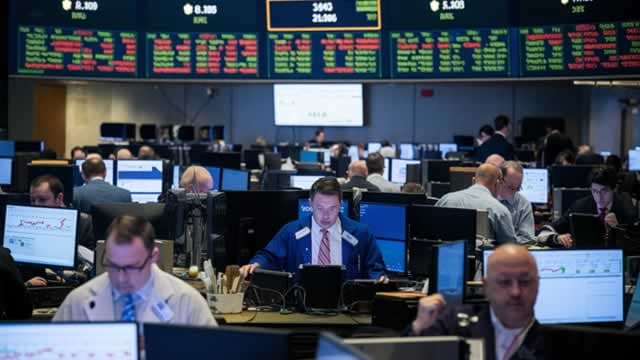
The Dow Jones Industrial Average surged more than 800 points, or roughly 1.7%, to breach an all-time record above 49,000 on Monday. The historic rally came as Wall Street assessed the US military's weekend capture of Venezuelan President Nicolás Maduro as a contained geopolitical event unlikely to spark global instability.

CNBC's "The Exchange" discusses whether international markets may be able to sustain its 2025 outperformance through 2026 with "Fast Money" trader Tim Seymour of Seymour Asset Management

Geoff Bysshe, the President of MarketGauge contributed to this article. The stock market's biggest headwind in 2026 may not be what you investors are thinking.
U.S. stocks traded higher toward the end of trading, with the Dow Jones index gaining more than 250 points on Monday.
Since rates peaked at 5.50% in 2023, the Fed has cut rates six times, lowering them by a cumulative 1.75% to approximately 3.75%. Those cuts have helped pave the way for a smoother ride, providing a meaningful tailwind to equity markets.
US stocks rose on Monday, with the Nasdaq 100 Index and the S&P 500 Index gaining, as demand for tech shares remained strong despite worries over geopolitical risk. Oil prices and gold rose, with Brent crude and gold prices increasing as oil traders weighed the fallout from the developments in Caracas and investors sought safe-haven assets.
Entering 2026, I see heightened volatility and correction risk driven by midterm election dynamics, stretched valuations, and major policy events. Valuations remain historically elevated, with the CAPE ratio near 39.42, suggesting limited upside and increased downside risk reminiscent of prior market peaks.

AeroVironment leads gains for defense contractors, two break out amid Venezuela operation, rising tensions with Israel, Iran.

After months of back-and-forth menaces, the US launched some proper attacks against Venezuela and captured its President, Nicolas Maduro. Debates are high in the impact on markets.

In September 1987, Donald Trump paid $94,801 for full-page advertisements in the New York Times, the Washington Post and the Boston Globe. He was 41 years old, not yet a politician.

I currently exclude international equities from my 10-ETF tactical mix due to high correlation with U.S. stocks and a strong dollar. Recent international outperformance is attributed to U.S. dollar weakness, not superior foreign economic fundamentals.

Defense-related stocks and banking giants Goldman Sachs and JPMorgan all rose.

President Trump's intervention in Venezuela carries risks, but market fundamentals remain solid.

The U.S.'s capture of Venezuela President Nicolás Maduro on Saturday, Jan. 3, triggered a massive rally in drone stocks as markets opened on Monday.

Market Catalysts anchor Julie Hyman breaks down the latest market moves for January 5, 2026. Oil stocks rallied following President Trump's capture of Venezuelan President Nicolás Maduro by US military forces.

Minneapolis Fed President Neel Kashkari told CNBC on Monday that the labor market is "clearly" cooling, with unemployment around 4.6% and businesses slowing their hiring. Kashkari said while inflation is still too high, policy is likely near neutral and the bigger risk right now may be unemployment rising further.